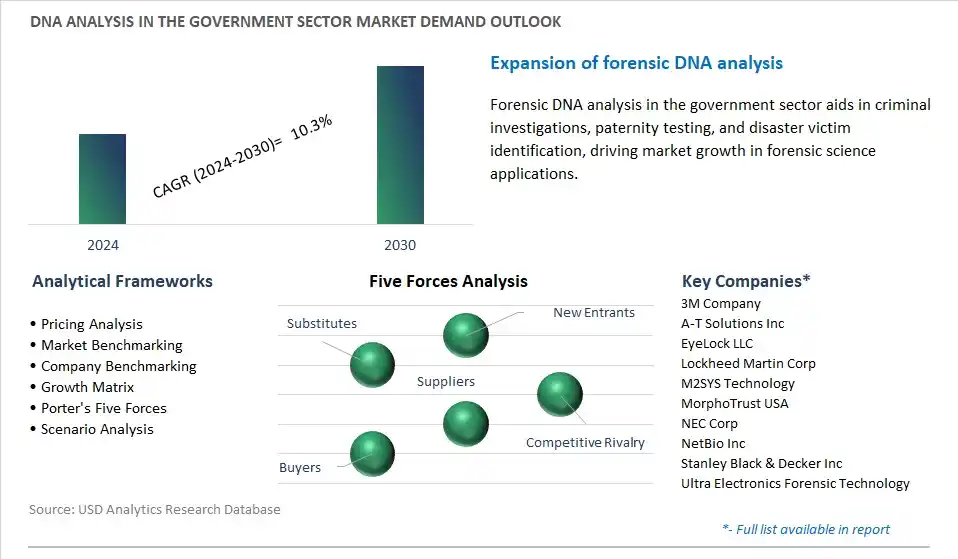
DNA Analysis in the Government Sector Market is estimated to increase at a growth rate of 10.3% CAGR over the forecast period from 2024 to 2030.
The global DNA Analysis in the Government Sector Market Study analyzes and forecasts the market size across 6 regions and 24 countries for diverse segments including By Type (Restriction Fragment Length Polymorphism (RFLP), Short Tandem Repeat (STR) Analysis, Single Nucleotide Polymorphism (SNP) Analysis, Others), By Application (Forensics, Law Enforcement), By End-User (Homeland Security, Defense Sector, Others).
An Introduction to DNA Analysis in the Government Sector Market in 2024
The DNA Analysis in the Government Sector Market pertains to the application of DNA testing, profiling, and analysis techniques by government agencies for forensic investigations, criminal justice, paternity testing, ancestry studies, and disaster victim identification. Government entities, including law enforcement agencies, forensic laboratories, immigration departments, and healthcare systems, utilize DNA analysis technologies such as polymerase chain reaction (PCR), short tandem repeat (STR) analysis, and next-generation sequencing (NGS) to obtain genetic information for various purposes, ensuring accuracy, reliability, and legality in DNA-related activities.
DNA Analysis in the Government Sector Market Competitive Landscape
The global DNA Analysis in the Government Sector Industry is highly competitive with a large number of companies focusing on niche market segments. Amidst intense competitive conditions, DNA Analysis in the Government Sector Companies are investing in new product launches and strengthening distribution channels. Key companies operating in the DNA Analysis in the Government Sector Industry include- 3M Company, A-T Solutions Inc, EyeLock LLC, Lockheed Martin Corp, M2SYS Technology, MorphoTrust USA, NEC Corp, NetBio Inc, Stanley Black & Decker Inc, Ultra Electronics Forensic Technology.
DNA Analysis in the Government Sector Market Trend: Expansion of Forensic DNA Databases and Criminal Justice Applications
One Market Trend in DNA analysis in the government sector is the expansion of forensic DNA databases and the increasing use of DNA technology in criminal justice applications. Government agencies responsible for law enforcement, public safety, and national security are increasingly utilizing DNA analysis techniques to solve crimes, identify suspects, and exonerate individuals wrongly convicted of offenses. Advances in DNA profiling technologies, such as short tandem repeat (STR) analysis and next-generation sequencing (NGS), have enabled the creation of comprehensive DNA databases containing genetic profiles of individuals convicted of crimes, as well as samples collected from crime scenes, victims, and unidentified human remains. This trend is driven by efforts to enhance forensic investigations, reduce crime rates, and ensure the fair administration of justice through the use of DNA evidence in criminal proceedings, including cold case investigations, missing persons identification, and forensic intelligence analysis.
DNA Analysis in the Government Sector Market Driver: Government Funding and Mandates for DNA Testing and Biometric Identification
The driver behind the demand for DNA analysis in the government sector is the allocation of government funding and the implementation of mandates for DNA testing and biometric identification programs. National governments, law enforcement agencies, and regulatory bodies worldwide are investing significant resources in DNA analysis infrastructure, capacity-building initiatives, and legislative frameworks to support the use of DNA technology in various applications, including criminal justice, border security, immigration control, and disaster victim identification. Funding for DNA testing laboratories, forensic science research programs, and biobanking initiatives is driven by national security priorities, public safety concerns, and the need to modernize forensic capabilities in the face of evolving threats and technological advancements. Additionally, legislative mandates requiring DNA profiling of certain offender populations, such as convicted felons or individuals under criminal investigation, further stimulate demand for DNA analysis services and technologies in the government sector.
DNA Analysis in the Government Sector Market Opportunity: Integration of DNA Analysis into Public Health Surveillance and Emergency Response
An opportunity exists for government agencies to integrate DNA analysis into public health surveillance and emergency response systems for the detection, monitoring, and control of infectious diseases, bioterrorism threats, and public health emergencies. DNA-based technologies, such as polymerase chain reaction (PCR), whole genome sequencing (WGS), and metagenomic analysis, offer rapid and accurate methods for identifying pathogens, tracking disease outbreaks, and monitoring the spread of antimicrobial resistance in human populations, wildlife, and environmental samples. By leveraging DNA analysis capabilities, governments can strengthen their preparedness and response strategies for emerging infectious diseases, bioterrorism incidents, and natural disasters, enabling timely interventions, resource allocation, and public health interventions to mitigate health risks and safeguard population health. Furthermore, the integration of DNA-based biometric identification systems into border security, immigration control, and disaster management protocols can enhance situational awareness, facilitate rapid identification of individuals, and streamline response efforts during crises or mass casualty events. By embracing innovation in DNA analysis technologies and interdisciplinary collaboration between law enforcement, public health agencies, and emergency responders, governments can harness the full potential of DNA analysis in safeguarding national security, protecting public safety, and enhancing resilience to biological threats and disasters.
Market Share Analysis: Short Tandem Repeat (STR) Analysis is the fastest growing segment in the DNA Analysis in the Government Sector industry
Within DNA analysis in the government sector, Short Tandem Repeat (STR) analysis stands out as the fastest-growing type. STR analysis involves examining specific regions of the DNA sequence that contain short tandem repeats, which are unique to each individual except for identical twins. This method offers high accuracy and sensitivity in identifying individuals, making it invaluable in forensic investigations, law enforcement, and homeland security applications. The surge in demand for STR analysis can be attributed to several factors, including advancements in technology, which have led to faster and more efficient analysis processes, as well as increasing regulatory requirements for accurate and reliable DNA profiling. Moreover, the versatility of STR analysis allows for its application in various scenarios, from identifying perpetrators of crimes to establishing familial relationships and resolving missing person cases. As governments worldwide prioritize enhancing their forensic capabilities and improving national security measures, the adoption of STR analysis is expected to continue its rapid growth, cementing its position as a cornerstone in DNA analysis within the government sector.
DNA Analysis in the Government Sector Market Segmentation
By Type
Restriction Fragment Length Polymorphism (RFLP)
Short Tandem Repeat (STR) Analysis
Single Nucleotide Polymorphism (SNP) Analysis
Others
By Application
Forensics
Law Enforcement
By End-User
Homeland Security
Defense Sector
Others
Geographical Analysis
North America (United States, Canada, Mexico)
Europe (Germany, France, United Kingdom, Spain, Italy, Rest of Europe)
Asia Pacific (China, India, Japan, South Korea, Rest of Asia Pacific)
South America (Brazil, Argentina, Rest of South America)
Middle East and Africa (Saudi Arabia, UAE, Rest of Middle East, South Africa, Egypt, Rest of Africa)
DNA Analysis in the Government Sector Companies
3M Company
A-T Solutions Inc
EyeLock LLC
Lockheed Martin Corp
M2SYS Technology
MorphoTrust USA
NEC Corp
NetBio Inc
Stanley Black & Decker Inc
Ultra Electronics Forensic Technology
* List not Exhaustive
Reasons to Buy the DNA Analysis in the Government Sector Market Study
• Deepen your industry insights and navigate uncertainties for strategy formulation, CAPEX, and Operational decisions
• Gain access to detailed insights on the DNA Analysis in the Government Sector Market, encompassing current market size, growth trends, and forecasts till 2030.
• Access detailed competitor analysis, enabling competitive advantage through a thorough understanding of market players, strategies, and potential differentiation opportunities
• Stay ahead of the curve with insights on technological advancements, innovations, and upcoming trends
• Identify lucrative investment avenues and expansion opportunities within the DNA Analysis in the Government Sector Industry, guided by robust, data-backed analysis.
• Understand regional and global markets through country-wise analysis, regional market potential, regulatory nuances, and dynamics
• Execute strategies with confidence and speed through information, analytics, and insights on the industry value chain
• Corporate leaders, strategists, financial experts, shareholders, asset managers, and governmental representatives can make long-term planning scenarios and build an integrated and timely understanding of market dynamics
• Benefit from tailored solutions and expert consultation based on report insights, providing personalized strategies aligned with specific business needs.
TABLE OF CONTENTS
1 Introduction to 2024 DNA Analysis in the Government Sector Market
1.1 Market Overview
1.2 Quick Facts
1.3 Scope/Objective of the Study
1.4 Market Definition
1.5 Countries and Regions Analyzed
1.6 Units, Currency, and Conversions
1.7 Industry Value Chain
2 Research Methodology
2.1 Market Size Estimation
2.2 Sources and Research Methodology
2.3 Data Triangulation
2.4 Assumptions and Limitations
3 Executive Summary
3.1 Global DNA Analysis in the Government Sector Market Size Outlook, $ Million, 2021 to 2030
3.2 DNA Analysis in the Government Sector Market Outlook by Type, $ Million, 2021 to 2030
3.3 DNA Analysis in the Government Sector Market Outlook by Product, $ Million, 2021 to 2030
3.4 DNA Analysis in the Government Sector Market Outlook by Application, $ Million, 2021 to 2030
3.5 DNA Analysis in the Government Sector Market Outlook by Key Countries, $ Million, 2021 to 2030
4 Market Dynamics
4.1 Key Driving Forces of DNA Analysis in the Government Sector Industry
4.2 Key Market Trends in DNA Analysis in the Government Sector Industry
4.3 Potential Opportunities in DNA Analysis in the Government Sector Industry
4.4 Key Challenges in DNA Analysis in the Government Sector Industry
5 Market Factor Analysis
5.1 Value Chain Analysis
5.2 Competitive Landscape
5.2.1 Global DNA Analysis in the Government Sector Market Share by Company (%), 2023
5.2.2 Product Offerings by Company
5.3 Porter’s Five Forces Analysis
5.4 Pricing Analysis and Outlook
6 Growth Outlook Across Scenarios
6.1 Growth Analysis-Case Scenario Definitions
6.2 Low Growth Scenario Forecasts
6.3 Reference Growth Scenario Forecasts
6.4 High Growth Scenario Forecasts
7 Global DNA Analysis in the Government Sector Market Outlook by Segments
7.1 DNA Analysis in the Government Sector Market Outlook by Segments, $ Million, 2021- 2030
By Type
Restriction Fragment Length Polymorphism (RFLP)
Short Tandem Repeat (STR) Analysis
Single Nucleotide Polymorphism (SNP) Analysis
Others
By Application
Forensics
Law Enforcement
By End-User
Homeland Security
Defense Sector
Others
8 North America DNA Analysis in the Government Sector Market Analysis and Outlook To 2030
8.1 Introduction to North America DNA Analysis in the Government Sector Markets in 2024
8.2 North America DNA Analysis in the Government Sector Market Size Outlook by Country, 2021-2030
8.2.1 United States
8.2.2 Canada
8.2.3 Mexico
8.3 North America DNA Analysis in the Government Sector Market size Outlook by Segments, 2021-2030
By Type
Restriction Fragment Length Polymorphism (RFLP)
Short Tandem Repeat (STR) Analysis
Single Nucleotide Polymorphism (SNP) Analysis
Others
By Application
Forensics
Law Enforcement
By End-User
Homeland Security
Defense Sector
Others
9 Europe DNA Analysis in the Government Sector Market Analysis and Outlook To 2030
9.1 Introduction to Europe DNA Analysis in the Government Sector Markets in 2024
9.2 Europe DNA Analysis in the Government Sector Market Size Outlook by Country, 2021-2030
9.2.1 Germany
9.2.2 France
9.2.3 Spain
9.2.4 United Kingdom
9.2.4 Italy
9.2.5 Russia
9.2.6 Norway
9.2.7 Rest of Europe
9.3 Europe DNA Analysis in the Government Sector Market Size Outlook by Segments, 2021-2030
By Type
Restriction Fragment Length Polymorphism (RFLP)
Short Tandem Repeat (STR) Analysis
Single Nucleotide Polymorphism (SNP) Analysis
Others
By Application
Forensics
Law Enforcement
By End-User
Homeland Security
Defense Sector
Others
10 Asia Pacific DNA Analysis in the Government Sector Market Analysis and Outlook To 2030
10.1 Introduction to Asia Pacific DNA Analysis in the Government Sector Markets in 2024
10.2 Asia Pacific DNA Analysis in the Government Sector Market Size Outlook by Country, 2021-2030
10.2.1 China
10.2.2 India
10.2.3 Japan
10.2.4 South Korea
10.2.5 Indonesia
10.2.6 Malaysia
10.2.7 Australia
10.2.8 Rest of Asia Pacific
10.3 Asia Pacific DNA Analysis in the Government Sector Market size Outlook by Segments, 2021-2030
By Type
Restriction Fragment Length Polymorphism (RFLP)
Short Tandem Repeat (STR) Analysis
Single Nucleotide Polymorphism (SNP) Analysis
Others
By Application
Forensics
Law Enforcement
By End-User
Homeland Security
Defense Sector
Others
11 South America DNA Analysis in the Government Sector Market Analysis and Outlook To 2030
11.1 Introduction to South America DNA Analysis in the Government Sector Markets in 2024
11.2 South America DNA Analysis in the Government Sector Market Size Outlook by Country, 2021-2030
11.2.1 Brazil
11.2.2 Argentina
11.2.3 Rest of South America
11.3 South America DNA Analysis in the Government Sector Market size Outlook by Segments, 2021-2030
By Type
Restriction Fragment Length Polymorphism (RFLP)
Short Tandem Repeat (STR) Analysis
Single Nucleotide Polymorphism (SNP) Analysis
Others
By Application
Forensics
Law Enforcement
By End-User
Homeland Security
Defense Sector
Others
12 Middle East and Africa DNA Analysis in the Government Sector Market Analysis and Outlook To 2030
12.1 Introduction to Middle East and Africa DNA Analysis in the Government Sector Markets in 2024
12.2 Middle East and Africa DNA Analysis in the Government Sector Market Size Outlook by Country, 2021-2030
12.2.1 Saudi Arabia
12.2.2 UAE
12.2.3 Oman
12.2.4 Rest of Middle East
12.2.5 Egypt
12.2.6 Nigeria
12.2.7 South Africa
12.2.8 Rest of Africa
12.3 Middle East and Africa DNA Analysis in the Government Sector Market size Outlook by Segments, 2021-2030
By Type
Restriction Fragment Length Polymorphism (RFLP)
Short Tandem Repeat (STR) Analysis
Single Nucleotide Polymorphism (SNP) Analysis
Others
By Application
Forensics
Law Enforcement
By End-User
Homeland Security
Defense Sector
Others
13 Company Profiles
13.1 Company Snapshot
13.2 SWOT Profiles
13.3 Products and Services
13.4 Recent Developments
13.5 Financial Profile
List of Companies
3M Company
A-T Solutions Inc
EyeLock LLC
Lockheed Martin Corp
M2SYS Technology
MorphoTrust USA
NEC Corp
NetBio Inc
Stanley Black & Decker Inc
Ultra Electronics Forensic Technology
14 Appendix
14.1 Customization Offerings
14.2 Subscription Services
14.3 Related Reports
14.4 Publisher Expertise
