The global Drilling Lubricants Market is poised to register a 4.9% CAGR from $3.3 Billion in 2024 to $4.4 Billion in 2030.
The global Drilling Lubricants Market Study analyzes and forecasts the market size across 6 regions and 24 countries for diverse segments -By Technique (Down The Hole Drills, Diamond Drilling, Top Hammer Drilling, Reverse Circulation Drilling, Others), By End-User (Mining, Oil & Gas, Construction, Others).
An Introduction to Global Drilling Lubricants Market in 2024
In the drilling lubricants market, the future is influenced by trends such as technological advancements, sustainability, and regulatory compliance driving innovation in lubricant formulations and applications. Drilling lubricants play a critical role in reducing friction, heat, and wear between drilling components during drilling operations in various industries such as oil and gas, mining, and construction. Key trends shaping this market include the development of environmentally friendly lubricants with biodegradable and non-toxic properties to minimize environmental impact and ensure compliance with regulations, the integration of advanced additives and lubricant technologies to improve lubricity, thermal stability, and equipment performance in extreme operating conditions, and the adoption of recycling and waste management practices to maximize lubricant lifespan and reduce disposal costs. As industries seek lubricant solutions that offer not only superior performance but also environmental responsibility and regulatory compliance, the demand for drilling lubricants that meet these criteria is expected to drive market growth and inspire further innovation in lubricant formulation and technology.
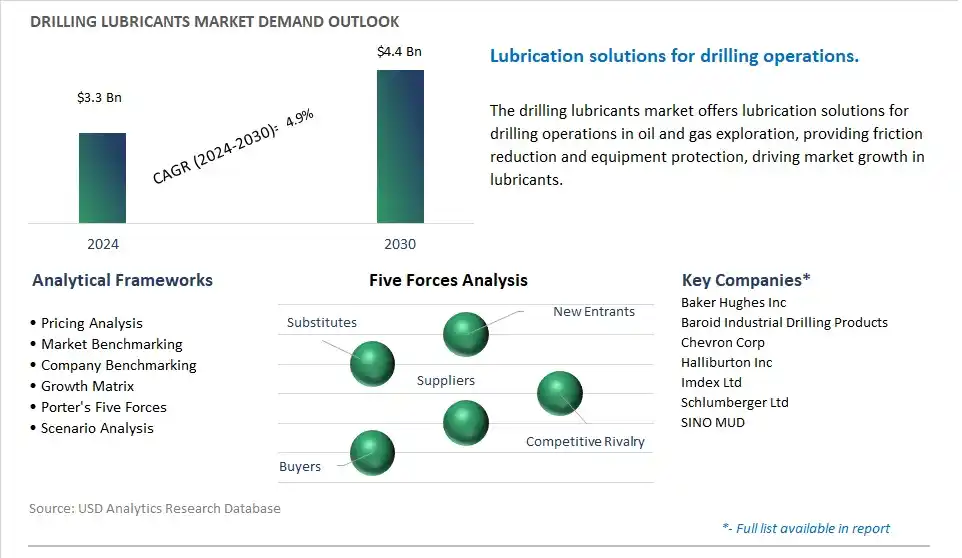
Drilling Lubricants Market Competitive Landscape
The market report analyses the leading companies in the industry including Baker Hughes Inc, Baroid Industrial Drilling Products, Chevron Corp, Halliburton Inc, Imdex Ltd, Schlumberger Ltd, SINO MUD.
Drilling Lubricants Market Dynamics
Drilling Lubricants Market Trend: Adoption of Environmentally Friendly Lubricants
One prominent market trend in the drilling lubricants industry is the adoption of environmentally friendly lubricants. With increasing regulatory pressure and growing environmental awareness, there is a rising demand for drilling lubricants that are biodegradable, non-toxic, and eco-friendly. Companies in the oil and gas sector are increasingly seeking lubricants that minimize environmental impact while maintaining performance and efficiency in drilling operations. The trend is driving the development and adoption of environmentally friendly drilling lubricants that meet stringent environmental regulations and sustainability goals.
Drilling Lubricants Market Driver: Growth in Oil and Gas Exploration and Production Activities
A key driver in the drilling lubricants market is the growth in oil and gas exploration and production activities. As global energy demand continues to rise, there is a growing need for drilling lubricants to support drilling operations in both conventional and unconventional oil and gas reservoirs. The exploration and production of oil and gas resources require the use of lubricants to reduce friction, heat, and wear on drilling equipment, enhance drilling efficiency, and prolong equipment lifespan. With increasing investments in oil and gas exploration and production projects worldwide, particularly in offshore and remote areas, there is a steady demand for drilling lubricants to support drilling activities, driving market growth in the industry.
Drilling Lubricants Market Opportunity: Development of High-Performance Specialty Lubricants
One potential opportunity in the drilling lubricants market lies in the development of high-performance specialty lubricants. As drilling operations become more complex and challenging, there is a need for lubricants with enhanced performance characteristics, such as improved lubricity, thermal stability, corrosion resistance, and wear protection. Manufacturers have an opportunity to innovate and develop specialty lubricants tailored to address specific challenges faced in drilling operations, such as high-temperature drilling, deepwater drilling, and abrasive environments. By offering specialized lubricant solutions and value-added products, manufacturers aim to gain market shares in the competitive drilling lubricants market, meet the evolving needs of drilling operators, and capitalize on new growth opportunities in the industry.
Drilling Lubricants Market Ecosystem
In the drilling lubricants market Ecosystem, Raw Material Acquisition involves obtaining base oils and additives from companies including Exxon Mobil Corporation, Lubrizol Corporation, and Neste Corporation. These materials are crucial for formulating lubricants tailored to specific drilling requirements. Drilling Lubricant Manufacturers including Baker Hughes Company and Schlumberger Limited undertake Processing and Manufacturing, blending these raw materials to create customized lubricant blends. Quality Control and Testing ensure lubricants meet performance specifications, with rigorous procedures implemented by drilling lubricant manufacturers to ensure friction reduction and stability under downhole conditions.
Transportation and Storage are facilitated by logistics companies including C.H. Robinson Worldwide, Inc., ensuring the timely delivery of drilling lubricants to rig locations. Distribution and Sales are typically managed by Drilling Fluid Service Companies including Halliburton Company and Baker Hughes Company, which act as distributors, supplying drilling lubricants alongside other drilling fluids to oil and gas exploration and production companies. The primary end-user application of drilling lubricants lies in Oil and Gas Drilling, where they are utilized to minimize friction between the drill bit and rock formation, enhancing drilling efficiency and extending drill bit life.
Drilling Lubricants Market Share Analysis: Diamond Drilling held the dominant revenue share in 2024
The largest segment in the Drilling Lubricants Market is the "Diamond Drilling" technique. This dominance can be attributed to diverse factors. Diamond drilling is widely used in various industries, including mining, construction, and geotechnical exploration, due to its versatility and efficiency in penetrating hard rock formations. Additionally, diamond drilling techniques offer superior precision and control, allowing for the extraction of core samples with minimal damage and maximum accuracy, which is essential for geological analysis and resource estimation. In addition, diamond drilling is favored for its ability to access deeper depths and produce high-quality core samples, making it indispensable for projects requiring detailed subsurface information. Further, advancements in diamond drilling technology, such as the development of synthetic diamond drill bits and improved lubricants, have further enhanced the performance and reliability of diamond drilling operations, consolidating its position as the largest segment in the drilling lubricants market.
Drilling Lubricants Market Share Analysis: Construction is the fastest growing market segment over the forecast period to 2030
The fastest-growing segment in the Drilling Lubricants Market is the "Construction" sector. This growth is driven by the construction industry is experiencing significant expansion globally, driven by urbanization, infrastructure development, and various large-scale projects. As construction activities increase, so does the demand for drilling lubricants to support drilling operations for foundations, piling, tunnels, and other construction-related tasks. Additionally, technological advancements in construction techniques and equipment have led to more complex and demanding drilling applications, requiring specialized lubricants to ensure optimal performance and efficiency. In addition, stringent environmental regulations and sustainability initiatives in the construction sector have prompted the adoption of eco-friendly drilling lubricants, further driving market growth. Further, the construction industry's resilience to economic fluctuations and its ongoing evolution toward advanced building practices contribute to the sustained demand for drilling lubricants in this segment. As a result, the Construction sector is the fastest-growing segment in the drilling lubricants market, fueled by robust construction activities and the need for specialized lubrication solutions to meet evolving industry requirements.
Drilling Lubricants Market Share Analysis: Oil and Gas held the dominant revenue share in 2024
The largest segment in the Drilling Lubricants Market is the "Oil and Gas" sector. This dominance can be attributed to diverse key factors. Firstly, the oil and gas industry require extensive drilling operations for exploration, extraction, and production activities. These drilling operations often involve challenging environments such as deepwater offshore locations, unconventional shale formations, and harsh Arctic conditions, where specialized lubricants are essential for maintaining drilling efficiency and equipment integrity. Additionally, the scale of drilling activities in the oil and gas sector is substantial, with numerous wells being drilled globally to meet the world's energy demands. In addition, advancements in drilling technologies, including horizontal drilling and hydraulic fracturing (fracking), have increased the complexity and intensity of drilling operations, driving the demand for high-performance lubricants that can withstand extreme pressures, temperatures, and corrosive environments. Further, stringent safety and environmental regulations in the oil and gas industry necessitate the use of environmentally friendly drilling lubricants to minimize ecological impact and comply with regulatory standards. As a result, the Oil and Gas sector remains the largest end-user segment in the drilling lubricants market due to its significant drilling activities, demanding operational conditions, and stringent performance requirements.
Drilling Lubricants Market Report Scope-
By Technique
Down The Hole Drills
Diamond Drilling
Top Hammer Drilling
Reverse Circulation Drilling
Others
By End-User
Mining
Oil & Gas
Construction
Others
Drilling Lubricants Market Companies Profiled
Baker Hughes Inc
Baroid Industrial Drilling Products
Chevron Corp
Halliburton Inc
Imdex Ltd
Schlumberger Ltd
SINO MUD
*- List Not Exhaustive
TABLE OF CONTENTS
1 Introduction to 2024 Drilling Lubricants Market
1.1 Market Overview
1.2 Quick Facts
1.3 Scope/Objective of the Study
1.4 Market Definition
1.5 Countries and Regions Covered
1.6 Units, Currency, and Conversions
1.7 Industry Value Chain
2 Research Methodology
2.1 Market Size Estimation
2.2 Sources and Research Methodology
2.3 Data Triangulation
2.4 Assumptions and Limitations
3 Executive Summary
3.1 Global Drilling Lubricants Market Size Outlook, $ Million, 2021 to 2030
3.2 Drilling Lubricants Market Outlook by Type, $ Million, 2021 to 2030
3.3 Drilling Lubricants Market Outlook by Product, $ Million, 2021 to 2030
3.4 Drilling Lubricants Market Outlook by Application, $ Million, 2021 to 2030
3.5 Drilling Lubricants Market Outlook by Key Countries, $ Million, 2021 to 2030
4 Market Dynamics
4.1 Key Driving Forces of Drilling Lubricants Industry
4.2 Key Market Trends in Drilling Lubricants Industry
4.3 Potential Opportunities in Drilling Lubricants Industry
4.4 Key Challenges in Drilling Lubricants Industry
5 Market Factor Analysis
5.1 Value Chain Analysis
5.2 Competitive Landscape
5.2.1 Global Drilling Lubricants Market Share by Company (%), 2023
5.2.2 Product Offerings by Company
5.3 Porter’s Five Forces Analysis
5.4 Pricing Analysis and Outlook
6 Growth Outlook Across Scenarios
6.1 Growth Analysis-Case Scenario Definitions
6.2 Low Growth Scenario Forecasts
6.3 Reference Growth Scenario Forecasts
6.4 High Growth Scenario Forecasts
7 Global Drilling Lubricants Market Outlook by Segments
7.1 Drilling Lubricants Market Outlook by Segments, $ Million, 2021- 2030
By Technique
Down The Hole Drills
Diamond Drilling
Top Hammer Drilling
Reverse Circulation Drilling
Others
By End-User
Mining
Oil & Gas
Construction
Others
8 North America Drilling Lubricants Market Analysis and Outlook To 2030
8.1 Introduction to North America Drilling Lubricants Markets in 2024
8.2 North America Drilling Lubricants Market Size Outlook by Country, 2021-2030
8.2.1 United States
8.2.2 Canada
8.2.3 Mexico
8.3 North America Drilling Lubricants Market size Outlook by Segments, 2021-2030
By Technique
Down The Hole Drills
Diamond Drilling
Top Hammer Drilling
Reverse Circulation Drilling
Others
By End-User
Mining
Oil & Gas
Construction
Others
9 Europe Drilling Lubricants Market Analysis and Outlook To 2030
9.1 Introduction to Europe Drilling Lubricants Markets in 2024
9.2 Europe Drilling Lubricants Market Size Outlook by Country, 2021-2030
9.2.1 Germany
9.2.2 France
9.2.3 Spain
9.2.4 United Kingdom
9.2.4 Italy
9.2.5 Russia
9.2.6 Norway
9.2.7 Rest of Europe
9.3 Europe Drilling Lubricants Market Size Outlook by Segments, 2021-2030
By Technique
Down The Hole Drills
Diamond Drilling
Top Hammer Drilling
Reverse Circulation Drilling
Others
By End-User
Mining
Oil & Gas
Construction
Others
10 Asia Pacific Drilling Lubricants Market Analysis and Outlook To 2030
10.1 Introduction to Asia Pacific Drilling Lubricants Markets in 2024
10.2 Asia Pacific Drilling Lubricants Market Size Outlook by Country, 2021-2030
10.2.1 China
10.2.2 India
10.2.3 Japan
10.2.4 South Korea
10.2.5 Indonesia
10.2.6 Malaysia
10.2.7 Australia
10.2.8 Rest of Asia Pacific
10.3 Asia Pacific Drilling Lubricants Market size Outlook by Segments, 2021-2030
By Technique
Down The Hole Drills
Diamond Drilling
Top Hammer Drilling
Reverse Circulation Drilling
Others
By End-User
Mining
Oil & Gas
Construction
Others
11 South America Drilling Lubricants Market Analysis and Outlook To 2030
11.1 Introduction to South America Drilling Lubricants Markets in 2024
11.2 South America Drilling Lubricants Market Size Outlook by Country, 2021-2030
11.2.1 Brazil
11.2.2 Argentina
11.2.3 Rest of South America
11.3 South America Drilling Lubricants Market size Outlook by Segments, 2021-2030
By Technique
Down The Hole Drills
Diamond Drilling
Top Hammer Drilling
Reverse Circulation Drilling
Others
By End-User
Mining
Oil & Gas
Construction
Others
12 Middle East and Africa Drilling Lubricants Market Analysis and Outlook To 2030
12.1 Introduction to Middle East and Africa Drilling Lubricants Markets in 2024
12.2 Middle East and Africa Drilling Lubricants Market Size Outlook by Country, 2021-2030
12.2.1 Saudi Arabia
12.2.2 UAE
12.2.3 Oman
12.2.4 Rest of Middle East
12.2.5 Egypt
12.2.6 Nigeria
12.2.7 South Africa
12.2.8 Rest of Africa
12.3 Middle East and Africa Drilling Lubricants Market size Outlook by Segments, 2021-2030
By Technique
Down The Hole Drills
Diamond Drilling
Top Hammer Drilling
Reverse Circulation Drilling
Others
By End-User
Mining
Oil & Gas
Construction
Others
13 Company Profiles
13.1 Company Snapshot
13.2 SWOT Profiles
13.3 Products and Services
13.4 Recent Developments
13.5 Financial Profile
Baker Hughes Inc
Baroid Industrial Drilling Products
Chevron Corp
Halliburton Inc
Imdex Ltd
Schlumberger Ltd
SINO MUD
14 Appendix
14.1 Customization Offerings
14.2 Subscription Services
14.3 Related Reports
14.4 Publisher Expertise
By Technique
Down The Hole Drills
Diamond Drilling
Top Hammer Drilling
Reverse Circulation Drilling
Others
By End-User
Mining
Oil & Gas
Construction
Others
Countries Analyzed
North America (US, Canada, Mexico)
Europe (Germany, UK, France, Spain, Italy, Russia, Rest of Europe)
Asia Pacific (China, India, Japan, South Korea, Australia, South East Asia, Rest of Asia)
South America (Brazil, Argentina, Rest of South America)
Middle East and Africa (Saudi Arabia, UAE, Rest of Middle East, South Africa, Egypt, Rest of Africa)
