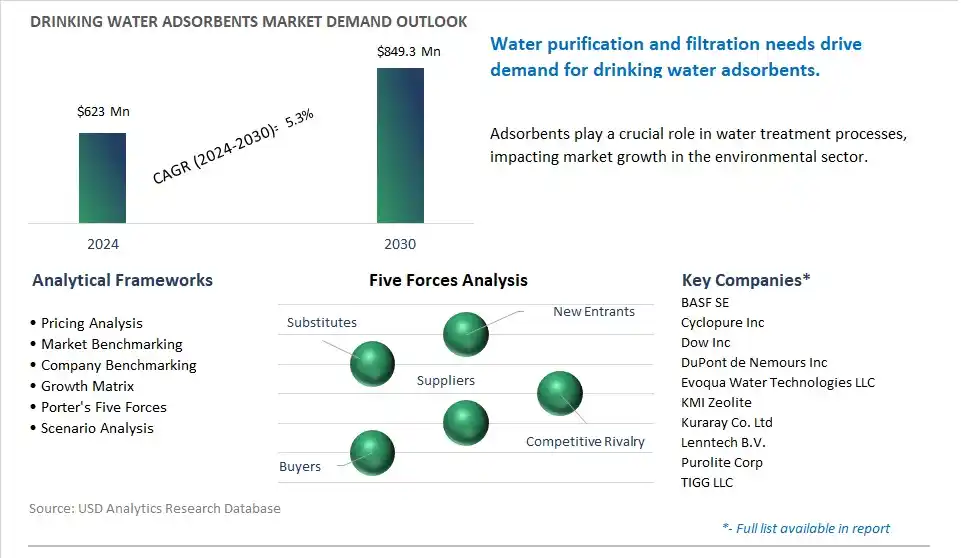
The global Drinking Water Adsorbents Market is poised to register a 5.3% CAGR from $623 Million in 2024 to $849.3 Million in 2030.
The global Drinking Water Adsorbents Market Study analyzes and forecasts the market size across 6 regions and 24 countries for diverse segments -By Product (Zeolite, Clay, Alumina, Activated Carbon, Manganese Oxide, Cellulose, Others).
An Introduction to Global Drinking Water Adsorbents Market in 2024
The drinking water adsorbents market is witnessing steady growth driven by the increasing need for efficient water treatment solutions to remove contaminants and ensure safe drinking water supplies. Key trends shaping the future of the industry include the growing awareness of water quality issues, pollution, and emerging contaminants such as pharmaceuticals, pesticides, and heavy metals in drinking water sources. As municipalities, industries, and households seek reliable and cost-effective adsorbents for water treatment, there's a growing demand for materials such as activated carbon, zeolites, and polymer resins that offer high adsorption capacity, selectivity, and regeneration potential. Moreover, advancements in adsorbent manufacturing technologies, including surface modification, pore size engineering, and regeneration methods, are driving market expansion by improving adsorbent performance, efficiency, and lifespan in water treatment applications. Additionally, the growing adoption of decentralized water treatment systems, point-of-use filters, and advanced oxidation processes (AOPs) is fueling demand for adsorbents that can effectively remove a wide range of contaminants from drinking water. Furthermore, the integration of adsorbent-based filtration systems with digital monitoring, remote sensing, and predictive analytics is driving innovation and market growth in the drinking water adsorbents industry, enabling real-time water quality monitoring, treatment optimization, and regulatory compliance in diverse water treatment applications.
Drinking Water Adsorbents Market Competitive Landscape
The market report analyses the leading companies in the industry including BASF SE, Cyclopure Inc, Dow Inc, DuPont de Nemours Inc, Evoqua Water Technologies LLC, KMI Zeolite, Kuraray Co. Ltd, Lenntech B.V., Purolite Corp, TIGG LLC.
Drinking Water Adsorbents Market Dynamics
Drinking Water Adsorbents Market Trend: Growing Demand for Sustainable and Eco-Friendly Drinking Water Adsorbents
One prominent trend in the drinking water adsorbents market is the increasing demand for sustainable and eco-friendly solutions. As environmental concerns continue to rise, there is a growing preference for adsorbent materials that are non-toxic, biodegradable, and renewable. Consumers and regulatory bodies alike are placing greater emphasis on the safety and sustainability of drinking water treatment processes. Consequently, there is a shift towards the adoption of natural adsorbents such as activated carbon derived from renewable sources like coconut shells or wood, as well as innovative bio-based materials that offer effective removal of contaminants while minimizing environmental impact.
Drinking Water Adsorbents Market Driver: Stringent Water Quality Regulations Driving Adoption of Drinking Water Adsorbents
The stringent regulations governing water quality and the increasing awareness of waterborne contaminants are significant drivers for the drinking water adsorbents market. Regulatory bodies worldwide impose strict limits on the levels of contaminants permissible in drinking water, including heavy metals, organic pollutants, and disinfection byproducts. Drinking water treatment plants and municipalities are compelled to invest in effective water treatment technologies to meet these regulatory requirements and ensure public health and safety. Adsorbent materials play a crucial role in the removal of various contaminants through processes such as adsorption, ion exchange, and filtration, driving their adoption in water treatment applications.
Drinking Water Adsorbents Market Opportunity: Development of Advanced Nanomaterial-Based Drinking Water Adsorbents
A potential opportunity in the drinking water adsorbents market lies in the development of advanced nanomaterial-based adsorbents. Nanotechnology offers unique advantages in terms of surface area, reactivity, and selectivity, making it well-suited for the removal of contaminants from water at the molecular level. Nanomaterials such as carbon nanotubes, graphene oxide, and nanoscale metal oxides exhibit exceptional adsorption properties and can effectively remove a wide range of pollutants, including heavy metals, organic compounds, and microorganisms. By leveraging advancements in nanoscience and engineering, there is an opportunity to design and commercialize next-generation drinking water adsorbents that offer higher efficiency, selectivity, and scalability compared to traditional adsorbent materials. This innovation presents an opportunity for companies to address emerging water treatment challenges and meet the evolving needs of municipalities, industries, and consumers for clean and safe drinking water.
Drinking Water Adsorbents Market Share Analysis: Activated Carbon segment generated the highest revenue in the industry
Activated carbon is the largest segment in the drinking water adsorbents market due to diverse key factors. Activated carbon is highly effective in removing contaminants such as organic compounds, volatile organic compounds (VOCs), chlorine, pesticides, and taste and odor compounds from water due to its large surface area and porous structure. This makes it an essential component in water treatment processes, including municipal water treatment plants, point-of-use filters, and residential water filtration systems. In addition, activated carbon's versatility and wide-ranging applicability contribute to its dominance in the market, as it can be tailored to specific water treatment requirements through variations in pore size, surface area, and activation methods. Additionally, the increasing concerns about water quality and the need for safe and clean drinking water further drive the demand for activated carbon in water treatment applications. With its proven efficacy, versatility, and widespread adoption in the water treatment industry, the activated carbon segment maintains its position as the largest in the drinking water adsorbents market.
Drinking Water Adsorbents Market Report Segmentation
By Product
Zeolite
Clay
Alumina
Activated Carbon
Manganese Oxide
Cellulose
Others
Regions Included
North America (US, Canada, Mexico)
Europe (Germany, UK, France, Spain, Italy, Russia, Rest of Europe)
Asia Pacific (China, India, Japan, South Korea, Australia, South East Asia, Rest of Asia)
South America (Brazil, Argentina, Rest of South America)
Middle East and Africa (Saudi Arabia, UAE, Rest of Middle East, South Africa, Egypt, Rest of Africa)
Drinking Water Adsorbents Companies Profiled in the Market Study
BASF SE
Cyclopure Inc
Dow Inc
DuPont de Nemours Inc
Evoqua Water Technologies LLC
KMI Zeolite
Kuraray Co. Ltd
Lenntech B.V.
Purolite Corp
TIGG LLC
*- List Not Exhaustive
TABLE OF CONTENTS
1 Introduction to 2024 Drinking Water Adsorbents Market
1.1 Market Overview
1.2 Quick Facts
1.3 Scope/Objective of the Study
1.4 Market Definition
1.5 Countries and Regions Covered
1.6 Units, Currency, and Conversions
1.7 Industry Value Chain
2 Research Methodology
2.1 Market Size Estimation
2.2 Sources and Research Methodology
2.3 Data Triangulation
2.4 Assumptions and Limitations
3 Executive Summary
3.1 Global Drinking Water Adsorbents Market Size Outlook, $ Million, 2021 to 2030
3.2 Drinking Water Adsorbents Market Outlook by Type, $ Million, 2021 to 2030
3.3 Drinking Water Adsorbents Market Outlook by Product, $ Million, 2021 to 2030
3.4 Drinking Water Adsorbents Market Outlook by Application, $ Million, 2021 to 2030
3.5 Drinking Water Adsorbents Market Outlook by Key Countries, $ Million, 2021 to 2030
4 Market Dynamics
4.1 Key Driving Forces of Drinking Water Adsorbents Industry
4.2 Key Market Trends in Drinking Water Adsorbents Industry
4.3 Potential Opportunities in Drinking Water Adsorbents Industry
4.4 Key Challenges in Drinking Water Adsorbents Industry
5 Market Factor Analysis
5.1 Value Chain Analysis
5.2 Competitive Landscape
5.2.1 Global Drinking Water Adsorbents Market Share by Company (%), 2023
5.2.2 Product Offerings by Company
5.3 Porter’s Five Forces Analysis
5.4 Pricing Analysis and Outlook
6 Growth Outlook Across Scenarios
6.1 Growth Analysis-Case Scenario Definitions
6.2 Low Growth Scenario Forecasts
6.3 Reference Growth Scenario Forecasts
6.4 High Growth Scenario Forecasts
7 Global Drinking Water Adsorbents Market Outlook by Segments
7.1 Drinking Water Adsorbents Market Outlook by Segments, $ Million, 2021- 2030
By Product
Zeolite
Clay
Alumina
Activated Carbon
Manganese Oxide
Cellulose
Others
8 North America Drinking Water Adsorbents Market Analysis and Outlook To 2030
8.1 Introduction to North America Drinking Water Adsorbents Markets in 2024
8.2 North America Drinking Water Adsorbents Market Size Outlook by Country, 2021-2030
8.2.1 United States
8.2.2 Canada
8.2.3 Mexico
8.3 North America Drinking Water Adsorbents Market size Outlook by Segments, 2021-2030
By Product
Zeolite
Clay
Alumina
Activated Carbon
Manganese Oxide
Cellulose
Others
9 Europe Drinking Water Adsorbents Market Analysis and Outlook To 2030
9.1 Introduction to Europe Drinking Water Adsorbents Markets in 2024
9.2 Europe Drinking Water Adsorbents Market Size Outlook by Country, 2021-2030
9.2.1 Germany
9.2.2 France
9.2.3 Spain
9.2.4 United Kingdom
9.2.4 Italy
9.2.5 Russia
9.2.6 Norway
9.2.7 Rest of Europe
9.3 Europe Drinking Water Adsorbents Market Size Outlook by Segments, 2021-2030
By Product
Zeolite
Clay
Alumina
Activated Carbon
Manganese Oxide
Cellulose
Others
10 Asia Pacific Drinking Water Adsorbents Market Analysis and Outlook To 2030
10.1 Introduction to Asia Pacific Drinking Water Adsorbents Markets in 2024
10.2 Asia Pacific Drinking Water Adsorbents Market Size Outlook by Country, 2021-2030
10.2.1 China
10.2.2 India
10.2.3 Japan
10.2.4 South Korea
10.2.5 Indonesia
10.2.6 Malaysia
10.2.7 Australia
10.2.8 Rest of Asia Pacific
10.3 Asia Pacific Drinking Water Adsorbents Market size Outlook by Segments, 2021-2030
By Product
Zeolite
Clay
Alumina
Activated Carbon
Manganese Oxide
Cellulose
Others
11 South America Drinking Water Adsorbents Market Analysis and Outlook To 2030
11.1 Introduction to South America Drinking Water Adsorbents Markets in 2024
11.2 South America Drinking Water Adsorbents Market Size Outlook by Country, 2021-2030
11.2.1 Brazil
11.2.2 Argentina
11.2.3 Rest of South America
11.3 South America Drinking Water Adsorbents Market size Outlook by Segments, 2021-2030
By Product
Zeolite
Clay
Alumina
Activated Carbon
Manganese Oxide
Cellulose
Others
12 Middle East and Africa Drinking Water Adsorbents Market Analysis and Outlook To 2030
12.1 Introduction to Middle East and Africa Drinking Water Adsorbents Markets in 2024
12.2 Middle East and Africa Drinking Water Adsorbents Market Size Outlook by Country, 2021-2030
12.2.1 Saudi Arabia
12.2.2 UAE
12.2.3 Oman
12.2.4 Rest of Middle East
12.2.5 Egypt
12.2.6 Nigeria
12.2.7 South Africa
12.2.8 Rest of Africa
12.3 Middle East and Africa Drinking Water Adsorbents Market size Outlook by Segments, 2021-2030
By Product
Zeolite
Clay
Alumina
Activated Carbon
Manganese Oxide
Cellulose
Others
13 Company Profiles
13.1 Company Snapshot
13.2 SWOT Profiles
13.3 Products and Services
13.4 Recent Developments
13.5 Financial Profile
BASF SE
Cyclopure Inc
Dow Inc
DuPont de Nemours Inc
Evoqua Water Technologies LLC
KMI Zeolite
Kuraray Co. Ltd
Lenntech B.V.
Purolite Corp
TIGG LLC
14 Appendix
14.1 Customization Offerings
14.2 Subscription Services
14.3 Related Reports
14.4 Publisher Expertise
By Product
Zeolite
Clay
Alumina
Activated Carbon
Manganese Oxide
Cellulose
Others
Countries Analyzed
North America (US, Canada, Mexico)
Europe (Germany, UK, France, Spain, Italy, Russia, Rest of Europe)
Asia Pacific (China, India, Japan, South Korea, Australia, South East Asia, Rest of Asia)
South America (Brazil, Argentina, Rest of South America)
Middle East and Africa (Saudi Arabia, UAE, Rest of Middle East, South Africa, Egypt, Rest of Africa)
