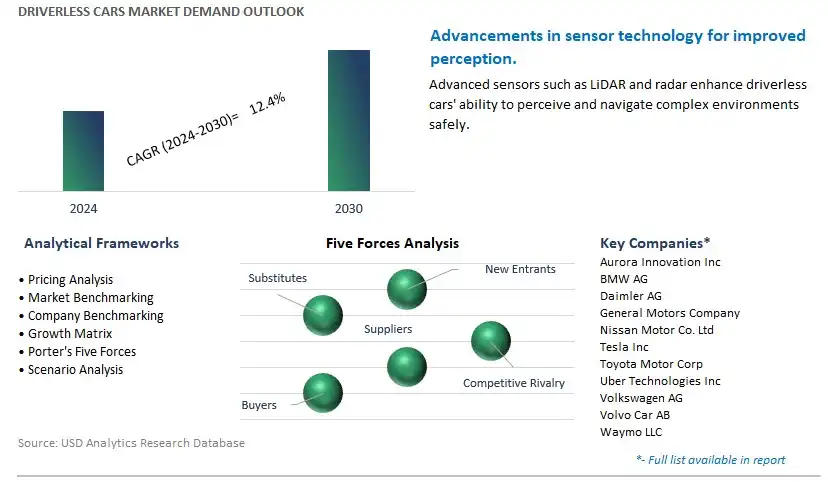
Driverless Cars Market is estimated to increase at a growth rate of 12.4% CAGR over the forecast period from 2024 to 2030.
The global Driverless Cars Market study analyzes and forecasts the market size across 6 regions and 24 countries for diverse segments including By Type (Semi-Autonomous Vehicles, Fully-Autonomous Vehicles), By Application (Civil, Robo Taxi, Ride Hail, Ride Share, Heavy duty vehicle, Light duty vehicle, Defence and military), By Propulsion (Battery Electric Vehicle (BEV), Internal Combustion Engine (ICE), Hybrid Electric Vehicle (HEV)), By Fuel (ICE (Internal Combustion Engine), EV (Electric Vehicle)).
An Introduction to Global Driverless Cars Market, 2024
The driverless cars market in 2024 continues to advance rapidly, as autonomous vehicle technology matures and gains acceptance among consumers, regulators, and industry stakeholders. Driverless cars, also known as self-driving or autonomous vehicles, leverage advanced sensors, cameras, and artificial intelligence algorithms to navigate roads and transport passengers without human intervention. With ongoing advancements in sensor technology, computing power, and machine learning algorithms, autonomous vehicles offer the promise of safer, more efficient, and accessible transportation for individuals and communities worldwide. As governments and regulatory bodies work to establish frameworks for the safe deployment of autonomous vehicles, leading automotive manufacturers and tech companies are investing heavily in research and development to bring self-driving technology to market. Moreover, the proliferation of mobility-as-a-service (MaaS) platforms and ride-sharing networks is expected to accelerate the adoption of driverless cars, offering consumers convenient and cost-effective alternatives to traditional car ownership. As the driverless cars market continues to evolve, it has the potential to revolutionize the way people and goods are transported, reshaping urban mobility and transportation ecosystems.
Driverless Cars Competitive Landscape
The global Driverless Cars market is highly competitive with a large number of companies focusing on niche market segments. Amidst intense competitive conditions, Driverless Cars Companies are investing in new product launches and strengthening distribution channels. Key companies operating in the Driverless Cars Market Industry include- Aurora Innovation Inc, BMW AG, Daimler AG, General Motors Company, Nissan Motor Co. Ltd, Tesla Inc, Toyota Motor Corp, Uber Technologies Inc, Volkswagen AG, Volvo Car AB, Waymo LLC.
Driver Less Cars Market Trend: Advancements in Autonomous Driving Technologies and Vehicle Connectivity Integration of Advanced Autonomous Driving Technologies
A prominent trend in the driverless cars market is the continuous advancements in autonomous driving technologies and vehicle connectivity. With rapid progress in artificial intelligence, sensor technologies, and data processing capabilities, driverless car manufacturers are pushing the boundaries of autonomy, making significant strides toward fully autonomous vehicles. Moreover, the integration of advanced vehicle connectivity features such as vehicle-to-vehicle (V2V) communication and vehicle-to-infrastructure (V2I) connectivity enhances the capabilities of driverless cars, enabling them to navigate complex environments, communicate with other vehicles, and respond to real-time traffic conditions. This trend towards the integration of advanced technologies is reshaping the landscape of the driverless cars market and driving innovation in autonomous vehicle development.
Driver Less Cars Market Driver: Demand for Improved Safety, Mobility, and Transportation Efficiency
The driver for the driverless cars market is the increasing demand for improved safety, mobility, and transportation efficiency. With millions of road accidents and fatalities occurring worldwide each year, there's a growing urgency to address road safety concerns and reduce traffic congestion. Driverless cars offer the potential to significantly improve road safety by eliminating human error, the leading cause of accidents, and enabling safer and more efficient transportation. Moreover, driverless cars have the potential to enhance mobility for individuals with disabilities, seniors, and those without access to traditional transportation options, driving market growth and adoption of autonomous vehicles.
Driver Less Cars Market Opportunity: Development of Autonomous Vehicle Ecosystems and Mobility Services
An Market Opportunity for growth and development in the driverless cars market lies in the development of autonomous vehicle ecosystems and mobility services. As driverless cars become increasingly prevalent, there's a growing Market Opportunity to create interconnected ecosystems that support the deployment, operation, and management of autonomous vehicles. This includes the development of mobility services such as autonomous ride-hailing, autonomous delivery, and autonomous shuttle services, as well as the integration of autonomous vehicles with public transportation systems and smart city infrastructure. By leveraging autonomous vehicle ecosystems and mobility services, stakeholders can address transportation challenges, improve mobility access, and unlock new revenue streams, thus driving further market growth and innovation in the driverless cars segment.
Driverless Cars Market Segmentation
By Type
Semi-Autonomous Vehicles
Fully-Autonomous Vehicles
By Application
Civil
Robo Taxi
Ride Hail
Ride Share
Heavy duty vehicle
Light duty vehicle
Defence and military
By Propulsion
Battery Electric Vehicle (BEV)
Internal Combustion Engine (ICE)
Hybrid Electric Vehicle (HEV)
By Fuel
ICE (Internal Combustion Engine)
EV (Electric Vehicle)Geographical Analysis
North America (United States, Canada, Mexico)
Europe (Germany, France, United Kingdom, Spain, Italy, Rest of Europe)
Asia Pacific (China, India, Japan, South Korea, Rest of Asia Pacific)
South America (Brazil, Argentina, Rest of South America)
Middle East and Africa (Saudi Arabia, UAE, Rest of Middle East, South Africa, Egypt, Rest of Africa
Driverless Cars Companies
Aurora Innovation Inc
BMW AG
Daimler AG
General Motors Company
Nissan Motor Co. Ltd
Tesla Inc
Toyota Motor Corp
Uber Technologies Inc
Volkswagen AG
Volvo Car AB
Waymo LLC
*- List not Exhaustive
TABLE OF CONTENTS
1 Introduction to 2024 Driverless Cars Market
1.1 Market Overview
1.2 Quick Facts
1.3 Scope/Objective of the Study
1.4 Market Definition
1.5 Countries and Regions Analyzed
1.6 Units, Currency, and Conversions
1.7 Industry Value Chain
2 Research Methodology
2.1 Market Size Estimation
2.2 Sources and Research Methodology
2.3 Data Triangulation
2.4 Assumptions and Limitations
3 Executive Summary
3.1 Global Driverless Cars Market Size Outlook, $ Million, 2021 to 2030
3.2 Driverless Cars Market Outlook by Type, $ Million, 2021 to 2030
3.3 Driverless Cars Market Outlook by Product, $ Million, 2021 to 2030
3.4 Driverless Cars Market Outlook by Application, $ Million, 2021 to 2030
3.5 Driverless Cars Market Outlook by Key Countries, $ Million, 2021 to 2030
4 Market Dynamics
4.1 Key Driving Forces of Driverless Cars Industry
4.2 Key Market Trends in Driverless Cars Industry
4.3 Potential Opportunities in Driverless Cars Industry
4.4 Key Challenges in Driverless Cars Industry
5 Market Factor Analysis
5.1 Value Chain Analysis
5.2 Competitive Landscape
5.2.1 Global Driverless Cars Market Share by Company (%), 2023
5.2.2 Product Offerings by Company
5.3 Porter’s Five Forces Analysis
5.4 Pricing Analysis and Outlook
6 Growth Outlook Across Scenarios
6.1 Growth Analysis-Case Scenario Definitions
6.2 Low Growth Scenario Forecasts
6.3 Reference Growth Scenario Forecasts
6.4 High Growth Scenario Forecasts
7 Global Driverless Cars Market Outlook by Segments
7.1 Driverless Cars Market Outlook by Segments, $ Million, 2021- 2030
By Type
Semi-Autonomous Vehicles
Fully-Autonomous Vehicles
By Application
Civil
Robo Taxi
Ride Hail
Ride Share
Heavy duty vehicle
Light duty vehicle
Defence and military
By Propulsion
Battery Electric Vehicle (BEV)
Internal Combustion Engine (ICE)
Hybrid Electric Vehicle (HEV)
By Fuel
ICE (Internal Combustion Engine)
EV (Electric Vehicle)
8 North America Driverless Cars Market Analysis and Outlook To 2030
8.1 Introduction to North America Driverless Cars Markets in 2024
8.2 North America Driverless Cars Market Size Outlook by Country, 2021-2030
8.2.1 United States
8.2.2 Canada
8.2.3 Mexico
8.3 North America Driverless Cars Market size Outlook by Segments, 2021-2030
By Type
Semi-Autonomous Vehicles
Fully-Autonomous Vehicles
By Application
Civil
Robo Taxi
Ride Hail
Ride Share
Heavy duty vehicle
Light duty vehicle
Defence and military
By Propulsion
Battery Electric Vehicle (BEV)
Internal Combustion Engine (ICE)
Hybrid Electric Vehicle (HEV)
By Fuel
ICE (Internal Combustion Engine)
EV (Electric Vehicle)
9 Europe Driverless Cars Market Analysis and Outlook To 2030
9.1 Introduction to Europe Driverless Cars Markets in 2024
9.2 Europe Driverless Cars Market Size Outlook by Country, 2021-2030
9.2.1 Germany
9.2.2 France
9.2.3 Spain
9.2.4 United Kingdom
9.2.4 Italy
9.2.5 Russia
9.2.6 Norway
9.2.7 Rest of Europe
9.3 Europe Driverless Cars Market Size Outlook by Segments, 2021-2030
By Type
Semi-Autonomous Vehicles
Fully-Autonomous Vehicles
By Application
Civil
Robo Taxi
Ride Hail
Ride Share
Heavy duty vehicle
Light duty vehicle
Defence and military
By Propulsion
Battery Electric Vehicle (BEV)
Internal Combustion Engine (ICE)
Hybrid Electric Vehicle (HEV)
By Fuel
ICE (Internal Combustion Engine)
EV (Electric Vehicle)
10 Asia Pacific Driverless Cars Market Analysis and Outlook To 2030
10.1 Introduction to Asia Pacific Driverless Cars Markets in 2024
10.2 Asia Pacific Driverless Cars Market Size Outlook by Country, 2021-2030
10.2.1 China
10.2.2 India
10.2.3 Japan
10.2.4 South Korea
10.2.5 Indonesia
10.2.6 Malaysia
10.2.7 Australia
10.2.8 Rest of Asia Pacific
10.3 Asia Pacific Driverless Cars Market size Outlook by Segments, 2021-2030
By Type
Semi-Autonomous Vehicles
Fully-Autonomous Vehicles
By Application
Civil
Robo Taxi
Ride Hail
Ride Share
Heavy duty vehicle
Light duty vehicle
Defence and military
By Propulsion
Battery Electric Vehicle (BEV)
Internal Combustion Engine (ICE)
Hybrid Electric Vehicle (HEV)
By Fuel
ICE (Internal Combustion Engine)
EV (Electric Vehicle)
11 South America Driverless Cars Market Analysis and Outlook To 2030
11.1 Introduction to South America Driverless Cars Markets in 2024
11.2 South America Driverless Cars Market Size Outlook by Country, 2021-2030
11.2.1 Brazil
11.2.2 Argentina
11.2.3 Rest of South America
11.3 South America Driverless Cars Market size Outlook by Segments, 2021-2030
By Type
Semi-Autonomous Vehicles
Fully-Autonomous Vehicles
By Application
Civil
Robo Taxi
Ride Hail
Ride Share
Heavy duty vehicle
Light duty vehicle
Defence and military
By Propulsion
Battery Electric Vehicle (BEV)
Internal Combustion Engine (ICE)
Hybrid Electric Vehicle (HEV)
By Fuel
ICE (Internal Combustion Engine)
EV (Electric Vehicle)
12 Middle East and Africa Driverless Cars Market Analysis and Outlook To 2030
12.1 Introduction to Middle East and Africa Driverless Cars Markets in 2024
12.2 Middle East and Africa Driverless Cars Market Size Outlook by Country, 2021-2030
12.2.1 Saudi Arabia
12.2.2 UAE
12.2.3 Oman
12.2.4 Rest of Middle East
12.2.5 Egypt
12.2.6 Nigeria
12.2.7 South Africa
12.2.8 Rest of Africa
12.3 Middle East and Africa Driverless Cars Market size Outlook by Segments, 2021-2030
By Type
Semi-Autonomous Vehicles
Fully-Autonomous Vehicles
By Application
Civil
Robo Taxi
Ride Hail
Ride Share
Heavy duty vehicle
Light duty vehicle
Defence and military
By Propulsion
Battery Electric Vehicle (BEV)
Internal Combustion Engine (ICE)
Hybrid Electric Vehicle (HEV)
By Fuel
ICE (Internal Combustion Engine)
EV (Electric Vehicle)
13 Company Profiles
13.1 Company Snapshot
13.2 SWOT Profiles
13.3 Products and Services
13.4 Recent Developments
13.5 Financial Profile
List of Companies
Aurora Innovation Inc
BMW AG
Daimler AG
General Motors Company
Nissan Motor Co. Ltd
Tesla Inc
Toyota Motor Corp
Uber Technologies Inc
Volkswagen AG
Volvo Car AB
Waymo LLC
14 Appendix
14.1 Customization Offerings
14.2 Subscription Services
14.3 Related Reports
14.4 Publisher Expertise
By Type
Semi-Autonomous Vehicles
Fully-Autonomous Vehicles
By Application
Civil
Robo Taxi
Ride Hail
Ride Share
Heavy duty vehicle
Light duty vehicle
Defence and military
By Propulsion
Battery Electric Vehicle (BEV)
Internal Combustion Engine (ICE)
Hybrid Electric Vehicle (HEV)
By Fuel
ICE (Internal Combustion Engine)
EV (Electric Vehicle)
