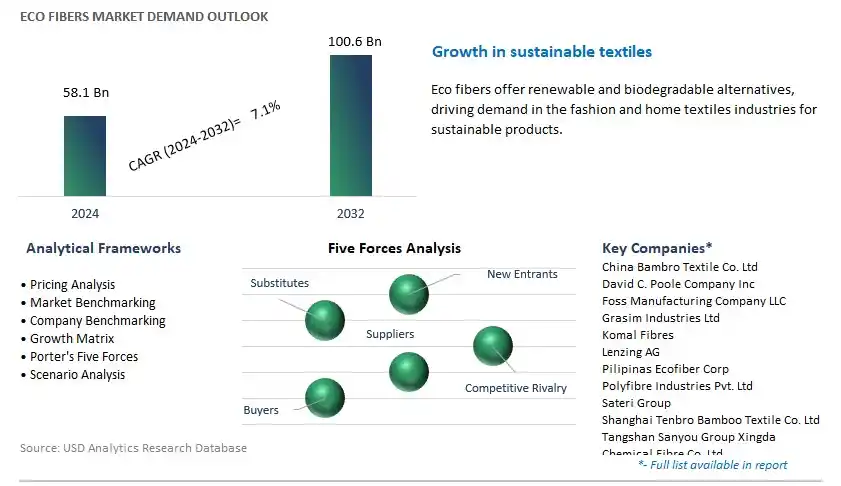
Global Eco Fibers Market Size is valued at $58.1 Billion in 2024 and is forecast to register a growth rate (CAGR) of 7.1% to reach $100.6 Billion by 2032.
The global Eco Fibers Market Study analyzes and forecasts the market size across 6 regions and 24 countries for diverse segments -By Type (Regenerated fibers, Recycle fibers, Organic fibers, Others), By Application (Clothing/ Textile, Household Furnishing, Industrial, Medical, Others).
An Introduction to Eco Fibers Market in 2024
Eco fibers, also known as sustainable fibers or green fibers, are natural or synthetic fibers produced using environmentally friendly and socially responsible practices, with minimal impact on ecosystems and human health. The market for eco fibers is driven by the growing awareness of environmental sustainability, ethical sourcing, and circular economy principles in the textile and apparel industry. Eco fibers encompass a wide range of materials, including organic cotton, bamboo, hemp, recycled polyester, lyocell, and regenerated cellulose fibers such as Tencel® and Modal®. These fibers are cultivated, harvested, or manufactured using methods that reduce water consumption, chemical usage, and carbon emissions compared to conventional fiber production processes. Additionally, eco fibers can be biodegradable, compostable, or recyclable at the end of their lifecycle, contributing to resource conservation and waste reduction efforts. Further, advancements in sustainable fiber sourcing, fiber processing technologies, and eco-certification programs are driving innovation and market growth within the eco fibers industry. As consumers demand transparency, traceability, and eco-friendly alternatives in their clothing and textile choices, eco fibers to gain traction as a preferred option for environmentally conscious brands, retailers, and consumers worldwide.
Eco Fibers Market Competitive Landscape
The market report analyses the leading companies in the industry including China Bambro Textile Co. Ltd, David C. Poole Company Inc, Foss Manufacturing Company LLC, Grasim Industries Ltd, Komal Fibres, Lenzing AG, Pilipinas Ecofiber Corp, Polyfibre Industries Pvt. Ltd, Sateri Group, Shanghai Tenbro Bamboo Textile Co. Ltd, Tangshan Sanyou Group Xingda Chemical Fibre Co. Ltd, Teijin Ltd, Unifi Inc, US Fibers, Vishal Poly Fibers Pvt. Ltd, Wellman Plastics Recycling LLC, and others.
Eco Fibers Market Dynamics
Market Trend: Increasing Demand for Sustainable and Eco-Friendly Textiles
A significant trend in the eco fibers market is the increasing demand for sustainable and eco-friendly textiles. With growing awareness about environmental issues and the impact of textile production on ecosystems and communities, there is a rising preference among consumers for textiles made from eco fibers derived from renewable and biodegradable sources. Eco fibers, such as organic cotton, bamboo, hemp, and recycled polyester, offer environmentally-friendly alternatives to conventional fibers, with reduced water and chemical usage, lower carbon footprint, and minimal impact on soil and biodiversity. This trend is driving the adoption of eco fibers by textile manufacturers, fashion brands, and retailers seeking to meet consumer demand for sustainable and ethically-produced clothing, home textiles, and accessories.
Market Driver: Shift Towards Circular Economy and Closed-Loop Supply Chains
The market for eco fibers is driven by the shift towards a circular economy and closed-loop supply chains in the textile industry. As concerns about resource scarcity, waste generation, and pollution intensify, there is a growing imperative for businesses to transition towards sustainable and circular business models that minimize waste and maximize resource efficiency. Eco fibers play a key role in this transition by offering renewable, biodegradable, and recyclable alternatives to conventional fibers, thereby reducing reliance on finite resources and diverting textile waste from landfills. Additionally, the adoption of closed-loop supply chains enables manufacturers to reclaim and recycle post-consumer textiles and fibers, further reducing environmental impact and creating value from waste. The shift towards circular economy principles drives the demand for eco fibers, as textile companies seek to align with sustainability goals, reduce their ecological footprint, and create more resilient and resource-efficient supply chains.
Market Opportunity: Innovation in Advanced Eco Fiber Technologies
An opportunity for market expansion in the eco fibers industry lies in innovation in advanced eco fiber technologies. While eco fibers such as organic cotton and bamboo have gained prominence in the market, there is potential to develop and commercialize new eco fibers with enhanced properties and functionalities to address evolving market needs and preferences. For example, there is an opportunity to explore the development of eco fibers with improved performance characteristics such as moisture-wicking, UV protection, antimicrobial properties, and flame resistance, to expand their applications in activewear, outdoor gear, and technical textiles. Additionally, there is potential to innovate in the field of biodegradable and compostable fibers, offering alternatives to synthetic fibers that contribute to microplastic pollution. By investing in research and development of advanced eco fiber technologies, manufacturers can differentiate their products, capture new market segments, and drive the adoption of sustainable textiles in a rapidly changing industry landscape.
Eco Fibers Market Share Analysis: Regenerated Fibers segment generated the highest revenue in 2024
Regenerated fibers emerge as the largest segment in the Eco Fibers market. Regenerated fibers, such as viscose and lyocell, are derived from natural materials like wood pulp or bamboo through a chemical process, making them eco-friendly alternatives to conventional synthetic fibers. Their popularity stems from their ability to mimic the properties of natural fibers like cotton and silk while offering enhanced sustainability and versatility in applications ranging from apparel to home textiles and non-woven materials. Moreover, the increasing awareness of environmental issues and the push towards sustainable fashion and textile production drive the demand for regenerated fibers as consumers seek more eco-conscious alternatives. Additionally, advancements in manufacturing technologies and the development of closed-loop production processes further bolster the appeal of regenerated fibers, reducing their environmental impact and making them more cost-effective for manufacturers. Furthermore, the growing emphasis on circular economy principles and recycling initiatives propels the growth of the regenerated fibers market as companies strive to reduce their carbon footprint and adopt more sustainable practices throughout the supply chain. Over the forecast period, regenerated fibers dominate the eco fibers market by offering a compelling combination of sustainability, performance, and versatility, catering to the evolving needs of environmentally conscious consumers and industries.
Eco Fibers Market Share Analysis: Clothing/Textile Application is poised to register the fastest CAGR over the forecast period
The Clothing/Textile application is the fastest-growing segment in the Eco Fibers market. With increasing awareness of environmental sustainability and ethical consumption practices, consumers are increasingly demanding eco-friendly alternatives in the fashion and textile industry. Eco fibers, such as organic cotton, recycled polyester, and bamboo, offer a sustainable solution to the environmental challenges posed by conventional textile production methods. Moreover, the rise of sustainable fashion movements, coupled with stringent regulations and certifications promoting eco-friendly practices, further accelerate the adoption of eco fibers in clothing and textile manufacturing. Additionally, the versatility and performance attributes of eco fibers, including breathability, durability, and softness, make them highly desirable for eco-conscious consumers seeking both style and sustainability in their apparel choices. Furthermore, collaborations between fashion brands, textile manufacturers, and sustainability initiatives drive innovation and investment in eco fiber technologies, further fuelling the growth of the Clothing/Textile application in the eco fibers market. Over the forecast period, the Clothing/Textile application presents significant growth opportunities in the eco fibers market, driven by the increasing demand for sustainable and ethically produced textiles among environmentally conscious consumers and industries.
Eco Fibers Market
By Type
Regenerated fibers
Recycle fibers
Organic fibers
Others
By Application
Clothing/ Textile
Household Furnishing
Industrial
Medical
Others
Countries Analyzed
North America (US, Canada, Mexico)
Europe (Germany, UK, France, Spain, Italy, Russia, Rest of Europe)
Asia Pacific (China, India, Japan, South Korea, Australia, South East Asia, Rest of Asia)
South America (Brazil, Argentina, Rest of South America)
Middle East and Africa (Saudi Arabia, UAE, Rest of Middle East, South Africa, Egypt, Rest of Africa)
Eco Fibers Companies Profiled in the Study
China Bambro Textile Co. Ltd
David C. Poole Company Inc
Foss Manufacturing Company LLC
Grasim Industries Ltd
Komal Fibres
Lenzing AG
Pilipinas Ecofiber Corp
Polyfibre Industries Pvt. Ltd
Sateri Group
Shanghai Tenbro Bamboo Textile Co. Ltd
Tangshan Sanyou Group Xingda Chemical Fibre Co. Ltd
Teijin Ltd
Unifi Inc
US Fibers
Vishal Poly Fibers Pvt. Ltd
Wellman Plastics Recycling LLC
*- List Not Exhaustive
TABLE OF CONTENTS
1 Introduction to 2024 Eco Fibers Market
1.1 Market Overview
1.2 Quick Facts
1.3 Scope/Objective of the Study
1.4 Market Definition
1.5 Countries and Regions Covered
1.6 Units, Currency, and Conversions
1.7 Industry Value Chain
2 Research Methodology
2.1 Market Size Estimation
2.2 Sources and Research Methodology
2.3 Data Triangulation
2.4 Assumptions and Limitations
3 Executive Summary
3.1 Global Eco Fibers Market Size Outlook, $ Million, 2021 to 2032
3.2 Eco Fibers Market Outlook by Type, $ Million, 2021 to 2032
3.3 Eco Fibers Market Outlook by Product, $ Million, 2021 to 2032
3.4 Eco Fibers Market Outlook by Application, $ Million, 2021 to 2032
3.5 Eco Fibers Market Outlook by Key Countries, $ Million, 2021 to 2032
4 Market Dynamics
4.1 Key Driving Forces of Eco Fibers Industry
4.2 Key Market Trends in Eco Fibers Industry
4.3 Potential Opportunities in Eco Fibers Industry
4.4 Key Challenges in Eco Fibers Industry
5 Market Factor Analysis
5.1 Value Chain Analysis
5.2 Competitive Landscape
5.2.1 Global Eco Fibers Market Share by Company (%), 2023
5.2.2 Product Offerings by Company
5.3 Porter’s Five Forces Analysis
5.4 Pricing Analysis and Outlook
6 Growth Outlook Across Scenarios
6.1 Growth Analysis-Case Scenario Definitions
6.2 Low Growth Scenario Forecasts
6.3 Reference Growth Scenario Forecasts
6.4 High Growth Scenario Forecasts
7 Global Eco Fibers Market Outlook by Segments
7.1 Eco Fibers Market Outlook by Segments, $ Million, 2021- 2032
By Type
Regenerated fibers
Recycle fibers
Organic fibers
Others
By Application
Clothing/ Textile
Household Furnishing
Industrial
Medical
Others
8 North America Eco Fibers Market Analysis and Outlook To 2032
8.1 Introduction to North America Eco Fibers Markets in 2024
8.2 North America Eco Fibers Market Size Outlook by Country, 2021-2032
8.2.1 United States
8.2.2 Canada
8.2.3 Mexico
8.3 North America Eco Fibers Market size Outlook by Segments, 2021-2032
By Type
Regenerated fibers
Recycle fibers
Organic fibers
Others
By Application
Clothing/ Textile
Household Furnishing
Industrial
Medical
Others
9 Europe Eco Fibers Market Analysis and Outlook To 2032
9.1 Introduction to Europe Eco Fibers Markets in 2024
9.2 Europe Eco Fibers Market Size Outlook by Country, 2021-2032
9.2.1 Germany
9.2.2 France
9.2.3 Spain
9.2.4 United Kingdom
9.2.4 Italy
9.2.5 Russia
9.2.6 Norway
9.2.7 Rest of Europe
9.3 Europe Eco Fibers Market Size Outlook by Segments, 2021-2032
By Type
Regenerated fibers
Recycle fibers
Organic fibers
Others
By Application
Clothing/ Textile
Household Furnishing
Industrial
Medical
Others
10 Asia Pacific Eco Fibers Market Analysis and Outlook To 2032
10.1 Introduction to Asia Pacific Eco Fibers Markets in 2024
10.2 Asia Pacific Eco Fibers Market Size Outlook by Country, 2021-2032
10.2.1 China
10.2.2 India
10.2.3 Japan
10.2.4 South Korea
10.2.5 Indonesia
10.2.6 Malaysia
10.2.7 Australia
10.2.8 Rest of Asia Pacific
10.3 Asia Pacific Eco Fibers Market size Outlook by Segments, 2021-2032
By Type
Regenerated fibers
Recycle fibers
Organic fibers
Others
By Application
Clothing/ Textile
Household Furnishing
Industrial
Medical
Others
11 South America Eco Fibers Market Analysis and Outlook To 2032
11.1 Introduction to South America Eco Fibers Markets in 2024
11.2 South America Eco Fibers Market Size Outlook by Country, 2021-2032
11.2.1 Brazil
11.2.2 Argentina
11.2.3 Rest of South America
11.3 South America Eco Fibers Market size Outlook by Segments, 2021-2032
By Type
Regenerated fibers
Recycle fibers
Organic fibers
Others
By Application
Clothing/ Textile
Household Furnishing
Industrial
Medical
Others
12 Middle East and Africa Eco Fibers Market Analysis and Outlook To 2032
12.1 Introduction to Middle East and Africa Eco Fibers Markets in 2024
12.2 Middle East and Africa Eco Fibers Market Size Outlook by Country, 2021-2032
12.2.1 Saudi Arabia
12.2.2 UAE
12.2.3 Oman
12.2.4 Rest of Middle East
12.2.5 Egypt
12.2.6 Nigeria
12.2.7 South Africa
12.2.8 Rest of Africa
12.3 Middle East and Africa Eco Fibers Market size Outlook by Segments, 2021-2032
By Type
Regenerated fibers
Recycle fibers
Organic fibers
Others
By Application
Clothing/ Textile
Household Furnishing
Industrial
Medical
Others
13 Company Profiles
13.1 Company Snapshot
13.2 SWOT Profiles
13.3 Products and Services
13.4 Recent Developments
13.5 Financial Profile
China Bambro Textile Co. Ltd
David C. Poole Company Inc
Foss Manufacturing Company LLC
Grasim Industries Ltd
Komal Fibres
Lenzing AG
Pilipinas Ecofiber Corp
Polyfibre Industries Pvt. Ltd
Sateri Group
Shanghai Tenbro Bamboo Textile Co. Ltd
Tangshan Sanyou Group Xingda Chemical Fibre Co. Ltd
Teijin Ltd
Unifi Inc
US Fibers
Vishal Poly Fibers Pvt. Ltd
Wellman Plastics Recycling LLC
14 Appendix
14.1 Customization Offerings
14.2 Subscription Services
14.3 Related Reports
14.4 Publisher Expertise
By Type
Regenerated fibers
Recycle fibers
Organic fibers
Others
By Application
Clothing/ Textile
Household Furnishing
Industrial
Medical
Others
Countries Analyzed
North America (US, Canada, Mexico)
Europe (Germany, UK, France, Spain, Italy, Russia, Rest of Europe)
Asia Pacific (China, India, Japan, South Korea, Australia, South East Asia, Rest of Asia)
South America (Brazil, Argentina, Rest of South America)
Middle East and Africa (Saudi Arabia, UAE, Rest of Middle East, South Africa, Egypt, Rest of Africa)
