Edge Computing in Healthcare Market is estimated to increase at a Compounded Annual Growth Rate of 33.5% CAGR over the forecast period from 2024 to 2030
The Edge Computing in Healthcare Market study analyzes and forecasts the market size across 6 regions and 24 countries for diverse segments- By Component (Hardware, Software, Services), By Application (Diagnostics, Telehealth & Remote Patient Monitoring, Robotic Surgery, Ambulances, Others), By End-User (Hospitals & Clinics, Long-term Care Centers and Home Care Settings, Ambulatory Care Centers, Others).
An Introduction to Edge Computing in Healthcare Market in 2024
Edge computing in healthcare refers to a distributed computing paradigm that brings computational resources closer to the point of data generation, processing, and analysis, enabling real-time data insights, reduced latency, and enhanced security for healthcare applications. In 2024, edge computing plays a transformative role in healthcare IT infrastructure, enabling healthcare organizations to harness the power of data for clinical decision-making, patient monitoring, and healthcare delivery. Edge computing technologies leverage edge devices, such as wearable sensors, medical devices, smartphones, and Internet of Things (IoT) devices, to collect and process healthcare data at the network edge, near the source of data generation. This allows for faster data processing, local data storage, and real-time analytics, reducing reliance on centralized data centers and cloud-based services. Edge computing applications in healthcare include remote patient monitoring, telemedicine, point-of-care diagnostics, predictive analytics, and personalized medicine, providing clinicians with actionable insights and decision support tools at the point of care. With advancements in edge computing infrastructure, software platforms, and connectivity solutions, edge computing enhances scalability, reliability, and interoperability of healthcare IT systems, enabling seamless integration with existing electronic health record (EHR) systems and clinical workflows. By enabling real-time data-driven decision-making, edge computing improves clinical efficiency, patient outcomes, and healthcare quality, while addressing challenges related to data privacy, security, and compliance with healthcare regulations.
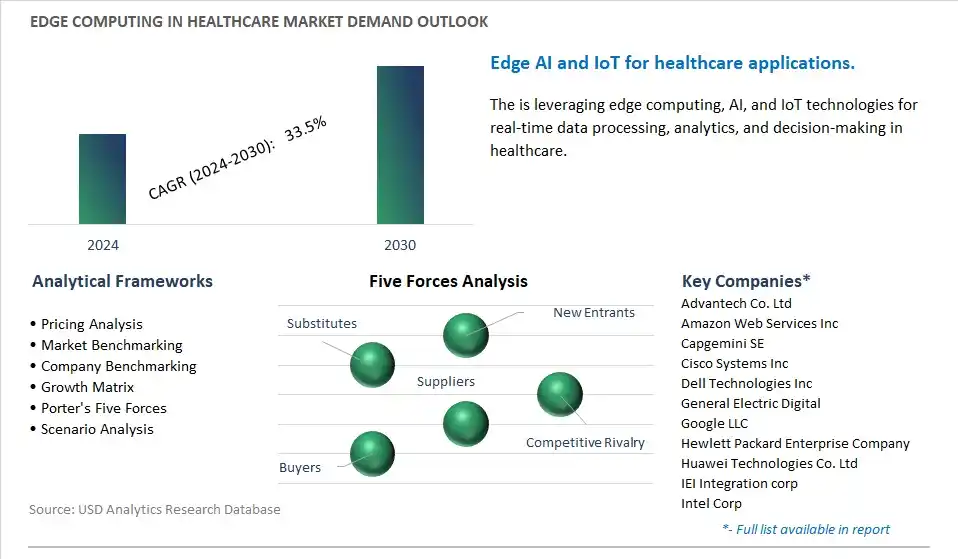
Market Trend: Adoption of Edge Computing for Real-Time Healthcare Applications
A significant trend in the healthcare industry is the increasing adoption of edge computing for real-time healthcare applications. Edge computing involves processing data near the source of generation, enabling faster response times, reduced latency, and improved performance for healthcare systems and devices. With the proliferation of Internet of Medical Things (IoMT) devices, wearable health trackers, and medical sensors, healthcare organizations are leveraging edge computing to analyze streaming data in real-time, monitor patient vitals, and support time-sensitive clinical decision-making. This trend reflects the growing need for decentralized computing architectures to support data-intensive healthcare applications, enhance patient care delivery, and optimize healthcare workflows.
Market Driver: Demand for Secure and Scalable Healthcare Infrastructure
A key driver fueling the adoption of edge computing in healthcare is the demand for secure and scalable healthcare infrastructure. Traditional cloud-based computing models may face challenges related to data privacy, security, and bandwidth constraints when processing large volumes of sensitive healthcare data generated by IoMT devices and medical sensors. Edge computing offers a distributed computing framework that allows healthcare organizations to process and analyze data locally, within the confines of their own network, thereby minimizing data exposure and mitigating security risks. Additionally, edge computing architectures provide scalability and flexibility to accommodate the growing volume and variety of healthcare data, supporting the dynamic needs of healthcare providers for real-time analytics, predictive modeling, and personalized patient care.
Market Opportunity: Development of Edge Computing Solutions for Remote Patient Monitoring
An opportunity within the edge computing in healthcare market lies in the development of edge computing solutions for remote patient monitoring. Remote patient monitoring (RPM) involves the collection of patient health data outside of traditional clinical settings, such as in the patient's home, through connected medical devices and wearable sensors. Edge computing enables the processing and analysis of streaming health data at the edge of the network, allowing for real-time monitoring of patient vitals, early detection of health deterioration, and timely intervention by healthcare providers. By developing edge computing solutions tailored for remote patient monitoring, technology vendors can address the growing demand for remote care delivery, improve patient outcomes, and reduce healthcare costs associated with hospital readmissions and emergency room visits. This opportunity allows vendors to leverage edge computing technologies to empower patients, enhance care coordination, and revolutionize the delivery of healthcare services in remote and underserved communities.
Edge Computing in Healthcare Market Share Analysis: Telehealth & Remote Patient Monitoring is the fastest growing segment over the forecast period to 2030
In the Edge Computing in Healthcare Market, the Telehealth & Remote Patient Monitoring segment emerges as the fastest-growing segment. This growth is propelled by several key factors. Firstly, there has been a significant rise in the adoption of telehealth and remote patient monitoring solutions, driven by factors such as advancements in technology, increasing healthcare costs, and the need for remote healthcare delivery, especially during the COVID-19 pandemic. Telehealth services enable healthcare providers to deliver medical care remotely, facilitating virtual consultations, remote monitoring of patient health parameters, and real-time communication between patients and healthcare professionals. Remote patient monitoring solutions leverage connected medical devices, wearables, and sensors to collect and transmit patient data, allowing for continuous monitoring of vital signs, medication adherence, and disease progression outside of traditional healthcare settings. The integration of edge computing technologies in telehealth and remote patient monitoring solutions enables real-time data processing, analysis, and decision-making at the point of care, enhancing the efficiency and effectiveness of remote healthcare delivery. Additionally, edge computing facilitates low-latency data transmission, ensuring timely delivery of critical healthcare information and enabling responsive interventions in case of emergencies. Furthermore, the growing emphasis on value-based care, population health management, and chronic disease management drives the adoption of telehealth and remote patient monitoring solutions among healthcare providers and payers seeking to improve patient outcomes, reduce hospital readmissions, and optimize resource utilization. As hospitals, clinics, long-term care centers, and ambulatory care centers increasingly invest in telehealth and remote patient monitoring technologies to enhance patient care delivery and expand access to healthcare services, the Telehealth & Remote Patient Monitoring segment is experiencing rapid growth and is expected to continue expanding in the Edge Computing in Healthcare Market.
Edge Computing in Healthcare Competitive Analysis
The market research study provides in-depth insights into leading companies including the SWOT analyses, product profile, financial details, and recent developments acrossAdvantech Co. Ltd, Amazon Web Services Inc, Capgemini SE, Cisco Systems Inc, Dell Technologies Inc, General Electric Digital, Google LLC, Hewlett Packard Enterprise Company, Huawei Technologies Co. Ltd, IEI Integration corp, Intel Corp, Microsoft Corp, Nokia Corp, NVIDIA Corp, VMware Inc
Edge Computing in Healthcare Market Segmentation
By Component
Hardware
Software
Services
By Application
Diagnostics
Telehealth & Remote Patient Monitoring
Robotic Surgery
Ambulances
Others
By End-User
Hospitals & Clinics
Long-term Care Centers and Home Care Settings
Ambulatory Care Centers
Others
Geographical Analysis
North America (United States, Canada, Mexico)
Europe (Germany, France, United Kingdom, Spain, Italy, Rest of Europe)
Asia Pacific (China, India, Japan, South Korea, Rest of Asia Pacific)
South America (Brazil, Argentina, Rest of South America)
Middle East and Africa (Saudi Arabia, UAE, Rest of Middle East, South Africa, Egypt, Rest of Africa)
Edge Computing in Healthcare Market Companies
Advantech Co. Ltd
Amazon Web Services Inc
Capgemini SE
Cisco Systems Inc
Dell Technologies Inc
General Electric Digital
Google LLC
Hewlett Packard Enterprise Company
Huawei Technologies Co. Ltd
IEI Integration corp
Intel Corp
Microsoft Corp
Nokia Corp
NVIDIA Corp
VMware Inc
Reasons to Buy the Edge Computing in Healthcare Market Study
• Deepen your industry insights and navigate uncertainties for strategy formulation, CAPEX, and Operational decisions
• Gain access to detailed insights on the Edge Computing in Healthcare Market, encompassing current market size, growth trends, and forecasts till 2030.
• Access detailed competitor analysis, enabling competitive advantage through a thorough understanding of market players, strategies, and potential differentiation opportunities
• Stay ahead of the curve with insights on technological advancements, innovations, and upcoming trends
• Identify lucrative investment avenues and expansion opportunities within the Edge Computing in Healthcare Market industry, guided by robust, data-backed analysis.
• Understand regional and global markets through country-wise analysis, regional market potential, regulatory nuances, and dynamics
• Execute strategies with confidence and speed through information, analytics, and insights on the industry value chain
• Corporate leaders, strategists, financial experts, shareholders, asset managers, and governmental representatives can make long-term planning scenarios and build an integrated and timely understanding of market dynamics
• Benefit from tailored solutions and expert consultation based on report insights, providing personalized strategies aligned with specific business needs.
TABLE OF CONTENTS
1 Introduction to 2024 Edge Computing in Healthcare Market
1.1 Market Overview
1.2 Quick Facts
1.3 Scope/Objective of the Study
1.4 Market Definition
1.5 Countries and Regions Covered
1.6 Units, Currency, and Conversions
1.7 Industry Value Chain
2 Research Methodology
2.1 Market Size Estimation
2.2 Sources and Research Methodology
2.3 Data Triangulation
2.4 Assumptions and Limitations
3 Executive Summary
3.1 Global Edge Computing in Healthcare Market Size Outlook, $ Million, 2021 to 2030
3.2 Edge Computing in Healthcare Market Outlook by Type, $ Million, 2021 to 2030
3.3 Edge Computing in Healthcare Market Outlook by Product, $ Million, 2021 to 2030
3.4 Edge Computing in Healthcare Market Outlook by Application, $ Million, 2021 to 2030
3.5 Edge Computing in Healthcare Market Outlook by Key Countries, $ Million, 2021 to 2030
4 Market Dynamics
4.1 Key Driving Forces of Edge Computing in Healthcare Industry
4.2 Key Market Trends in Edge Computing in Healthcare Industry
4.3 Potential Opportunities in Edge Computing in Healthcare Industry
4.4 Key Challenges in Edge Computing in Healthcare Industry
5 Market Factor Analysis
5.1 Value Chain Analysis
5.2 Competitive Landscape
5.2.1 Global Edge Computing in Healthcare Market Share by Company (%), 2023
5.2.2 Product Offerings by Company
5.3 Porter’s Five Forces Analysis
5.4 Pricing Analysis and Outlook
6 Growth Outlook Across Scenarios
6.1 Growth Analysis-Case Scenario Definitions
6.2 Low Growth Scenario Forecasts
6.3 Reference Growth Scenario Forecasts
6.4 High Growth Scenario Forecasts
7 Global Edge Computing in Healthcare Market Outlook by Segments
7.1 Edge Computing in Healthcare Market Outlook by Segments, $ Million, 2021- 2030
By Component
Hardware
Software
Services
By Application
Diagnostics
Telehealth & Remote Patient Monitoring
Robotic Surgery
Ambulances
Others
By End-User
Hospitals & Clinics
Long-term Care Centers and Home Care Settings
Ambulatory Care Centers
Others
8 North America Edge Computing in Healthcare Market Analysis and Outlook To 2030
8.1 Introduction to North America Edge Computing in Healthcare Markets in 2024
8.2 North America Edge Computing in Healthcare Market Size Outlook by Country, 2021-2030
8.2.1 United States
8.2.2 Canada
8.2.3 Mexico
8.3 North America Edge Computing in Healthcare Market size Outlook by Segments, 2021-2030
By Component
Hardware
Software
Services
By Application
Diagnostics
Telehealth & Remote Patient Monitoring
Robotic Surgery
Ambulances
Others
By End-User
Hospitals & Clinics
Long-term Care Centers and Home Care Settings
Ambulatory Care Centers
Others
9 Europe Edge Computing in Healthcare Market Analysis and Outlook To 2030
9.1 Introduction to Europe Edge Computing in Healthcare Markets in 2024
9.2 Europe Edge Computing in Healthcare Market Size Outlook by Country, 2021-2030
9.2.1 Germany
9.2.2 France
9.2.3 Spain
9.2.4 United Kingdom
9.2.4 Italy
9.2.5 Russia
9.2.6 Norway
9.2.7 Rest of Europe
9.3 Europe Edge Computing in Healthcare Market Size Outlook by Segments, 2021-2030
By Component
Hardware
Software
Services
By Application
Diagnostics
Telehealth & Remote Patient Monitoring
Robotic Surgery
Ambulances
Others
By End-User
Hospitals & Clinics
Long-term Care Centers and Home Care Settings
Ambulatory Care Centers
Others
10 Asia Pacific Edge Computing in Healthcare Market Analysis and Outlook To 2030
10.1 Introduction to Asia Pacific Edge Computing in Healthcare Markets in 2024
10.2 Asia Pacific Edge Computing in Healthcare Market Size Outlook by Country, 2021-2030
10.2.1 China
10.2.2 India
10.2.3 Japan
10.2.4 South Korea
10.2.5 Indonesia
10.2.6 Malaysia
10.2.7 Australia
10.2.8 Rest of Asia Pacific
10.3 Asia Pacific Edge Computing in Healthcare Market size Outlook by Segments, 2021-2030
By Component
Hardware
Software
Services
By Application
Diagnostics
Telehealth & Remote Patient Monitoring
Robotic Surgery
Ambulances
Others
By End-User
Hospitals & Clinics
Long-term Care Centers and Home Care Settings
Ambulatory Care Centers
Others
11 South America Edge Computing in Healthcare Market Analysis and Outlook To 2030
11.1 Introduction to South America Edge Computing in Healthcare Markets in 2024
11.2 South America Edge Computing in Healthcare Market Size Outlook by Country, 2021-2030
11.2.1 Brazil
11.2.2 Argentina
11.2.3 Rest of South America
11.3 South America Edge Computing in Healthcare Market size Outlook by Segments, 2021-2030
By Component
Hardware
Software
Services
By Application
Diagnostics
Telehealth & Remote Patient Monitoring
Robotic Surgery
Ambulances
Others
By End-User
Hospitals & Clinics
Long-term Care Centers and Home Care Settings
Ambulatory Care Centers
Others
12 Middle East and Africa Edge Computing in Healthcare Market Analysis and Outlook To 2030
12.1 Introduction to Middle East and Africa Edge Computing in Healthcare Markets in 2024
12.2 Middle East and Africa Edge Computing in Healthcare Market Size Outlook by Country, 2021-2030
12.2.1 Saudi Arabia
12.2.2 UAE
12.2.3 Oman
12.2.4 Rest of Middle East
12.2.5 Egypt
12.2.6 Nigeria
12.2.7 South Africa
12.2.8 Rest of Africa
12.3 Middle East and Africa Edge Computing in Healthcare Market size Outlook by Segments, 2021-2030
By Component
Hardware
Software
Services
By Application
Diagnostics
Telehealth & Remote Patient Monitoring
Robotic Surgery
Ambulances
Others
By End-User
Hospitals & Clinics
Long-term Care Centers and Home Care Settings
Ambulatory Care Centers
Others
13 Company Profiles
13.1 Company Snapshot
13.2 SWOT Profiles
13.3 Products and Services
13.4 Recent Developments
13.5 Financial Profile
List of Companies
Advantech Co. Ltd
Amazon Web Services Inc
Capgemini SE
Cisco Systems Inc
Dell Technologies Inc
General Electric Digital
Google LLC
Hewlett Packard Enterprise Company
Huawei Technologies Co. Ltd
IEI Integration corp
Intel Corp
Microsoft Corp
Nokia Corp
NVIDIA Corp
VMware Inc
14 Appendix
14.1 Customization Offerings
14.2 Subscription Services
14.3 Related Reports
14.4 Publisher Expertise
By Component
Hardware
Software
Services
By Application
Diagnostics
Telehealth & Remote Patient Monitoring
Robotic Surgery
Ambulances
Others
By End-User
Hospitals & Clinics
Long-term Care Centers and Home Care Settings
Ambulatory Care Centers
Others
Countries Analyzed
North America (United States, Canada, Mexico)
Europe (Germany, France, United Kingdom, Spain, Italy, Rest of Europe)
Asia Pacific (China, India, Japan, South Korea, Rest of Asia Pacific)
South America (Brazil, Argentina, Rest of South America)
Middle East and Africa (Saudi Arabia, UAE, Rest of Middle East, South Africa, Egypt, Rest of Africa)
