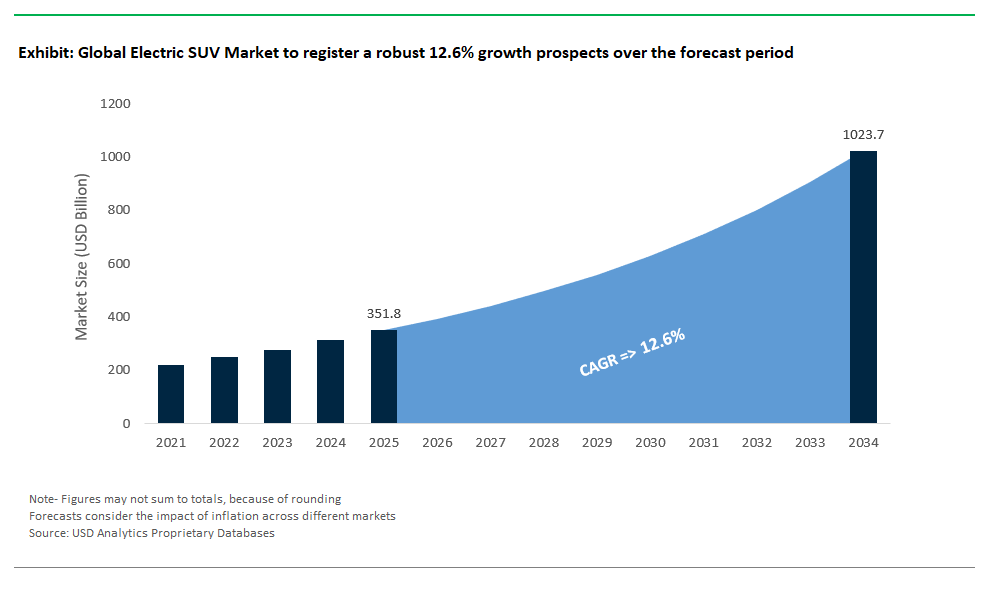
The Global Electric SUV Market Size is estimated at $351.8 Billion in 2025 and is forecast to register an annual growth rate (CAGR) of 12.6% to reach $1023.5 Billion by 2034.
The global Electric SUV Market Study analyzes and forecasts the market size across 6 regions and 24 countries for diverse segments -By Vehicle (Compact, Mid-size, Full-size), By Propulsion (Battery Electric Vehicle (BEV), Plug-in Hybrid Electric Vehicle (PHEV)), By Vehicle Range (Up to 250 Miles, 250 to 500 Mile, Above 500 Miles), By Drive (FWD, RWD, AWD).
An Introduction to Electric SUV Market in 2025
The Electric SUV Market is experiencing a robust surge in popularity, fueled by the growing emphasis on sustainability and the shift towards cleaner transportation solutions. Electric SUVs combine the versatility and space of traditional sport utility vehicles with the environmental benefits of electric propulsion. This market growth is driven by advancements in battery technology, which have improved driving range and reduced charging times, along with increasing government incentives and stricter emissions regulations. As consumers become more environmentally conscious, automakers are expanding their electric SUV offerings with enhanced performance, innovative features, and competitive pricing. The market is also supported by a growing network of fast-charging infrastructure and advancements in electric vehicle (EV) technology, making electric SUVs an attractive choice for a wide range of consumers.
Electric SUV Competitive Landscape
The market report analyses the leading companies in the industry including AB Volvo, BYD Company Ltd, Chevrolet, Ford Motor Company, Honda Motor Co. Ltd, Hyundai Motor Company, Kia Corp, Nissan Motor Corp, Tesla Inc, Toyota Motor Corp, Volkswagen AG, and others.
Electric SUV Market Dynamics
Market Trend: Shift Towards Premium and Long-Range Electric SUVs
A prominent trend in the electric SUV market is the growing consumer preference for premium, long-range electric SUVs. As electric vehicle (EV) technology advances, automakers are focusing on expanding their offerings of high-performance SUVs with extended ranges, advanced infotainment systems, and luxury features. The demand for spacious, family-oriented vehicles that can comfortably accommodate long road trips is driving manufacturers to invest in battery technology that supports ranges exceeding 300 miles per charge. Companies like Tesla, Rivian, and traditional automakers like Ford and Volkswagen are launching electric SUVs that cater to both eco-conscious consumers and those seeking luxury. Moreover, the integration of advanced driver-assistance systems (ADAS), AI-powered in-car systems, and seamless connectivity features in these vehicles is becoming a standard expectation. This trend underscores the market’s movement toward combining sustainability with high-end performance and comfort, appealing to a broad range of consumers who are increasingly prioritizing electric powertrains in their vehicle choices.
Market Driver: Government Incentives and Stringent Emission Regulations
Government incentives and stringent emission regulations are key drivers fueling the growth of the electric SUV market. Countries worldwide are intensifying their efforts to reduce greenhouse gas emissions, with many implementing stricter fuel efficiency standards and incentivizing the adoption of zero-emission vehicles through tax credits, rebates, and subsidies. Additionally, several governments have set deadlines to phase out internal combustion engine vehicles, further pushing consumers and manufacturers towards electric alternatives. In markets like Europe, China, and North America, where regulatory pressures are particularly strong, automakers are prioritizing the development of electric SUVs to meet both regulatory requirements and market demand. Subsidies that reduce the upfront costs of electric vehicles, along with benefits like reduced road taxes and access to low-emission zones, are encouraging consumers to opt for electric SUVs over traditional vehicles. These regulatory frameworks are instrumental in accelerating the transition to electric mobility, making electric SUVs a significant growth segment in the global automotive industry.
Market Opportunity: Expanding Charging Infrastructure and Energy Management Solutions
The expansion of charging infrastructure and energy management solutions presents a significant growth opportunity in the electric SUV market. As more consumers adopt electric vehicles, the demand for accessible, fast, and reliable charging stations is rising sharply. This has led to increased investments in public and private charging networks, with companies deploying high-speed chargers along highways, in urban centers, and in residential areas. The growth of smart grid technologies and energy management solutions, such as vehicle-to-grid (V2G) systems, also offers opportunities for integrating electric SUVs into broader energy ecosystems. By enabling vehicles to serve as energy storage units and feed power back to the grid during peak demand, these solutions not only enhance grid stability but also provide additional value to EV owners. As charging infrastructure becomes more ubiquitous and energy management technologies advance, consumers will experience greater convenience and flexibility, which in turn is likely to drive higher adoption rates of electric SUVs, particularly in regions where charging networks are currently underdeveloped.
Electric SUV Market Share Analysis: Mid-Size Electric SUVs generated the highest revenue in 2024
In the Electric SUV market, mid-size electric SUVs represent the largest segment due to their balanced combination of size, performance, and utility, which appeals to a broad range of consumers. Mid-size SUVs offer ample interior space and cargo capacity, making them suitable for family use and long-distance travel while maintaining a manageable footprint compared to full-size SUVs. This segment's popularity is further bolstered by the increasing availability of mid-size electric SUVs from various automakers, providing consumers with more options and competitive pricing. The mid-size category effectively addresses the demand for versatile and practical electric vehicles, driving its prominence in the market.
Electric SUV Market Share Analysis: Battery Electric Vehicles (BEV) is poised to register the fastest CAGR over the forecast period
In the Electric SUV market, Battery Electric Vehicles (BEVs) are the fastest-growing segment due to their full-electric propulsion system and increasing consumer preference for zero-emissions vehicles. BEVs offer several advantages over Plug-in Hybrid Electric Vehicles (PHEVs), including longer all-electric driving ranges and lower operational costs since they do not rely on internal combustion engines. The advancements in battery technology, expanding charging infrastructure, and government incentives promoting electric mobility are accelerating the adoption of BEVs. As consumers and automakers increasingly focus on sustainability and reducing carbon footprints, BEVs are experiencing rapid growth, reflecting a broader shift towards fully electric transportation solutions.
Electric SUV Market Share Analysis: 250 to 500 Miles generated the highest revenue in 2024
In the Electric SUV market, the 250 to 500 miles range category is the largest segment due to its optimal balance between driving range and battery cost, making it the most practical choice for a wide range of consumers. Vehicles within this range provide sufficient distance for most daily commutes and moderate long-distance travel, alleviating range anxiety while remaining more affordable than models with ranges above 500 miles. As advancements in battery technology continue to improve, electric SUVs offering a range between 250 and 500 miles strike a balance between performance, cost, and consumer expectations, driving their dominance in the market.
Electric SUV Market Share Analysis: All-Wheel Drive (AWD) is poised to register the fastest CAGR over the forecast period
In the Electric SUV market, All-Wheel Drive (AWD) is the fastest-growing segment due to its superior traction, handling, and performance in diverse driving conditions. AWD systems provide enhanced stability and control, making electric SUVs more appealing to consumers in regions with adverse weather conditions or rough terrain. The increasing availability of AWD options in electric SUVs addresses the demand for high-performance and versatile vehicles that can handle various road conditions while maintaining electric efficiency. As automakers continue to introduce advanced AWD technologies and consumers seek vehicles that offer both power and versatility, the AWD segment is experiencing significant growth in the electric SUV market.
Electric SUV Market Report Scope
|
Parameter
|
Details
|
|
Market Size (2025)
|
$ 351.8 Billion
|
|
Market Size (2034)
|
$ 1023.5 Billion
|
|
Market Growth Rate
|
12.6%
|
|
Segments
|
By Vehicle (Compact, Mid-size, Full-size), By Propulsion (Battery Electric Vehicle (BEV), Plug-in Hybrid Electric Vehicle (PHEV)), By Vehicle Range (Up to 250 Miles, 250 to 500 Mile, Above 500 Miles), By Drive (FWD, RWD, AWD)
|
|
Study Period
|
2019- 2024 and 2025-2034
|
|
Units
|
Revenue (USD)
|
|
Qualitative Analysis
|
Porter’s Five Forces, SWOT Profile, Market Share, Scenario Forecasts, Market Ecosystem, Company Ranking, Market Dynamics, Industry Benchmarking
|
|
Companies
|
AB Volvo, BYD Company Ltd, Chevrolet, Ford Motor Company, Honda Motor Co. Ltd, Hyundai Motor Company, Kia Corp, Nissan Motor Corp, Tesla Inc, Toyota Motor Corp, Volkswagen AG
|
|
Countries
|
US, Canada, Mexico, Germany, France, Spain, Italy, UK, Russia, China, India, Japan, South Korea, Australia, South East Asia, Brazil, Argentina, Middle East, Africa
|
Electric SUV Market Segmentation
By Vehicle
Compact
Mid-size
Full-size
By Propulsion
Battery Electric Vehicle (BEV)
Plug-in Hybrid Electric Vehicle (PHEV)
By Vehicle Range
Up to 250 Miles
250 to 500 Mile
Above 500 Miles
By Drive
FWD
RWD
AWD
Countries Analyzed
North America (US, Canada, Mexico)
Europe (Germany, UK, France, Spain, Italy, Russia, Rest of Europe)
Asia Pacific (China, India, Japan, South Korea, Australia, South East Asia, Rest of Asia)
South America (Brazil, Argentina, Rest of South America)
Middle East and Africa (Saudi Arabia, UAE, Rest of Middle East, South Africa, Egypt, Rest of Africa)
Electric SUV Companies Profiled in the Study
AB Volvo
BYD Company Ltd
Chevrolet
Ford Motor Company
Honda Motor Co. Ltd
Hyundai Motor Company
Kia Corp
Nissan Motor Corp
Tesla Inc
Toyota Motor Corp
Volkswagen AG
*- List Not Exhaustive
About USD Analytics
Table of Contents
List of Charts and Exhibits
List of Tables
1. Executive Summary
What’s New in 2025?
Top 10 Takeaways from the industry
Potential Opportunities for Industry Stakeholders
Strategic Imperatives
Company Market Positioning
Industry Benchmarking Matrix
2. Research Scope and Methodology
Market Definition
Market Segments
Companies Profiled
Research Methodology
Bottom-Up Method
Top-Down Method
Data Triangulation
Forecast Methodology
Data Sources
USDA Proprietary Databases
External Sources
Primary Research and Interviews
Conversion Rates for USD
Abbreviations
3. Strategic Landscape: Key Insights and Implications
Spotlight: Key Strategies opted by Business Leaders
Competitive Landscape
Market Size ($ Million) and Share (%) by Company, 2024
SWOT Analysis
- Key Market Strengths
- Key Market Weaknesses
- Potential Opportunities
- Potential Threats
Porter’s Five Force Analysis
- Summary
- Bargaining Power of Buyers- Impact Analysis
- Bargaining Power of Suppliers- Impact Analysis
- Threat of new entrants- Impact Analysis
- Intensity of Competitive Rivalry- Impact Analysis
Macro-Environmental Analysis
- Economic forecasts by Country, 2010- 2035
- Population forecasts by Country, 2010- 2035
- Inflation Outlook by Country, 2010-2035
- Impact of Russia-Ukraine Conflict, Sluggish China Growth, US Developments
5. Growth Opportunity Analysis
Trends at a Glance
- What are the most noteworthy trends in the market
- Where should leaders pay attention?
- What industries are likely to be affected by the growth?
Market Dynamics
- Charting a path forward
- Growth Drivers
- Growth Barriers
Key Industry Stakeholders
- Suppliers
- Manufacturers and Service Providers
- Distribution Channels
- End-Users and Applications
- Regulators
- Investors, Traders, and R&D Institutes
Regulatory Landscape
6. Market Size Outlook to 2034
Global Nanocoatings Market Size Forecast, USD Million, 2018- 2034
- Historic Market Size, 2018- 2024
- Forecast Market Size, 2024- 2034
Scenario Analysis
- Low Growth Scenario: Definition and Outlook to 2034
- Reference Case: Definition and Outlook to 2034
- High Growth Scenario: Definition and Outlook to 2034
Pricing Analysis and Outlook
- Nanocoatings Average Price Forecast, 2021- 2034
- Key Factors Shaping the Pricing Patterns
7. Historical Nanocoatings Market Size by Segments, 2018- 2024
Key Statistics, 2024
Nanocoatings Market Size Outlook by Type, USD Million, 2018- 2024
Growth Comparison (y-o-y) across Nanocoatings Types, 2018- 2024
Nanocoatings Market Size Outlook by Application, USD Million, 2018- 2024
Growth Comparison (y-o-y) across Nanocoatings Applications, 2018- 2024
8. Nanocoatings Market Size Outlook by Segments, 2024- 2034
By Vehicle
Compact
Mid-size
Full-size
By Propulsion
Battery Electric Vehicle (BEV)
Plug-in Hybrid Electric Vehicle (PHEV)
By Vehicle Range
Up to 250 Miles
250 to 500 Mile
Above 500 Miles
By Drive
FWD
RWD
AWD
9. Nanocoatings Market Size Outlook by Region
North America
Key Market Dynamics
North America Nanocoatings Market Size Outlook by Type, USD Million, 2021-2034
North America Nanocoatings Market Size Outlook by Application, USD Million, 2021-2034
North America Nanocoatings Market Size Outlook by Sales Channel, USD Million, 2021-2034
North America Nanocoatings Market Size Outlook by Country, USD Million, 2021-2034
Europe
Key Market Dynamics
Europe Nanocoatings Market Size Outlook by Type, USD Million, 2021-2034
Europe Nanocoatings Market Size Outlook by Application, USD Million, 2021-2034
Europe Nanocoatings Market Size Outlook by Sales Channel, USD Million, 2021-2034
Europe Nanocoatings Market Size Outlook by Country, USD Million, 2021-2034
Asia Pacific
Key Market Dynamics
Asia Pacific Nanocoatings Market Size Outlook by Type, USD Million, 2021-2034
Asia Pacific Nanocoatings Market Size Outlook by Application, USD Million, 2021-2034
Asia Pacific Nanocoatings Market Size Outlook by Sales Channel, USD Million, 2021-2034
Asia Pacific Nanocoatings Market Size Outlook by Country, USD Million, 2021-2034
South America
Key Market Dynamics
South America Nanocoatings Market Size Outlook by Type, USD Million, 2021-2034
South America Nanocoatings Market Size Outlook by Application, USD Million, 2021-2034
South America Nanocoatings Market Size Outlook by Sales Channel, USD Million, 2021-2034
South America Nanocoatings Market Size Outlook by Country, USD Million, 2021-2034
Middle East and Africa
Key Market Dynamics
Middle East and Africa Nanocoatings Market Size Outlook by Type, USD Million, 2021-2034
Middle East and Africa Nanocoatings Market Size Outlook by Application, USD Million, 2021-2034
Middle East and Africa Nanocoatings Market Size Outlook by Sales Channel, USD Million, 2021-2034
Middle East and Africa Nanocoatings Market Size Outlook by Country, USD Million, 2021-2034
10. United States Nanocoatings Market Analysis and Outlook, 2021- 2034
Key Statistics
United States Nanocoatings Market Size Outlook by Type, 2021- 2034
United States Nanocoatings Market Size Outlook by Application, 2021- 2034
United States Nanocoatings Market Size Outlook by End-User, 2021- 2034
11. Canada Nanocoatings Market Analysis and Outlook, 2021- 2034
Key Statistics
Canada Nanocoatings Market Size Outlook by Type, 2021- 2034
Canada Nanocoatings Market Size Outlook by Application, 2021- 2034
Canada Nanocoatings Market Size Outlook by End-User, 2021- 2034
12. Mexico Nanocoatings Market Analysis and Outlook, 2021- 2034
Key Statistics
Mexico Nanocoatings Market Size Outlook by Type, 2021- 2034
Mexico Nanocoatings Market Size Outlook by Application, 2021- 2034
Mexico Nanocoatings Market Size Outlook by End-User, 2021- 2034
13. Germany Nanocoatings Market Analysis and Outlook, 2021- 2034
Key Statistics
Germany Nanocoatings Market Size Outlook by Type, 2021- 2034
Germany Nanocoatings Market Size Outlook by Application, 2021- 2034
Germany Nanocoatings Market Size Outlook by End-User, 2021- 2034
14. France Nanocoatings Market Analysis and Outlook, 2021- 2034
Key Statistics
France Nanocoatings Market Size Outlook by Type, 2021- 2034
France Nanocoatings Market Size Outlook by Application, 2021- 2034
France Nanocoatings Market Size Outlook by End-User, 2021- 2034
15. United Kingdom Nanocoatings Market Analysis and Outlook, 2021- 2034
Key Statistics
United Kingdom Nanocoatings Market Size Outlook by Type, 2021- 2034
United Kingdom Nanocoatings Market Size Outlook by Application, 2021- 2034
United Kingdom Nanocoatings Market Size Outlook by End-User, 2021- 2034
16. Spain Nanocoatings Market Analysis and Outlook, 2021- 2034
Key Statistics
Spain Nanocoatings Market Size Outlook by Type, 2021- 2034
Spain Nanocoatings Market Size Outlook by Application, 2021- 2034
Spain Nanocoatings Market Size Outlook by End-User, 2021- 2034
17. Italy Nanocoatings Market Analysis and Outlook, 2021- 2034
Key Statistics
Italy Nanocoatings Market Size Outlook by Type, 2021- 2034
Italy Nanocoatings Market Size Outlook by Application, 2021- 2034
Italy Nanocoatings Market Size Outlook by End-User, 2021- 2034
18. Benelux Nanocoatings Market Analysis and Outlook, 2021- 2034
Key Statistics
Benelux Nanocoatings Market Size Outlook by Type, 2021- 2034
Benelux Nanocoatings Market Size Outlook by Application, 2021- 2034
Benelux Nanocoatings Market Size Outlook by End-User, 2021- 2034
19. Nordic Nanocoatings Market Analysis and Outlook, 2021- 2034
Key Statistics
Nordic Nanocoatings Market Size Outlook by Type, 2021- 2034
Nordic Nanocoatings Market Size Outlook by Application, 2021- 2034
Nordic Nanocoatings Market Size Outlook by End-User, 2021- 2034
20. Rest of Europe Nanocoatings Market Analysis and Outlook, 2021- 2034
Key Statistics
Rest of Europe Nanocoatings Market Size Outlook by Type, 2021- 2034
Rest of Europe Nanocoatings Market Size Outlook by Application, 2021- 2034
Rest of Europe Nanocoatings Market Size Outlook by End-User, 2021- 2034
21. China Nanocoatings Market Analysis and Outlook, 2021- 2034
Key Statistics
China Nanocoatings Market Size Outlook by Type, 2021- 2034
China Nanocoatings Market Size Outlook by Application, 2021- 2034
China Nanocoatings Market Size Outlook by End-User, 2021- 2034
22. India Nanocoatings Market Analysis and Outlook, 2021- 2034
Key Statistics
India Nanocoatings Market Size Outlook by Type, 2021- 2034
India Nanocoatings Market Size Outlook by Application, 2021- 2034
India Nanocoatings Market Size Outlook by End-User, 2021- 2034
23. Japan Nanocoatings Market Analysis and Outlook, 2021- 2034
Key Statistics
Japan Nanocoatings Market Size Outlook by Type, 2021- 2034
Japan Nanocoatings Market Size Outlook by Application, 2021- 2034
Japan Nanocoatings Market Size Outlook by End-User, 2021- 2034
24. South Korea Nanocoatings Market Analysis and Outlook, 2021- 2034
Key Statistics
South Korea Nanocoatings Market Size Outlook by Type, 2021- 2034
South Korea Nanocoatings Market Size Outlook by Application, 2021- 2034
South Korea Nanocoatings Market Size Outlook by End-User, 2021- 2034
25. Australia Nanocoatings Market Analysis and Outlook, 2021- 2034
Key Statistics
Australia Nanocoatings Market Size Outlook by Type, 2021- 2034
Australia Nanocoatings Market Size Outlook by Application, 2021- 2034
Australia Nanocoatings Market Size Outlook by End-User, 2021- 2034
26. South East Asia Nanocoatings Market Analysis and Outlook, 2021- 2034
Key Statistics
South East Asia Nanocoatings Market Size Outlook by Type, 2021- 2034
South East Asia Nanocoatings Market Size Outlook by Application, 2021- 2034
South East Asia Nanocoatings Market Size Outlook by End-User, 2021- 2034
27. Rest of Asia Pacific Nanocoatings Market Analysis and Outlook, 2021- 2034
Key Statistics
Rest of Asia Pacific Nanocoatings Market Size Outlook by Type, 2021- 2034
Rest of Asia Pacific Nanocoatings Market Size Outlook by Application, 2021- 2034
Rest of Asia Pacific Nanocoatings Market Size Outlook by End-User, 2021- 2034
28. Brazil Nanocoatings Market Analysis and Outlook, 2021- 2034
Key Statistics
Brazil Nanocoatings Market Size Outlook by Type, 2021- 2034
Brazil Nanocoatings Market Size Outlook by Application, 2021- 2034
Brazil Nanocoatings Market Size Outlook by End-User, 2021- 2034
29. Argentina Nanocoatings Market Analysis and Outlook, 2021- 2034
Key Statistics
Argentina Nanocoatings Market Size Outlook by Type, 2021- 2034
Argentina Nanocoatings Market Size Outlook by Application, 2021- 2034
Argentina Nanocoatings Market Size Outlook by End-User, 2021- 2034
30. Rest of South America Nanocoatings Market Analysis and Outlook, 2021- 2034
Key Statistics
Rest of South America Nanocoatings Market Size Outlook by Type, 2021- 2034
Rest of South America Nanocoatings Market Size Outlook by Application, 2021- 2034
Rest of South America Nanocoatings Market Size Outlook by End-User, 2021- 2034
31. United Arab Emirates Nanocoatings Market Analysis and Outlook, 2021- 2034
Key Statistics
United Arab Emirates Nanocoatings Market Size Outlook by Type, 2021- 2034
United Arab Emirates Nanocoatings Market Size Outlook by Application, 2021- 2034
United Arab Emirates Nanocoatings Market Size Outlook by End-User, 2021- 2034
32. Saudi Arabia Nanocoatings Market Analysis and Outlook, 2021- 2034
Key Statistics
Saudi Arabia Nanocoatings Market Size Outlook by Type, 2021- 2034
Saudi Arabia Nanocoatings Market Size Outlook by Application, 2021- 2034
Saudi Arabia Nanocoatings Market Size Outlook by End-User, 2021- 2034
33. Rest of Middle East Nanocoatings Market Analysis and Outlook, 2021- 2034
Key Statistics
Rest of Middle East Nanocoatings Market Size Outlook by Type, 2021- 2034
Rest of Middle East Nanocoatings Market Size Outlook by Application, 2021- 2034
Rest of Middle East Nanocoatings Market Size Outlook by End-User, 2021- 2034
34. South Africa Nanocoatings Market Analysis and Outlook, 2021- 2034
Key Statistics
South Africa Nanocoatings Market Size Outlook by Type, 2021- 2034
South Africa Nanocoatings Market Size Outlook by Application, 2021- 2034
South Africa Nanocoatings Market Size Outlook by End-User, 2021- 2034
35. Rest of Africa Nanocoatings Market Analysis and Outlook, 2021- 2034
Key Statistics
Rest of Africa Nanocoatings Market Size Outlook by Type, 2021- 2034
Rest of Africa Nanocoatings Market Size Outlook by Application, 2021- 2034
Rest of Africa Nanocoatings Market Size Outlook by End-User, 2021- 2034
36. Key Companies
Market Share Analysis
AB Volvo
BYD Company Ltd
Chevrolet
Ford Motor Company
Honda Motor Co. Ltd
Hyundai Motor Company
Kia Corp
Nissan Motor Corp
Tesla Inc
Toyota Motor Corp
Volkswagen AG
Company Benchmarking
Financial Analysis
37. Recent Market Developments
38. Appendix
Looking Ahead
Research Methodology
Legal Disclaimer
