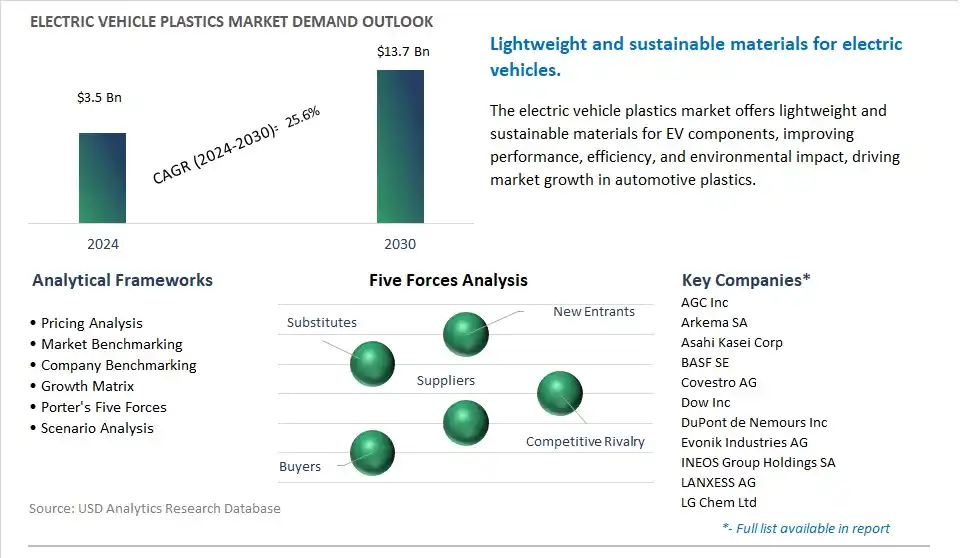
The global Electric Vehicle Plastics Market is poised to register a 25.6% CAGR from $3.5 Billion in 2024 to $13.7 Billion in 2030.
The global Electric Vehicle Plastics Market Study analyzes and forecasts the market size across 6 regions and 24 countries for diverse segments -By Plastic (Polypropylene (PP), Polyamide (PA), Polycarbonate (PC), Polyethylene (PE), Polyurethane (PU), Polyvinyl Chloride (PVC), Polyvinyl Butyral (PVB), Polybutylene Terephthalate (PBT), Acrylonitrile Butadiene Styrene (ABS), Polyethylene Terephthalate (PET), Others), By Application (Interior, Exterior, Powertrain System/ Under Bonnet, Lighting & Electric Wiring), By Component (Steering & Dashboards, Car Upholstery, Bumper, Door Assembly, Exterior Trim, Interior Trim, Connector and Cables, Battery, Lighting, Electric wiring, Others), By Vehicle (Battery electric vehicle (BEV), Hybrid Electric Vehicle (HEV), Plug-in Hybrid Vehicle (PHEV)).
An Introduction to Global Electric Vehicle Plastics Market in 2024
In the electric vehicle plastics market, the future is influenced by trends such as automotive electrification, lightweighting, and sustainability driving innovation in material science, design, and manufacturing processes. Electric vehicles (EVs) require lightweight and durable materials to optimize performance, range, and efficiency while meeting stringent safety and regulatory requirements. Key trends shaping this market include the development of high-performance plastics and composites to replace traditional metal components, the integration of recycled and bio-based plastics to enhance sustainability and reduce carbon footprint, and the adoption of advanced molding and joining techniques such as injection molding, thermoforming, and bonding for complex EV components. As the automotive industry undergoes a shift towards electric mobility, the demand for plastics and composites that offer lightweighting, design flexibility, and environmental sustainability is expected to drive market growth and inspire further innovation in EV material solutions.
Electric Vehicle Plastics Market Competitive Landscape
The market report analyses the leading companies in the industry including AGC Inc, Arkema SA, Asahi Kasei Corp, BASF SE, Covestro AG, Dow Inc, DuPont de Nemours Inc, Evonik Industries AG, INEOS Group Holdings SA, LANXESS AG, LG Chem Ltd, LyondellBasell Industries N.V., Saudi Basic Industries Corp, Solvay SA, Sumitomo Chemical Company Ltd, Ube Industries Ltd.
Electric Vehicle Plastics Market Dynamics
Electric Vehicle Plastics Market Trend: Lightweighting for Increased Range and Efficiency
One prominent market trend in the electric vehicle plastics industry is the focus on lightweighting to enhance vehicle range and efficiency. As electric vehicles (EVs) continue to gain popularity, manufacturers are increasingly incorporating lightweight plastics and composites in vehicle design to reduce overall weight. Lightweighting helps to extend the range of electric vehicles by improving energy efficiency and battery performance. This reflects a strategic shift towards materials that offer strength, durability, and lightweight properties, contributing to the advancement of electric vehicle technology and the reduction of carbon emissions in the transportation sector.
Electric Vehicle Plastics Market Driver: Regulatory Pressure and Emission Reduction Targets
A key driver in the electric vehicle plastics market is regulatory pressure and emission reduction targets. Governments worldwide are implementing stringent regulations and emission reduction targets to combat climate change and reduce air pollution. As part of these efforts, policymakers are incentivizing the adoption of electric vehicles and imposing emissions standards that encourage automakers to produce more fuel-efficient and environmentally friendly vehicles. Electric vehicle manufacturers are turning to lightweight plastics as a solution to meet regulatory requirements and achieve sustainability goals, driving market demand for plastics and composites in the electric vehicle industry.
Electric Vehicle Plastics Market Opportunity: Development of Sustainable and Recyclable Materials
One potential opportunity in the electric vehicle plastics market lies in the development of sustainable and recyclable materials. With increasing emphasis on environmental sustainability and circular economy principles, there is a growing demand for plastics and composites that are eco-friendly, biodegradable, and recyclable. Manufacturers have an opportunity to innovate and develop sustainable alternatives to traditional petroleum-based plastics, such as bio-based plastics, recycled plastics, and biodegradable polymers. By offering electric vehicle plastics made from sustainable materials, automakers can reduce their environmental footprint, enhance brand reputation, and appeal to environmentally conscious consumers. Additionally, investing in research and development of recyclable plastics can help address end-of-life concerns and promote closed-loop recycling processes, contributing to a more sustainable future for the electric vehicle industry.
Electric Vehicle Plastics Market Ecosystem
The electric vehicle (EV) plastics Market Ecosystem encompasses diverse key stages, each involving specific companies contributing to the production and integration of plastic components into EVs. Beginning with Raw Material Suppliers including ExxonMobil and Braskem, which provide traditional plastics and sustainable alternatives, respectively, Polymer Producers including LyondellBasell and RTP Company transform these materials into plastic resins tailored for EV applications.
Component Manufacturers including Magna International and Stratasys utilize these resins to shape plastic components through injection molding or 3D printing techniques. Tier 1 Automotive Suppliers including Continental and EV OEMs including Tesla and General Motors then integrate these plastic components into the final vehicles, ensuring their inclusion in the EV manufacturing process.
Recycling and Recovery, handled by waste management companies including Veolia and plastic recyclers including Reliance Industries, close the loop by collecting end-of-life vehicles, processing used plastics, and converting recycled materials back into usable forms, promoting sustainability within the EV plastics Industry.
Electric Vehicle Plastics Market Share Analysis: Polypropylene (PP) held the dominant revenue share in 2024
The largest segment in the Electric Vehicle Plastics Market is the "Polypropylene (PP)" category. This dominance is driven by polypropylene is widely used in the automotive industry due to its excellent combination of properties, including high impact strength, chemical resistance, and thermal stability. Additionally, polypropylene is lightweight and cost-effective, making it an ideal material for components that require both structural integrity and weight reduction, such as interior trim, bumpers, and under-the-hood applications. In addition, polypropylene can be easily molded into complex shapes using various processing techniques, allowing for efficient manufacturing of intricate automotive parts. Further, the growing demand for electric vehicles (EVs) has led to increased use of polypropylene in battery components, electric powertrains, and thermal management systems due to its ability to withstand high temperatures and harsh operating conditions. As a result, the Polypropylene segment remains the largest in the electric vehicle plastics market due to its versatility, performance, and widespread application across different EV components.
Electric Vehicle Plastics Market Share Analysis: Powertrain System/Under Bonnet is the fastest growing market segment over the forecast period to 2030
The fastest-growing segment in the Electric Vehicle Plastics Market is the "Powertrain System/Under Bonnet" application. This growth can be attributed to diverse key factors. Firstly, the electrification of vehicles has led to significant changes in the design and construction of powertrain systems, including the transition from traditional internal combustion engines to electric motors and battery packs. As a result, there is a growing demand for lightweight, durable, and heat-resistant plastics to replace metal components in the powertrain system and under the bonnet. Plastics offer advantages such as reduced weight, improved thermal management, and corrosion resistance, contributing to enhanced performance and efficiency of electric vehicles. Additionally, the complexity and integration of electronic components, sensors, and cooling systems in electric powertrains require advanced plastics with excellent mechanical properties and dimensional stability. In addition, the increasing adoption of electric vehicles worldwide and government incentives to promote electric mobility further drive the demand for plastics in powertrain applications. Further, advancements in polymer materials and manufacturing processes enable the development of innovative plastic solutions tailored to meet the specific requirements of electric powertrains, driving the growth of the Powertrain System/Under Bonnet segment in the electric vehicle plastics market.
Electric Vehicle Plastics Market Share Analysis: Battery is the fastest growing market segment over the forecast period to 2030
The fastest-growing segment in the Electric Vehicle Plastics Market is the "Battery" component category. This growth can be attributed to diverse key factors. Firstly, as electric vehicle (EV) adoption continues to rise globally, there is an increasing demand for high-performance and lightweight materials for battery components. Plastics offer advantages such as excellent electrical insulation, thermal management, and design flexibility, making them ideal for use in battery enclosures, housings, and thermal management systems. Additionally, the trend toward larger battery capacities and longer driving ranges in EVs necessitates the use of lightweight materials to reduce overall vehicle weight and improve energy efficiency. Plastics contribute to weight reduction while providing sufficient strength, impact resistance, and durability to protect the battery pack from external forces and environmental factors. In addition, advancements in polymer technology and composite materials enable the development of innovative plastic solutions that meet the stringent safety, performance, and regulatory requirements of electric vehicle batteries. Further, government incentives and regulations aimed at reducing greenhouse gas emissions and promoting electric mobility drive investments in battery technology and infrastructure, further boosting the demand for plastics in electric vehicle battery components. As a result, the Battery component segment is experiencing rapid growth in the electric vehicle plastics market due to its critical role in electric vehicle performance, range, and sustainability.
Electric Vehicle Plastics Market Report Scope-
By Plastic
Polypropylene (PP)
Polyamide (PA)
Polycarbonate (PC)
Polyethylene (PE)
Polyurethane (PU)
Polyvinyl Chloride (PVC)
Polyvinyl Butyral (PVB)
Polybutylene Terephthalate (PBT)
Acrylonitrile Butadiene Styrene (ABS)
Polyethylene Terephthalate (PET)
Others
By Application
Interior
Exterior
Powertrain System/ Under Bonnet
Lighting & Electric Wiring
By Component
Steering & Dashboards
Car Upholstery
Bumper
Door Assembly
Exterior Trim
Interior Trim
Connector and Cables
Battery
Lighting
Electric wiring
Others
By Vehicle
Battery electric vehicle (BEV)
Hybrid Electric Vehicle (HEV)
Plug-in Hybrid Vehicle (PHEV)
Electric Vehicle Plastics Market Companies Profiled
AGC Inc
Arkema SA
Asahi Kasei Corp
BASF SE
Covestro AG
Dow Inc
DuPont de Nemours Inc
Evonik Industries AG
INEOS Group Holdings SA
LANXESS AG
LG Chem Ltd
LyondellBasell Industries N.V.
Saudi Basic Industries Corp
Solvay SA
Sumitomo Chemical Company Ltd
Ube Industries Ltd
*- List Not Exhaustive
TABLE OF CONTENTS
1 Introduction to 2024 Electric Vehicle Plastics Market
1.1 Market Overview
1.2 Quick Facts
1.3 Scope/Objective of the Study
1.4 Market Definition
1.5 Countries and Regions Covered
1.6 Units, Currency, and Conversions
1.7 Industry Value Chain
2 Research Methodology
2.1 Market Size Estimation
2.2 Sources and Research Methodology
2.3 Data Triangulation
2.4 Assumptions and Limitations
3 Executive Summary
3.1 Global Electric Vehicle Plastics Market Size Outlook, $ Million, 2021 to 2030
3.2 Electric Vehicle Plastics Market Outlook by Type, $ Million, 2021 to 2030
3.3 Electric Vehicle Plastics Market Outlook by Product, $ Million, 2021 to 2030
3.4 Electric Vehicle Plastics Market Outlook by Application, $ Million, 2021 to 2030
3.5 Electric Vehicle Plastics Market Outlook by Key Countries, $ Million, 2021 to 2030
4 Market Dynamics
4.1 Key Driving Forces of Electric Vehicle Plastics Industry
4.2 Key Market Trends in Electric Vehicle Plastics Industry
4.3 Potential Opportunities in Electric Vehicle Plastics Industry
4.4 Key Challenges in Electric Vehicle Plastics Industry
5 Market Factor Analysis
5.1 Value Chain Analysis
5.2 Competitive Landscape
5.2.1 Global Electric Vehicle Plastics Market Share by Company (%), 2023
5.2.2 Product Offerings by Company
5.3 Porter’s Five Forces Analysis
5.4 Pricing Analysis and Outlook
6 Growth Outlook Across Scenarios
6.1 Growth Analysis-Case Scenario Definitions
6.2 Low Growth Scenario Forecasts
6.3 Reference Growth Scenario Forecasts
6.4 High Growth Scenario Forecasts
7 Global Electric Vehicle Plastics Market Outlook by Segments
7.1 Electric Vehicle Plastics Market Outlook by Segments, $ Million, 2021- 2030
By Plastic
Polypropylene (PP)
Polyamide (PA)
Polycarbonate (PC)
Polyethylene (PE)
Polyurethane (PU)
Polyvinyl Chloride (PVC)
Polyvinyl Butyral (PVB)
Polybutylene Terephthalate (PBT)
Acrylonitrile Butadiene Styrene (ABS)
Polyethylene Terephthalate (PET)
Others
By Application
Interior
Exterior
Powertrain System/ Under Bonnet
Lighting & Electric Wiring
By Component
Steering & Dashboards
Car Upholstery
Bumper
Door Assembly
Exterior Trim
Interior Trim
Connector and Cables
Battery
Lighting
Electric wiring
Others
By Vehicle
Battery electric vehicle (BEV)
Hybrid Electric Vehicle (HEV)
Plug-in Hybrid Vehicle (PHEV)
8 North America Electric Vehicle Plastics Market Analysis and Outlook To 2030
8.1 Introduction to North America Electric Vehicle Plastics Markets in 2024
8.2 North America Electric Vehicle Plastics Market Size Outlook by Country, 2021-2030
8.2.1 United States
8.2.2 Canada
8.2.3 Mexico
8.3 North America Electric Vehicle Plastics Market size Outlook by Segments, 2021-2030
By Plastic
Polypropylene (PP)
Polyamide (PA)
Polycarbonate (PC)
Polyethylene (PE)
Polyurethane (PU)
Polyvinyl Chloride (PVC)
Polyvinyl Butyral (PVB)
Polybutylene Terephthalate (PBT)
Acrylonitrile Butadiene Styrene (ABS)
Polyethylene Terephthalate (PET)
Others
By Application
Interior
Exterior
Powertrain System/ Under Bonnet
Lighting & Electric Wiring
By Component
Steering & Dashboards
Car Upholstery
Bumper
Door Assembly
Exterior Trim
Interior Trim
Connector and Cables
Battery
Lighting
Electric wiring
Others
By Vehicle
Battery electric vehicle (BEV)
Hybrid Electric Vehicle (HEV)
Plug-in Hybrid Vehicle (PHEV)
9 Europe Electric Vehicle Plastics Market Analysis and Outlook To 2030
9.1 Introduction to Europe Electric Vehicle Plastics Markets in 2024
9.2 Europe Electric Vehicle Plastics Market Size Outlook by Country, 2021-2030
9.2.1 Germany
9.2.2 France
9.2.3 Spain
9.2.4 United Kingdom
9.2.4 Italy
9.2.5 Russia
9.2.6 Norway
9.2.7 Rest of Europe
9.3 Europe Electric Vehicle Plastics Market Size Outlook by Segments, 2021-2030
By Plastic
Polypropylene (PP)
Polyamide (PA)
Polycarbonate (PC)
Polyethylene (PE)
Polyurethane (PU)
Polyvinyl Chloride (PVC)
Polyvinyl Butyral (PVB)
Polybutylene Terephthalate (PBT)
Acrylonitrile Butadiene Styrene (ABS)
Polyethylene Terephthalate (PET)
Others
By Application
Interior
Exterior
Powertrain System/ Under Bonnet
Lighting & Electric Wiring
By Component
Steering & Dashboards
Car Upholstery
Bumper
Door Assembly
Exterior Trim
Interior Trim
Connector and Cables
Battery
Lighting
Electric wiring
Others
By Vehicle
Battery electric vehicle (BEV)
Hybrid Electric Vehicle (HEV)
Plug-in Hybrid Vehicle (PHEV)
10 Asia Pacific Electric Vehicle Plastics Market Analysis and Outlook To 2030
10.1 Introduction to Asia Pacific Electric Vehicle Plastics Markets in 2024
10.2 Asia Pacific Electric Vehicle Plastics Market Size Outlook by Country, 2021-2030
10.2.1 China
10.2.2 India
10.2.3 Japan
10.2.4 South Korea
10.2.5 Indonesia
10.2.6 Malaysia
10.2.7 Australia
10.2.8 Rest of Asia Pacific
10.3 Asia Pacific Electric Vehicle Plastics Market size Outlook by Segments, 2021-2030
By Plastic
Polypropylene (PP)
Polyamide (PA)
Polycarbonate (PC)
Polyethylene (PE)
Polyurethane (PU)
Polyvinyl Chloride (PVC)
Polyvinyl Butyral (PVB)
Polybutylene Terephthalate (PBT)
Acrylonitrile Butadiene Styrene (ABS)
Polyethylene Terephthalate (PET)
Others
By Application
Interior
Exterior
Powertrain System/ Under Bonnet
Lighting & Electric Wiring
By Component
Steering & Dashboards
Car Upholstery
Bumper
Door Assembly
Exterior Trim
Interior Trim
Connector and Cables
Battery
Lighting
Electric wiring
Others
By Vehicle
Battery electric vehicle (BEV)
Hybrid Electric Vehicle (HEV)
Plug-in Hybrid Vehicle (PHEV)
11 South America Electric Vehicle Plastics Market Analysis and Outlook To 2030
11.1 Introduction to South America Electric Vehicle Plastics Markets in 2024
11.2 South America Electric Vehicle Plastics Market Size Outlook by Country, 2021-2030
11.2.1 Brazil
11.2.2 Argentina
11.2.3 Rest of South America
11.3 South America Electric Vehicle Plastics Market size Outlook by Segments, 2021-2030
By Plastic
Polypropylene (PP)
Polyamide (PA)
Polycarbonate (PC)
Polyethylene (PE)
Polyurethane (PU)
Polyvinyl Chloride (PVC)
Polyvinyl Butyral (PVB)
Polybutylene Terephthalate (PBT)
Acrylonitrile Butadiene Styrene (ABS)
Polyethylene Terephthalate (PET)
Others
By Application
Interior
Exterior
Powertrain System/ Under Bonnet
Lighting & Electric Wiring
By Component
Steering & Dashboards
Car Upholstery
Bumper
Door Assembly
Exterior Trim
Interior Trim
Connector and Cables
Battery
Lighting
Electric wiring
Others
By Vehicle
Battery electric vehicle (BEV)
Hybrid Electric Vehicle (HEV)
Plug-in Hybrid Vehicle (PHEV)
12 Middle East and Africa Electric Vehicle Plastics Market Analysis and Outlook To 2030
12.1 Introduction to Middle East and Africa Electric Vehicle Plastics Markets in 2024
12.2 Middle East and Africa Electric Vehicle Plastics Market Size Outlook by Country, 2021-2030
12.2.1 Saudi Arabia
12.2.2 UAE
12.2.3 Oman
12.2.4 Rest of Middle East
12.2.5 Egypt
12.2.6 Nigeria
12.2.7 South Africa
12.2.8 Rest of Africa
12.3 Middle East and Africa Electric Vehicle Plastics Market size Outlook by Segments, 2021-2030
By Plastic
Polypropylene (PP)
Polyamide (PA)
Polycarbonate (PC)
Polyethylene (PE)
Polyurethane (PU)
Polyvinyl Chloride (PVC)
Polyvinyl Butyral (PVB)
Polybutylene Terephthalate (PBT)
Acrylonitrile Butadiene Styrene (ABS)
Polyethylene Terephthalate (PET)
Others
By Application
Interior
Exterior
Powertrain System/ Under Bonnet
Lighting & Electric Wiring
By Component
Steering & Dashboards
Car Upholstery
Bumper
Door Assembly
Exterior Trim
Interior Trim
Connector and Cables
Battery
Lighting
Electric wiring
Others
By Vehicle
Battery electric vehicle (BEV)
Hybrid Electric Vehicle (HEV)
Plug-in Hybrid Vehicle (PHEV)
13 Company Profiles
13.1 Company Snapshot
13.2 SWOT Profiles
13.3 Products and Services
13.4 Recent Developments
13.5 Financial Profile
AGC Inc
Arkema SA
Asahi Kasei Corp
BASF SE
Covestro AG
Dow Inc
DuPont de Nemours Inc
Evonik Industries AG
INEOS Group Holdings SA
LANXESS AG
LG Chem Ltd
LyondellBasell Industries N.V.
Saudi Basic Industries Corp
Solvay SA
Sumitomo Chemical Company Ltd
Ube Industries Ltd
14 Appendix
14.1 Customization Offerings
14.2 Subscription Services
14.3 Related Reports
14.4 Publisher Expertise
By Plastic
Polypropylene (PP)
Polyamide (PA)
Polycarbonate (PC)
Polyethylene (PE)
Polyurethane (PU)
Polyvinyl Chloride (PVC)
Polyvinyl Butyral (PVB)
Polybutylene Terephthalate (PBT)
Acrylonitrile Butadiene Styrene (ABS)
Polyethylene Terephthalate (PET)
Others
By Application
Interior
Exterior
Powertrain System/ Under Bonnet
Lighting & Electric Wiring
By Component
Steering & Dashboards
Car Upholstery
Bumper
Door Assembly
Exterior Trim
Interior Trim
Connector and Cables
Battery
Lighting
Electric wiring
Others
By Vehicle
Battery electric vehicle (BEV)
Hybrid Electric Vehicle (HEV)
Plug-in Hybrid Vehicle (PHEV)
Countries Analyzed
North America (US, Canada, Mexico)
Europe (Germany, UK, France, Spain, Italy, Russia, Rest of Europe)
Asia Pacific (China, India, Japan, South Korea, Australia, South East Asia, Rest of Asia)
South America (Brazil, Argentina, Rest of South America)
Middle East and Africa (Saudi Arabia, UAE, Rest of Middle East, South Africa, Egypt, Rest of Africa)
