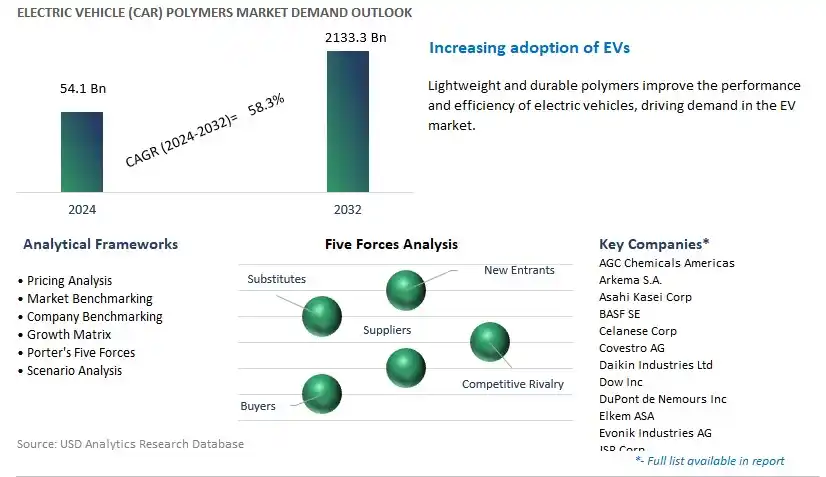
Global Electric Vehicle (Car) Polymers Market Size is valued at $54.1 Billion in 2024 and is forecast to register a growth rate (CAGR) of 58.3% to reach $2133.3 Billion by 2032.
The global Electric Vehicle (Car) Polymers Market Study analyzes and forecasts the market size across 6 regions and 24 countries for diverse segments -By Type (Engineering Plastics, Elastomers), By Component (Powertrain System, Exterior, Interior).
An Introduction to Electric Vehicle (Car) Polymers Market in 2024
Electric vehicle (EV) polymers are specialty polymers and polymer-based composites designed to meet the unique requirements of electric vehicles, including lightweighting, thermal management, electrical insulation, and mechanical strength. The market for electric vehicle polymers is driven by the rapid growth of the electric vehicle market worldwide, fueled by environmental regulations, government incentives, and consumer demand for clean and efficient transportation solutions. EV polymers find applications in various components of electric vehicles such as battery packs, electric motors, power electronics, charging infrastructure, and interior and exterior parts. These polymers offer properties such as high heat resistance, flame retardancy, electrical conductivity, and impact resistance, enabling the development of lightweight and durable EV components that meet stringent performance and safety standards. Further, advancements in polymer chemistry, additive manufacturing, and composite materials are driving innovation and market growth within the electric vehicle polymers industry. As automakers and suppliers race to develop next-generation electric vehicles with improved range, efficiency, and reliability, EV polymers play a critical role in enabling the transition to sustainable mobility solutions while addressing the unique challenges and opportunities of electrification.
Electric Vehicle (Car) Polymers Market Competitive Landscape
The market report analyses the leading companies in the industry including AGC Chemicals Americas, Arkema S.A., Asahi Kasei Corp, BASF SE, Celanese Corp, Covestro AG, Daikin Industries Ltd, Dow Inc, DuPont de Nemours Inc, Elkem ASA, Evonik Industries AG, JSR Corp, LANXESS AG, LG Chem Ltd, LyondellBasell Industries Holdings B.V., Mitsubishi Engineering-Plastics Corp, Royal DSM N.V., SABIC, Solvay S.A., Sumitomo Chemical Co. Ltd, and others.
Electric Vehicle (Car) Polymers Market Dynamics
Market Trend: Growing Demand for Lightweight and Sustainable Materials
The electric vehicle (EV) industry is witnessing a significant trend towards the adoption of lightweight and sustainable materials, including polymers. As automakers strive to enhance the range and efficiency of electric vehicles, there is a rising demand for high-performance polymers that offer strength, durability, and reduced weight. Lightweight polymers contribute to improving energy efficiency and extending the driving range of EVs, making them increasingly popular among consumers and manufacturers alike. This trend is reshaping the automotive industry's approach to material selection, with a growing emphasis on eco-friendly solutions that meet stringent regulatory standards for emissions and sustainability.
Market Driver: Stringent Emission Regulations and Environmental Concerns
One of the primary drivers propelling the demand for polymers in electric vehicles is the implementation of stringent emission regulations and heightened environmental concerns worldwide. Governments and regulatory bodies are imposing strict emission standards to combat climate change and reduce air pollution, incentivizing the adoption of electric vehicles. Polymers play a crucial role in addressing these challenges by enabling the development of lightweight components that contribute to enhanced fuel efficiency and reduced emissions. As automakers seek to comply with increasingly stringent regulations, the demand for innovative polymer solutions in electric vehicles is expected to surge, driving market growth in the coming years.
Market Opportunity: Advancements in Polymer Technology for EVs
The burgeoning electric vehicle market presents a significant opportunity for advancements in polymer technology, offering potential for innovation and market expansion. Manufacturers are focusing on developing advanced polymer formulations tailored specifically for the unique requirements of electric vehicles, such as thermal management, battery protection, and structural integrity. Opportunities abound for the development of novel polymers with enhanced properties, including heat resistance, electrical conductivity, and flame retardancy, to meet the evolving needs of electric vehicle manufacturers. Additionally, the integration of sustainable and recyclable polymers can further bolster the environmental credentials of electric vehicles, opening up new avenues for growth and differentiation in the market. As the electric vehicle industry continues to evolve, investments in research and development aimed at advancing polymer technology represent a promising opportunity for stakeholders to capitalize on the growing demand for eco-friendly mobility solutions.
Electric Vehicle (Car) Polymers Market Share Analysis: Engineering Plastics segment generated the highest revenue in 2024
Engineering Plastics emerge as the largest segment in the Electric Vehicle (Car) Polymers market. Engineering plastics offer a unique combination of strength, durability, and lightweight properties, making them ideal for various applications in electric vehicles (EVs). These polymers play a critical role in the manufacturing of components such as battery enclosures, structural parts, interior trims, and thermal management systems, where high-performance materials are essential for ensuring safety, efficiency, and longevity. Moreover, engineering plastics offer superior chemical resistance, heat resistance, and electrical insulation properties, making them well-suited for the demanding operating conditions within EVs. Additionally, the shift towards electric mobility and the increasing production of EVs worldwide drive the consumption of engineering plastics in the automotive sector, as manufacturers seek lightweight and sustainable materials to improve vehicle performance and range. Furthermore, advancements in polymer technologies, including the development of bio-based and recyclable engineering plastics, align with the growing emphasis on sustainability and environmental responsibility in the automotive industry, further reinforcing the dominance of engineering plastics in the Electric Vehicle (Car) Polymers market. Over the forecast period, engineering plastics dominate the market landscape by offering unmatched performance, versatility, and sustainability, addressing the evolving needs of automakers for advanced polymer solutions in electric vehicle manufacturing.
Electric Vehicle (Car) Polymers Market Share Analysis: Powertrain System Component is poised to register the fastest CAGR over the forecast period
The Powertrain System component is the fastest-growing segment in the Electric Vehicle (Car) Polymers market. As electric vehicles gain traction worldwide, there's a significant demand for lightweight and high-performance polymers in the powertrain system, which encompasses critical components such as battery enclosures, electric motors, inverters, and cooling systems. Polymers play a crucial role in enhancing the efficiency, safety, and reliability of electric vehicle powertrains by providing thermal insulation, electrical insulation, and mechanical reinforcement properties. Moreover, the transition towards electrification necessitates the development of advanced polymer materials capable of withstanding high temperatures, corrosive environments, and rigorous operating conditions within the powertrain. Additionally, the increasing emphasis on energy efficiency and range optimization in electric vehicles drives the demand for lightweight polymers that can reduce overall vehicle weight and improve performance. Furthermore, advancements in polymer technologies, including the development of specialized formulations tailored for electric vehicle applications, further accelerate the adoption of polymers in the powertrain system. Over the forecast period, the Powertrain System component presents significant growth opportunities in the Electric Vehicle (Car) Polymers market, driven by the imperative for advanced materials that can enhance the performance and sustainability of electric vehicle powertrains.
Electric Vehicle (Car) Polymers Market
By Type
Engineering Plastics
-Acrylonitrile Butadiene Styrene (ABS)
-Polyamide
-Polycarbonate
-Polyphenylene Sulfide (PPS)
-Polyurethane
-Polypropylene
-Fluoropolymer
-Thermoplastic Polyester
-Others
Elastomers
-Synthetic Rubber
-Natural Rubber
-Fluoroelastomer
-Silicone Elastomer
-Others
By Component
Powertrain System
Exterior
InteriorCountries Analyzed
North America (US, Canada, Mexico)
Europe (Germany, UK, France, Spain, Italy, Russia, Rest of Europe)
Asia Pacific (China, India, Japan, South Korea, Australia, South East Asia, Rest of Asia)
South America (Brazil, Argentina, Rest of South America)
Middle East and Africa (Saudi Arabia, UAE, Rest of Middle East, South Africa, Egypt, Rest of Africa)
Electric Vehicle Polymers Companies Profiled in the Study
AGC Chemicals Americas
Arkema S.A.
Asahi Kasei Corp
BASF SE
Celanese Corp
Covestro AG
Daikin Industries Ltd
Dow Inc
DuPont de Nemours Inc
Elkem ASA
Evonik Industries AG
JSR Corp
LANXESS AG
LG Chem Ltd
LyondellBasell Industries Holdings B.V.
Mitsubishi Engineering-Plastics Corp
Royal DSM N.V.
SABIC
Solvay S.A.
Sumitomo Chemical Co. Ltd
*- List Not Exhaustive
TABLE OF CONTENTS
1 Introduction to 2024 Electric Vehicle Polymers Market
1.1 Market Overview
1.2 Quick Facts
1.3 Scope/Objective of the Study
1.4 Market Definition
1.5 Countries and Regions Covered
1.6 Units, Currency, and Conversions
1.7 Industry Value Chain
2 Research Methodology
2.1 Market Size Estimation
2.2 Sources and Research Methodology
2.3 Data Triangulation
2.4 Assumptions and Limitations
3 Executive Summary
3.1 Global Electric Vehicle Polymers Market Size Outlook, $ Million, 2021 to 2032
3.2 Electric Vehicle Polymers Market Outlook by Type, $ Million, 2021 to 2032
3.3 Electric Vehicle Polymers Market Outlook by Product, $ Million, 2021 to 2032
3.4 Electric Vehicle Polymers Market Outlook by Application, $ Million, 2021 to 2032
3.5 Electric Vehicle Polymers Market Outlook by Key Countries, $ Million, 2021 to 2032
4 Market Dynamics
4.1 Key Driving Forces of Electric Vehicle Polymers Industry
4.2 Key Market Trends in Electric Vehicle Polymers Industry
4.3 Potential Opportunities in Electric Vehicle Polymers Industry
4.4 Key Challenges in Electric Vehicle Polymers Industry
5 Market Factor Analysis
5.1 Value Chain Analysis
5.2 Competitive Landscape
5.2.1 Global Electric Vehicle Polymers Market Share by Company (%), 2023
5.2.2 Product Offerings by Company
5.3 Porter’s Five Forces Analysis
5.4 Pricing Analysis and Outlook
6 Growth Outlook Across Scenarios
6.1 Growth Analysis-Case Scenario Definitions
6.2 Low Growth Scenario Forecasts
6.3 Reference Growth Scenario Forecasts
6.4 High Growth Scenario Forecasts
7 Global Electric Vehicle Polymers Market Outlook by Segments
7.1 Electric Vehicle Polymers Market Outlook by Segments, $ Million, 2021- 2032
By Type
Engineering Plastics
-Acrylonitrile Butadiene Styrene (ABS)
-Polyamide
-Polycarbonate
-Polyphenylene Sulfide (PPS)
-Polyurethane
-Polypropylene
-Fluoropolymer
-Thermoplastic Polyester
-Others
Elastomers
-Synthetic Rubber
-Natural Rubber
-Fluoroelastomer
-Silicone Elastomer
-Others
By Component
Powertrain System
Exterior
Interior
8 North America Electric Vehicle Polymers Market Analysis and Outlook To 2032
8.1 Introduction to North America Electric Vehicle Polymers Markets in 2024
8.2 North America Electric Vehicle Polymers Market Size Outlook by Country, 2021-2032
8.2.1 United States
8.2.2 Canada
8.2.3 Mexico
8.3 North America Electric Vehicle Polymers Market size Outlook by Segments, 2021-2032
By Type
Engineering Plastics
-Acrylonitrile Butadiene Styrene (ABS)
-Polyamide
-Polycarbonate
-Polyphenylene Sulfide (PPS)
-Polyurethane
-Polypropylene
-Fluoropolymer
-Thermoplastic Polyester
-Others
Elastomers
-Synthetic Rubber
-Natural Rubber
-Fluoroelastomer
-Silicone Elastomer
-Others
By Component
Powertrain System
Exterior
Interior
9 Europe Electric Vehicle Polymers Market Analysis and Outlook To 2032
9.1 Introduction to Europe Electric Vehicle Polymers Markets in 2024
9.2 Europe Electric Vehicle Polymers Market Size Outlook by Country, 2021-2032
9.2.1 Germany
9.2.2 France
9.2.3 Spain
9.2.4 United Kingdom
9.2.4 Italy
9.2.5 Russia
9.2.6 Norway
9.2.7 Rest of Europe
9.3 Europe Electric Vehicle Polymers Market Size Outlook by Segments, 2021-2032
By Type
Engineering Plastics
-Acrylonitrile Butadiene Styrene (ABS)
-Polyamide
-Polycarbonate
-Polyphenylene Sulfide (PPS)
-Polyurethane
-Polypropylene
-Fluoropolymer
-Thermoplastic Polyester
-Others
Elastomers
-Synthetic Rubber
-Natural Rubber
-Fluoroelastomer
-Silicone Elastomer
-Others
By Component
Powertrain System
Exterior
Interior
10 Asia Pacific Electric Vehicle Polymers Market Analysis and Outlook To 2032
10.1 Introduction to Asia Pacific Electric Vehicle Polymers Markets in 2024
10.2 Asia Pacific Electric Vehicle Polymers Market Size Outlook by Country, 2021-2032
10.2.1 China
10.2.2 India
10.2.3 Japan
10.2.4 South Korea
10.2.5 Indonesia
10.2.6 Malaysia
10.2.7 Australia
10.2.8 Rest of Asia Pacific
10.3 Asia Pacific Electric Vehicle Polymers Market size Outlook by Segments, 2021-2032
By Type
Engineering Plastics
-Acrylonitrile Butadiene Styrene (ABS)
-Polyamide
-Polycarbonate
-Polyphenylene Sulfide (PPS)
-Polyurethane
-Polypropylene
-Fluoropolymer
-Thermoplastic Polyester
-Others
Elastomers
-Synthetic Rubber
-Natural Rubber
-Fluoroelastomer
-Silicone Elastomer
-Others
By Component
Powertrain System
Exterior
Interior
11 South America Electric Vehicle Polymers Market Analysis and Outlook To 2032
11.1 Introduction to South America Electric Vehicle Polymers Markets in 2024
11.2 South America Electric Vehicle Polymers Market Size Outlook by Country, 2021-2032
11.2.1 Brazil
11.2.2 Argentina
11.2.3 Rest of South America
11.3 South America Electric Vehicle Polymers Market size Outlook by Segments, 2021-2032
By Type
Engineering Plastics
-Acrylonitrile Butadiene Styrene (ABS)
-Polyamide
-Polycarbonate
-Polyphenylene Sulfide (PPS)
-Polyurethane
-Polypropylene
-Fluoropolymer
-Thermoplastic Polyester
-Others
Elastomers
-Synthetic Rubber
-Natural Rubber
-Fluoroelastomer
-Silicone Elastomer
-Others
By Component
Powertrain System
Exterior
Interior
12 Middle East and Africa Electric Vehicle Polymers Market Analysis and Outlook To 2032
12.1 Introduction to Middle East and Africa Electric Vehicle Polymers Markets in 2024
12.2 Middle East and Africa Electric Vehicle Polymers Market Size Outlook by Country, 2021-2032
12.2.1 Saudi Arabia
12.2.2 UAE
12.2.3 Oman
12.2.4 Rest of Middle East
12.2.5 Egypt
12.2.6 Nigeria
12.2.7 South Africa
12.2.8 Rest of Africa
12.3 Middle East and Africa Electric Vehicle Polymers Market size Outlook by Segments, 2021-2032
By Type
Engineering Plastics
-Acrylonitrile Butadiene Styrene (ABS)
-Polyamide
-Polycarbonate
-Polyphenylene Sulfide (PPS)
-Polyurethane
-Polypropylene
-Fluoropolymer
-Thermoplastic Polyester
-Others
Elastomers
-Synthetic Rubber
-Natural Rubber
-Fluoroelastomer
-Silicone Elastomer
-Others
By Component
Powertrain System
Exterior
Interior
13 Company Profiles
13.1 Company Snapshot
13.2 SWOT Profiles
13.3 Products and Services
13.4 Recent Developments
13.5 Financial Profile
AGC Chemicals Americas
Arkema S.A.
Asahi Kasei Corp
BASF SE
Celanese Corp
Covestro AG
Daikin Industries Ltd
Dow Inc
DuPont de Nemours Inc
Elkem ASA
Evonik Industries AG
JSR Corp
LANXESS AG
LG Chem Ltd
LyondellBasell Industries Holdings B.V.
Mitsubishi Engineering-Plastics Corp
Royal DSM N.V.
SABIC
Solvay S.A.
Sumitomo Chemical Co. Ltd
14 Appendix
14.1 Customization Offerings
14.2 Subscription Services
14.3 Related Reports
14.4 Publisher Expertise
By Type
Engineering Plastics
-Acrylonitrile Butadiene Styrene (ABS)
-Polyamide
-Polycarbonate
-Polyphenylene Sulfide (PPS)
-Polyurethane
-Polypropylene
-Fluoropolymer
-Thermoplastic Polyester
-Others
Elastomers
-Synthetic Rubber
-Natural Rubber
-Fluoroelastomer
-Silicone Elastomer
-Others
By Component
Powertrain System
Exterior
Interior
Countries Analyzed
North America (US, Canada, Mexico)
Europe (Germany, UK, France, Spain, Italy, Russia, Rest of Europe)
Asia Pacific (China, India, Japan, South Korea, Australia, South East Asia, Rest of Asia)
South America (Brazil, Argentina, Rest of South America)
Middle East and Africa (Saudi Arabia, UAE, Rest of Middle East, South Africa, Egypt, Rest of Africa)
