
The Electrotherapy Devices Market study analyzes and forecasts the market size across 6 regions and 24 countries for diverse segments- By Product (High Frequency, Med Frequency, Low Frequency), By Application (Nervous Disease, Muscle Injury, Inflammation, Pain Relief, Others).
In 2024, the market for electrotherapy devices addresses the therapeutic application of electrical stimulation for pain management, rehabilitation, and physical therapy, offering a diverse range of electrotherapy modalities, devices, and accessories designed to relieve pain, improve muscle function, and promote tissue healing. Electrotherapy involves the use of electrical currents to stimulate nerves, muscles, or other tissues, modulating pain perception, reducing inflammation, and facilitating neuromuscular re-education in patients with musculoskeletal injuries, neurological disorders, or chronic pain conditions. Electrotherapy devices may include transcutaneous electrical nerve stimulation (TENS) units, neuromuscular electrical stimulation (NMES) devices, interferential therapy units, and microcurrent therapy devices, each offering unique waveforms, frequencies, and treatment parameters tailored to specific therapeutic goals and patient needs. These devices deliver electrical impulses through electrodes placed on the skin, targeting specific anatomical sites or pain pathways to produce analgesic, muscle-relaxant, or rehabilitative effects. With a focus on effectiveness, safety, and patient comfort, electrotherapy devices undergo clinical trials, evidence-based practice guidelines, and regulatory approval processes to ensure efficacy, tolerability, and regulatory compliance in pain management and rehabilitation settings. Moreover, with advancements in wearable technology, biofeedback integration, and personalized treatment protocols, the electrotherapy market continues to evolve, offering innovative solutions, customizable treatment regimens, and remote monitoring capabilities for optimizing patient outcomes, enhancing functional recovery, and improving quality of life for individuals experiencing acute or chronic pain, injury, or disability.
A prominent trend in the electrotherapy devices market is the integration of digital health technologies to enhance therapy delivery, monitoring, and patient engagement. Electrotherapy devices, which utilize electrical stimulation to treat pain, muscle dysfunction, and neurological conditions, are increasingly incorporating digital features such as smartphone connectivity, app-based control, and cloud-based data storage. These advancements enable healthcare providers to personalize treatment protocols, remotely monitor patient progress, and adjust therapy parameters in real-time. Additionally, digital health technologies facilitate patient education, adherence tracking, and outcomes assessment, improving therapy efficacy and patient satisfaction. This trend reflects the growing convergence of healthcare and technology, driving innovation and market growth in the digital electrotherapy segment.
A key driver for the electrotherapy devices market is the aging population and the consequent rise in the prevalence of chronic pain conditions. As the global population ages, the incidence of chronic pain disorders such as osteoarthritis, low back pain, neuropathy, and fibromyalgia increases, leading to a growing demand for non-pharmacological pain management solutions. Electrotherapy devices offer non-invasive, drug-free alternatives for pain relief, muscle rehabilitation, and functional restoration, making them attractive options for patients seeking safe and effective pain management strategies. The aging population's desire for improved quality of life, mobility, and independence drives the demand for electrotherapy devices, supporting market growth and the adoption of electrotherapy technologies in clinical practice.
An opportunity for innovation and market expansion in the electrotherapy devices market lies in the expansion into home healthcare and telemedicine applications. While electrotherapy has traditionally been administered in clinical settings such as physical therapy clinics and rehabilitation centers, there is growing interest in home-based electrotherapy solutions that enable patients to manage their conditions conveniently and independently. By developing portable, user-friendly electrotherapy devices with remote monitoring capabilities, companies can empower patients to receive treatment at home under the guidance of healthcare providers. Additionally, there is an opportunity to integrate electrotherapy devices with telemedicine platforms, enabling virtual consultations, remote therapy sessions, and telerehabilitation programs for patients unable to access traditional healthcare facilities. This opportunity aligns with the increasing demand for home-based care, remote monitoring solutions, and telehealth services, driving innovation and market expansion in the home electrotherapy segment.
The fastest-growing segment in the Electrotherapy Devices Market is the High-Frequency segment. This growth can be attributed to several factors. Firstly, high-frequency electrotherapy devices are effective in treating a wide range of conditions, including nervous diseases, muscle injuries, inflammation, and pain relief. Their versatility makes them popular among healthcare providers and patients alike. Secondly, advancements in technology have led to the development of more efficient and user-friendly high-frequency electrotherapy devices, which are driving their adoption in clinical settings. Additionally, the rising prevalence of chronic pain conditions and musculoskeletal disorders is increasing the demand for electrotherapy devices that offer effective pain management solutions. Overall, the high-frequency segment is experiencing rapid growth due to its effectiveness, versatility, and technological advancements.
The market research study provides in-depth insights into leading companies including the SWOT analyses, product profile, financial details, and recent developments acrossAliMed Inc, Astar Technology Co. Ltd, BTL Industries Inc, DJO Global Inc, Dynatronics Corp, EME SRL, GymnaUniphy NV, HMS Medical Systems, Medtronic plc, NeuroMetrix Inc, Omron Healthcare Inc, Zynex Medical Holdings Inc
By Product
High Frequency
Med Frequency
Low Frequency
By Application
Nervous Disease
Muscle Injury
Inflammation
Pain Relief
Others
Geographical Analysis
North America (United States, Canada, Mexico)
Europe (Germany, France, United Kingdom, Spain, Italy, Rest of Europe)
Asia Pacific (China, India, Japan, South Korea, Rest of Asia Pacific)
South America (Brazil, Argentina, Rest of South America)
Middle East and Africa (Saudi Arabia, UAE, Rest of Middle East, South Africa, Egypt, Rest of Africa)
AliMed Inc
Astar Technology Co. Ltd
BTL Industries Inc
DJO Global Inc
Dynatronics Corp
EME SRL
GymnaUniphy NV
HMS Medical Systems
Medtronic plc
NeuroMetrix Inc
Omron Healthcare Inc
Zynex Medical Holdings Inc
• Deepen your industry insights and navigate uncertainties for strategy formulation, CAPEX, and Operational decisions
• Gain access to detailed insights on the Electrotherapy Devices Market, encompassing current market size, growth trends, and forecasts till 2030.
• Access detailed competitor analysis, enabling competitive advantage through a thorough understanding of market players, strategies, and potential differentiation opportunities
• Stay ahead of the curve with insights on technological advancements, innovations, and upcoming trends
• Identify lucrative investment avenues and expansion opportunities within the Electrotherapy Devices Market industry, guided by robust, data-backed analysis.
• Understand regional and global markets through country-wise analysis, regional market potential, regulatory nuances, and dynamics
• Execute strategies with confidence and speed through information, analytics, and insights on the industry value chain
• Corporate leaders, strategists, financial experts, shareholders, asset managers, and governmental representatives can make long-term planning scenarios and build an integrated and timely understanding of market dynamics
• Benefit from tailored solutions and expert consultation based on report insights, providing personalized strategies aligned with specific business needs.
TABLE OF CONTENTS
1 Introduction to 2024 Electrotherapy Devices Market
1.1 Market Overview
1.2 Quick Facts
1.3 Scope/Objective of the Study
1.4 Market Definition
1.5 Countries and Regions Covered
1.6 Units, Currency, and Conversions
1.7 Industry Value Chain
2 Research Methodology
2.1 Market Size Estimation
2.2 Sources and Research Methodology
2.3 Data Triangulation
2.4 Assumptions and Limitations
3 Executive Summary
3.1 Global Electrotherapy Devices Market Size Outlook, $ Million, 2021 to 2030
3.2 Electrotherapy Devices Market Outlook by Type, $ Million, 2021 to 2030
3.3 Electrotherapy Devices Market Outlook by Product, $ Million, 2021 to 2030
3.4 Electrotherapy Devices Market Outlook by Application, $ Million, 2021 to 2030
3.5 Electrotherapy Devices Market Outlook by Key Countries, $ Million, 2021 to 2030
4 Market Dynamics
4.1 Key Driving Forces of Electrotherapy Devices Industry
4.2 Key Market Trends in Electrotherapy Devices Industry
4.3 Potential Opportunities in Electrotherapy Devices Industry
4.4 Key Challenges in Electrotherapy Devices Industry
5 Market Factor Analysis
5.1 Value Chain Analysis
5.2 Competitive Landscape
5.2.1 Global Electrotherapy Devices Market Share by Company (%), 2023
5.2.2 Product Offerings by Company
5.3 Porter’s Five Forces Analysis
5.4 Pricing Analysis and Outlook
6 Growth Outlook Across Scenarios
6.1 Growth Analysis-Case Scenario Definitions
6.2 Low Growth Scenario Forecasts
6.3 Reference Growth Scenario Forecasts
6.4 High Growth Scenario Forecasts
7 Global Electrotherapy Devices Market Outlook by Segments
7.1 Electrotherapy Devices Market Outlook by Segments, $ Million, 2021- 2030
By Product
High Frequency
Med Frequency
Low Frequency
By Application
Nervous Disease
Muscle Injury
Inflammation
Pain Relief
Others
8 North America Electrotherapy Devices Market Analysis and Outlook To 2030
8.1 Introduction to North America Electrotherapy Devices Markets in 2024
8.2 North America Electrotherapy Devices Market Size Outlook by Country, 2021-2030
8.2.1 United States
8.2.2 Canada
8.2.3 Mexico
8.3 North America Electrotherapy Devices Market size Outlook by Segments, 2021-2030
By Product
High Frequency
Med Frequency
Low Frequency
By Application
Nervous Disease
Muscle Injury
Inflammation
Pain Relief
Others
9 Europe Electrotherapy Devices Market Analysis and Outlook To 2030
9.1 Introduction to Europe Electrotherapy Devices Markets in 2024
9.2 Europe Electrotherapy Devices Market Size Outlook by Country, 2021-2030
9.2.1 Germany
9.2.2 France
9.2.3 Spain
9.2.4 United Kingdom
9.2.4 Italy
9.2.5 Russia
9.2.6 Norway
9.2.7 Rest of Europe
9.3 Europe Electrotherapy Devices Market Size Outlook by Segments, 2021-2030
By Product
High Frequency
Med Frequency
Low Frequency
By Application
Nervous Disease
Muscle Injury
Inflammation
Pain Relief
Others
10 Asia Pacific Electrotherapy Devices Market Analysis and Outlook To 2030
10.1 Introduction to Asia Pacific Electrotherapy Devices Markets in 2024
10.2 Asia Pacific Electrotherapy Devices Market Size Outlook by Country, 2021-2030
10.2.1 China
10.2.2 India
10.2.3 Japan
10.2.4 South Korea
10.2.5 Indonesia
10.2.6 Malaysia
10.2.7 Australia
10.2.8 Rest of Asia Pacific
10.3 Asia Pacific Electrotherapy Devices Market size Outlook by Segments, 2021-2030
By Product
High Frequency
Med Frequency
Low Frequency
By Application
Nervous Disease
Muscle Injury
Inflammation
Pain Relief
Others
11 South America Electrotherapy Devices Market Analysis and Outlook To 2030
11.1 Introduction to South America Electrotherapy Devices Markets in 2024
11.2 South America Electrotherapy Devices Market Size Outlook by Country, 2021-2030
11.2.1 Brazil
11.2.2 Argentina
11.2.3 Rest of South America
11.3 South America Electrotherapy Devices Market size Outlook by Segments, 2021-2030
By Product
High Frequency
Med Frequency
Low Frequency
By Application
Nervous Disease
Muscle Injury
Inflammation
Pain Relief
Others
12 Middle East and Africa Electrotherapy Devices Market Analysis and Outlook To 2030
12.1 Introduction to Middle East and Africa Electrotherapy Devices Markets in 2024
12.2 Middle East and Africa Electrotherapy Devices Market Size Outlook by Country, 2021-2030
12.2.1 Saudi Arabia
12.2.2 UAE
12.2.3 Oman
12.2.4 Rest of Middle East
12.2.5 Egypt
12.2.6 Nigeria
12.2.7 South Africa
12.2.8 Rest of Africa
12.3 Middle East and Africa Electrotherapy Devices Market size Outlook by Segments, 2021-2030
By Product
High Frequency
Med Frequency
Low Frequency
By Application
Nervous Disease
Muscle Injury
Inflammation
Pain Relief
Others
13 Company Profiles
13.1 Company Snapshot
13.2 SWOT Profiles
13.3 Products and Services
13.4 Recent Developments
13.5 Financial Profile
List of Companies
AliMed Inc
Astar Technology Co. Ltd
BTL Industries Inc
DJO Global Inc
Dynatronics Corp
EME SRL
GymnaUniphy NV
HMS Medical Systems
Medtronic plc
NeuroMetrix Inc
Omron Healthcare Inc
Zynex Medical Holdings Inc
14 Appendix
14.1 Customization Offerings
14.2 Subscription Services
14.3 Related Reports
14.4 Publisher Expertise
By Product
High Frequency
Med Frequency
Low Frequency
By Application
Nervous Disease
Muscle Injury
Inflammation
Pain Relief
Others
Countries Analyzed
North America (United States, Canada, Mexico)
Europe (Germany, France, United Kingdom, Spain, Italy, Rest of Europe)
Asia Pacific (China, India, Japan, South Korea, Rest of Asia Pacific)
South America (Brazil, Argentina, Rest of South America)
Middle East and Africa (Saudi Arabia, UAE, Rest of Middle East, South Africa, Egypt, Rest of Africa)
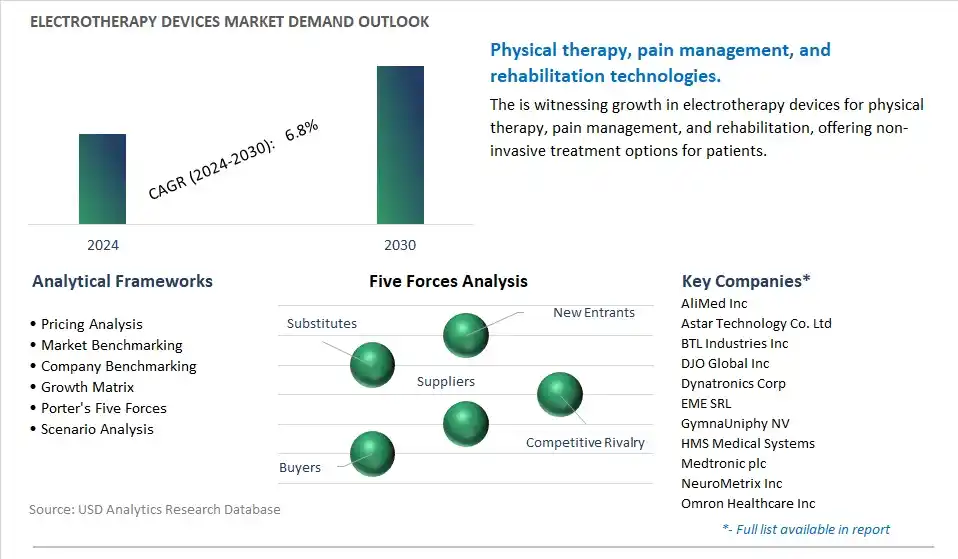
The global Electrotherapy Devices Market is one of the lucrative growth markets, poised to register a 6.8% growth (CAGR) between 2024 and 2030.
Emerging Markets across Asia Pacific, Europe, and Americas present robust growth prospects.
AliMed Inc, Astar Technology Co. Ltd, BTL Industries Inc, DJO Global Inc, Dynatronics Corp, EME SRL, GymnaUniphy NV, HMS Medical Systems, Medtronic plc, NeuroMetrix Inc, Omron Healthcare Inc, Zynex Medical Holdings Inc
Base Year- 2023; Estimated Year- 2024; Historic Period- 2018-2023; Forecast period- 2024 to 2030; Currency: USD; Volume