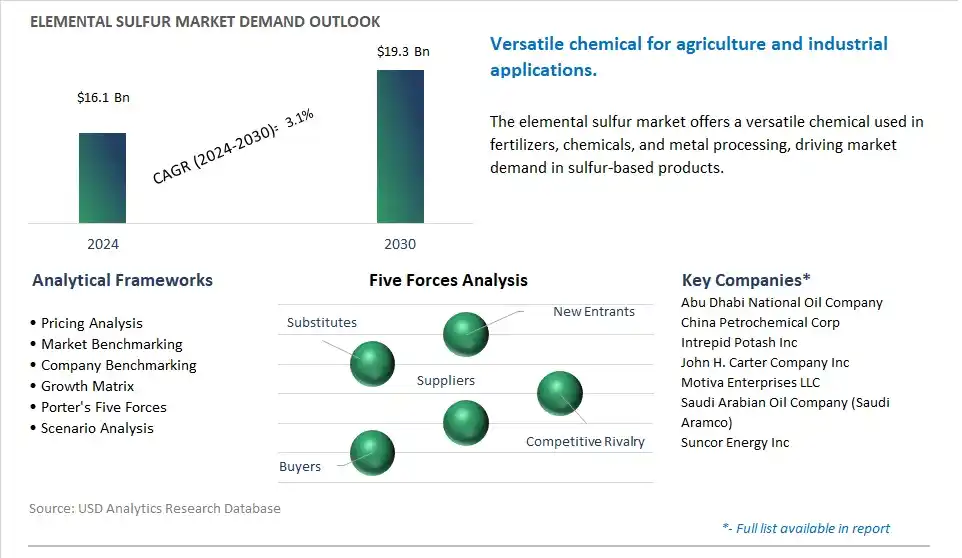
The global Elemental Sulfur Market is poised to register a 3.1% CAGR from $16.1 Billion in 2024 to $19.3 Billion in 2030.
The global Elemental Sulfur Market Study analyzes and forecasts the market size across 6 regions and 24 countries for diverse segments -By Source (Refineries, Gas Processing Plant, Others), By End-User (Agriculture, Chemical, Rubber, Metallurgy, Others).
An Introduction to Global Elemental Sulfur Market in 2024
In the elemental sulfur market, the future is driven by trends such as agricultural demand, industrial applications, and environmental concerns driving innovation in sulfur recovery, processing, and utilization. Elemental sulfur, a naturally occurring element, is used in various industries including agriculture, chemicals, and pharmaceuticals. Key trends shaping this market include advancements in sulfur recovery technologies from oil and gas production, refining, and mining operations to minimize environmental emissions and waste, the development of innovative sulfur-based chemicals and materials for industrial processes and consumer products, and the integration of sulfur into agricultural fertilizers and soil amendments to improve crop yield and soil health. As industries seek sustainable solutions for sulfur management and utilization, the demand for elemental sulfur and its derivatives is expected to drive market growth and stimulate further innovation in sulfur processing and applications.
Elemental Sulfur Market Competitive Landscape
The market report analyses the leading companies in the industry including Abu Dhabi National Oil Company, China Petrochemical Corp, Intrepid Potash Inc, John H. Carter Company Inc, Motiva Enterprises LLC, Saudi Arabian Oil Company (Saudi Aramco), Suncor Energy Inc.
Elemental Sulfur Market Dynamics
Elemental Sulfur Market Trend: Growing Demand for Sustainable Agriculture Practices
One prominent market trend in the elemental sulfur industry is the growing demand for sustainable agriculture practices. As concerns about environmental sustainability and soil health continue to rise, there is an increasing preference among farmers for organic and environmentally friendly agricultural inputs. Elemental sulfur is widely used as a soil amendment and fertilizer in organic farming practices due to its effectiveness in lowering soil pH, controlling soil-borne diseases, and promoting plant growth. The trend towards sustainable agriculture practices is driving market demand for elemental sulfur as farmers seek alternatives to synthetic chemical fertilizers and pesticides, contributing to the growth of the elemental sulfur market.
Elemental Sulfur Market Driver: Expansion of Agrochemical Industry and Crop Production
A key driver in the elemental sulfur market is the expansion of the agrochemical industry and crop production. With the growing global population and increasing food demand, there is a continuous need to enhance agricultural productivity and crop yields. Elemental sulfur plays a vital role in modern agriculture as a key ingredient in sulfur-containing fertilizers and pesticides used to improve soil fertility, increase nutrient uptake, and protect crops from pests and diseases. As agricultural practices intensify and expand to meet rising food demand, the demand for elemental sulfur as an essential agrochemical input is expected to continue growing, driving market growth and expansion.
Elemental Sulfur Market Opportunity: Development of Innovative Formulations and Application Technologies
One potential opportunity in the elemental sulfur market lies in the development of innovative formulations and application technologies. Manufacturers and agrochemical companies have an opportunity to innovate and develop new sulfur formulations and delivery systems that offer improved efficacy, safety, and ease of use for farmers. This includes developing micronized sulfur formulations for better dispersion and absorption, encapsulated sulfur products for controlled release and reduced volatility, and sulfur-based biostimulants for enhanced plant growth promotion and stress tolerance. Additionally, there is potential to invest in precision agriculture technologies and digital farming solutions that optimize sulfur application rates and timing based on soil and crop-specific requirements, maximizing the efficiency and effectiveness of elemental sulfur utilization in agriculture. By capitalizing on these opportunities for innovation and technology advancement, stakeholders in the elemental sulfur market can meet the evolving needs of modern agriculture and drive sustainable growth in the industry.
Elemental Sulfur Market Ecosystem
The elemental sulfur Market Ecosystem involves diverse key stages, each critical in the production, processing, and distribution of this industrial material with diverse applications. Extraction methods including the Frasch Process, employed by companies including Sulphur Mines Company, and the Claus Process utilized by oil and gas giants including ExxonMobil and Freeport-McMoRan, ensure the procurement of elemental sulfur.
Transportation, facilitated by major shipping companies including Maersk, and rail networks including BNSF Railway, ensures the global movement of sulfur from extraction sites to processing facilities and end users. Processing and purification stages, including grinding, granulation, and purification processes including the Frasch Sulfur Purification Process, are handled by existing sulfur producers with on-site facilities and independent processing companies, ensuring the sulfur meets industrial-grade specifications.
Once processed, sulfur is distributed to various industrial end-users by chemical distributors including Brenntag and Univar Solutions, or directly by large sulfur producers including Koch Industries and Freeport-McMoRan, which dedicated sales teams for customer interaction. The end users of elemental sulfur span multiple industries, including the fertilizer industry, where it is used in sulfuric acid production, as well as the chemical industry for various applications. Additionally, sulfur finds applications in the pulp and paper industry, rubber manufacturing, and the pigment industry, highlighting its versatility and significance across diverse sectors.
Elemental Sulfur Market Share Analysis: Refineries held the dominant revenue share in 2024
The largest segment in the Elemental Sulfur Market is the "Refineries" source category. This dominance can be attributed to diverse key factors. Firstly, refineries are major sources of elemental sulfur production globally due to the sulfur content present in crude oil and natural gas. During the refining process, sulfur-containing compounds such as hydrogen sulfide (H2S) and sulfur dioxide (SO2) are removed from crude oil and natural gas streams through various refining techniques, resulting in the generation of elemental sulfur as a by-product. Additionally, stringent environmental regulations require refineries to reduce sulfur emissions and comply with sulfur content limits in refined products such as gasoline and diesel fuel. As a result, refineries invest in sulfur recovery units (SRUs) and sulfur processing facilities to recover elemental sulfur from sulfur-rich streams and convert it into a marketable product. In addition, refineries have large-scale sulfur recovery and processing capabilities, allowing them to produce significant quantities of elemental sulfur for various industrial applications such as sulfuric acid production, agricultural fertilizers, and chemical manufacturing. Further, the growing demand for sulfuric acid, which is a key industrial chemical used in fertilizer production, metal processing, and chemical synthesis, drives the demand for elemental sulfur as a feedstock. As a result, the Refineries source segment remains the largest in the Elemental Sulfur Market due to the significant sulfur content in crude oil and natural gas feedstocks processed by refineries and the essential role of sulfur recovery units in sulfur management and environmental compliance within the refining industry.
Elemental Sulfur Market Share Analysis: Agriculture is the fastest growing market segment over the forecast period to 2030
The fastest-growing segment in the Elemental Sulfur Market is the "Agriculture" end-user category. This growth can be attributed to diverse key factors. Firstly, elemental sulfur is a vital component in agricultural applications, particularly in soil amendment and crop production. Sulfur is an essential nutrient for plant growth and development, playing a critical role in protein synthesis, enzyme activation, and chlorophyll formation. Additionally, sulfur helps improve soil pH balance and enhances nutrient uptake by plants, leading to increased crop yields, improved quality, and better resistance to diseases and pests. In addition, the growing global population and increasing food demand drive the expansion of agricultural activities and the adoption of sulfur-containing fertilizers to boost agricultural productivity and sustainability. Further, regulatory initiatives promoting sustainable agriculture practices and reducing reliance on synthetic fertilizers further propel the demand for elemental sulfur as a natural and eco-friendly soil amendment. As a result, the Agriculture end-user segment is experiencing rapid growth in the Elemental Sulfur Market due to the essential role of sulfur in promoting plant health and enhancing agricultural productivity, coupled with increasing awareness of sustainable farming practices and environmental stewardship.
Elemental Sulfur Market Report Scope-
By Source
Refineries
Gas Processing Plant
Others
By End-User
Agriculture
Chemical
Rubber
Metallurgy
Others
Elemental Sulfur Market Companies Profiled
Abu Dhabi National Oil Company
China Petrochemical Corp
Intrepid Potash Inc
John H. Carter Company Inc
Motiva Enterprises LLC
Saudi Arabian Oil Company (Saudi Aramco)
Suncor Energy Inc
*- List Not Exhaustive
TABLE OF CONTENTS
1 Introduction to 2024 Elemental Sulfur Market
1.1 Market Overview
1.2 Quick Facts
1.3 Scope/Objective of the Study
1.4 Market Definition
1.5 Countries and Regions Covered
1.6 Units, Currency, and Conversions
1.7 Industry Value Chain
2 Research Methodology
2.1 Market Size Estimation
2.2 Sources and Research Methodology
2.3 Data Triangulation
2.4 Assumptions and Limitations
3 Executive Summary
3.1 Global Elemental Sulfur Market Size Outlook, $ Million, 2021 to 2030
3.2 Elemental Sulfur Market Outlook by Type, $ Million, 2021 to 2030
3.3 Elemental Sulfur Market Outlook by Product, $ Million, 2021 to 2030
3.4 Elemental Sulfur Market Outlook by Application, $ Million, 2021 to 2030
3.5 Elemental Sulfur Market Outlook by Key Countries, $ Million, 2021 to 2030
4 Market Dynamics
4.1 Key Driving Forces of Elemental Sulfur Industry
4.2 Key Market Trends in Elemental Sulfur Industry
4.3 Potential Opportunities in Elemental Sulfur Industry
4.4 Key Challenges in Elemental Sulfur Industry
5 Market Factor Analysis
5.1 Value Chain Analysis
5.2 Competitive Landscape
5.2.1 Global Elemental Sulfur Market Share by Company (%), 2023
5.2.2 Product Offerings by Company
5.3 Porter’s Five Forces Analysis
5.4 Pricing Analysis and Outlook
6 Growth Outlook Across Scenarios
6.1 Growth Analysis-Case Scenario Definitions
6.2 Low Growth Scenario Forecasts
6.3 Reference Growth Scenario Forecasts
6.4 High Growth Scenario Forecasts
7 Global Elemental Sulfur Market Outlook by Segments
7.1 Elemental Sulfur Market Outlook by Segments, $ Million, 2021- 2030
By Source
Refineries
Gas Processing Plant
Others
By End-User
Agriculture
Chemical
Rubber
Metallurgy
Others
8 North America Elemental Sulfur Market Analysis and Outlook To 2030
8.1 Introduction to North America Elemental Sulfur Markets in 2024
8.2 North America Elemental Sulfur Market Size Outlook by Country, 2021-2030
8.2.1 United States
8.2.2 Canada
8.2.3 Mexico
8.3 North America Elemental Sulfur Market size Outlook by Segments, 2021-2030
By Source
Refineries
Gas Processing Plant
Others
By End-User
Agriculture
Chemical
Rubber
Metallurgy
Others
9 Europe Elemental Sulfur Market Analysis and Outlook To 2030
9.1 Introduction to Europe Elemental Sulfur Markets in 2024
9.2 Europe Elemental Sulfur Market Size Outlook by Country, 2021-2030
9.2.1 Germany
9.2.2 France
9.2.3 Spain
9.2.4 United Kingdom
9.2.4 Italy
9.2.5 Russia
9.2.6 Norway
9.2.7 Rest of Europe
9.3 Europe Elemental Sulfur Market Size Outlook by Segments, 2021-2030
By Source
Refineries
Gas Processing Plant
Others
By End-User
Agriculture
Chemical
Rubber
Metallurgy
Others
10 Asia Pacific Elemental Sulfur Market Analysis and Outlook To 2030
10.1 Introduction to Asia Pacific Elemental Sulfur Markets in 2024
10.2 Asia Pacific Elemental Sulfur Market Size Outlook by Country, 2021-2030
10.2.1 China
10.2.2 India
10.2.3 Japan
10.2.4 South Korea
10.2.5 Indonesia
10.2.6 Malaysia
10.2.7 Australia
10.2.8 Rest of Asia Pacific
10.3 Asia Pacific Elemental Sulfur Market size Outlook by Segments, 2021-2030
By Source
Refineries
Gas Processing Plant
Others
By End-User
Agriculture
Chemical
Rubber
Metallurgy
Others
11 South America Elemental Sulfur Market Analysis and Outlook To 2030
11.1 Introduction to South America Elemental Sulfur Markets in 2024
11.2 South America Elemental Sulfur Market Size Outlook by Country, 2021-2030
11.2.1 Brazil
11.2.2 Argentina
11.2.3 Rest of South America
11.3 South America Elemental Sulfur Market size Outlook by Segments, 2021-2030
By Source
Refineries
Gas Processing Plant
Others
By End-User
Agriculture
Chemical
Rubber
Metallurgy
Others
12 Middle East and Africa Elemental Sulfur Market Analysis and Outlook To 2030
12.1 Introduction to Middle East and Africa Elemental Sulfur Markets in 2024
12.2 Middle East and Africa Elemental Sulfur Market Size Outlook by Country, 2021-2030
12.2.1 Saudi Arabia
12.2.2 UAE
12.2.3 Oman
12.2.4 Rest of Middle East
12.2.5 Egypt
12.2.6 Nigeria
12.2.7 South Africa
12.2.8 Rest of Africa
12.3 Middle East and Africa Elemental Sulfur Market size Outlook by Segments, 2021-2030
By Source
Refineries
Gas Processing Plant
Others
By End-User
Agriculture
Chemical
Rubber
Metallurgy
Others
13 Company Profiles
13.1 Company Snapshot
13.2 SWOT Profiles
13.3 Products and Services
13.4 Recent Developments
13.5 Financial Profile
Abu Dhabi National Oil Company
China Petrochemical Corp
Intrepid Potash Inc
John H. Carter Company Inc
Motiva Enterprises LLC
Saudi Arabian Oil Company (Saudi Aramco)
Suncor Energy Inc
14 Appendix
14.1 Customization Offerings
14.2 Subscription Services
14.3 Related Reports
14.4 Publisher Expertise
By Source
Refineries
Gas Processing Plant
Others
By End-User
Agriculture
Chemical
Rubber
Metallurgy
Others
Countries Analyzed
North America (US, Canada, Mexico)
Europe (Germany, UK, France, Spain, Italy, Russia, Rest of Europe)
Asia Pacific (China, India, Japan, South Korea, Australia, South East Asia, Rest of Asia)
South America (Brazil, Argentina, Rest of South America)
Middle East and Africa (Saudi Arabia, UAE, Rest of Middle East, South Africa, Egypt, Rest of Africa)
