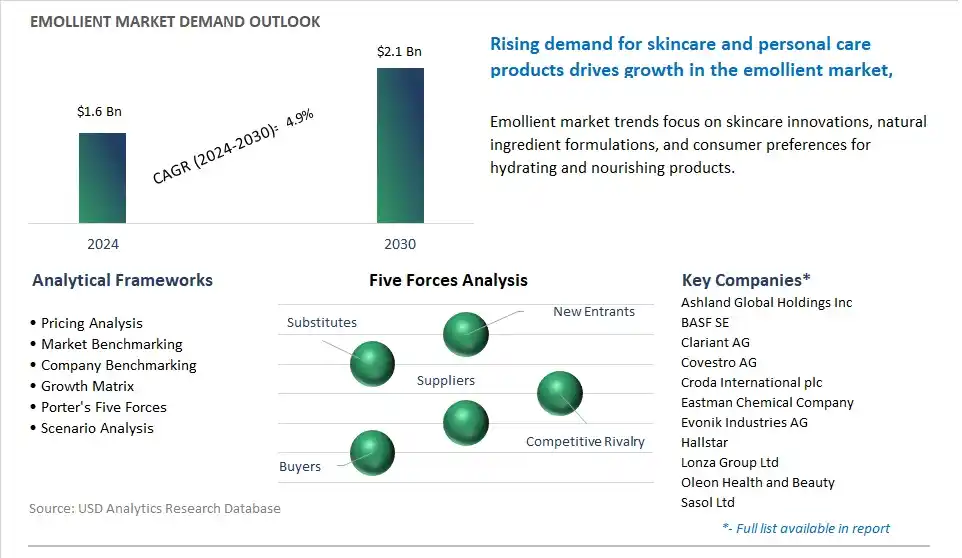
The global Emollient Market is poised to register a 4.9% CAGR from $1.6 Billion in 2024 to $2.1 Billion in 2030.
The global Emollient Market Study analyzes and forecasts the market size across 6 regions and 24 countries for diverse segments -By Form (Solid, Liquid), By Type (Esters, Fatty Acids, Fatty Alcohols, Ethers, Silicones, Others), By Application (Skin Care, Hair Care, Deodorants, Oral Care, Others).
An Introduction to Global Emollient Market in 2024
The market for emollients is experiencing growth driven by the increasing demand for skin and hair care products that provide moisturization, hydration, and barrier protection. Key trends shaping the future of the industry include innovations in emollient formulations, delivery systems, and natural alternatives to meet the requirements for effective, safe, and multifunctional ingredients in cosmetics and personal care formulations. Advanced emollients offer benefits such as skin smoothing, softening, and conditioning, making them essential for creams, lotions, lip balms, and hair care products. Moreover, the integration of natural oils, butters, and esters as emollient ingredients enhances product performance, sensorial attributes, and consumer appeal, addressing concerns about chemical sensitivities and environmental impact. Additionally, the growing consumer awareness of skin health, wellness, and ingredient transparency drives market demand for emollients that provide moisturizing benefits, skin comfort, and formulation versatility while meeting clean beauty standards and regulatory requirements. As beauty and personal care brands prioritize efficacy, safety, and sustainability, the emollient market is poised for continued growth and innovation as a key component of skincare and haircare formulations that deliver hydration, nourishment, and sensory indulgence to consumers worldwide.
Emollient Market Competitive Landscape
The market report analyses the leading companies in the industry including Ashland Global Holdings Inc, BASF SE, Clariant AG, Covestro AG, Croda International plc, Eastman Chemical Company, Evonik Industries AG, Hallstar, Lonza Group Ltd, Oleon Health and Beauty, Sasol Ltd, Solvay SA, Stepan Company, The Lubrizol Corp, Vantage Specialty Chemicals Inc.
Emollient Market Dynamics
Emollient Market Trend: Shift towards Natural and Sustainable Ingredients in Personal Care
A prominent trend in the emollient market is the shift towards natural and sustainable ingredients in the personal care industry. With increasing consumer awareness of environmental sustainability and desire for clean label products, there is a rising preference for emollients derived from natural sources such as plant oils, butters, and esters. Natural emollients offer moisturizing, softening, and protective properties while minimizing environmental impact and providing a more sustainable alternative to synthetic counterparts. This trend is driven by consumer demand for eco-friendly and skin-friendly products, regulatory restrictions on certain synthetic ingredients, and industry initiatives towards sustainability, shaping the future of the emollient market towards greater adoption of natural and sustainable formulations in skincare, haircare, and cosmetics.
Emollient Market Driver: Growing Demand for Personal Care Products
The primary driver behind the growth of the emollient market is the growing demand for personal care products globally. As consumers become more conscious of their health and appearance, there is an increasing demand for skincare, haircare, and cosmetic products that offer moisturization, nourishment, and protection. Emollients play a vital role in formulating such products by providing hydration, lubrication, and barrier function to the skin and hair. Moreover, advancements in cosmetic science, formulation technology, and consumer preferences for multifunctional products drive the demand for innovative emollient solutions with improved sensory attributes, stability, and performance. This driver is fueled by changing lifestyle trends, demographic shifts, and increasing disposable incomes, stimulating market growth and investment in emollient technologies and applications.
Emollient Market Opportunity: Expansion into Clean Beauty and Natural Cosmetics
An opportunity for market growth within the emollient sector lies in the expansion into clean beauty and natural cosmetics. While emollients are widely used in conventional personal care products, there are untapped opportunities in the clean beauty movement and natural cosmetics market. Clean beauty products, which emphasize transparency, safety, and sustainability, are gaining popularity among consumers seeking safer and more natural alternatives to mainstream cosmetics. Natural emollients, derived from plant-based sources and free from synthetic additives, align with clean beauty principles and offer benefits such as skin compatibility, moisturization, and eco-friendliness. By developing specialized formulations and marketing strategies for clean beauty and natural cosmetics, emollient manufacturers can capitalize on emerging market trends, differentiate their products from competitors, and establish stronger market presence in dynamic and growing segments. Additionally, collaboration with clean beauty brands, cosmetic formulators, and regulatory authorities enables emollient suppliers to address market needs, comply with industry standards, and drive innovation in natural and sustainable cosmetics.
Emollient Market Share Analysis: Liquid segment generated the highest revenue in the industry
The Liquid segment is the largest segment in the Emollient Market for diverse compelling reasons. The liquid emollients offer versatility and ease of formulation in various cosmetic and personal care products. Liquid emollients include oils, esters, and silicone-based ingredients that provide moisturizing, smoothing, and softening properties to the skin and hair. Additionally, liquid emollients are commonly used in formulations such as lotions, creams, serums, hair conditioners, and makeup products due to their ability to spread easily, penetrate the skin, and deliver targeted benefits. In addition, liquid emollients are preferred for their lightweight and non-greasy texture, making them suitable for both leave-on and rinse-off products. Further, the liquid form allows for precise dosing and blending with other ingredients, enabling formulators to create customized formulations tailored to specific product requirements and consumer preferences. As consumer demand for skincare, haircare, and personal care products continues to grow, the Liquid segment maintains its dominance in the Emollient Market, supporting the formulation of a wide range of cosmetic and personal care products.
Emollient Market Share Analysis: Silicones Segment is poised to register the fastest growth rate (CAGR) over the forecast period to 2030
The Silicones segment is the fastest-growing segment in the Emollient Market for diverse compelling reasons. The silicones are synthetic compounds derived from silicon, oxygen, carbon, and other elements, known for their unique properties such as smoothness, lubricity, water resistance, and film-forming capabilities. Silicone-based emollients are widely used in cosmetic and personal care products for their excellent spreadability, lightweight texture, and long-lasting moisturizing effects on the skin and hair. Additionally, silicone emollients impart a silky, non-greasy feel to formulations, making them ideal for skincare, haircare, and makeup products. In addition, silicone emollients offer benefits such as enhanced product stability, UV protection, heat resistance, and compatibility with other ingredients, allowing formulators to create high-performance formulations with improved sensory attributes. Further, consumer preferences for products with elegant textures, long-lasting hydration, and improved skin feel drive the demand for silicone-based emollients in the cosmetic and personal care industry. As manufacturers continue to innovate and develop advanced silicone-based emollients with enhanced properties and functionalities, the Silicones segment experiences rapid growth in the Emollient Market, meeting the evolving needs of consumers and formulators alike.
Emollient Market Share Analysis: Oral Care Segment is poised to register the fastest growth rate (CAGR) over the forecast period to 2030
The Oral Care segment is the fastest-growing segment in the Emollient Market for diverse compelling reasons. The there is increasing consumer awareness and demand for oral care products that offer moisturizing and soothing benefits for the lips and oral mucosa. Emollients are used in oral care formulations such as lip balms, lipsticks, lip glosses, and oral care creams to provide hydration, protection, and comfort to the lips and mouth. Additionally, emollients help prevent dryness, chapping, and irritation caused by environmental factors, harsh weather conditions, and oral hygiene practices. In addition, the rise of premium and natural oral care products featuring botanical extracts, vitamins, and moisturizing agents drives the incorporation of emollients in oral care formulations to enhance product efficacy and consumer appeal. Further, the growing trend of multifunctional oral care products, such as lip balms with SPF protection, anti-aging benefits, and tinted formulations, creates opportunities for emollients to offer additional functional benefits beyond basic moisturization. As consumers increasingly prioritize oral health, comfort, and aesthetics, the demand for emollients in oral care applications is expected to experience rapid growth, positioning the Oral Care segment as the fastest-growing segment in the Emollient Market.
Emollient Market Report Segmentation
By Form
Solid
Liquid
By Type
Esters
Fatty Acids
Fatty Alcohols
Ethers
Silicones
Others
By Application
Skin Care
Hair Care
Deodorants
Oral Care
Others
Regions Included
North America (US, Canada, Mexico)
Europe (Germany, UK, France, Spain, Italy, Russia, Rest of Europe)
Asia Pacific (China, India, Japan, South Korea, Australia, South East Asia, Rest of Asia)
South America (Brazil, Argentina, Rest of South America)
Middle East and Africa (Saudi Arabia, UAE, Rest of Middle East, South Africa, Egypt, Rest of Africa)
Emollient Companies Profiled in the Market Study
Ashland Global Holdings Inc
BASF SE
Clariant AG
Covestro AG
Croda International plc
Eastman Chemical Company
Evonik Industries AG
Hallstar
Lonza Group Ltd
Oleon Health and Beauty
Sasol Ltd
Solvay SA
Stepan Company
The Lubrizol Corp
Vantage Specialty Chemicals Inc
*- List Not Exhaustive
TABLE OF CONTENTS
1 Introduction to 2024 Emollient Market
1.1 Market Overview
1.2 Quick Facts
1.3 Scope/Objective of the Study
1.4 Market Definition
1.5 Countries and Regions Covered
1.6 Units, Currency, and Conversions
1.7 Industry Value Chain
2 Research Methodology
2.1 Market Size Estimation
2.2 Sources and Research Methodology
2.3 Data Triangulation
2.4 Assumptions and Limitations
3 Executive Summary
3.1 Global Emollient Market Size Outlook, $ Million, 2021 to 2030
3.2 Emollient Market Outlook by Type, $ Million, 2021 to 2030
3.3 Emollient Market Outlook by Product, $ Million, 2021 to 2030
3.4 Emollient Market Outlook by Application, $ Million, 2021 to 2030
3.5 Emollient Market Outlook by Key Countries, $ Million, 2021 to 2030
4 Market Dynamics
4.1 Key Driving Forces of Emollient Industry
4.2 Key Market Trends in Emollient Industry
4.3 Potential Opportunities in Emollient Industry
4.4 Key Challenges in Emollient Industry
5 Market Factor Analysis
5.1 Value Chain Analysis
5.2 Competitive Landscape
5.2.1 Global Emollient Market Share by Company (%), 2023
5.2.2 Product Offerings by Company
5.3 Porter’s Five Forces Analysis
5.4 Pricing Analysis and Outlook
6 Growth Outlook Across Scenarios
6.1 Growth Analysis-Case Scenario Definitions
6.2 Low Growth Scenario Forecasts
6.3 Reference Growth Scenario Forecasts
6.4 High Growth Scenario Forecasts
7 Global Emollient Market Outlook by Segments
7.1 Emollient Market Outlook by Segments, $ Million, 2021- 2030
By Form
Solid
Liquid
By Type
Esters
Fatty Acids
Fatty Alcohols
Ethers
Silicones
Others
By Application
Skin Care
Hair Care
Deodorants
Oral Care
Others
8 North America Emollient Market Analysis and Outlook To 2030
8.1 Introduction to North America Emollient Markets in 2024
8.2 North America Emollient Market Size Outlook by Country, 2021-2030
8.2.1 United States
8.2.2 Canada
8.2.3 Mexico
8.3 North America Emollient Market size Outlook by Segments, 2021-2030
By Form
Solid
Liquid
By Type
Esters
Fatty Acids
Fatty Alcohols
Ethers
Silicones
Others
By Application
Skin Care
Hair Care
Deodorants
Oral Care
Others
9 Europe Emollient Market Analysis and Outlook To 2030
9.1 Introduction to Europe Emollient Markets in 2024
9.2 Europe Emollient Market Size Outlook by Country, 2021-2030
9.2.1 Germany
9.2.2 France
9.2.3 Spain
9.2.4 United Kingdom
9.2.4 Italy
9.2.5 Russia
9.2.6 Norway
9.2.7 Rest of Europe
9.3 Europe Emollient Market Size Outlook by Segments, 2021-2030
By Form
Solid
Liquid
By Type
Esters
Fatty Acids
Fatty Alcohols
Ethers
Silicones
Others
By Application
Skin Care
Hair Care
Deodorants
Oral Care
Others
10 Asia Pacific Emollient Market Analysis and Outlook To 2030
10.1 Introduction to Asia Pacific Emollient Markets in 2024
10.2 Asia Pacific Emollient Market Size Outlook by Country, 2021-2030
10.2.1 China
10.2.2 India
10.2.3 Japan
10.2.4 South Korea
10.2.5 Indonesia
10.2.6 Malaysia
10.2.7 Australia
10.2.8 Rest of Asia Pacific
10.3 Asia Pacific Emollient Market size Outlook by Segments, 2021-2030
By Form
Solid
Liquid
By Type
Esters
Fatty Acids
Fatty Alcohols
Ethers
Silicones
Others
By Application
Skin Care
Hair Care
Deodorants
Oral Care
Others
11 South America Emollient Market Analysis and Outlook To 2030
11.1 Introduction to South America Emollient Markets in 2024
11.2 South America Emollient Market Size Outlook by Country, 2021-2030
11.2.1 Brazil
11.2.2 Argentina
11.2.3 Rest of South America
11.3 South America Emollient Market size Outlook by Segments, 2021-2030
By Form
Solid
Liquid
By Type
Esters
Fatty Acids
Fatty Alcohols
Ethers
Silicones
Others
By Application
Skin Care
Hair Care
Deodorants
Oral Care
Others
12 Middle East and Africa Emollient Market Analysis and Outlook To 2030
12.1 Introduction to Middle East and Africa Emollient Markets in 2024
12.2 Middle East and Africa Emollient Market Size Outlook by Country, 2021-2030
12.2.1 Saudi Arabia
12.2.2 UAE
12.2.3 Oman
12.2.4 Rest of Middle East
12.2.5 Egypt
12.2.6 Nigeria
12.2.7 South Africa
12.2.8 Rest of Africa
12.3 Middle East and Africa Emollient Market size Outlook by Segments, 2021-2030
By Form
Solid
Liquid
By Type
Esters
Fatty Acids
Fatty Alcohols
Ethers
Silicones
Others
By Application
Skin Care
Hair Care
Deodorants
Oral Care
Others
13 Company Profiles
13.1 Company Snapshot
13.2 SWOT Profiles
13.3 Products and Services
13.4 Recent Developments
13.5 Financial Profile
Ashland Global Holdings Inc
BASF SE
Clariant AG
Covestro AG
Croda International plc
Eastman Chemical Company
Evonik Industries AG
Hallstar
Lonza Group Ltd
Oleon Health and Beauty
Sasol Ltd
Solvay SA
Stepan Company
The Lubrizol Corp
Vantage Specialty Chemicals Inc
14 Appendix
14.1 Customization Offerings
14.2 Subscription Services
14.3 Related Reports
14.4 Publisher Expertise
By Form
Solid
Liquid
By Type
Esters
Fatty Acids
Fatty Alcohols
Ethers
Silicones
Others
By Application
Skin Care
Hair Care
Deodorants
Oral Care
Others
Countries Analyzed
North America (US, Canada, Mexico)
Europe (Germany, UK, France, Spain, Italy, Russia, Rest of Europe)
Asia Pacific (China, India, Japan, South Korea, Australia, South East Asia, Rest of Asia)
South America (Brazil, Argentina, Rest of South America)
Middle East and Africa (Saudi Arabia, UAE, Rest of Middle East, South Africa, Egypt, Rest of Africa)
