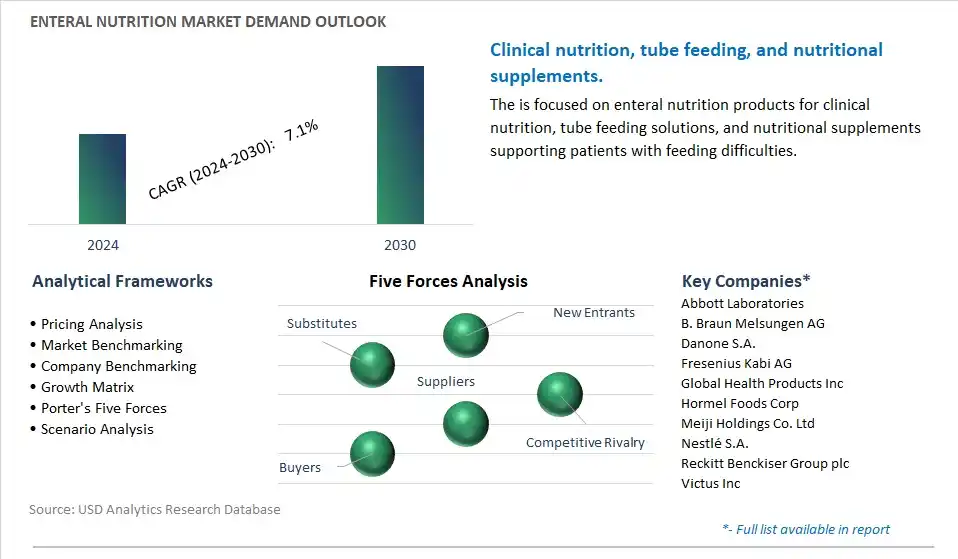
Enteral Nutrition Market is estimated to increase at a Compounded Annual Growth Rate of 7.1% CAGR over the forecast period from 2024 to 2030
The Enteral Nutrition Market study analyzes and forecasts the market size across 6 regions and 24 countries for diverse segments- By Protein Composition (Standard Protein Diet, High Protein Supplement, Protein for Diabetes Care Patient, Others), By Form (Powder, Liquid), By Age Group (Adults, Pediatric), By Distribution Channel (Hospital Sales, Retail, Online).
An Introduction to Enteral Nutrition Market in 2024
In 2024, the market for enteral nutrition addresses the nutritional needs of patients who are unable to meet their dietary requirements orally, offering a range of enteral feeding formulas, feeding tubes, delivery systems, and enteral nutrition accessories designed to provide essential nutrients, vitamins, and calories for individuals with impaired swallowing, gastrointestinal dysfunction, or malnutrition. Enteral nutrition, also known as tube feeding, involves the delivery of liquid nutritional formulas directly into the gastrointestinal tract via a feeding tube inserted through the nose, mouth, or directly into the stomach or small intestine, bypassing the oral cavity and esophagus. Enteral feeding formulas are available in various formulations, including standard polymeric formulas, elemental formulas, disease-specific formulas, and specialized formulas for specific medical conditions or nutritional requirements. These formulas are formulated to provide adequate protein, carbohydrates, fats, vitamins, and minerals to support nutritional needs and promote healing in patients with acute or chronic illnesses, critical illness, or medical conditions that compromise oral intake or nutrient absorption. Enteral feeding tubes may include nasogastric tubes, nasojejunal tubes, gastrostomy tubes, or jejunostomy tubes, each selected based on the patient's clinical status, nutritional requirements, and anticipated duration of enteral feeding. With a focus on safety, tolerability, and nutritional adequacy, enteral nutrition products undergo quality control, nutritional analysis, and regulatory compliance to ensure product consistency, microbiological safety, and compliance with dietary guidelines and standards of care. Moreover, with advancements in formula composition, tube design, and feeding pump technology, the enteral nutrition market continues to innovate, offering tailored solutions, enteral nutrition protocols, and feeding regimens that are customizable, patient-centric, and adaptable to the diverse nutritional needs and clinical scenarios encountered in healthcare settings.
Market Trend: Increasing Preference for Home Enteral Nutrition
A prominent trend in the enteral nutrition market is the increasing preference for home enteral nutrition among patients requiring long-term nutritional support. Home enteral nutrition allows patients with chronic conditions such as gastrointestinal disorders, cancer, and neurological diseases to receive essential nutrients directly into the gastrointestinal tract through feeding tubes, bypassing the oral route. Advancements in enteral nutrition formulations, delivery systems, and support services have made home enteral nutrition more accessible, convenient, and cost-effective for patients and caregivers. Additionally, the COVID-19 pandemic has accelerated the shift towards home-based care and remote monitoring, further driving the adoption of home enteral nutrition as a preferred option for managing malnutrition and improving patient outcomes. This trend reflects the growing emphasis on patient-centered care, healthcare decentralization, and value-based models, driving market growth and innovation in the home enteral nutrition segment.
Market Driver: Rising Prevalence of Malnutrition and Chronic Diseases
A key driver for the enteral nutrition market is the rising prevalence of malnutrition and chronic diseases worldwide. Malnutrition is a common complication in patients with chronic conditions such as cancer, gastrointestinal disorders, critical illness, and neurological impairments, leading to poor clinical outcomes, prolonged hospitalizations, and increased healthcare costs. Enteral nutrition plays a crucial role in providing essential nutrients, maintaining nutritional status, and supporting immune function in these vulnerable patient populations. With the aging population, increasing incidence of chronic diseases, and rising healthcare expenditures, there is growing recognition of the importance of early nutritional intervention and proactive management of malnutrition, driving demand for enteral nutrition products and services. The growing burden of malnutrition-related morbidity and mortality fuels market growth and investment in enteral nutrition solutions, supporting improved patient care and healthcare sustainability.
Market Opportunity: Expansion into Specialized Nutritional Formulations and Therapeutic Areas
An opportunity for innovation and market expansion in the enteral nutrition market lies in the development of specialized nutritional formulations and therapeutic solutions tailored to specific patient populations and clinical indications. As our understanding of the nutritional requirements and metabolic pathways in different disease states advances, there is an opportunity to formulate enteral nutrition products with targeted nutrients, bioactive ingredients, and disease-specific formulations to address the unique needs of patients with specific medical conditions. Additionally, there is an opportunity to expand into emerging therapeutic areas such as oncology, gastroenterology, critical care, and geriatrics, where enteral nutrition plays a vital role in optimizing patient outcomes, reducing complications, and improving quality of life. By leveraging scientific research, clinical evidence, and patient insights, companies can develop innovative enteral nutrition solutions that meet the evolving needs of healthcare providers and patients, driving market differentiation and growth in specialized nutritional segments.
Enteral Nutrition Market Share Analysis: High Protein Supplement
The High Protein Supplement segment within the Enteral Nutrition market is experiencing rapid growth due to several factors driving the demand for specialized nutritional formulations targeting specific patient populations. High protein supplements are designed to provide concentrated protein sources to individuals who require increased protein intake for various medical conditions or nutritional support. These supplements are enriched with essential amino acids and nutrients to support tissue repair, muscle maintenance, and overall health, making them particularly beneficial for patients recovering from surgery, trauma, or illness, as well as individuals with increased protein needs due to metabolic conditions or age-related muscle loss. With the growing prevalence of chronic diseases, aging populations, and nutritional deficiencies, there is rising demand for enteral nutrition products that offer tailored formulations to meet the unique dietary requirements of patients. High protein supplements play a crucial role in supporting muscle mass, promoting wound healing, and improving clinical outcomes in hospitalized patients, elderly individuals, and those with conditions such as malnutrition, diabetes, and sarcopenia. Additionally, advancements in nutritional science and formulation technology have led to the development of high-quality protein supplements with improved taste, texture, and bioavailability, enhancing patient compliance and nutritional outcomes. Hospitals, retail outlets, and online platforms are increasingly offering high protein supplements as part of their enteral nutrition product portfolios to meet the diverse needs of patients and caregivers. As the demand for specialized enteral nutrition products continues to rise, driven by factors such as population aging, increasing disease burden, and growing awareness of nutritional therapy, the High Protein Supplement segment is poised for significant growth in the Enteral Nutrition market, catering to the evolving needs of patients across different age groups and medical conditions.
Enteral Nutrition Competitive Analysis
The market research study provides in-depth insights into leading companies including the SWOT analyses, product profile, financial details, and recent developments acrossAbbott Laboratories, B. Braun Melsungen AG, Danone S.A., Fresenius Kabi AG, Global Health Products Inc, Hormel Foods Corp, Meiji Holdings Co. Ltd, Nestlé S.A., Reckitt Benckiser Group plc, Victus Inc
Enteral Nutrition Market Segmentation
By Protein Composition
Standard Protein Diet
High Protein Supplement
Protein for Diabetes Care Patient
Others
By Form
Powder
Liquid
By Age Group
Adults
Pediatric
By Distribution Channel
Hospital Sales
Retail
Online
Geographical Analysis
North America (United States, Canada, Mexico)
Europe (Germany, France, United Kingdom, Spain, Italy, Rest of Europe)
Asia Pacific (China, India, Japan, South Korea, Rest of Asia Pacific)
South America (Brazil, Argentina, Rest of South America)
Middle East and Africa (Saudi Arabia, UAE, Rest of Middle East, South Africa, Egypt, Rest of Africa)
Enteral Nutrition Market Companies
Abbott Laboratories
B. Braun Melsungen AG
Danone S.A.
Fresenius Kabi AG
Global Health Products Inc
Hormel Foods Corp
Meiji Holdings Co. Ltd
Nestlé S.A.
Reckitt Benckiser Group plc
Victus Inc
Reasons to Buy the Enteral Nutrition Market Study
• Deepen your industry insights and navigate uncertainties for strategy formulation, CAPEX, and Operational decisions
• Gain access to detailed insights on the Enteral Nutrition Market, encompassing current market size, growth trends, and forecasts till 2030.
• Access detailed competitor analysis, enabling competitive advantage through a thorough understanding of market players, strategies, and potential differentiation opportunities
• Stay ahead of the curve with insights on technological advancements, innovations, and upcoming trends
• Identify lucrative investment avenues and expansion opportunities within the Enteral Nutrition Market industry, guided by robust, data-backed analysis.
• Understand regional and global markets through country-wise analysis, regional market potential, regulatory nuances, and dynamics
• Execute strategies with confidence and speed through information, analytics, and insights on the industry value chain
• Corporate leaders, strategists, financial experts, shareholders, asset managers, and governmental representatives can make long-term planning scenarios and build an integrated and timely understanding of market dynamics
• Benefit from tailored solutions and expert consultation based on report insights, providing personalized strategies aligned with specific business needs.
TABLE OF CONTENTS
1 Introduction to 2024 Enteral Nutrition Market
1.1 Market Overview
1.2 Quick Facts
1.3 Scope/Objective of the Study
1.4 Market Definition
1.5 Countries and Regions Covered
1.6 Units, Currency, and Conversions
1.7 Industry Value Chain
2 Research Methodology
2.1 Market Size Estimation
2.2 Sources and Research Methodology
2.3 Data Triangulation
2.4 Assumptions and Limitations
3 Executive Summary
3.1 Global Enteral Nutrition Market Size Outlook, $ Million, 2021 to 2030
3.2 Enteral Nutrition Market Outlook by Type, $ Million, 2021 to 2030
3.3 Enteral Nutrition Market Outlook by Product, $ Million, 2021 to 2030
3.4 Enteral Nutrition Market Outlook by Application, $ Million, 2021 to 2030
3.5 Enteral Nutrition Market Outlook by Key Countries, $ Million, 2021 to 2030
4 Market Dynamics
4.1 Key Driving Forces of Enteral Nutrition Industry
4.2 Key Market Trends in Enteral Nutrition Industry
4.3 Potential Opportunities in Enteral Nutrition Industry
4.4 Key Challenges in Enteral Nutrition Industry
5 Market Factor Analysis
5.1 Value Chain Analysis
5.2 Competitive Landscape
5.2.1 Global Enteral Nutrition Market Share by Company (%), 2023
5.2.2 Product Offerings by Company
5.3 Porter’s Five Forces Analysis
5.4 Pricing Analysis and Outlook
6 Growth Outlook Across Scenarios
6.1 Growth Analysis-Case Scenario Definitions
6.2 Low Growth Scenario Forecasts
6.3 Reference Growth Scenario Forecasts
6.4 High Growth Scenario Forecasts
7 Global Enteral Nutrition Market Outlook by Segments
7.1 Enteral Nutrition Market Outlook by Segments, $ Million, 2021- 2030
By Protein Composition
Standard Protein Diet
High Protein Supplement
Protein for Diabetes Care Patient
Others
By Form
Powder
Liquid
By Age Group
Adults
Pediatric
By Distribution Channel
Hospital Sales
Retail
Online
8 North America Enteral Nutrition Market Analysis and Outlook To 2030
8.1 Introduction to North America Enteral Nutrition Markets in 2024
8.2 North America Enteral Nutrition Market Size Outlook by Country, 2021-2030
8.2.1 United States
8.2.2 Canada
8.2.3 Mexico
8.3 North America Enteral Nutrition Market size Outlook by Segments, 2021-2030
By Protein Composition
Standard Protein Diet
High Protein Supplement
Protein for Diabetes Care Patient
Others
By Form
Powder
Liquid
By Age Group
Adults
Pediatric
By Distribution Channel
Hospital Sales
Retail
Online
9 Europe Enteral Nutrition Market Analysis and Outlook To 2030
9.1 Introduction to Europe Enteral Nutrition Markets in 2024
9.2 Europe Enteral Nutrition Market Size Outlook by Country, 2021-2030
9.2.1 Germany
9.2.2 France
9.2.3 Spain
9.2.4 United Kingdom
9.2.4 Italy
9.2.5 Russia
9.2.6 Norway
9.2.7 Rest of Europe
9.3 Europe Enteral Nutrition Market Size Outlook by Segments, 2021-2030
By Protein Composition
Standard Protein Diet
High Protein Supplement
Protein for Diabetes Care Patient
Others
By Form
Powder
Liquid
By Age Group
Adults
Pediatric
By Distribution Channel
Hospital Sales
Retail
Online
10 Asia Pacific Enteral Nutrition Market Analysis and Outlook To 2030
10.1 Introduction to Asia Pacific Enteral Nutrition Markets in 2024
10.2 Asia Pacific Enteral Nutrition Market Size Outlook by Country, 2021-2030
10.2.1 China
10.2.2 India
10.2.3 Japan
10.2.4 South Korea
10.2.5 Indonesia
10.2.6 Malaysia
10.2.7 Australia
10.2.8 Rest of Asia Pacific
10.3 Asia Pacific Enteral Nutrition Market size Outlook by Segments, 2021-2030
By Protein Composition
Standard Protein Diet
High Protein Supplement
Protein for Diabetes Care Patient
Others
By Form
Powder
Liquid
By Age Group
Adults
Pediatric
By Distribution Channel
Hospital Sales
Retail
Online
11 South America Enteral Nutrition Market Analysis and Outlook To 2030
11.1 Introduction to South America Enteral Nutrition Markets in 2024
11.2 South America Enteral Nutrition Market Size Outlook by Country, 2021-2030
11.2.1 Brazil
11.2.2 Argentina
11.2.3 Rest of South America
11.3 South America Enteral Nutrition Market size Outlook by Segments, 2021-2030
By Protein Composition
Standard Protein Diet
High Protein Supplement
Protein for Diabetes Care Patient
Others
By Form
Powder
Liquid
By Age Group
Adults
Pediatric
By Distribution Channel
Hospital Sales
Retail
Online
12 Middle East and Africa Enteral Nutrition Market Analysis and Outlook To 2030
12.1 Introduction to Middle East and Africa Enteral Nutrition Markets in 2024
12.2 Middle East and Africa Enteral Nutrition Market Size Outlook by Country, 2021-2030
12.2.1 Saudi Arabia
12.2.2 UAE
12.2.3 Oman
12.2.4 Rest of Middle East
12.2.5 Egypt
12.2.6 Nigeria
12.2.7 South Africa
12.2.8 Rest of Africa
12.3 Middle East and Africa Enteral Nutrition Market size Outlook by Segments, 2021-2030
By Protein Composition
Standard Protein Diet
High Protein Supplement
Protein for Diabetes Care Patient
Others
By Form
Powder
Liquid
By Age Group
Adults
Pediatric
By Distribution Channel
Hospital Sales
Retail
Online
13 Company Profiles
13.1 Company Snapshot
13.2 SWOT Profiles
13.3 Products and Services
13.4 Recent Developments
13.5 Financial Profile
List of Companies
Abbott Laboratories
B. Braun Melsungen AG
Danone S.A.
Fresenius Kabi AG
Global Health Products Inc
Hormel Foods Corp
Meiji Holdings Co. Ltd
Nestlé S.A.
Reckitt Benckiser Group plc
Victus Inc
14 Appendix
14.1 Customization Offerings
14.2 Subscription Services
14.3 Related Reports
14.4 Publisher Expertise
By Protein Composition
Standard Protein Diet
High Protein Supplement
Protein for Diabetes Care Patient
Others
By Form
Powder
Liquid
By Age Group
Adults
Pediatric
By Distribution Channel
Hospital Sales
Retail
Online
Countries Analyzed
North America (United States, Canada, Mexico)
Europe (Germany, France, United Kingdom, Spain, Italy, Rest of Europe)
Asia Pacific (China, India, Japan, South Korea, Rest of Asia Pacific)
South America (Brazil, Argentina, Rest of South America)
Middle East and Africa (Saudi Arabia, UAE, Rest of Middle East, South Africa, Egypt, Rest of Africa)
