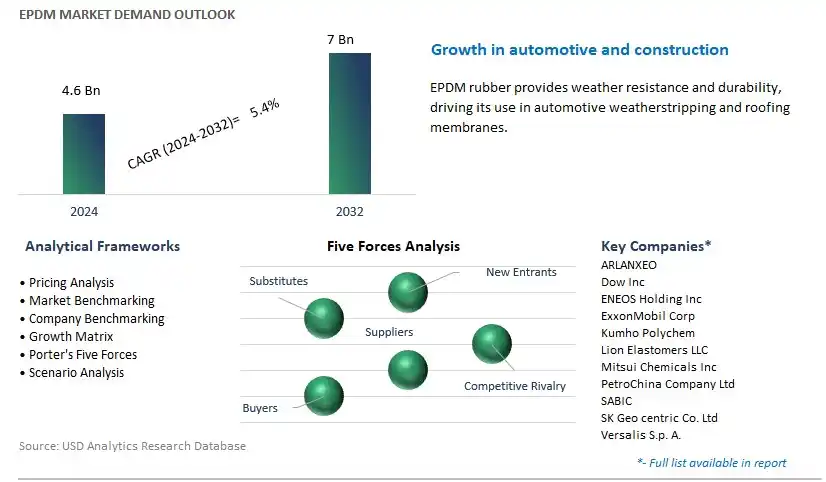
Global EPDM Market Size is valued at $4.6 Billion in 2024 and is forecast to register a growth rate (CAGR) of 5.4% to reach $7 Billion by 2032.
The global EPDM Market Study analyzes and forecasts the market size across 6 regions and 24 countries for diverse segments -By Manufacturing Process (Solution Polymerization Process, Slurry/Suspension Process, Gas-phase Polymerization Process), By Application (Automotive, Building & Construction, Plastic Modifications, Tires & Tubes, Wire & Cables, Lubricant Additives, Others).
An Introduction to EPDM Market in 2024
Ethylene Propylene Diene Monomer (EPDM) remains a cornerstone material in the realm of synthetic rubbers, renowned for its exceptional weather resistance, thermal stability, and electrical insulation properties. In 2024, the EPDM market s to flourish, driven by its widespread utilization in automotive components, roofing membranes, and electrical insulation. Notably, advancements in EPDM formulations have led to enhanced durability and resistance to aging, making it an ideal choice for outdoor applications exposed to harsh environmental conditions. Additionally, the growing emphasis on sustainability has spurred the development of bio-based and recyclable variants of EPDM, further augmenting its appeal across various industries.
EPDM Market Competitive Landscape
The market report analyses the leading companies in the industry including ARLANXEO, Dow Inc, ENEOS Holding Inc, ExxonMobil Corp, Kumho Polychem, Lion Elastomers LLC, Mitsui Chemicals Inc, PetroChina Company Ltd, SABIC, SK Geo centric Co. Ltd, Versalis S.p. A., and others.
EPDM Market Dynamics
Market Trend: Growing Demand for EPDM in Automotive and Construction Industries
A prominent trend in the EPDM (Ethylene Propylene Diene Monomer) market is the increasing demand from the automotive and construction industries. EPDM rubber is prized for its excellent weather resistance, thermal stability, and durability, making it a preferred choice for sealing systems, weatherstripping, roofing membranes, and automotive hoses and gaskets. As automotive manufacturers strive to enhance vehicle performance, fuel efficiency, and sustainability, and construction companies prioritize energy efficiency and environmental sustainability, the demand for EPDM continues to rise. This trend reflects the industry's reliance on EPDM as a versatile material that offers long-term reliability and performance in diverse applications.
Market Driver: Regulatory Standards and Sustainability Initiatives
A key driver propelling the demand for EPDM is the implementation of regulatory standards and sustainability initiatives aimed at reducing carbon emissions and enhancing energy efficiency in buildings and vehicles. EPDM's exceptional properties make it well-suited for meeting stringent regulatory requirements for weatherproofing, insulation, and sealing in construction projects and automotive applications. Moreover, EPDM's recyclability and compatibility with green building standards contribute to its popularity as a sustainable material choice. As governments worldwide enact stricter environmental regulations and promote sustainable development, the demand for EPDM is expected to further increase, driven by its contribution to energy conservation and environmental stewardship.
Market Opportunity: Expansion into Emerging Applications and Geographies
Amidst the growing demand for EPDM in established markets such as automotive and construction, there exists a significant opportunity for expansion into emerging applications and geographies. EPDM manufacturers can capitalize on this opportunity by diversifying their product offerings to cater to evolving market needs, such as EPDM blends for electrical insulation, thermoplastic EPDM for automotive interiors, and EPDM roofing membranes with enhanced fire resistance. Furthermore, targeting emerging markets in Asia-Pacific, Latin America, and Africa presents untapped opportunities for growth, driven by rapid urbanization, infrastructure development, and automotive production expansion. By leveraging innovation, strategic partnerships, and market intelligence, companies can seize opportunities to penetrate new application areas and geographical regions, thereby expanding their presence and market share in the global EPDM market.
EPDM Market Share Analysis: Solution Polymerization Process segment generated the highest revenue in 2024
The Solution Polymerization Process is the largest segment in the EPDM (Ethylene Propylene Diene Monomer) market. In the solution polymerization process, EPDM is synthesized by polymerizing ethylene, propylene, and a diene monomer in a solvent solution, resulting in a high-quality polymer with consistent properties and uniform molecular weight distribution. This manufacturing method offers advantages such as precise control over polymer structure, faster reaction kinetics, and the ability to produce EPDM with tailored properties to meet specific application requirements. Moreover, the solution polymerization process enables the production of EPDM with enhanced characteristics such as high tensile strength, excellent ozone and weather resistance, and superior thermal stability, making it suitable for various demanding applications in automotive, construction, and industrial sectors. Additionally, advancements in solution polymerization technology and catalyst systems contribute to the continuous improvement of EPDM properties and processing efficiency, further reinforcing the dominance of the Solution Polymerization Process in the EPDM market. Over the forecast period, the Solution Polymerization Process segment presents significant opportunities for manufacturers and end-users seeking high-performance EPDM materials with exceptional quality and versatility to address diverse application needs.
EPDM Market Share Analysis: Plastic Modifications is poised to register the fastest CAGR over the forecast period
The Plastic Modifications segment is the fastest-growing segment in the EPDM (Ethylene Propylene Diene Monomer) market. EPDM is widely used in plastic modifications, where it serves as a versatile and high-performance elastomer additive to enhance the mechanical, thermal, and weathering properties of plastics. With the increasing demand for durable and weather-resistant plastic materials in various industries such as automotive, consumer goods, and electronics, there's a growing need for EPDM-based additives to improve the performance and longevity of plastic products. Moreover, EPDM additives offer benefits such as increased flexibility, impact resistance, UV stability, and thermal conductivity, making them ideal for applications requiring tough and resilient plastic materials. Additionally, the rising emphasis on sustainability and recyclability in plastics drives the demand for EPDM-based additives, as they enable the development of eco-friendly and long-lasting plastic products. Furthermore, advancements in EPDM formulation technologies and compounding techniques cater to the evolving needs of plastic manufacturers for customized solutions tailored to specific application requirements, further fuelling the growth of the Plastic Modifications segment in the EPDM market. Over the forecast period, the Plastic Modifications segment presents significant growth opportunities driven by the increasing adoption of EPDM additives to enhance the performance and sustainability of plastic materials in diverse industrial and consumer applications.
EPDM Market
By Manufacturing Process
Solution Polymerization Process
Slurry/Suspension Process
Gas-phase Polymerization Process
By Application
Automotive
Building & Construction
Plastic Modifications
Tires & Tubes
Wire & Cables
Lubricant Additives
Others
Countries Analyzed
North America (US, Canada, Mexico)
Europe (Germany, UK, France, Spain, Italy, Russia, Rest of Europe)
Asia Pacific (China, India, Japan, South Korea, Australia, South East Asia, Rest of Asia)
South America (Brazil, Argentina, Rest of South America)
Middle East and Africa (Saudi Arabia, UAE, Rest of Middle East, South Africa, Egypt, Rest of Africa)
EPDM Companies Profiled in the Study
ARLANXEO
Dow Inc
ENEOS Holding Inc
ExxonMobil Corp
Kumho Polychem
Lion Elastomers LLC
Mitsui Chemicals Inc
PetroChina Company Ltd
SABIC
SK Geo centric Co. Ltd
Versalis S.p. A.
*- List Not Exhaustive
TABLE OF CONTENTS
1 Introduction to 2024 EPDM Market
1.1 Market Overview
1.2 Quick Facts
1.3 Scope/Objective of the Study
1.4 Market Definition
1.5 Countries and Regions Covered
1.6 Units, Currency, and Conversions
1.7 Industry Value Chain
2 Research Methodology
2.1 Market Size Estimation
2.2 Sources and Research Methodology
2.3 Data Triangulation
2.4 Assumptions and Limitations
3 Executive Summary
3.1 Global EPDM Market Size Outlook, $ Million, 2021 to 2032
3.2 EPDM Market Outlook by Type, $ Million, 2021 to 2032
3.3 EPDM Market Outlook by Product, $ Million, 2021 to 2032
3.4 EPDM Market Outlook by Application, $ Million, 2021 to 2032
3.5 EPDM Market Outlook by Key Countries, $ Million, 2021 to 2032
4 Market Dynamics
4.1 Key Driving Forces of EPDM Industry
4.2 Key Market Trends in EPDM Industry
4.3 Potential Opportunities in EPDM Industry
4.4 Key Challenges in EPDM Industry
5 Market Factor Analysis
5.1 Value Chain Analysis
5.2 Competitive Landscape
5.2.1 Global EPDM Market Share by Company (%), 2023
5.2.2 Product Offerings by Company
5.3 Porter’s Five Forces Analysis
5.4 Pricing Analysis and Outlook
6 Growth Outlook Across Scenarios
6.1 Growth Analysis-Case Scenario Definitions
6.2 Low Growth Scenario Forecasts
6.3 Reference Growth Scenario Forecasts
6.4 High Growth Scenario Forecasts
7 Global EPDM Market Outlook by Segments
7.1 EPDM Market Outlook by Segments, $ Million, 2021- 2032
By Manufacturing Process
Solution Polymerization Process
Slurry/Suspension Process
Gas-phase Polymerization Process
By Application
Automotive
Building & Construction
Plastic Modifications
Tires & Tubes
Wire & Cables
Lubricant Additives
Others
8 North America EPDM Market Analysis and Outlook To 2032
8.1 Introduction to North America EPDM Markets in 2024
8.2 North America EPDM Market Size Outlook by Country, 2021-2032
8.2.1 United States
8.2.2 Canada
8.2.3 Mexico
8.3 North America EPDM Market size Outlook by Segments, 2021-2032
By Manufacturing Process
Solution Polymerization Process
Slurry/Suspension Process
Gas-phase Polymerization Process
By Application
Automotive
Building & Construction
Plastic Modifications
Tires & Tubes
Wire & Cables
Lubricant Additives
Others
9 Europe EPDM Market Analysis and Outlook To 2032
9.1 Introduction to Europe EPDM Markets in 2024
9.2 Europe EPDM Market Size Outlook by Country, 2021-2032
9.2.1 Germany
9.2.2 France
9.2.3 Spain
9.2.4 United Kingdom
9.2.4 Italy
9.2.5 Russia
9.2.6 Norway
9.2.7 Rest of Europe
9.3 Europe EPDM Market Size Outlook by Segments, 2021-2032
By Manufacturing Process
Solution Polymerization Process
Slurry/Suspension Process
Gas-phase Polymerization Process
By Application
Automotive
Building & Construction
Plastic Modifications
Tires & Tubes
Wire & Cables
Lubricant Additives
Others
10 Asia Pacific EPDM Market Analysis and Outlook To 2032
10.1 Introduction to Asia Pacific EPDM Markets in 2024
10.2 Asia Pacific EPDM Market Size Outlook by Country, 2021-2032
10.2.1 China
10.2.2 India
10.2.3 Japan
10.2.4 South Korea
10.2.5 Indonesia
10.2.6 Malaysia
10.2.7 Australia
10.2.8 Rest of Asia Pacific
10.3 Asia Pacific EPDM Market size Outlook by Segments, 2021-2032
By Manufacturing Process
Solution Polymerization Process
Slurry/Suspension Process
Gas-phase Polymerization Process
By Application
Automotive
Building & Construction
Plastic Modifications
Tires & Tubes
Wire & Cables
Lubricant Additives
Others
11 South America EPDM Market Analysis and Outlook To 2032
11.1 Introduction to South America EPDM Markets in 2024
11.2 South America EPDM Market Size Outlook by Country, 2021-2032
11.2.1 Brazil
11.2.2 Argentina
11.2.3 Rest of South America
11.3 South America EPDM Market size Outlook by Segments, 2021-2032
By Manufacturing Process
Solution Polymerization Process
Slurry/Suspension Process
Gas-phase Polymerization Process
By Application
Automotive
Building & Construction
Plastic Modifications
Tires & Tubes
Wire & Cables
Lubricant Additives
Others
12 Middle East and Africa EPDM Market Analysis and Outlook To 2032
12.1 Introduction to Middle East and Africa EPDM Markets in 2024
12.2 Middle East and Africa EPDM Market Size Outlook by Country, 2021-2032
12.2.1 Saudi Arabia
12.2.2 UAE
12.2.3 Oman
12.2.4 Rest of Middle East
12.2.5 Egypt
12.2.6 Nigeria
12.2.7 South Africa
12.2.8 Rest of Africa
12.3 Middle East and Africa EPDM Market size Outlook by Segments, 2021-2032
By Manufacturing Process
Solution Polymerization Process
Slurry/Suspension Process
Gas-phase Polymerization Process
By Application
Automotive
Building & Construction
Plastic Modifications
Tires & Tubes
Wire & Cables
Lubricant Additives
Others
13 Company Profiles
13.1 Company Snapshot
13.2 SWOT Profiles
13.3 Products and Services
13.4 Recent Developments
13.5 Financial Profile
ARLANXEO
Dow Inc
ENEOS Holding Inc
ExxonMobil Corp
Kumho Polychem
Lion Elastomers LLC
Mitsui Chemicals Inc
PetroChina Company Ltd
SABIC
SK Geo centric Co. Ltd
Versalis S.p. A.
14 Appendix
14.1 Customization Offerings
14.2 Subscription Services
14.3 Related Reports
14.4 Publisher Expertise
By Manufacturing Process
Solution Polymerization Process
Slurry/Suspension Process
Gas-phase Polymerization Process
By Application
Automotive
Building & Construction
Plastic Modifications
Tires & Tubes
Wire & Cables
Lubricant Additives
Others
Countries Analyzed
North America (US, Canada, Mexico)
Europe (Germany, UK, France, Spain, Italy, Russia, Rest of Europe)
Asia Pacific (China, India, Japan, South Korea, Australia, South East Asia, Rest of Asia)
South America (Brazil, Argentina, Rest of South America)
Middle East and Africa (Saudi Arabia, UAE, Rest of Middle East, South Africa, Egypt, Rest of Africa)
