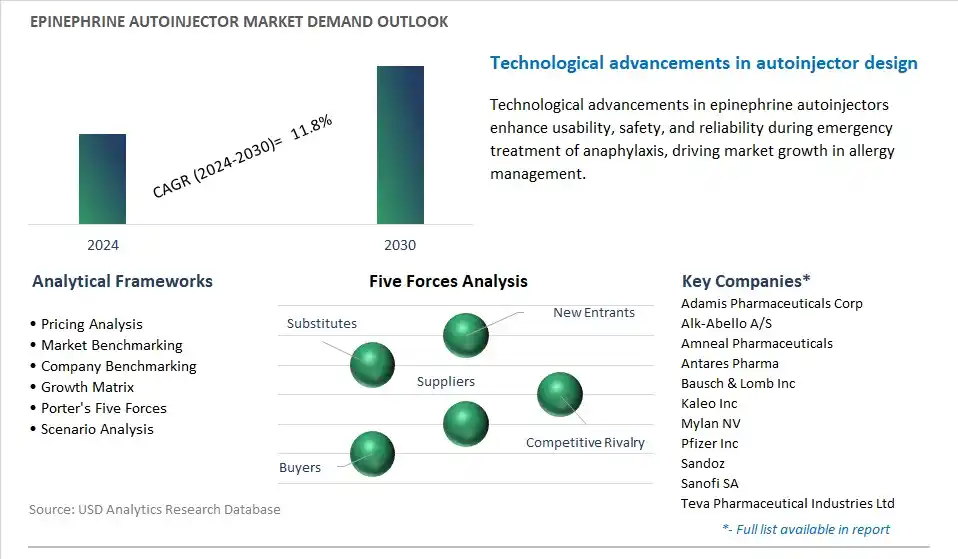
Epinephrine Autoinjector Market is estimated to increase at a growth rate of 11.8% CAGR over the forecast period from 2024 to 2030.
The global Epinephrine Autoinjector Market Study analyzes and forecasts the market size across 6 regions and 24 countries for diverse segments including By Dosage (0.15 mg, 0.30 mg, 0.5 mg), By Age Group (0 to 6 Years, 6 to 12 Years, Over 12 Years), By End-User (Hospitals, Clinics, Home-based).
An Introduction to Epinephrine Autoinjector Market in 2024
The Epinephrine Autoinjector Market includes medical devices designed for the emergency treatment of severe allergic reactions (anaphylaxis) by delivering a rapid dose of epinephrine (adrenaline) via an autoinjector device. These devices are essential for individuals with known allergies to insect stings, foods, medications, or other allergens, providing on-the-spot administration of epinephrine to counteract allergic symptoms and prevent life-threatening complications. With a focus on user-friendly designs, intuitive operation, and portability, the epinephrine autoinjector market supports prompt and effective management of anaphylaxis in various settings, including homes, schools, healthcare facilities, and public spaces.
Epinephrine Autoinjector Market Competitive Landscape
The global Epinephrine Autoinjector Industry is highly competitive with a large number of companies focusing on niche market segments. Amidst intense competitive conditions, Epinephrine Autoinjector Companies are investing in new product launches and strengthening distribution channels. Key companies operating in the Epinephrine Autoinjector Industry include- Adamis Pharmaceuticals Corp, Alk-Abello A/S, Amneal Pharmaceuticals, Antares Pharma, Bausch & Lomb Inc, Kaleo Inc, Mylan NV, Pfizer Inc, Sandoz, Sanofi SA, Teva Pharmaceutical Industries Ltd.
Epinephrine Autoinjector Market Trend: Increased Awareness and Accessibility of Epinephrine Autoinjectors
In the Epinephrine Autoinjector market, a significant trend is the increased awareness and accessibility of these life-saving devices. Epinephrine autoinjectors are used for the emergency treatment of severe allergic reactions, such as anaphylaxis, which can be triggered by food allergies, insect stings, medications, or other allergens. In recent years, there has been growing recognition of the importance of prompt and effective management of anaphylaxis, leading to increased awareness among healthcare providers, patients, caregivers, and the general public about the need for epinephrine autoinjectors. This trend is further supported by initiatives such as public health campaigns, legislation mandating the availability of epinephrine in schools and public places, and efforts to improve access to affordable autoinjector devices. As a result, there is a growing market opportunity for epinephrine autoinjectors that offer user-friendly designs, reliable performance, and affordability to meet the needs of individuals at risk of anaphylaxis.
Epinephrine Autoinjector Market Driver: Rising Prevalence of Allergic Diseases and Anaphylactic Reactions
The primary driver for the Epinephrine Autoinjector market is the rising prevalence of allergic diseases and anaphylactic reactions worldwide. Allergic diseases, including food allergies, asthma, allergic rhinitis, and atopic dermatitis, are becoming increasingly common, affecting millions of individuals globally. Anaphylaxis, a severe and potentially life-threatening allergic reaction, can occur suddenly and require immediate intervention with epinephrine to prevent serious complications or fatalities. As the incidence of allergic diseases and anaphylactic reactions continues to rise, there is a corresponding increase in the demand for epinephrine autoinjectors as essential emergency treatments. Additionally, with heightened awareness of allergies and improved diagnostic capabilities, more individuals are being diagnosed with allergies and prescribed epinephrine autoinjectors as part of their emergency action plans, driving market growth within the segment.
Epinephrine Autoinjector Market Opportunity: Innovation in Device Design and Technology Integration
An opportunity exists in innovation in device design and technology integration to enhance the usability, effectiveness, and accessibility of epinephrine autoinjectors. While existing autoinjector devices are effective in delivering life-saving medication, there is room for improvement in terms of user experience, portability, and functionality. Companies can capitalize on this opportunity by investing in research and development to create next-generation autoinjectors with features such as ergonomic designs, intuitive user interfaces, and built-in training modules to guide users through the injection process. Additionally, there is potential for the integration of connectivity features, such as smartphone apps or Bluetooth-enabled devices, to provide real-time alerts, dose tracking, and emergency notifications to caregivers or healthcare providers. By enhancing device design and technology integration, companies can improve the user experience, increase adherence to treatment protocols, and ultimately save lives in emergency situations involving anaphylaxis.
Market Share Analysis: Epinephrine Autoinjector - 0.15 mg for Ages 0 to 6 Years in Home-based Settings is the fastest growing segment in the Epinephrine Autoinjector industry
The segment of Epinephrine Autoinjector with a dosage of 0.15 mg specifically tailored for children aged 0 to 6 years and distributed for home-based use is experiencing remarkable growth. This surge can be attributed to the increasing awareness about severe allergic reactions, such as anaphylaxis, in young children, and the necessity for prompt and effective treatment. With the prevalence of food allergies and other allergens rising among infants and toddlers, there is a growing demand for safe and user-friendly epinephrine autoinjectors suitable for this age group. Home-based settings offer convenience and accessibility for parents and caregivers to administer emergency treatment swiftly in case of allergic reactions, making the 0.15 mg epinephrine autoinjector a vital tool in managing pediatric allergies. As more parents and caregivers seek out reliable solutions for managing allergic emergencies in young children, the market for 0.15 mg epinephrine autoinjectors designed for home-based use in the 0 to 6 years age group is experiencing significant growth, prompting pharmaceutical companies to innovate and expand their offerings in this segment.
Epinephrine Autoinjector Market Segmentation
By Dosage
0.15 mg
0.30 mg
0.5 mg
By Age-group
0 to 6 Years
6 to 12 Years
Over 12 Years
By End-User
Hospitals
Clinics
Home-based
Geographical Analysis
North America (United States, Canada, Mexico)
Europe (Germany, France, United Kingdom, Spain, Italy, Rest of Europe)
Asia Pacific (China, India, Japan, South Korea, Rest of Asia Pacific)
South America (Brazil, Argentina, Rest of South America)
Middle East and Africa (Saudi Arabia, UAE, Rest of Middle East, South Africa, Egypt, Rest of Africa)
Epinephrine Autoinjector Companies
Adamis Pharmaceuticals Corp
Alk-Abello A/S
Amneal Pharmaceuticals
Antares Pharma
Bausch & Lomb Inc
Kaleo Inc
Mylan NV
Pfizer Inc
Sandoz
Sanofi SA
Teva Pharmaceutical Industries Ltd
* List not Exhaustive
Reasons to Buy the Epinephrine Autoinjector Market Study
• Deepen your industry insights and navigate uncertainties for strategy formulation, CAPEX, and Operational decisions
• Gain access to detailed insights on the Epinephrine Autoinjector Market, encompassing current market size, growth trends, and forecasts till 2030.
• Access detailed competitor analysis, enabling competitive advantage through a thorough understanding of market players, strategies, and potential differentiation opportunities
• Stay ahead of the curve with insights on technological advancements, innovations, and upcoming trends
• Identify lucrative investment avenues and expansion opportunities within the Epinephrine Autoinjector Industry, guided by robust, data-backed analysis.
• Understand regional and global markets through country-wise analysis, regional market potential, regulatory nuances, and dynamics
• Execute strategies with confidence and speed through information, analytics, and insights on the industry value chain
• Corporate leaders, strategists, financial experts, shareholders, asset managers, and governmental representatives can make long-term planning scenarios and build an integrated and timely understanding of market dynamics
• Benefit from tailored solutions and expert consultation based on report insights, providing personalized strategies aligned with specific business needs.
TABLE OF CONTENTS
1 Introduction to 2024 Epinephrine Autoinjector Market
1.1 Market Overview
1.2 Quick Facts
1.3 Scope/Objective of the Study
1.4 Market Definition
1.5 Countries and Regions Analyzed
1.6 Units, Currency, and Conversions
1.7 Industry Value Chain
2 Research Methodology
2.1 Market Size Estimation
2.2 Sources and Research Methodology
2.3 Data Triangulation
2.4 Assumptions and Limitations
3 Executive Summary
3.1 Global Epinephrine Autoinjector Market Size Outlook, $ Million, 2021 to 2030
3.2 Epinephrine Autoinjector Market Outlook by Type, $ Million, 2021 to 2030
3.3 Epinephrine Autoinjector Market Outlook by Product, $ Million, 2021 to 2030
3.4 Epinephrine Autoinjector Market Outlook by Application, $ Million, 2021 to 2030
3.5 Epinephrine Autoinjector Market Outlook by Key Countries, $ Million, 2021 to 2030
4 Market Dynamics
4.1 Key Driving Forces of Epinephrine Autoinjector Industry
4.2 Key Market Trends in Epinephrine Autoinjector Industry
4.3 Potential Opportunities in Epinephrine Autoinjector Industry
4.4 Key Challenges in Epinephrine Autoinjector Industry
5 Market Factor Analysis
5.1 Value Chain Analysis
5.2 Competitive Landscape
5.2.1 Global Epinephrine Autoinjector Market Share by Company (%), 2023
5.2.2 Product Offerings by Company
5.3 Porter’s Five Forces Analysis
5.4 Pricing Analysis and Outlook
6 Growth Outlook Across Scenarios
6.1 Growth Analysis-Case Scenario Definitions
6.2 Low Growth Scenario Forecasts
6.3 Reference Growth Scenario Forecasts
6.4 High Growth Scenario Forecasts
7 Global Epinephrine Autoinjector Market Outlook by Segments
7.1 Epinephrine Autoinjector Market Outlook by Segments, $ Million, 2021- 2030
By Dosage
0.15 mg
0.30 mg
0.5 mg
By Age-group
0 to 6 Years
6 to 12 Years
Over 12 Years
By End-User
Hospitals
Clinics
Home-based
8 North America Epinephrine Autoinjector Market Analysis and Outlook To 2030
8.1 Introduction to North America Epinephrine Autoinjector Markets in 2024
8.2 North America Epinephrine Autoinjector Market Size Outlook by Country, 2021-2030
8.2.1 United States
8.2.2 Canada
8.2.3 Mexico
8.3 North America Epinephrine Autoinjector Market size Outlook by Segments, 2021-2030
By Dosage
0.15 mg
0.30 mg
0.5 mg
By Age-group
0 to 6 Years
6 to 12 Years
Over 12 Years
By End-User
Hospitals
Clinics
Home-based
9 Europe Epinephrine Autoinjector Market Analysis and Outlook To 2030
9.1 Introduction to Europe Epinephrine Autoinjector Markets in 2024
9.2 Europe Epinephrine Autoinjector Market Size Outlook by Country, 2021-2030
9.2.1 Germany
9.2.2 France
9.2.3 Spain
9.2.4 United Kingdom
9.2.4 Italy
9.2.5 Russia
9.2.6 Norway
9.2.7 Rest of Europe
9.3 Europe Epinephrine Autoinjector Market Size Outlook by Segments, 2021-2030
By Dosage
0.15 mg
0.30 mg
0.5 mg
By Age-group
0 to 6 Years
6 to 12 Years
Over 12 Years
By End-User
Hospitals
Clinics
Home-based
10 Asia Pacific Epinephrine Autoinjector Market Analysis and Outlook To 2030
10.1 Introduction to Asia Pacific Epinephrine Autoinjector Markets in 2024
10.2 Asia Pacific Epinephrine Autoinjector Market Size Outlook by Country, 2021-2030
10.2.1 China
10.2.2 India
10.2.3 Japan
10.2.4 South Korea
10.2.5 Indonesia
10.2.6 Malaysia
10.2.7 Australia
10.2.8 Rest of Asia Pacific
10.3 Asia Pacific Epinephrine Autoinjector Market size Outlook by Segments, 2021-2030
By Dosage
0.15 mg
0.30 mg
0.5 mg
By Age-group
0 to 6 Years
6 to 12 Years
Over 12 Years
By End-User
Hospitals
Clinics
Home-based
11 South America Epinephrine Autoinjector Market Analysis and Outlook To 2030
11.1 Introduction to South America Epinephrine Autoinjector Markets in 2024
11.2 South America Epinephrine Autoinjector Market Size Outlook by Country, 2021-2030
11.2.1 Brazil
11.2.2 Argentina
11.2.3 Rest of South America
11.3 South America Epinephrine Autoinjector Market size Outlook by Segments, 2021-2030
By Dosage
0.15 mg
0.30 mg
0.5 mg
By Age-group
0 to 6 Years
6 to 12 Years
Over 12 Years
By End-User
Hospitals
Clinics
Home-based
12 Middle East and Africa Epinephrine Autoinjector Market Analysis and Outlook To 2030
12.1 Introduction to Middle East and Africa Epinephrine Autoinjector Markets in 2024
12.2 Middle East and Africa Epinephrine Autoinjector Market Size Outlook by Country, 2021-2030
12.2.1 Saudi Arabia
12.2.2 UAE
12.2.3 Oman
12.2.4 Rest of Middle East
12.2.5 Egypt
12.2.6 Nigeria
12.2.7 South Africa
12.2.8 Rest of Africa
12.3 Middle East and Africa Epinephrine Autoinjector Market size Outlook by Segments, 2021-2030
By Dosage
0.15 mg
0.30 mg
0.5 mg
By Age-group
0 to 6 Years
6 to 12 Years
Over 12 Years
By End-User
Hospitals
Clinics
Home-based
13 Company Profiles
13.1 Company Snapshot
13.2 SWOT Profiles
13.3 Products and Services
13.4 Recent Developments
13.5 Financial Profile
List of Companies
Adamis Pharmaceuticals Corp
Alk-Abello A/S
Amneal Pharmaceuticals
Antares Pharma
Bausch & Lomb Inc
Kaleo Inc
Mylan NV
Pfizer Inc
Sandoz
Sanofi SA
Teva Pharmaceutical Industries Ltd
14 Appendix
14.1 Customization Offerings
14.2 Subscription Services
14.3 Related Reports
14.4 Publisher Expertise
