
The global Escalators and Moving Walkways Market Study analyzes and forecasts the market size across 6 regions and 24 countries for diverse segments -By Product (Escalators, Moving Walkways), By Business (New Equipment, Maintenance, Modernization), By Application (Retail, Public Transit, Airports, Institution, Others).
The future of the escalators and moving walkways market is influenced by trends such as urbanization, transportation infrastructure upgrades, and advancements in technology driving innovation in system design, safety features, and energy efficiency. Escalators and moving walkways play a crucial role in facilitating pedestrian movement in various environments, including airports, shopping malls, and transit stations. Key trends shaping this market include the development of smart escalator systems with features such as real-time monitoring, predictive maintenance, and passenger flow optimization to improve efficiency and reliability, the integration of safety enhancements such as anti-slip surfaces, handrail sanitization systems, and emergency stop mechanisms to enhance passenger safety and comfort, and the adoption of energy-efficient components and regenerative braking systems to reduce energy consumption and environmental impact. As urban populations grow and transportation networks become more integrated, the demand for escalators and moving walkways that offer safe, efficient, and sustainable mobility solutions is expected to drive market growth and inspire further innovation in system design and technology.
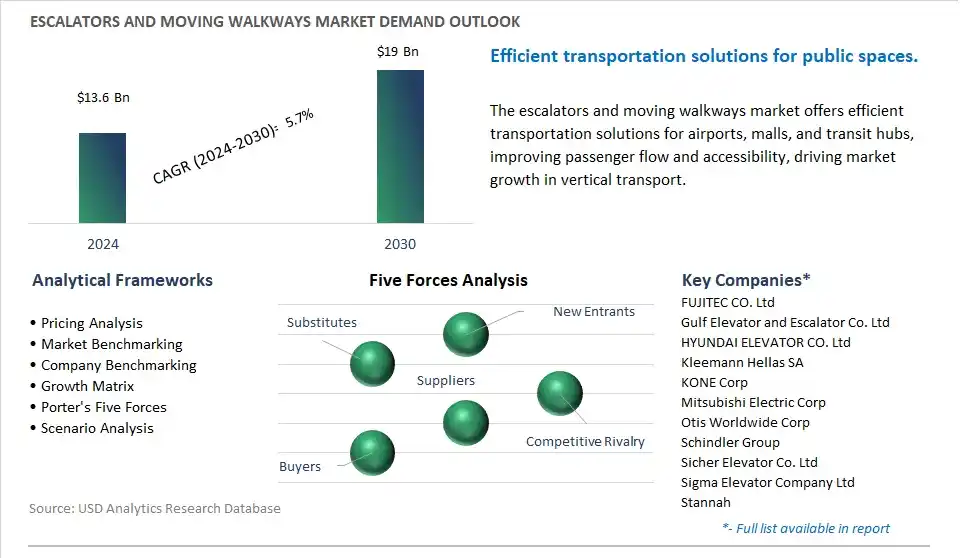
The market report analyses the leading companies in the industry including FUJITEC CO. Ltd, Gulf Elevator and Escalator Co. Ltd, HYUNDAI ELEVATOR CO. Ltd, Kleemann Hellas SA, KONE Corp, Mitsubishi Electric Corp, Otis Worldwide Corp, Schindler Group, Sicher Elevator Co. Ltd, Sigma Elevator Company Ltd, Stannah, Stein Ltd, Thyssenkrupp AG, TK Elevator, Toshiba Corp.
One prominent market trend in the escalators and moving walkways industry is the rapid urbanization and infrastructure development taking place in urban centers worldwide. As populations continue to migrate to cities, there is a growing demand for efficient transportation solutions within public spaces, commercial complexes, transportation hubs, and retail environments. Escalators and moving walkways play a crucial role in facilitating the movement of people within buildings and large-scale infrastructure projects, enhancing accessibility, convenience, and traffic flow.
A key driver in the escalators and moving walkways market is the increasing focus on passenger safety and comfort. With the rise in passenger volumes and the importance of enhancing the passenger experience, there is a heightened emphasis on implementing advanced safety features, ergonomic designs, and user-friendly interfaces in escalator and moving walkway systems. Manufacturers and operators prioritize the integration of safety sensors, emergency stop mechanisms, anti-slip surfaces, and ergonomic handrails to ensure the well-being of passengers and prevent accidents or injuries. Additionally, innovations in technology, such as destination control systems and energy-efficient designs, contribute to improving passenger comfort, reducing wait times, and optimizing energy consumption.
One potential opportunity in the escalators and moving walkways market lies in the adoption of smart technologies and connectivity to enhance system performance, maintenance efficiency, and passenger experience. Manufacturers have an opportunity to integrate IoT (Internet of Things) sensors, predictive maintenance algorithms, and remote monitoring capabilities into escalator and moving walkway systems. By collecting and analyzing real-time data on equipment status, usage patterns, and performance metrics, operators can proactively identify potential issues, schedule maintenance activities, and optimize system uptime. Furthermore, connectivity features enable operators to deliver personalized passenger services, such as real-time information displays, wayfinding assistance, and targeted advertisements. Embracing smart technologies and connectivity not only improves operational efficiency but also enhances the overall passenger journey, making escalators and moving walkways integral components of smart, connected urban environments.
The Escalators and Moving Walkways market involves a comprehensive Market Ecosystem, with research and development initiatives undertaken by leading manufacturers including ThyssenKrupp Elevator, Schindler Group, and KONE, aimed at enhancing safety, energy efficiency, and passenger experience. Universities also play a limited role in researching relevant areas including materials science and control systems. Manufacturing facilities operated by elevator and escalator manufacturers produce components for these transportation systems, with material suppliers including ArcelorMittal and Covestro providing essential materials.
Distribution channels are established through manufacturer sales teams that engage with construction companies and building owners, while distributors occasionally handle specific component distribution. Installation, testing, and commissioning are handled by specialized elevator and escalator installation companies in collaboration with construction contractors, if necessary. Maintenance and service are provided by dedicated maintenance companies and manufacturer service teams, ensuring optimal functioning and safety.
Modernization and renovation services are offered by specialized companies or provided by manufacturers themselves to upgrade existing escalators and moving walkways with newer components and features.
The largest segment in the Escalators and Moving Walkways Market is the "Escalators" product category. This dominance can be attributed to diverse key factors. Firstly, escalators are widely used in various settings such as shopping malls, airports, metro stations, and commercial buildings to facilitate vertical transportation of people between different floors efficiently and safely. Escalators are essential components of modern infrastructure, providing convenience and accessibility to pedestrians, shoppers, commuters, and travelers. Additionally, escalators are installed in high-traffic areas where the volume of foot traffic requires continuous and reliable transportation solutions. Further, escalators are available in various configurations, including straight, curved, and spiral designs, allowing for flexibility in installation and integration into diverse architectural layouts. In addition, escalators are often preferred over moving walkways in locations with significant vertical distances or where space constraints limit the installation of long, continuous walkways. As a result, the Escalators product segment remains the largest in the Escalators and Moving Walkways Market due to its widespread application, high demand, and essential role in modern urban mobility and transportation infrastructure.
The fastest-growing segment in the Escalators and Moving Walkways Market is the "Modernization" business category. This growth can be attributed to diverse key factors. Firstly, as urbanization continues to expand rapidly, existing escalators and moving walkways in various public spaces, transportation hubs, and commercial buildings are aging and in need of upgrades to meet modern safety standards, energy efficiency requirements, and user expectations. Modernization involves retrofitting and upgrading existing escalators and moving walkways with advanced technologies, improved safety features, energy-efficient components, and enhanced aesthetics to prolong their service life and maintain optimal performance. Additionally, modernization initiatives aim to address reliability issues, reduce downtime, and improve the overall passenger experience by incorporating features such as destination control systems, digital displays, real-time monitoring, and predictive maintenance capabilities. In addition, stringent regulations and industry standards governing escalator and moving walkway safety and performance drive the demand for modernization services to ensure compliance and mitigate risks associated with outdated equipment. Further, the economic benefits of modernization, such as lower operating costs, reduced energy consumption, and extended equipment lifespan, incentivize building owners, facility managers, and transportation authorities to invest in modernization projects as a cost-effective alternative to purchasing new equipment. As a result, the Modernization business segment is experiencing rapid growth in the Escalators and Moving Walkways Market due to the increasing demand for upgrading and optimizing existing infrastructure to meet evolving safety, efficiency, and sustainability requirements in urban environments.
The fastest-growing segment in the Escalators and Moving Walkways Market is the "Airports" application category. This growth can be attributed to diverse key factors. Firstly, airports are major transportation hubs experiencing continuous growth in passenger traffic due to increasing air travel demand worldwide. Escalators and moving walkways play a crucial role in enhancing passenger flow, efficiency, and comfort within airport terminals by providing quick and convenient vertical transportation between different levels, gates, and facilities. Additionally, airports are undergoing expansion and renovation projects to accommodate growing passenger volumes, modernize infrastructure, and improve the passenger experience. As a result, there is a rising demand for escalators and moving walkways to support airport expansion initiatives and meet the evolving needs of travelers. Further, airports prioritize safety, reliability, and operational efficiency, driving the adoption of advanced escalator and moving walkway technologies, including destination control systems, real-time monitoring, and predictive maintenance solutions, to ensure seamless operations and minimize downtime. In addition, the COVID-19 pandemic has accelerated the adoption of touchless technologies and social distancing measures in airports, leading to increased interest in contactless escalator and moving walkway solutions equipped with sensor-based controls and sanitation features to enhance passenger safety and hygiene. Additionally, airports are focusing on sustainability initiatives to reduce energy consumption and environmental impact, prompting the adoption of energy-efficient escalators and moving walkways with regenerative braking systems and LED lighting. As a result, the Airports application segment is experiencing rapid growth in the Escalators and Moving Walkways Market due to the increasing demand for efficient, safe, and technologically advanced vertical transportation solutions in airport terminals worldwide.
By Product
Escalators
-Parallel
-Multi-Parallel
-Others
Moving Walkways
By Business
New Equipment
Maintenance
Modernization
By Application
Retail
Public Transit
Airports
Institution
Others
FUJITEC CO. Ltd
Gulf Elevator and Escalator Co. Ltd
HYUNDAI ELEVATOR CO. Ltd
Kleemann Hellas SA
KONE Corp
Mitsubishi Electric Corp
Otis Worldwide Corp
Schindler Group
Sicher Elevator Co. Ltd
Sigma Elevator Company Ltd
Stannah
Stein Ltd
Thyssenkrupp AG
TK Elevator
Toshiba Corp
*- List Not Exhaustive
TABLE OF CONTENTS
1 Introduction to 2024 Escalators and Moving Walkways Market
1.1 Market Overview
1.2 Quick Facts
1.3 Scope/Objective of the Study
1.4 Market Definition
1.5 Countries and Regions Covered
1.6 Units, Currency, and Conversions
1.7 Industry Value Chain
2 Research Methodology
2.1 Market Size Estimation
2.2 Sources and Research Methodology
2.3 Data Triangulation
2.4 Assumptions and Limitations
3 Executive Summary
3.1 Global Escalators and Moving Walkways Market Size Outlook, $ Million, 2021 to 2030
3.2 Escalators and Moving Walkways Market Outlook by Type, $ Million, 2021 to 2030
3.3 Escalators and Moving Walkways Market Outlook by Product, $ Million, 2021 to 2030
3.4 Escalators and Moving Walkways Market Outlook by Application, $ Million, 2021 to 2030
3.5 Escalators and Moving Walkways Market Outlook by Key Countries, $ Million, 2021 to 2030
4 Market Dynamics
4.1 Key Driving Forces of Escalators and Moving Walkways Industry
4.2 Key Market Trends in Escalators and Moving Walkways Industry
4.3 Potential Opportunities in Escalators and Moving Walkways Industry
4.4 Key Challenges in Escalators and Moving Walkways Industry
5 Market Factor Analysis
5.1 Value Chain Analysis
5.2 Competitive Landscape
5.2.1 Global Escalators and Moving Walkways Market Share by Company (%), 2023
5.2.2 Product Offerings by Company
5.3 Porter’s Five Forces Analysis
5.4 Pricing Analysis and Outlook
6 Growth Outlook Across Scenarios
6.1 Growth Analysis-Case Scenario Definitions
6.2 Low Growth Scenario Forecasts
6.3 Reference Growth Scenario Forecasts
6.4 High Growth Scenario Forecasts
7 Global Escalators and Moving Walkways Market Outlook by Segments
7.1 Escalators and Moving Walkways Market Outlook by Segments, $ Million, 2021- 2030
By Product
Escalators
-Parallel
-Multi-Parallel
-Others
Moving Walkways
By Business
New Equipment
Maintenance
Modernization
By Application
Retail
Public Transit
Airports
Institution
Others
8 North America Escalators and Moving Walkways Market Analysis and Outlook To 2030
8.1 Introduction to North America Escalators and Moving Walkways Markets in 2024
8.2 North America Escalators and Moving Walkways Market Size Outlook by Country, 2021-2030
8.2.1 United States
8.2.2 Canada
8.2.3 Mexico
8.3 North America Escalators and Moving Walkways Market size Outlook by Segments, 2021-2030
By Product
Escalators
-Parallel
-Multi-Parallel
-Others
Moving Walkways
By Business
New Equipment
Maintenance
Modernization
By Application
Retail
Public Transit
Airports
Institution
Others
9 Europe Escalators and Moving Walkways Market Analysis and Outlook To 2030
9.1 Introduction to Europe Escalators and Moving Walkways Markets in 2024
9.2 Europe Escalators and Moving Walkways Market Size Outlook by Country, 2021-2030
9.2.1 Germany
9.2.2 France
9.2.3 Spain
9.2.4 United Kingdom
9.2.4 Italy
9.2.5 Russia
9.2.6 Norway
9.2.7 Rest of Europe
9.3 Europe Escalators and Moving Walkways Market Size Outlook by Segments, 2021-2030
By Product
Escalators
-Parallel
-Multi-Parallel
-Others
Moving Walkways
By Business
New Equipment
Maintenance
Modernization
By Application
Retail
Public Transit
Airports
Institution
Others
10 Asia Pacific Escalators and Moving Walkways Market Analysis and Outlook To 2030
10.1 Introduction to Asia Pacific Escalators and Moving Walkways Markets in 2024
10.2 Asia Pacific Escalators and Moving Walkways Market Size Outlook by Country, 2021-2030
10.2.1 China
10.2.2 India
10.2.3 Japan
10.2.4 South Korea
10.2.5 Indonesia
10.2.6 Malaysia
10.2.7 Australia
10.2.8 Rest of Asia Pacific
10.3 Asia Pacific Escalators and Moving Walkways Market size Outlook by Segments, 2021-2030
By Product
Escalators
-Parallel
-Multi-Parallel
-Others
Moving Walkways
By Business
New Equipment
Maintenance
Modernization
By Application
Retail
Public Transit
Airports
Institution
Others
11 South America Escalators and Moving Walkways Market Analysis and Outlook To 2030
11.1 Introduction to South America Escalators and Moving Walkways Markets in 2024
11.2 South America Escalators and Moving Walkways Market Size Outlook by Country, 2021-2030
11.2.1 Brazil
11.2.2 Argentina
11.2.3 Rest of South America
11.3 South America Escalators and Moving Walkways Market size Outlook by Segments, 2021-2030
By Product
Escalators
-Parallel
-Multi-Parallel
-Others
Moving Walkways
By Business
New Equipment
Maintenance
Modernization
By Application
Retail
Public Transit
Airports
Institution
Others
12 Middle East and Africa Escalators and Moving Walkways Market Analysis and Outlook To 2030
12.1 Introduction to Middle East and Africa Escalators and Moving Walkways Markets in 2024
12.2 Middle East and Africa Escalators and Moving Walkways Market Size Outlook by Country, 2021-2030
12.2.1 Saudi Arabia
12.2.2 UAE
12.2.3 Oman
12.2.4 Rest of Middle East
12.2.5 Egypt
12.2.6 Nigeria
12.2.7 South Africa
12.2.8 Rest of Africa
12.3 Middle East and Africa Escalators and Moving Walkways Market size Outlook by Segments, 2021-2030
By Product
Escalators
-Parallel
-Multi-Parallel
-Others
Moving Walkways
By Business
New Equipment
Maintenance
Modernization
By Application
Retail
Public Transit
Airports
Institution
Others
13 Company Profiles
13.1 Company Snapshot
13.2 SWOT Profiles
13.3 Products and Services
13.4 Recent Developments
13.5 Financial Profile
FUJITEC CO. Ltd
Gulf Elevator and Escalator Co. Ltd
HYUNDAI ELEVATOR CO. Ltd
Kleemann Hellas SA
KONE Corp
Mitsubishi Electric Corp
Otis Worldwide Corp
Schindler Group
Sicher Elevator Co. Ltd
Sigma Elevator Company Ltd
Stannah
Stein Ltd
Thyssenkrupp AG
TK Elevator
Toshiba Corp
14 Appendix
14.1 Customization Offerings
14.2 Subscription Services
14.3 Related Reports
14.4 Publisher Expertise
By Product
Escalators
-Parallel
-Multi-Parallel
-Others
Moving Walkways
By Business
New Equipment
Maintenance
Modernization
By Application
Retail
Public Transit
Airports
Institution
Others
Countries Analyzed
North America (US, Canada, Mexico)
Europe (Germany, UK, France, Spain, Italy, Russia, Rest of Europe)
Asia Pacific (China, India, Japan, South Korea, Australia, South East Asia, Rest of Asia)
South America (Brazil, Argentina, Rest of South America)
Middle East and Africa (Saudi Arabia, UAE, Rest of Middle East, South Africa, Egypt, Rest of Africa)
Global Escalators and Moving Walkways is forecast to reach $19 Billion in 2030 from $13.6 Billion in 2024, registering a CAGR of 5.7% over the outlook period
Emerging Markets across Asia Pacific, Europe, and Americas present robust growth prospects.
FUJITEC CO. Ltd, Gulf Elevator and Escalator Co. Ltd, HYUNDAI ELEVATOR CO. Ltd, Kleemann Hellas SA, KONE Corp, Mitsubishi Electric Corp, Otis Worldwide Corp, Schindler Group, Sicher Elevator Co. Ltd, Sigma Elevator Company Ltd, Stannah, Stein Ltd, Thyssenkrupp AG, TK Elevator, Toshiba Corp
Base Year- 2023; Estimated Year- 2024; Historic Period- 2018-2023; Forecast period- 2024 to 2030; Currency: Revenue (USD); Volume