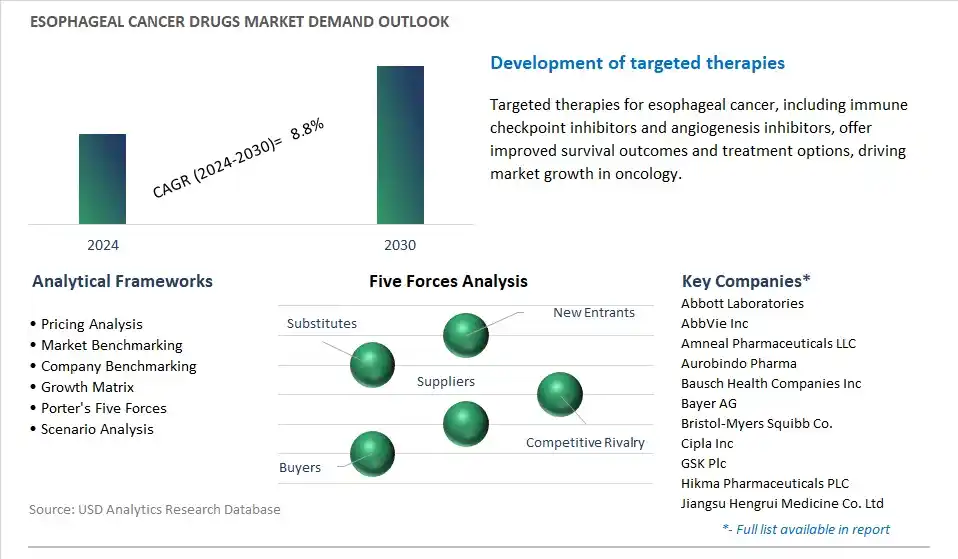
Esophageal Cancer Drugs Market is estimated to increase at a growth rate of 8.8% CAGR over the forecast period from 2024 to 2030.
The global Esophageal Cancer Drugs Market Study analyzes and forecasts the market size across 6 regions and 24 countries for diverse segments including By Type (Esophageal Squamous-Cell Carcinoma, Esophageal Adenocarcinoma, Others), By Treatment (Chemotherapy, Targeted Therapy, Others), By Route of Administration (Oral, Parenteral, Others), By End-User (Hospitals, Homecare, Speciality Centres, Others), By Distribution Channel (Hospital Pharmacy, Online Pharmacy, Retail Pharmacy).
An Introduction to Esophageal Cancer Drugs Market in 2024
The Esophageal Cancer Drugs Market involves pharmaceuticals and targeted therapies developed for the treatment of esophageal cancer, including squamous cell carcinoma and adenocarcinoma of the esophagus. These drugs encompass chemotherapy agents, immunotherapies, and molecularly targeted therapies aimed at inhibiting cancer cell growth, metastasis, and tumor progression. With a focus on personalized medicine approaches, biomarker testing, and combination therapies, the esophageal cancer drugs market continues to advance treatment options, improve survival rates, and enhance outcomes for patients diagnosed with esophageal malignancies.
Esophageal Cancer Drugs Market Competitive Landscape
The global Esophageal Cancer Drugs Industry is highly competitive with a large number of companies focusing on niche market segments. Amidst intense competitive conditions, Esophageal Cancer Drugs Companies are investing in new product launches and strengthening distribution channels. Key companies operating in the Esophageal Cancer Drugs Industry include- Abbott Laboratories, AbbVie Inc, Amneal Pharmaceuticals LLC, Aurobindo Pharma, Bausch Health Companies Inc, Bayer AG, Bristol-Myers Squibb Co., Cipla Inc, GSK Plc, Hikma Pharmaceuticals PLC, Jiangsu Hengrui Medicine Co. Ltd, Johnson & Johnson Private Ltd, LEO Pharma A/S, Lupin, Merck KGaA, Mylan N.V., Novartis AG, Otsuka America Pharmaceutical Inc, Pfizer Inc, Sun Pharmaceutical Industries Ltd.
Esophageal Cancer Drugs Market Trend: Advancements in Targeted Therapies and Immunotherapy
In the market for Esophageal Cancer Drugs, a prominent trend is the advancements in targeted therapies and immunotherapy for the treatment of esophageal cancer. Esophageal cancer is a challenging disease with limited treatment options and poor prognosis, particularly in advanced stages. However, recent years have seen significant progress in understanding the molecular mechanisms underlying esophageal cancer development and progression, leading to the identification of novel therapeutic targets and immunomodulatory pathways. This trend encompasses the development of targeted drugs that inhibit specific molecular pathways involved in tumor growth and metastasis, as well as immunotherapy approaches that harness the body's immune system to recognize and destroy cancer cells. As researchers and pharmaceutical companies continue to explore new therapeutic modalities and combination strategies, there is a growing market opportunity for esophageal cancer drugs that offer improved efficacy, tolerability, and survival outcomes for patients.
Esophageal Cancer Drugs Market Driver: Rising Incidence and Mortality Rates of Esophageal Cancer
The primary driver for the Esophageal Cancer Drugs market is the rising incidence and mortality rates of esophageal cancer worldwide. Esophageal cancer is one of the most aggressive and lethal malignancies, with a high propensity for metastasis and poor response to conventional treatments such as surgery, chemotherapy, and radiation therapy. The incidence of esophageal cancer varies geographically, with higher rates observed in regions with a high prevalence of risk factors such as tobacco use, alcohol consumption, obesity, and gastroesophageal reflux disease (GERD). Additionally, the prognosis for esophageal cancer remains dismal, with low survival rates and limited treatment options for advanced-stage disease. As the global burden of esophageal cancer continues to increase due to population aging, changing lifestyle factors, and environmental exposures, there is a pressing need for innovative drugs and treatment approaches that can improve outcomes and quality of life for affected patients. This drives the demand for research and development efforts focused on discovering and developing effective esophageal cancer drugs.
Esophageal Cancer Drugs Market Opportunity: Personalized Medicine and Biomarker-guided Treatment Strategies
An opportunity exists in the implementation of personalized medicine and biomarker-guided treatment strategies for esophageal cancer patients. While conventional treatment approaches for esophageal cancer are largely based on histological subtype and disease stage, there is growing recognition of the heterogeneity within esophageal tumors and the importance of molecular profiling to guide treatment decisions. Companies can capitalize on this opportunity by developing companion diagnostic tests and biomarker-based assays that identify predictive markers of treatment response, tumor aggressiveness, and drug resistance in esophageal cancer patients. Additionally, there is potential for integrating genomic, transcriptomic, and proteomic data into clinical decision-making algorithms to tailor treatment regimens to individual patient profiles and optimize therapeutic outcomes. By embracing personalized medicine approaches and biomarker-guided treatment strategies, companies can enhance the efficacy and precision of esophageal cancer drugs, reduce the risk of adverse events, and improve patient outcomes and survival rates.
Market Share Analysis: Esophageal Cancer Drugs - Targeted Therapy for Esophageal Adenocarcinoma is the fastest growing segment in the Esophageal Cancer Drugs industry
Within the realm of esophageal cancer drugs, targeted therapy for esophageal adenocarcinoma emerges as the fastest-growing segment. This growth is propelled by several factors, including the increasing understanding of the molecular mechanisms driving esophageal adenocarcinoma, the need for more effective and personalized treatment options, and advancements in targeted therapy research and development. Esophageal adenocarcinoma, a subtype of esophageal cancer, is characterized by specific genetic alterations and molecular pathways that can be targeted by novel therapeutic agents. Targeted therapies aim to inhibit these specific molecular targets, thereby disrupting tumor growth and improving patient outcomes. Compared to conventional chemotherapy, targeted therapy offers the potential for higher response rates, fewer side effects, and prolonged survival in patients with esophageal adenocarcinoma. As the demand for precision medicine approaches continues to rise in oncology, the market for targeted therapy drugs tailored to esophageal adenocarcinoma is experiencing rapid growth. Pharmaceutical companies are investing in the development of innovative targeted agents and companion diagnostics to identify suitable patients, driving further expansion of this segment in the esophageal cancer drug market.
Esophageal Cancer Drugs Market Segmentation
By Type
Esophageal Squamous-Cell Carcinoma
Esophageal Adenocarcinoma
Others
By Treatment
Chemotherapy
Targeted Therapy
Others
By Route of Administration
Oral
Parenteral
Others
By End-User
Hospitals
Homecare
Speciality Centres
Others
By Distribution Channel
Hospital Pharmacy
Online Pharmacy
Retail Pharmacy
Geographical Analysis
North America (United States, Canada, Mexico)
Europe (Germany, France, United Kingdom, Spain, Italy, Rest of Europe)
Asia Pacific (China, India, Japan, South Korea, Rest of Asia Pacific)
South America (Brazil, Argentina, Rest of South America)
Middle East and Africa (Saudi Arabia, UAE, Rest of Middle East, South Africa, Egypt, Rest of Africa)
Esophageal Cancer Drugs Companies
Abbott Laboratories
AbbVie Inc
Amneal Pharmaceuticals LLC
Aurobindo Pharma
Bausch Health Companies Inc
Bayer AG
Bristol-Myers Squibb Co.
Cipla Inc
GSK Plc
Hikma Pharmaceuticals PLC
Jiangsu Hengrui Medicine Co. Ltd
Johnson & Johnson Private Ltd
LEO Pharma A/S
Lupin
Merck KGaA
Mylan N.V.
Novartis AG
Otsuka America Pharmaceutical Inc
Pfizer Inc
Sun Pharmaceutical Industries Ltd
* List not Exhaustive
Reasons to Buy the Esophageal Cancer Drugs Market Study
• Deepen your industry insights and navigate uncertainties for strategy formulation, CAPEX, and Operational decisions
• Gain access to detailed insights on the Esophageal Cancer Drugs Market, encompassing current market size, growth trends, and forecasts till 2030.
• Access detailed competitor analysis, enabling competitive advantage through a thorough understanding of market players, strategies, and potential differentiation opportunities
• Stay ahead of the curve with insights on technological advancements, innovations, and upcoming trends
• Identify lucrative investment avenues and expansion opportunities within the Esophageal Cancer Drugs Industry, guided by robust, data-backed analysis.
• Understand regional and global markets through country-wise analysis, regional market potential, regulatory nuances, and dynamics
• Execute strategies with confidence and speed through information, analytics, and insights on the industry value chain
• Corporate leaders, strategists, financial experts, shareholders, asset managers, and governmental representatives can make long-term planning scenarios and build an integrated and timely understanding of market dynamics
• Benefit from tailored solutions and expert consultation based on report insights, providing personalized strategies aligned with specific business needs.
TABLE OF CONTENTS
1 Introduction to 2024 Esophageal Cancer Drugs Market
1.1 Market Overview
1.2 Quick Facts
1.3 Scope/Objective of the Study
1.4 Market Definition
1.5 Countries and Regions Analyzed
1.6 Units, Currency, and Conversions
1.7 Industry Value Chain
2 Research Methodology
2.1 Market Size Estimation
2.2 Sources and Research Methodology
2.3 Data Triangulation
2.4 Assumptions and Limitations
3 Executive Summary
3.1 Global Esophageal Cancer Drugs Market Size Outlook, $ Million, 2021 to 2030
3.2 Esophageal Cancer Drugs Market Outlook by Type, $ Million, 2021 to 2030
3.3 Esophageal Cancer Drugs Market Outlook by Product, $ Million, 2021 to 2030
3.4 Esophageal Cancer Drugs Market Outlook by Application, $ Million, 2021 to 2030
3.5 Esophageal Cancer Drugs Market Outlook by Key Countries, $ Million, 2021 to 2030
4 Market Dynamics
4.1 Key Driving Forces of Esophageal Cancer Drugs Industry
4.2 Key Market Trends in Esophageal Cancer Drugs Industry
4.3 Potential Opportunities in Esophageal Cancer Drugs Industry
4.4 Key Challenges in Esophageal Cancer Drugs Industry
5 Market Factor Analysis
5.1 Value Chain Analysis
5.2 Competitive Landscape
5.2.1 Global Esophageal Cancer Drugs Market Share by Company (%), 2023
5.2.2 Product Offerings by Company
5.3 Porter’s Five Forces Analysis
5.4 Pricing Analysis and Outlook
6 Growth Outlook Across Scenarios
6.1 Growth Analysis-Case Scenario Definitions
6.2 Low Growth Scenario Forecasts
6.3 Reference Growth Scenario Forecasts
6.4 High Growth Scenario Forecasts
7 Global Esophageal Cancer Drugs Market Outlook by Segments
7.1 Esophageal Cancer Drugs Market Outlook by Segments, $ Million, 2021- 2030
By Type
Esophageal Squamous-Cell Carcinoma
Esophageal Adenocarcinoma
Others
By Treatment
Chemotherapy
Targeted Therapy
Others
By Route of Administration
Oral
Parenteral
Others
By End-User
Hospitals
Homecare
Speciality Centres
Others
By Distribution Channel
Hospital Pharmacy
Online Pharmacy
Retail Pharmacy
8 North America Esophageal Cancer Drugs Market Analysis and Outlook To 2030
8.1 Introduction to North America Esophageal Cancer Drugs Markets in 2024
8.2 North America Esophageal Cancer Drugs Market Size Outlook by Country, 2021-2030
8.2.1 United States
8.2.2 Canada
8.2.3 Mexico
8.3 North America Esophageal Cancer Drugs Market size Outlook by Segments, 2021-2030
By Type
Esophageal Squamous-Cell Carcinoma
Esophageal Adenocarcinoma
Others
By Treatment
Chemotherapy
Targeted Therapy
Others
By Route of Administration
Oral
Parenteral
Others
By End-User
Hospitals
Homecare
Speciality Centres
Others
By Distribution Channel
Hospital Pharmacy
Online Pharmacy
Retail Pharmacy
9 Europe Esophageal Cancer Drugs Market Analysis and Outlook To 2030
9.1 Introduction to Europe Esophageal Cancer Drugs Markets in 2024
9.2 Europe Esophageal Cancer Drugs Market Size Outlook by Country, 2021-2030
9.2.1 Germany
9.2.2 France
9.2.3 Spain
9.2.4 United Kingdom
9.2.4 Italy
9.2.5 Russia
9.2.6 Norway
9.2.7 Rest of Europe
9.3 Europe Esophageal Cancer Drugs Market Size Outlook by Segments, 2021-2030
By Type
Esophageal Squamous-Cell Carcinoma
Esophageal Adenocarcinoma
Others
By Treatment
Chemotherapy
Targeted Therapy
Others
By Route of Administration
Oral
Parenteral
Others
By End-User
Hospitals
Homecare
Speciality Centres
Others
By Distribution Channel
Hospital Pharmacy
Online Pharmacy
Retail Pharmacy
10 Asia Pacific Esophageal Cancer Drugs Market Analysis and Outlook To 2030
10.1 Introduction to Asia Pacific Esophageal Cancer Drugs Markets in 2024
10.2 Asia Pacific Esophageal Cancer Drugs Market Size Outlook by Country, 2021-2030
10.2.1 China
10.2.2 India
10.2.3 Japan
10.2.4 South Korea
10.2.5 Indonesia
10.2.6 Malaysia
10.2.7 Australia
10.2.8 Rest of Asia Pacific
10.3 Asia Pacific Esophageal Cancer Drugs Market size Outlook by Segments, 2021-2030
By Type
Esophageal Squamous-Cell Carcinoma
Esophageal Adenocarcinoma
Others
By Treatment
Chemotherapy
Targeted Therapy
Others
By Route of Administration
Oral
Parenteral
Others
By End-User
Hospitals
Homecare
Speciality Centres
Others
By Distribution Channel
Hospital Pharmacy
Online Pharmacy
Retail Pharmacy
11 South America Esophageal Cancer Drugs Market Analysis and Outlook To 2030
11.1 Introduction to South America Esophageal Cancer Drugs Markets in 2024
11.2 South America Esophageal Cancer Drugs Market Size Outlook by Country, 2021-2030
11.2.1 Brazil
11.2.2 Argentina
11.2.3 Rest of South America
11.3 South America Esophageal Cancer Drugs Market size Outlook by Segments, 2021-2030
By Type
Esophageal Squamous-Cell Carcinoma
Esophageal Adenocarcinoma
Others
By Treatment
Chemotherapy
Targeted Therapy
Others
By Route of Administration
Oral
Parenteral
Others
By End-User
Hospitals
Homecare
Speciality Centres
Others
By Distribution Channel
Hospital Pharmacy
Online Pharmacy
Retail Pharmacy
12 Middle East and Africa Esophageal Cancer Drugs Market Analysis and Outlook To 2030
12.1 Introduction to Middle East and Africa Esophageal Cancer Drugs Markets in 2024
12.2 Middle East and Africa Esophageal Cancer Drugs Market Size Outlook by Country, 2021-2030
12.2.1 Saudi Arabia
12.2.2 UAE
12.2.3 Oman
12.2.4 Rest of Middle East
12.2.5 Egypt
12.2.6 Nigeria
12.2.7 South Africa
12.2.8 Rest of Africa
12.3 Middle East and Africa Esophageal Cancer Drugs Market size Outlook by Segments, 2021-2030
By Type
Esophageal Squamous-Cell Carcinoma
Esophageal Adenocarcinoma
Others
By Treatment
Chemotherapy
Targeted Therapy
Others
By Route of Administration
Oral
Parenteral
Others
By End-User
Hospitals
Homecare
Speciality Centres
Others
By Distribution Channel
Hospital Pharmacy
Online Pharmacy
Retail Pharmacy
13 Company Profiles
13.1 Company Snapshot
13.2 SWOT Profiles
13.3 Products and Services
13.4 Recent Developments
13.5 Financial Profile
List of Companies
Abbott Laboratories
AbbVie Inc
Amneal Pharmaceuticals LLC
Aurobindo Pharma
Bausch Health Companies Inc
Bayer AG
Bristol-Myers Squibb Co.
Cipla Inc
GSK Plc
Hikma Pharmaceuticals PLC
Jiangsu Hengrui Medicine Co. Ltd
Johnson & Johnson Private Ltd
LEO Pharma A/S
Lupin
Merck KGaA
Mylan N.V.
Novartis AG
Otsuka America Pharmaceutical Inc
Pfizer Inc
Sun Pharmaceutical Industries Ltd
14 Appendix
14.1 Customization Offerings
14.2 Subscription Services
14.3 Related Reports
14.4 Publisher Expertise
