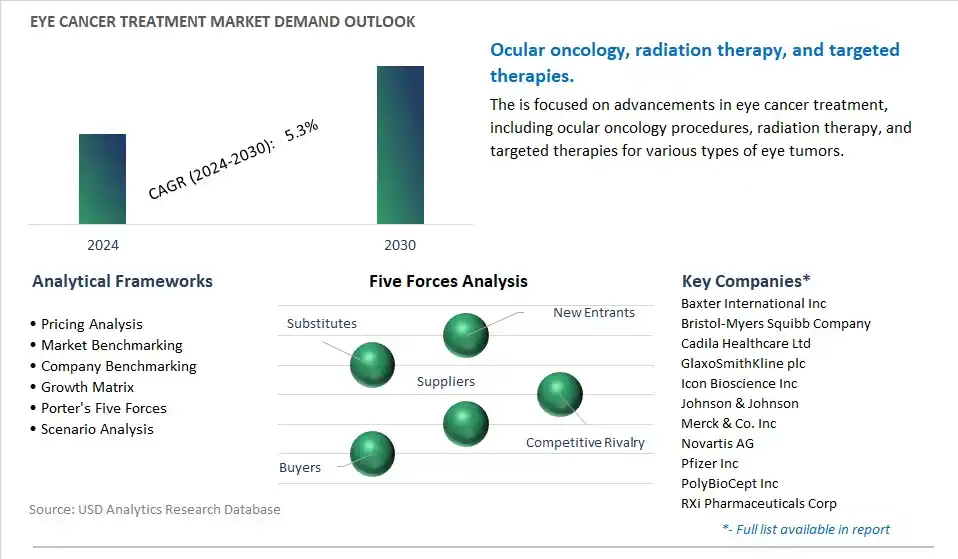
Eye Cancer Treatment Market is estimated to increase at a Compounded Annual Growth Rate of 5.3% CAGR over the forecast period from 2024 to 2030
The Eye Cancer Treatment Market study analyzes and forecasts the market size across 6 regions and 24 countries for diverse segments- By Treatment (Surgery, Radiation therapy, Laser Therapy, Cryotherapy, Chemotherapy, Bone Marrow Transplantation), By Type (Non-hereditary Retinoblastoma, Hereditary Retinoblastoma), By Stage (Intraocular Retinoblastoma, Extraocular Retinoblastoma).
An Introduction to Eye Cancer Treatment Market in 2024
In 2024, the market for eye cancer treatment addresses the need for effective therapies to manage ocular malignancies, offering a range of treatment modalities, surgical techniques, and targeted therapies for the management of intraocular tumors, including retinoblastoma, uveal melanoma, and ocular lymphoma. Eye cancer treatment encompasses various approaches, depending on the type, location, and stage of the ocular tumor, and may include surgical resection, radiation therapy, chemotherapy, targeted therapy, or a combination of these modalities. Surgical interventions for intraocular tumors may involve techniques such as enucleation, local tumor resection, plaque brachytherapy, or transpupillary thermotherapy, tailored to preserve vision, minimize morbidity, and achieve oncological control while preserving the integrity of surrounding ocular structures. Radiation therapy options may include external beam radiation therapy (EBRT), proton beam therapy, or stereotactic radiosurgery, delivering targeted doses of radiation to the tumor while sparing adjacent healthy tissues. Chemotherapy agents such as carboplatin, vincristine, or melphalan may be used for intraocular chemotherapy or as adjuvant therapy to systemic treatment regimens for metastatic disease. With a focus on preserving vision, maintaining quality of life, and achieving long-term disease control, eye cancer treatment strategies undergo multidisciplinary evaluation, personalized treatment planning, and ongoing surveillance to optimize outcomes and minimize treatment-related complications. Moreover, with advancements in imaging technology, molecular diagnostics, and targeted therapy options, the eye cancer treatment market continues to evolve, offering innovative approaches, precision medicine strategies, and vision-sparing therapies for improving survival rates and preserving visual function in patients with ocular malignancies.
Market Trend: Advancements in Targeted Therapies and Immunotherapy
A prominent trend in the eye cancer treatment market is the advancements in targeted therapies and immunotherapy. Traditional treatment approaches for eye cancer, such as surgery, radiation therapy, and chemotherapy, are being complemented and sometimes replaced by targeted therapies that specifically target cancer cells while sparing healthy tissue. Additionally, immunotherapy, which harnesses the body's immune system to fight cancer, has emerged as a promising treatment modality for certain types of eye cancer. These advancements offer the potential for improved efficacy, reduced side effects, and better outcomes for patients with eye cancer. The increasing focus on personalized medicine and precision oncology drives the development and adoption of targeted therapies and immunotherapies in the eye cancer treatment market, leading to advancements in treatment options and patient care.
Market Driver: Growing Incidence of Eye Cancer and Aging Population
A key driver for the eye cancer treatment market is the growing incidence of eye cancer and the aging population. Eye cancer encompasses a range of malignancies affecting different structures of the eye, including the retina, iris, conjunctiva, and orbit. Factors such as increasing longevity, exposure to ultraviolet radiation, genetic predisposition, and lifestyle habits contribute to the rising incidence of eye cancer worldwide. As the global population ages and life expectancy increases, the prevalence of age-related eye conditions and ocular tumors also rises, driving demand for effective and innovative treatment options. The growing burden of eye cancer underscores the need for advancements in diagnosis, treatment, and supportive care, supporting market growth and investment in eye cancer treatment research, development, and commercialization.
Market Opportunity: Integration of Artificial Intelligence in Diagnosis and Treatment Planning
An opportunity for innovation and market expansion in the eye cancer treatment market lies in the integration of artificial intelligence (AI) in diagnosis and treatment planning. AI technologies, including machine learning algorithms and computer vision systems, hold promise in improving the accuracy, efficiency, and reproducibility of eye cancer diagnosis, staging, and treatment selection. By analyzing medical imaging data such as optical coherence tomography (OCT) scans, fundus photographs, and magnetic resonance imaging (MRI) scans, AI systems can assist clinicians in detecting subtle changes in ocular structures indicative of cancerous growth, facilitating early diagnosis and intervention. Additionally, AI-driven decision support tools can aid in treatment planning by predicting treatment responses, optimizing dosing regimens, and identifying personalized therapeutic strategies based on patient-specific factors. By leveraging the capabilities of AI in eye cancer care, companies can develop innovative solutions that enhance diagnostic accuracy, treatment outcomes, and patient satisfaction, driving market differentiation and growth in the evolving landscape of eye cancer treatment.
Eye Cancer Treatment Market Share Analysis: Chemotherapy Treatment
The Chemotherapy Treatment segment within the Eye Cancer Treatment market is experiencing rapid growth due to several factors driving the demand for effective systemic therapy options in the management of eye cancer. Chemotherapy plays a crucial role in the treatment of both intraocular and extraocular retinoblastoma, as well as other ocular malignancies such as uveal melanoma and conjunctival tumors. Chemotherapy involves the administration of cytotoxic drugs either orally or intravenously, which target rapidly dividing cancer cells and inhibit tumor growth and spread. With the increasing incidence of eye cancer worldwide, particularly retinoblastoma in pediatric patients, there is growing demand for chemotherapy regimens that provide tumor control while preserving vision and ocular function. Chemotherapy may be used as primary therapy for small tumors or in combination with other treatment modalities such as surgery, radiation therapy, and local therapies for advanced or metastatic disease. Additionally, advancements in chemotherapy protocols, drug delivery techniques, and supportive care measures have led to improved outcomes and reduced treatment-related toxicity in patients with eye cancer. Hospitals, cancer centers, and pediatric oncology units are increasingly incorporating chemotherapy into multidisciplinary treatment plans for eye cancer patients, driven by the need for comprehensive and personalized care approaches that optimize clinical outcomes and quality of life. As research continues to uncover novel chemotherapy agents, targeted therapies, and immunotherapeutic strategies for eye cancer, the Chemotherapy Treatment segment is poised for significant growth in the Eye Cancer Treatment market, offering promising therapeutic options and hope for patients with ocular malignancies at various stages of disease.
Eye Cancer Treatment Competitive Analysis
The market research study provides in-depth insights into leading companies including the SWOT analyses, product profile, financial details, and recent developments acrossBaxter International Inc, Bristol-Myers Squibb Company, Cadila Healthcare Ltd, GlaxoSmithKline plc, Icon Bioscience Inc, Johnson & Johnson, Merck & Co. Inc, Novartis AG, Pfizer Inc, PolyBioCept Inc, RXi Pharmaceuticals Corp, Teva Pharmaceutical Industries Ltd
Eye Cancer Treatment Market Segmentation
By Treatment
Surgery
Radiation therapy
Laser Therapy
Cryotherapy
Chemotherapy
Bone Marrow Transplantation
By Type
Non-hereditary Retinoblastoma
Hereditary Retinoblastoma
By Stage
Intraocular Retinoblastoma
Extraocular Retinoblastoma
Geographical Analysis
North America (United States, Canada, Mexico)
Europe (Germany, France, United Kingdom, Spain, Italy, Rest of Europe)
Asia Pacific (China, India, Japan, South Korea, Rest of Asia Pacific)
South America (Brazil, Argentina, Rest of South America)
Middle East and Africa (Saudi Arabia, UAE, Rest of Middle East, South Africa, Egypt, Rest of Africa)
Eye Cancer Treatment Market Companies
Baxter International Inc
Bristol-Myers Squibb Company
Cadila Healthcare Ltd
GlaxoSmithKline plc
Icon Bioscience Inc
Johnson & Johnson
Merck & Co. Inc
Novartis AG
Pfizer Inc
PolyBioCept Inc
RXi Pharmaceuticals Corp
Teva Pharmaceutical Industries Ltd
Reasons to Buy the Eye Cancer Treatment Market Study
• Deepen your industry insights and navigate uncertainties for strategy formulation, CAPEX, and Operational decisions
• Gain access to detailed insights on the Eye Cancer Treatment Market, encompassing current market size, growth trends, and forecasts till 2030.
• Access detailed competitor analysis, enabling competitive advantage through a thorough understanding of market players, strategies, and potential differentiation opportunities
• Stay ahead of the curve with insights on technological advancements, innovations, and upcoming trends
• Identify lucrative investment avenues and expansion opportunities within the Eye Cancer Treatment Market industry, guided by robust, data-backed analysis.
• Understand regional and global markets through country-wise analysis, regional market potential, regulatory nuances, and dynamics
• Execute strategies with confidence and speed through information, analytics, and insights on the industry value chain
• Corporate leaders, strategists, financial experts, shareholders, asset managers, and governmental representatives can make long-term planning scenarios and build an integrated and timely understanding of market dynamics
• Benefit from tailored solutions and expert consultation based on report insights, providing personalized strategies aligned with specific business needs.
TABLE OF CONTENTS
1 Introduction to 2024 Eye Cancer Treatment Market
1.1 Market Overview
1.2 Quick Facts
1.3 Scope/Objective of the Study
1.4 Market Definition
1.5 Countries and Regions Covered
1.6 Units, Currency, and Conversions
1.7 Industry Value Chain
2 Research Methodology
2.1 Market Size Estimation
2.2 Sources and Research Methodology
2.3 Data Triangulation
2.4 Assumptions and Limitations
3 Executive Summary
3.1 Global Eye Cancer Treatment Market Size Outlook, $ Million, 2021 to 2030
3.2 Eye Cancer Treatment Market Outlook by Type, $ Million, 2021 to 2030
3.3 Eye Cancer Treatment Market Outlook by Product, $ Million, 2021 to 2030
3.4 Eye Cancer Treatment Market Outlook by Application, $ Million, 2021 to 2030
3.5 Eye Cancer Treatment Market Outlook by Key Countries, $ Million, 2021 to 2030
4 Market Dynamics
4.1 Key Driving Forces of Eye Cancer Treatment Industry
4.2 Key Market Trends in Eye Cancer Treatment Industry
4.3 Potential Opportunities in Eye Cancer Treatment Industry
4.4 Key Challenges in Eye Cancer Treatment Industry
5 Market Factor Analysis
5.1 Value Chain Analysis
5.2 Competitive Landscape
5.2.1 Global Eye Cancer Treatment Market Share by Company (%), 2023
5.2.2 Product Offerings by Company
5.3 Porter’s Five Forces Analysis
5.4 Pricing Analysis and Outlook
6 Growth Outlook Across Scenarios
6.1 Growth Analysis-Case Scenario Definitions
6.2 Low Growth Scenario Forecasts
6.3 Reference Growth Scenario Forecasts
6.4 High Growth Scenario Forecasts
7 Global Eye Cancer Treatment Market Outlook by Segments
7.1 Eye Cancer Treatment Market Outlook by Segments, $ Million, 2021- 2030
By Treatment
Surgery
Radiation therapy
Laser Therapy
Cryotherapy
Chemotherapy
Bone Marrow Transplantation
By Type
Non-hereditary Retinoblastoma
Hereditary Retinoblastoma
By Stage
Intraocular Retinoblastoma
Extraocular Retinoblastoma
8 North America Eye Cancer Treatment Market Analysis and Outlook To 2030
8.1 Introduction to North America Eye Cancer Treatment Markets in 2024
8.2 North America Eye Cancer Treatment Market Size Outlook by Country, 2021-2030
8.2.1 United States
8.2.2 Canada
8.2.3 Mexico
8.3 North America Eye Cancer Treatment Market size Outlook by Segments, 2021-2030
By Treatment
Surgery
Radiation therapy
Laser Therapy
Cryotherapy
Chemotherapy
Bone Marrow Transplantation
By Type
Non-hereditary Retinoblastoma
Hereditary Retinoblastoma
By Stage
Intraocular Retinoblastoma
Extraocular Retinoblastoma
9 Europe Eye Cancer Treatment Market Analysis and Outlook To 2030
9.1 Introduction to Europe Eye Cancer Treatment Markets in 2024
9.2 Europe Eye Cancer Treatment Market Size Outlook by Country, 2021-2030
9.2.1 Germany
9.2.2 France
9.2.3 Spain
9.2.4 United Kingdom
9.2.4 Italy
9.2.5 Russia
9.2.6 Norway
9.2.7 Rest of Europe
9.3 Europe Eye Cancer Treatment Market Size Outlook by Segments, 2021-2030
By Treatment
Surgery
Radiation therapy
Laser Therapy
Cryotherapy
Chemotherapy
Bone Marrow Transplantation
By Type
Non-hereditary Retinoblastoma
Hereditary Retinoblastoma
By Stage
Intraocular Retinoblastoma
Extraocular Retinoblastoma
10 Asia Pacific Eye Cancer Treatment Market Analysis and Outlook To 2030
10.1 Introduction to Asia Pacific Eye Cancer Treatment Markets in 2024
10.2 Asia Pacific Eye Cancer Treatment Market Size Outlook by Country, 2021-2030
10.2.1 China
10.2.2 India
10.2.3 Japan
10.2.4 South Korea
10.2.5 Indonesia
10.2.6 Malaysia
10.2.7 Australia
10.2.8 Rest of Asia Pacific
10.3 Asia Pacific Eye Cancer Treatment Market size Outlook by Segments, 2021-2030
By Treatment
Surgery
Radiation therapy
Laser Therapy
Cryotherapy
Chemotherapy
Bone Marrow Transplantation
By Type
Non-hereditary Retinoblastoma
Hereditary Retinoblastoma
By Stage
Intraocular Retinoblastoma
Extraocular Retinoblastoma
11 South America Eye Cancer Treatment Market Analysis and Outlook To 2030
11.1 Introduction to South America Eye Cancer Treatment Markets in 2024
11.2 South America Eye Cancer Treatment Market Size Outlook by Country, 2021-2030
11.2.1 Brazil
11.2.2 Argentina
11.2.3 Rest of South America
11.3 South America Eye Cancer Treatment Market size Outlook by Segments, 2021-2030
By Treatment
Surgery
Radiation therapy
Laser Therapy
Cryotherapy
Chemotherapy
Bone Marrow Transplantation
By Type
Non-hereditary Retinoblastoma
Hereditary Retinoblastoma
By Stage
Intraocular Retinoblastoma
Extraocular Retinoblastoma
12 Middle East and Africa Eye Cancer Treatment Market Analysis and Outlook To 2030
12.1 Introduction to Middle East and Africa Eye Cancer Treatment Markets in 2024
12.2 Middle East and Africa Eye Cancer Treatment Market Size Outlook by Country, 2021-2030
12.2.1 Saudi Arabia
12.2.2 UAE
12.2.3 Oman
12.2.4 Rest of Middle East
12.2.5 Egypt
12.2.6 Nigeria
12.2.7 South Africa
12.2.8 Rest of Africa
12.3 Middle East and Africa Eye Cancer Treatment Market size Outlook by Segments, 2021-2030
By Treatment
Surgery
Radiation therapy
Laser Therapy
Cryotherapy
Chemotherapy
Bone Marrow Transplantation
By Type
Non-hereditary Retinoblastoma
Hereditary Retinoblastoma
By Stage
Intraocular Retinoblastoma
Extraocular Retinoblastoma
13 Company Profiles
13.1 Company Snapshot
13.2 SWOT Profiles
13.3 Products and Services
13.4 Recent Developments
13.5 Financial Profile
List of Companies
Baxter International Inc
Bristol-Myers Squibb Company
Cadila Healthcare Ltd
GlaxoSmithKline plc
Icon Bioscience Inc
Johnson & Johnson
Merck & Co. Inc
Novartis AG
Pfizer Inc
PolyBioCept Inc
RXi Pharmaceuticals Corp
Teva Pharmaceutical Industries Ltd
14 Appendix
14.1 Customization Offerings
14.2 Subscription Services
14.3 Related Reports
14.4 Publisher Expertise
By Treatment
Surgery
Radiation therapy
Laser Therapy
Cryotherapy
Chemotherapy
Bone Marrow Transplantation
By Type
Non-hereditary Retinoblastoma
Hereditary Retinoblastoma
By Stage
Intraocular Retinoblastoma
Extraocular Retinoblastoma
Countries Analyzed
North America (United States, Canada, Mexico)
Europe (Germany, France, United Kingdom, Spain, Italy, Rest of Europe)
Asia Pacific (China, India, Japan, South Korea, Rest of Asia Pacific)
South America (Brazil, Argentina, Rest of South America)
Middle East and Africa (Saudi Arabia, UAE, Rest of Middle East, South Africa, Egypt, Rest of Africa)
