
The global Fab Materials Market Study analyzes and forecasts the market size across 6 regions and 24 countries for diverse segments -By Type (Silicon Materials, Electronic gases, Photomasks, Photoresist ancillaries, CMP, Others), By Application (Electronics Industry, Aviation Industry, Automobile Industry, Communication Equipment, Others).
The fab materials market is experiencing a paradigm shift driven by advancements in semiconductor technology, growing demand for miniaturization, and increasing complexity of electronic devices. With the rapid proliferation of emerging technologies such as artificial intelligence, internet of things, and 5G connectivity, there is a heightened need for high-performance materials that can meet the stringent requirements of next-generation electronic components. This has spurred significant investments in research and development to innovate novel materials with superior electrical, thermal, and mechanical properties. Moreover, the transition towards advanced packaging techniques such as 3D integration and heterogeneous integration is driving the demand for innovative fab materials capable of enabling finer pitches, higher densities, and improved reliability. Furthermore, sustainability considerations and environmental regulations are reshaping the fab materials market, prompting manufacturers to explore eco-friendly alternatives and adopt cleaner production processes to reduce environmental impact. Collaboration between material suppliers, semiconductor manufacturers, and research institutions is expected to drive further innovation and accelerate market growth in the fab materials industry.
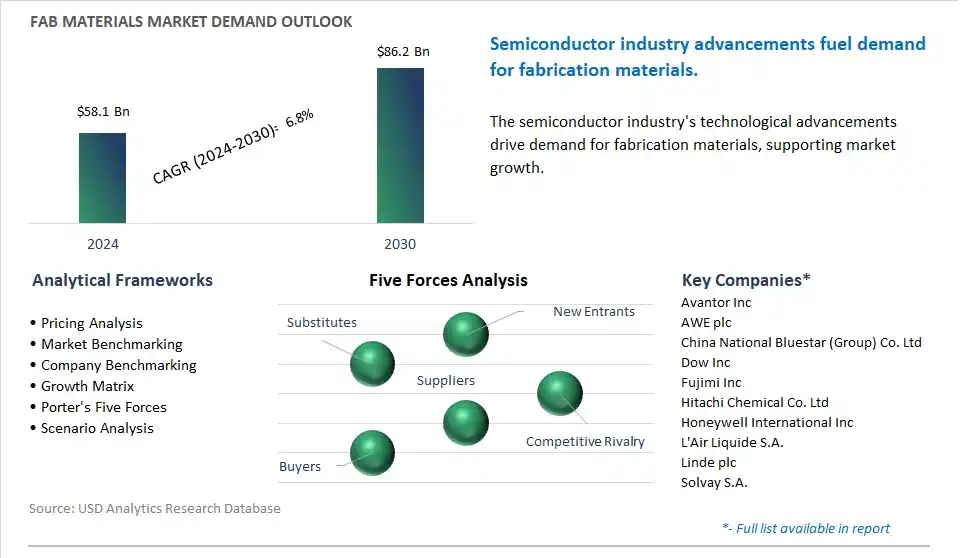
The market report analyses the leading companies in the industry including Avantor Inc, AWE plc, China National Bluestar (Group) Co. Ltd, Dow Inc, Fujimi Inc, Hitachi Chemical Co. Ltd, Honeywell International Inc, L'Air Liquide S.A., Linde plc, Solvay S.A..
One prominent trend in the fab materials market is the continuous advancements in semiconductor manufacturing processes. As semiconductor technology evolves rapidly to meet the demands of increasingly complex electronic devices, there is a growing need for specialized materials used in fabrication processes. These materials must possess properties such as high purity, precise composition, and compatibility with cutting-edge manufacturing techniques like extreme ultraviolet lithography (EUV) and advanced packaging technologies. The trend towards miniaturization and integration of components also drives the development of new fab materials capable of meeting stringent performance requirements while enabling higher yields and productivity.
A key driver in the fab materials market is the increasing demand for high-performance electronic devices across various sectors, including consumer electronics, automotive, telecommunications, and healthcare. As consumers expect faster, more energy-efficient, and feature-rich devices, semiconductor manufacturers are under pressure to produce chips with higher processing speeds, reduced power consumption, and enhanced functionality. This demand drives the need for advanced fab materials that enable the fabrication of semiconductor components with superior electrical, thermal, and mechanical properties. Moreover, emerging technologies such as 5G, artificial intelligence (AI), and Internet of Things (IoT) further amplify the demand for innovative fab materials to support the development of next-generation electronic products.
An opportunity within the fab materials market lies in the development of sustainable and eco-friendly materials for semiconductor fabrication. With increasing environmental concerns and regulatory pressures, there is a growing emphasis on adopting greener practices and reducing the environmental footprint of semiconductor manufacturing processes. Manufacturers can capitalize on this trend by investing in research and development to create fab materials that minimize resource consumption, reduce hazardous emissions, and offer recyclability or biodegradability. By providing environmentally responsible solutions, companies can not only meet the sustainability goals of their customers but also differentiate themselves in the market and appeal to environmentally conscious consumers.
Silicon Materials stand as the largest segment in the Fab Materials Market, driven by their fundamental role in semiconductor manufacturing processes and the production of electronic devices. Silicon materials, including silicon wafers and silicon ingots, serve as the foundational substrate for semiconductor fabrication, providing the essential platform for the deposition, etching, and patterning of integrated circuits (ICs). With the continued miniaturization and increasing complexity of semiconductor devices, the demand for high-quality silicon materials remains robust, as they determine the performance, reliability, and yield of semiconductor products. Further, advancements in semiconductor technologies, such as the transition to smaller feature sizes, 3D integration, and emerging applications like Internet of Things (IoT) and artificial intelligence (AI), drive the need for innovative silicon materials with enhanced properties and specifications. Additionally, the Silicon Materials segment benefits from the vertically integrated nature of semiconductor manufacturing, where silicon material suppliers often collaborate closely with semiconductor foundries and device manufacturers to develop customized solutions and ensure supply chain reliability. As the semiconductor industry continues to evolve and expand, propelled by technological innovations and market demand, the Silicon Materials segment maintains its dominance in the Fab Materials Market, driven by its critical role in semiconductor manufacturing processes.
The Electronics Industry segment is the fastest-growing segment in the Fab Materials Market, propelled by the increasing demand for electronic devices across various sectors and the rapid pace of technological advancements. As consumers embrace digitalization and connectivity, the electronics industry experiences robust growth driven by trends such as 5G technology, IoT devices, artificial intelligence, and smart devices. These innovations drive the need for advanced semiconductor materials and technologies to support the development of smaller, faster, and more energy-efficient electronic devices. Additionally, the proliferation of electronic components in automotive systems, communication equipment, and consumer electronics further amplifies the demand for fab materials used in semiconductor fabrication. Further, the ongoing digital transformation of industries such as healthcare, manufacturing, and transportation fuels the demand for electronic components and systems, driving growth in the electronics industry and subsequently in the Fab Materials Market. As manufacturers strive to meet the evolving demands for high-performance and reliable electronic devices, the demand for fab materials in the electronics industry is expected to experience rapid growth, positioning it as the fastest-growing segment in the market.
By Type
Silicon Materials
Electronic gases
Photomasks
Photoresist ancillaries
CMP
Others
By Application
Electronics Industry
Aviation Industry
Automobile Industry
Communication Equipment
Others
Regions Included
North America (US, Canada, Mexico)
Europe (Germany, UK, France, Spain, Italy, Russia, Rest of Europe)
Asia Pacific (China, India, Japan, South Korea, Australia, South East Asia, Rest of Asia)
South America (Brazil, Argentina, Rest of South America)
Middle East and Africa (Saudi Arabia, UAE, Rest of Middle East, South Africa, Egypt, Rest of Africa)
Avantor Inc
AWE plc
China National Bluestar (Group) Co. Ltd
Dow Inc
Fujimi Inc
Hitachi Chemical Co. Ltd
Honeywell International Inc
L'Air Liquide S.A.
Linde plc
Solvay S.A.
*- List Not Exhaustive
TABLE OF CONTENTS
1 Introduction to 2024 Fab Materials Market
1.1 Market Overview
1.2 Quick Facts
1.3 Scope/Objective of the Study
1.4 Market Definition
1.5 Countries and Regions Covered
1.6 Units, Currency, and Conversions
1.7 Industry Value Chain
2 Research Methodology
2.1 Market Size Estimation
2.2 Sources and Research Methodology
2.3 Data Triangulation
2.4 Assumptions and Limitations
3 Executive Summary
3.1 Global Fab Materials Market Size Outlook, $ Million, 2021 to 2030
3.2 Fab Materials Market Outlook by Type, $ Million, 2021 to 2030
3.3 Fab Materials Market Outlook by Product, $ Million, 2021 to 2030
3.4 Fab Materials Market Outlook by Application, $ Million, 2021 to 2030
3.5 Fab Materials Market Outlook by Key Countries, $ Million, 2021 to 2030
4 Market Dynamics
4.1 Key Driving Forces of Fab Materials Industry
4.2 Key Market Trends in Fab Materials Industry
4.3 Potential Opportunities in Fab Materials Industry
4.4 Key Challenges in Fab Materials Industry
5 Market Factor Analysis
5.1 Value Chain Analysis
5.2 Competitive Landscape
5.2.1 Global Fab Materials Market Share by Company (%), 2023
5.2.2 Product Offerings by Company
5.3 Porter’s Five Forces Analysis
5.4 Pricing Analysis and Outlook
6 Growth Outlook Across Scenarios
6.1 Growth Analysis-Case Scenario Definitions
6.2 Low Growth Scenario Forecasts
6.3 Reference Growth Scenario Forecasts
6.4 High Growth Scenario Forecasts
7 Global Fab Materials Market Outlook by Segments
7.1 Fab Materials Market Outlook by Segments, $ Million, 2021- 2030
By Type
Silicon Materials
Electronic gases
Photomasks
Photoresist ancillaries
CMP
Others
By Application
Electronics Industry
Aviation Industry
Automobile Industry
Communication Equipment
Others
8 North America Fab Materials Market Analysis and Outlook To 2030
8.1 Introduction to North America Fab Materials Markets in 2024
8.2 North America Fab Materials Market Size Outlook by Country, 2021-2030
8.2.1 United States
8.2.2 Canada
8.2.3 Mexico
8.3 North America Fab Materials Market size Outlook by Segments, 2021-2030
By Type
Silicon Materials
Electronic gases
Photomasks
Photoresist ancillaries
CMP
Others
By Application
Electronics Industry
Aviation Industry
Automobile Industry
Communication Equipment
Others
9 Europe Fab Materials Market Analysis and Outlook To 2030
9.1 Introduction to Europe Fab Materials Markets in 2024
9.2 Europe Fab Materials Market Size Outlook by Country, 2021-2030
9.2.1 Germany
9.2.2 France
9.2.3 Spain
9.2.4 United Kingdom
9.2.4 Italy
9.2.5 Russia
9.2.6 Norway
9.2.7 Rest of Europe
9.3 Europe Fab Materials Market Size Outlook by Segments, 2021-2030
By Type
Silicon Materials
Electronic gases
Photomasks
Photoresist ancillaries
CMP
Others
By Application
Electronics Industry
Aviation Industry
Automobile Industry
Communication Equipment
Others
10 Asia Pacific Fab Materials Market Analysis and Outlook To 2030
10.1 Introduction to Asia Pacific Fab Materials Markets in 2024
10.2 Asia Pacific Fab Materials Market Size Outlook by Country, 2021-2030
10.2.1 China
10.2.2 India
10.2.3 Japan
10.2.4 South Korea
10.2.5 Indonesia
10.2.6 Malaysia
10.2.7 Australia
10.2.8 Rest of Asia Pacific
10.3 Asia Pacific Fab Materials Market size Outlook by Segments, 2021-2030
By Type
Silicon Materials
Electronic gases
Photomasks
Photoresist ancillaries
CMP
Others
By Application
Electronics Industry
Aviation Industry
Automobile Industry
Communication Equipment
Others
11 South America Fab Materials Market Analysis and Outlook To 2030
11.1 Introduction to South America Fab Materials Markets in 2024
11.2 South America Fab Materials Market Size Outlook by Country, 2021-2030
11.2.1 Brazil
11.2.2 Argentina
11.2.3 Rest of South America
11.3 South America Fab Materials Market size Outlook by Segments, 2021-2030
By Type
Silicon Materials
Electronic gases
Photomasks
Photoresist ancillaries
CMP
Others
By Application
Electronics Industry
Aviation Industry
Automobile Industry
Communication Equipment
Others
12 Middle East and Africa Fab Materials Market Analysis and Outlook To 2030
12.1 Introduction to Middle East and Africa Fab Materials Markets in 2024
12.2 Middle East and Africa Fab Materials Market Size Outlook by Country, 2021-2030
12.2.1 Saudi Arabia
12.2.2 UAE
12.2.3 Oman
12.2.4 Rest of Middle East
12.2.5 Egypt
12.2.6 Nigeria
12.2.7 South Africa
12.2.8 Rest of Africa
12.3 Middle East and Africa Fab Materials Market size Outlook by Segments, 2021-2030
By Type
Silicon Materials
Electronic gases
Photomasks
Photoresist ancillaries
CMP
Others
By Application
Electronics Industry
Aviation Industry
Automobile Industry
Communication Equipment
Others
13 Company Profiles
13.1 Company Snapshot
13.2 SWOT Profiles
13.3 Products and Services
13.4 Recent Developments
13.5 Financial Profile
Avantor Inc
AWE plc
China National Bluestar (Group) Co. Ltd
Dow Inc
Fujimi Inc
Hitachi Chemical Co. Ltd
Honeywell International Inc
L'Air Liquide S.A.
Linde plc
Solvay S.A.
14 Appendix
14.1 Customization Offerings
14.2 Subscription Services
14.3 Related Reports
14.4 Publisher Expertise
By Type
Silicon Materials
Electronic gases
Photomasks
Photoresist ancillaries
CMP
Others
By Application
Electronics Industry
Aviation Industry
Automobile Industry
Communication Equipment
Others
Countries Analyzed
North America (US, Canada, Mexico)
Europe (Germany, UK, France, Spain, Italy, Russia, Rest of Europe)
Asia Pacific (China, India, Japan, South Korea, Australia, South East Asia, Rest of Asia)
South America (Brazil, Argentina, Rest of South America)
Middle East and Africa (Saudi Arabia, UAE, Rest of Middle East, South Africa, Egypt, Rest of Africa)
Global Fab Materials is forecast to reach $86.2 Billion in 2030 from $58.1 Billion in 2024, registering a CAGR of 6.8%
Emerging Markets across Asia Pacific, Europe, and Americas present robust growth prospects.
Avantor Inc, AWE plc, China National Bluestar (Group) Co. Ltd, Dow Inc, Fujimi Inc, Hitachi Chemical Co. Ltd, Honeywell International Inc, L'Air Liquide S.A., Linde plc, Solvay S.A.
Base Year- 2023; Estimated Year- 2024; Historic Period- 2018-2023; Forecast period- 2024 to 2030; Currency: Revenue (USD); Volume