
The global Factor IX Deficiency Treatment Market Study analyzes and forecasts the market size across 6 regions and 24 countries for diverse segments including By Treatment (Hemophilia B, Hemophilia B Inhibitors), By Application (Hospitals, Clinics, Others).
The Factor IX Deficiency Treatment Market focuses on therapies and products for managing hemophilia B, also known as Factor IX deficiency. Hemophilia B is a rare genetic bleeding disorder characterized by a deficiency of clotting factor IX, leading to prolonged bleeding and easy bruising. Treatments in this market include factor IX replacement therapies, gene therapies, and medications aimed at controlling bleeding episodes and preventing complications in patients with hemophilia B.
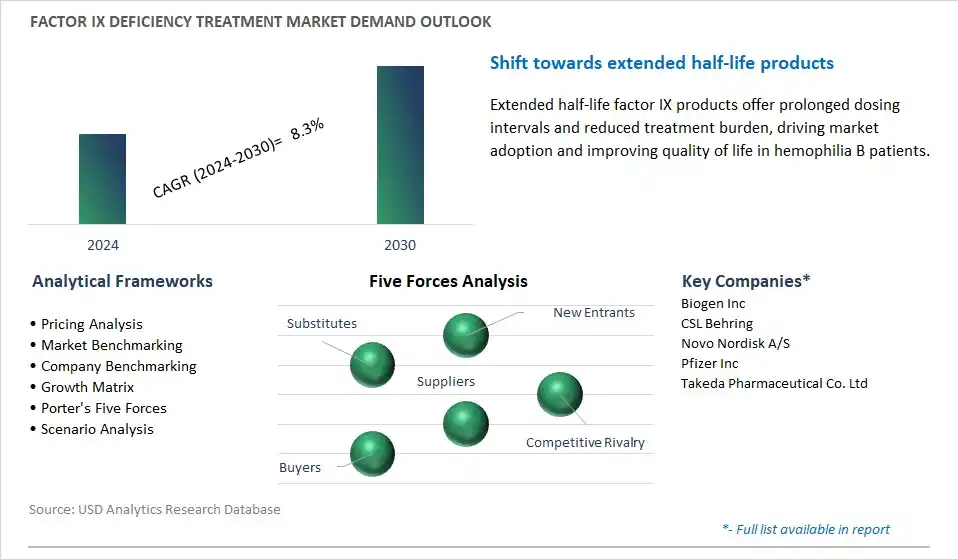
The global Factor IX Deficiency Treatment Industry is highly competitive with a large number of companies focusing on niche market segments. Amidst intense competitive conditions, Factor IX Deficiency Treatment Companies are investing in new product launches and strengthening distribution channels. Key companies operating in the Factor IX Deficiency Treatment Industry include- Biogen Inc, CSL Behring, Novo Nordisk A/S, Pfizer Inc, Takeda Pharmaceutical Co. Ltd.
A significant trend in the Factor IX deficiency treatment market is the rapid advancements in gene therapy approaches, offering potential curative options for patients with hemophilia B. Gene therapy holds promise in providing long-term and sustainable production of Factor IX, reducing the need for frequent infusions of clotting factor concentrates. With ongoing clinical trials demonstrating encouraging results, gene therapy is reshaping the treatment landscape for Factor IX deficiency, driving research and investment in this innovative therapeutic modality.
A key driver in the Factor IX deficiency treatment market is the growing demand for long-acting Factor IX products that offer extended protection against bleeding episodes and reduced treatment burden for patients with hemophilia B. Long-acting Factor IX concentrates provide a convenient and effective prophylactic treatment option, allowing for fewer infusions and improved adherence to therapy regimens. This trend is fueled by the desire to enhance patient convenience, reduce healthcare costs associated with hospital visits, and improve overall quality of life for individuals living with Factor IX deficiency.
One Market Opportunity in the Factor IX deficiency treatment market lies in expanding into emerging markets with under-served patient populations and growing healthcare infrastructure. While hemophilia care is well-established in developed countries, there are regions where access to Factor IX products and specialized treatment centers remains limited. By entering these markets with affordable and accessible treatment options, pharmaceutical companies can address unmet medical needs, improve patient outcomes, and capture a significant share of the growing global hemophilia market.
Among the treatments for Factor IX deficiency, the fastest growth is observed in the treatment for Hemophilia B. Hemophilia B, also known as Christmas disease, is a hereditary bleeding disorder caused by a deficiency in clotting Factor IX. The treatment for Hemophilia B typically involves replacing the missing Factor IX through intravenous infusion of plasma-derived or recombinant Factor IX concentrates. With advancements in biotechnology and the development of extended half-life Factor IX products, there has been a significant improvement in the management of Hemophilia B, leading to better control of bleeding episodes and improved quality of life for patients. Additionally, the availability of prophylactic treatment regimens has further contributed to reducing the frequency of bleeding episodes and preventing long-term joint damage in individuals with Hemophilia B. Moreover, increased awareness and diagnosis of bleeding disorders, along with improved access to treatment in hospitals and clinics, have fueled the growth of Hemophilia B treatment. As research continues to advance and new therapies emerge, the market for Hemophilia B treatment is expected to continue its rapid growth, addressing the unmet medical needs of patients with Factor IX deficiency.
By Treatment
Hemophilia B
Hemophilia B Inhibitors
By Application
Hospitals
Clinics
Others
Geographical Analysis
North America (United States, Canada, Mexico)
Europe (Germany, France, United Kingdom, Spain, Italy, Rest of Europe)
Asia Pacific (China, India, Japan, South Korea, Rest of Asia Pacific)
South America (Brazil, Argentina, Rest of South America)
Middle East and Africa (Saudi Arabia, UAE, Rest of Middle East, South Africa, Egypt, Rest of Africa)
Biogen Inc
CSL Behring
Novo Nordisk A/S
Pfizer Inc
Takeda Pharmaceutical Co. Ltd
* List not Exhaustive
• Deepen your industry insights and navigate uncertainties for strategy formulation, CAPEX, and Operational decisions
• Gain access to detailed insights on the Factor IX Deficiency Treatment Market, encompassing current market size, growth trends, and forecasts till 2030.
• Access detailed competitor analysis, enabling competitive advantage through a thorough understanding of market players, strategies, and potential differentiation opportunities
• Stay ahead of the curve with insights on technological advancements, innovations, and upcoming trends
• Identify lucrative investment avenues and expansion opportunities within the Factor IX Deficiency Treatment Industry, guided by robust, data-backed analysis.
• Understand regional and global markets through country-wise analysis, regional market potential, regulatory nuances, and dynamics
• Execute strategies with confidence and speed through information, analytics, and insights on the industry value chain
• Corporate leaders, strategists, financial experts, shareholders, asset managers, and governmental representatives can make long-term planning scenarios and build an integrated and timely understanding of market dynamics
• Benefit from tailored solutions and expert consultation based on report insights, providing personalized strategies aligned with specific business needs.
TABLE OF CONTENTS
1 Introduction to 2024 Factor IX Deficiency Treatment Market
1.1 Market Overview
1.2 Quick Facts
1.3 Scope/Objective of the Study
1.4 Market Definition
1.5 Countries and Regions Analyzed
1.6 Units, Currency, and Conversions
1.7 Industry Value Chain
2 Research Methodology
2.1 Market Size Estimation
2.2 Sources and Research Methodology
2.3 Data Triangulation
2.4 Assumptions and Limitations
3 Executive Summary
3.1 Global Factor IX Deficiency Treatment Market Size Outlook, $ Million, 2021 to 2030
3.2 Factor IX Deficiency Treatment Market Outlook by Type, $ Million, 2021 to 2030
3.3 Factor IX Deficiency Treatment Market Outlook by Product, $ Million, 2021 to 2030
3.4 Factor IX Deficiency Treatment Market Outlook by Application, $ Million, 2021 to 2030
3.5 Factor IX Deficiency Treatment Market Outlook by Key Countries, $ Million, 2021 to 2030
4 Market Dynamics
4.1 Key Driving Forces of Factor IX Deficiency Treatment Industry
4.2 Key Market Trends in Factor IX Deficiency Treatment Industry
4.3 Potential Opportunities in Factor IX Deficiency Treatment Industry
4.4 Key Challenges in Factor IX Deficiency Treatment Industry
5 Market Factor Analysis
5.1 Value Chain Analysis
5.2 Competitive Landscape
5.2.1 Global Factor IX Deficiency Treatment Market Share by Company (%), 2023
5.2.2 Product Offerings by Company
5.3 Porter’s Five Forces Analysis
5.4 Pricing Analysis and Outlook
6 Growth Outlook Across Scenarios
6.1 Growth Analysis-Case Scenario Definitions
6.2 Low Growth Scenario Forecasts
6.3 Reference Growth Scenario Forecasts
6.4 High Growth Scenario Forecasts
7 Global Factor IX Deficiency Treatment Market Outlook by Segments
7.1 Factor IX Deficiency Treatment Market Outlook by Segments, $ Million, 2021- 2030
By Treatment
Hemophilia B
Hemophilia B Inhibitors
By Application
Hospitals
Clinics
Others
8 North America Factor IX Deficiency Treatment Market Analysis and Outlook To 2030
8.1 Introduction to North America Factor IX Deficiency Treatment Markets in 2024
8.2 North America Factor IX Deficiency Treatment Market Size Outlook by Country, 2021-2030
8.2.1 United States
8.2.2 Canada
8.2.3 Mexico
8.3 North America Factor IX Deficiency Treatment Market size Outlook by Segments, 2021-2030
By Treatment
Hemophilia B
Hemophilia B Inhibitors
By Application
Hospitals
Clinics
Others
9 Europe Factor IX Deficiency Treatment Market Analysis and Outlook To 2030
9.1 Introduction to Europe Factor IX Deficiency Treatment Markets in 2024
9.2 Europe Factor IX Deficiency Treatment Market Size Outlook by Country, 2021-2030
9.2.1 Germany
9.2.2 France
9.2.3 Spain
9.2.4 United Kingdom
9.2.4 Italy
9.2.5 Russia
9.2.6 Norway
9.2.7 Rest of Europe
9.3 Europe Factor IX Deficiency Treatment Market Size Outlook by Segments, 2021-2030
By Treatment
Hemophilia B
Hemophilia B Inhibitors
By Application
Hospitals
Clinics
Others
10 Asia Pacific Factor IX Deficiency Treatment Market Analysis and Outlook To 2030
10.1 Introduction to Asia Pacific Factor IX Deficiency Treatment Markets in 2024
10.2 Asia Pacific Factor IX Deficiency Treatment Market Size Outlook by Country, 2021-2030
10.2.1 China
10.2.2 India
10.2.3 Japan
10.2.4 South Korea
10.2.5 Indonesia
10.2.6 Malaysia
10.2.7 Australia
10.2.8 Rest of Asia Pacific
10.3 Asia Pacific Factor IX Deficiency Treatment Market size Outlook by Segments, 2021-2030
By Treatment
Hemophilia B
Hemophilia B Inhibitors
By Application
Hospitals
Clinics
Others
11 South America Factor IX Deficiency Treatment Market Analysis and Outlook To 2030
11.1 Introduction to South America Factor IX Deficiency Treatment Markets in 2024
11.2 South America Factor IX Deficiency Treatment Market Size Outlook by Country, 2021-2030
11.2.1 Brazil
11.2.2 Argentina
11.2.3 Rest of South America
11.3 South America Factor IX Deficiency Treatment Market size Outlook by Segments, 2021-2030
By Treatment
Hemophilia B
Hemophilia B Inhibitors
By Application
Hospitals
Clinics
Others
12 Middle East and Africa Factor IX Deficiency Treatment Market Analysis and Outlook To 2030
12.1 Introduction to Middle East and Africa Factor IX Deficiency Treatment Markets in 2024
12.2 Middle East and Africa Factor IX Deficiency Treatment Market Size Outlook by Country, 2021-2030
12.2.1 Saudi Arabia
12.2.2 UAE
12.2.3 Oman
12.2.4 Rest of Middle East
12.2.5 Egypt
12.2.6 Nigeria
12.2.7 South Africa
12.2.8 Rest of Africa
12.3 Middle East and Africa Factor IX Deficiency Treatment Market size Outlook by Segments, 2021-2030
By Treatment
Hemophilia B
Hemophilia B Inhibitors
By Application
Hospitals
Clinics
Others
13 Company Profiles
13.1 Company Snapshot
13.2 SWOT Profiles
13.3 Products and Services
13.4 Recent Developments
13.5 Financial Profile
List of Companies
Biogen Inc
CSL Behring
Novo Nordisk A/S
Pfizer Inc
Takeda Pharmaceutical Co. Ltd
14 Appendix
14.1 Customization Offerings
14.2 Subscription Services
14.3 Related Reports
14.4 Publisher Expertise
By Treatment
Hemophilia B
Hemophilia B Inhibitors
By Application
Hospitals
Clinics
Others
The global Factor IX Deficiency Treatment Market is one of the lucrative growth markets, poised to register a 8.3% growth (CAGR) between 2024 and 2030.
Emerging Markets across Asia Pacific, Europe, and Americas present robust growth prospects.
Biogen Inc, CSL Behring, Novo Nordisk A/S, Pfizer Inc, Takeda Pharmaceutical Co. Ltd
Base Year- 2023; Estimated Year- 2024; Historic Period- 2018-2023; Forecast period- 2024 to 2030; Currency: USD; Volume