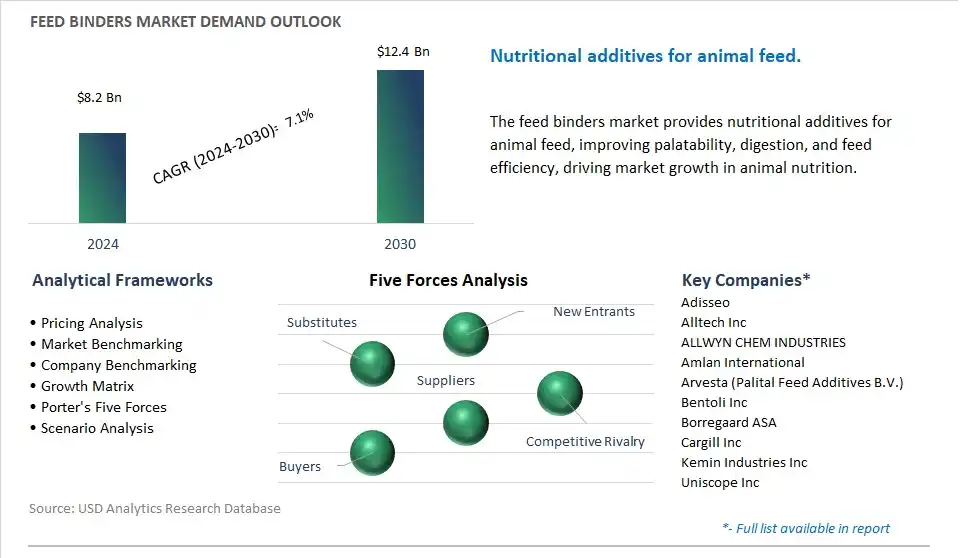
The global Feed Binders Market is poised to register a 7.1% CAGR from $8.2 Billion in 2024 to $12.4 Billion in 2030.
The global Feed Binders Market Study analyzes and forecasts the market size across 6 regions and 24 countries for diverse segments -By Sub Additive (Natural Binders, Synthetic Binders), By Animal (Aquaculture, Ruminants, Swine, Others).
An Introduction to Global Feed Binders Market in 2024
The future of the feed binders market is influenced by trends such as animal nutrition, sustainability, and technological advancements driving innovation in binder formulations, application methods, and performance characteristics. Feed binders play a critical role in the production of pelleted feed for livestock, aquaculture, and pet food industries by improving pellet quality, durability, and handling characteristics. Key trends shaping this market include advancements in binder ingredients such as lignin, starches, and hydrocolloids to enhance binding strength, pellet integrity, and nutrient retention in feed formulations, the development of specialty binders with functional additives such as enzymes, probiotics, and antioxidants to improve animal health, growth, and feed efficiency, and the adoption of sustainable practices such as bio-based binders, recycled materials, and reduced dust emissions to meet environmental regulations and consumer preferences. As animal feed producers seek to optimize feed quality, performance, and sustainability, the demand for feed binders that offer reliable binding properties, nutritional benefits, and environmental responsibility is expected to drive market growth and stimulate further innovation in feed binder technology.
Feed Binders Market Competitive Landscape
The market report analyses the leading companies in the industry including Adisseo, Alltech Inc, ALLWYN CHEM INDUSTRIES, Amlan International, Arvesta (Palital Feed Additives B.V.), Bentoli Inc, Borregaard ASA, Cargill Inc, Kemin Industries Inc, Uniscope Inc.
Feed Binders Market Dynamics
Feed Binders Market Trend: Increasing Demand for Natural and Sustainable Feed Binders in Animal Nutrition
A prominent trend in the feed binders market is the growing demand for natural and sustainable alternatives in animal nutrition. With consumers becoming more conscious of the quality and origin of animal products, there is a shift towards feed formulations that are free from synthetic additives and chemicals. Natural feed binders derived from plant-based sources such as guar gum, lignin, and starch are gaining popularity due to their eco-friendly profiles and perceived health benefits for livestock. The trend is driving manufacturers to innovate and offer feed binder solutions that meet the evolving preferences of animal producers and consumers alike.
Feed Binders Market Driver: Focus on Animal Health and Performance in Livestock Farming
The primary driver for the feed binders market is the increasing focus on animal health and performance in livestock farming. As the global population continues to grow, there is a growing demand for high-quality animal products such as meat, milk, and eggs. To meet this demand sustainably, livestock producers are prioritizing the optimization of animal nutrition and health through the use of feed additives such as binders. Feed binders play a crucial role in improving feed quality, enhancing nutrient absorption, and reducing feed wastage, ultimately leading to improved animal performance and productivity. This focus on optimizing livestock nutrition and performance is fueling the demand for feed binders as essential components of modern feed formulations.
Feed Binders Market Opportunity: Development of Specialty Feed Binder Formulations for Niche Applications
An opportunity exists for companies operating in the feed binders market to develop specialty formulations tailored for niche applications within the livestock industry. While traditional feed binders cater to general livestock feed formulations, there is a growing demand for specialized solutions to address specific challenges and requirements in niche segments such as aquaculture, pet food, and organic farming. By leveraging their expertise in feed formulation and binder technology, companies aim to capitalize on this opportunity to develop customized solutions that cater to the unique needs of these niche markets. Additionally, investing in research and development to innovate novel binder formulations with targeted functionalities can further differentiate products and enable companies to capture a larger share of the expanding market for specialty feed additives.
Feed Binders Market Ecosystem
The Market Ecosystem of the feed binders market encompasses diverse key stages, beginning with raw material sourcing from suppliers including Imerys, Ingredion Incorporated, and Rousselot, which provide clay minerals, starches, plant gums, gelatin, and molasses, among others. Additionally, lignosulfonates from companies including Borregaard and synthetic binders from specialized suppliers are sourced depending on binder type.
Feed binder manufacturers including DuPont, Cargill, and Evonik Industries then formulate various binders tailored to specific animal feed requirements. Distribution channels involve feed mill suppliers including ADM Animal Nutrition and direct sales by large manufacturers. Further, animal feed producers, integrators, and contract feeders utilize feed binders in their formulations, addressing the needs of various livestock animals including poultry, swine, cattle, and aquaculture.
Key companies including DuPont, Cargill, and Borregaard contribute to the production, distribution, and application of feed binders, supporting the animal feed industry with improved pellet quality, reduced dust generation, and enhanced nutrient utilization.
Feed Binders Market Share Analysis: Natural Binders held the dominant revenue share in 2024
The Natural Binders segment stands as the largest sector in the Feed Binders Market, owing to diverse significant factors driving its dominance. Natural binders, derived from organic sources such as plants, animals, and minerals, hold a substantial market share due to their perceived advantages over synthetic alternatives. Natural binders are often preferred by livestock producers and feed manufacturers due to their perceived safety, sustainability, and compatibility with organic farming practices. Additionally, natural binders offer benefits such as improved digestibility, reduced environmental impact, and enhanced animal health compared to synthetic counterparts. Further, with the increasing consumer demand for organic and natural products, the demand for feed binders derived from natural sources is on the rise. As a result, the Natural Binders segment continues to maintain its leading position in the Feed Binders Market, catering to the preferences of both producers and consumers in the livestock industry.
Feed Binders Market Share Analysis: Aquaculture is the fastest growing market segment over the forecast period to 2030
The Aquaculture segment is the fastest-growing sector in the Feed Binders Market, driven by diverse key factors propelling its expansion. As the aquaculture industry continues to experience rapid growth globally, there is a growing need for high-quality feed formulations that promote optimal growth, health, and sustainability of aquatic species. Feed binders play a crucial role in aquafeed manufacturing by improving pellet integrity, reducing nutrient leaching, and enhancing feed digestibility for aquatic organisms. Additionally, the increasing demand for seafood and the depletion of wild fish stocks have led to intensified aquaculture production, further driving the need for effective feed solutions. In addition, advancements in aquafeed technology and formulations aim to address challenges such as water pollution, disease resistance, and environmental sustainability, creating opportunities for innovative feed binder solutions tailored to the unique requirements of aquaculture species. As aquaculture continues to expand to meet global seafood demand, the demand for feed binders in the Aquaculture segment is expected to surge, making it the fastest-growing sector in the Feed Binders Market.
Feed Binders Market Report Scope-
By Sub Additive
Natural Binders
Synthetic Binders
By Animal
Aquaculture
-Fish
-Shrimp
Poultry
-Broiler
-Layer
Ruminants
-Beef Cattle
-Dairy Cattle
Swine
Others
Feed Binders Market Companies Profiled
Adisseo
Alltech Inc
ALLWYN CHEM INDUSTRIES
Amlan International
Arvesta (Palital Feed Additives B.V.)
Bentoli Inc
Borregaard ASA
Cargill Inc
Kemin Industries Inc
Uniscope Inc
*- List Not Exhaustive
TABLE OF CONTENTS
1 Introduction to 2024 Feed Binders Market
1.1 Market Overview
1.2 Quick Facts
1.3 Scope/Objective of the Study
1.4 Market Definition
1.5 Countries and Regions Covered
1.6 Units, Currency, and Conversions
1.7 Industry Value Chain
2 Research Methodology
2.1 Market Size Estimation
2.2 Sources and Research Methodology
2.3 Data Triangulation
2.4 Assumptions and Limitations
3 Executive Summary
3.1 Global Feed Binders Market Size Outlook, $ Million, 2021 to 2030
3.2 Feed Binders Market Outlook by Type, $ Million, 2021 to 2030
3.3 Feed Binders Market Outlook by Product, $ Million, 2021 to 2030
3.4 Feed Binders Market Outlook by Application, $ Million, 2021 to 2030
3.5 Feed Binders Market Outlook by Key Countries, $ Million, 2021 to 2030
4 Market Dynamics
4.1 Key Driving Forces of Feed Binders Industry
4.2 Key Market Trends in Feed Binders Industry
4.3 Potential Opportunities in Feed Binders Industry
4.4 Key Challenges in Feed Binders Industry
5 Market Factor Analysis
5.1 Value Chain Analysis
5.2 Competitive Landscape
5.2.1 Global Feed Binders Market Share by Company (%), 2023
5.2.2 Product Offerings by Company
5.3 Porter’s Five Forces Analysis
5.4 Pricing Analysis and Outlook
6 Growth Outlook Across Scenarios
6.1 Growth Analysis-Case Scenario Definitions
6.2 Low Growth Scenario Forecasts
6.3 Reference Growth Scenario Forecasts
6.4 High Growth Scenario Forecasts
7 Global Feed Binders Market Outlook by Segments
7.1 Feed Binders Market Outlook by Segments, $ Million, 2021- 2030
By Sub Additive
Natural Binders
Synthetic Binders
By Animal
Aquaculture
-Fish
-Shrimp
Poultry
-Broiler
-Layer
Ruminants
-Beef Cattle
-Dairy Cattle
Swine
Others
8 North America Feed Binders Market Analysis and Outlook To 2030
8.1 Introduction to North America Feed Binders Markets in 2024
8.2 North America Feed Binders Market Size Outlook by Country, 2021-2030
8.2.1 United States
8.2.2 Canada
8.2.3 Mexico
8.3 North America Feed Binders Market size Outlook by Segments, 2021-2030
By Sub Additive
Natural Binders
Synthetic Binders
By Animal
Aquaculture
-Fish
-Shrimp
Poultry
-Broiler
-Layer
Ruminants
-Beef Cattle
-Dairy Cattle
Swine
Others
9 Europe Feed Binders Market Analysis and Outlook To 2030
9.1 Introduction to Europe Feed Binders Markets in 2024
9.2 Europe Feed Binders Market Size Outlook by Country, 2021-2030
9.2.1 Germany
9.2.2 France
9.2.3 Spain
9.2.4 United Kingdom
9.2.4 Italy
9.2.5 Russia
9.2.6 Norway
9.2.7 Rest of Europe
9.3 Europe Feed Binders Market Size Outlook by Segments, 2021-2030
By Sub Additive
Natural Binders
Synthetic Binders
By Animal
Aquaculture
-Fish
-Shrimp
Poultry
-Broiler
-Layer
Ruminants
-Beef Cattle
-Dairy Cattle
Swine
Others
10 Asia Pacific Feed Binders Market Analysis and Outlook To 2030
10.1 Introduction to Asia Pacific Feed Binders Markets in 2024
10.2 Asia Pacific Feed Binders Market Size Outlook by Country, 2021-2030
10.2.1 China
10.2.2 India
10.2.3 Japan
10.2.4 South Korea
10.2.5 Indonesia
10.2.6 Malaysia
10.2.7 Australia
10.2.8 Rest of Asia Pacific
10.3 Asia Pacific Feed Binders Market size Outlook by Segments, 2021-2030
By Sub Additive
Natural Binders
Synthetic Binders
By Animal
Aquaculture
-Fish
-Shrimp
Poultry
-Broiler
-Layer
Ruminants
-Beef Cattle
-Dairy Cattle
Swine
Others
11 South America Feed Binders Market Analysis and Outlook To 2030
11.1 Introduction to South America Feed Binders Markets in 2024
11.2 South America Feed Binders Market Size Outlook by Country, 2021-2030
11.2.1 Brazil
11.2.2 Argentina
11.2.3 Rest of South America
11.3 South America Feed Binders Market size Outlook by Segments, 2021-2030
By Sub Additive
Natural Binders
Synthetic Binders
By Animal
Aquaculture
-Fish
-Shrimp
Poultry
-Broiler
-Layer
Ruminants
-Beef Cattle
-Dairy Cattle
Swine
Others
12 Middle East and Africa Feed Binders Market Analysis and Outlook To 2030
12.1 Introduction to Middle East and Africa Feed Binders Markets in 2024
12.2 Middle East and Africa Feed Binders Market Size Outlook by Country, 2021-2030
12.2.1 Saudi Arabia
12.2.2 UAE
12.2.3 Oman
12.2.4 Rest of Middle East
12.2.5 Egypt
12.2.6 Nigeria
12.2.7 South Africa
12.2.8 Rest of Africa
12.3 Middle East and Africa Feed Binders Market size Outlook by Segments, 2021-2030
By Sub Additive
Natural Binders
Synthetic Binders
By Animal
Aquaculture
-Fish
-Shrimp
Poultry
-Broiler
-Layer
Ruminants
-Beef Cattle
-Dairy Cattle
Swine
Others
13 Company Profiles
13.1 Company Snapshot
13.2 SWOT Profiles
13.3 Products and Services
13.4 Recent Developments
13.5 Financial Profile
Adisseo
Alltech Inc
ALLWYN CHEM INDUSTRIES
Amlan International
Arvesta (Palital Feed Additives B.V.)
Bentoli Inc
Borregaard ASA
Cargill Inc
Kemin Industries Inc
Uniscope Inc
14 Appendix
14.1 Customization Offerings
14.2 Subscription Services
14.3 Related Reports
14.4 Publisher Expertise
By Sub Additive
Natural Binders
Synthetic Binders
By Animal
Aquaculture
-Fish
-Shrimp
Poultry
-Broiler
-Layer
Ruminants
-Beef Cattle
-Dairy Cattle
Swine
Others
Countries Analyzed
North America (US, Canada, Mexico)
Europe (Germany, UK, France, Spain, Italy, Russia, Rest of Europe)
Asia Pacific (China, India, Japan, South Korea, Australia, South East Asia, Rest of Asia)
South America (Brazil, Argentina, Rest of South America)
Middle East and Africa (Saudi Arabia, UAE, Rest of Middle East, South Africa, Egypt, Rest of Africa)
