The global Fiber Cement Market is poised to register a 6.1% CAGR from $18.9 Billion in 2024 to $27 Billion in 2030.
The global Fiber Cement Market Study analyzes and forecasts the market size across 6 regions and 24 countries for diverse segments -By End-User (Commercial, Industrial and Institutional, Infrastructure, Residential), By Application (Cladding, Molding and Trimming, Roofing, Siding, Others).
An Introduction to Global Fiber Cement Market in 2024
The fiber cement market is experiencing steady growth driven by its applications in building materials such as siding, roofing, cladding, and façade systems for residential, commercial, and industrial construction projects. Key trends shaping the future of the industry include the increasing demand for durable, low-maintenance building materials that offer superior weather resistance, fire performance, and design versatility while meeting sustainability and energy efficiency requirements. As architects, builders, and homeowners seek alternatives to traditional materials such as wood, vinyl, and aluminum, there's a growing need for fiber cement products that provide excellent dimensional stability, impact resistance, and thermal insulation properties while reducing environmental impact and lifecycle costs. Moreover, advancements in fiber cement manufacturing technologies, including autoclave curing, Hatschek process, and extrusion techniques, are driving market expansion by improving product quality, consistency, and production efficiency in fiber cement production plants. Additionally, the growing adoption of fiber cement in green building certification programs, energy-efficient construction standards, and sustainable building codes is fueling demand for eco-friendly, low-carbon building materials that contribute to energy savings, indoor air quality, and environmental stewardship. Furthermore, the integration of fiber cement with digital design tools, prefabrication methods, and modular construction techniques is driving innovation and market growth in the fiber cement industry, enabling the development of off-site manufactured components, custom architectural solutions, and high-performance building envelopes for the future of construction and urban development.
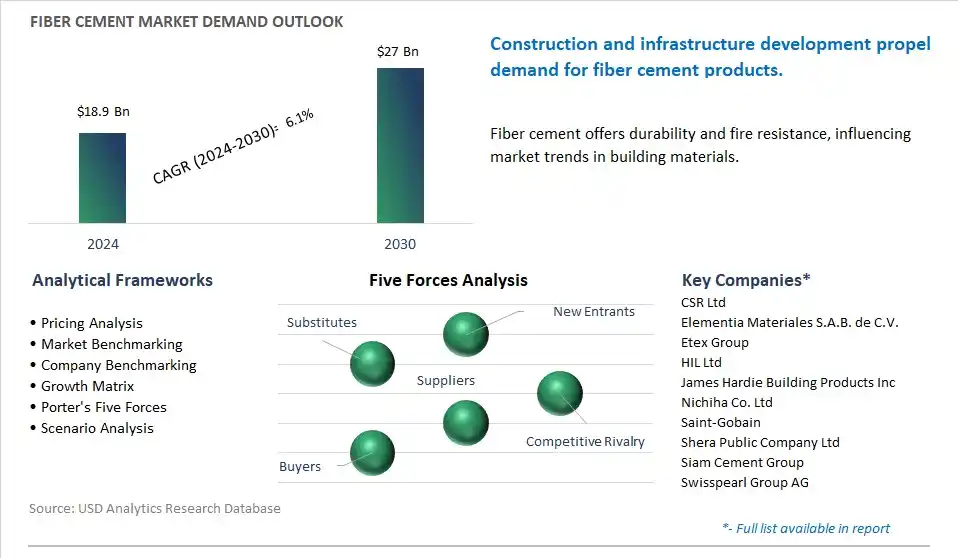
Fiber Cement Market Competitive Landscape
The market report analyses the leading companies in the industry including CSR Ltd, Elementia Materiales S.A.B. de C.V., Etex Group, HIL Ltd, James Hardie Building Products Inc, Nichiha Co. Ltd, Saint-Gobain, Shera Public Company Ltd, Siam Cement Group, Swisspearl Group AG.
Fiber Cement Market Dynamics
Fiber Cement Market Trend: Increasing Demand for Sustainable Construction Materials Drives Fiber Cement Market Growth
One prominent trend in the fiber cement market is the increasing demand for sustainable construction materials. Fiber cement, known for its durability, fire resistance, and low maintenance requirements, is gaining popularity as a sustainable alternative to traditional building materials such as wood, vinyl, and aluminum. With growing concerns about climate change, energy efficiency, and environmental sustainability, there is a rising preference for construction materials that offer longevity, resilience, and eco-friendly attributes. Fiber cement products, including siding, roofing, and cladding systems, are favored by architects, builders, and homeowners for their ability to withstand harsh weather conditions, resist pests and rot, and contribute to energy-efficient building designs. The trend towards sustainable construction practices drives the adoption of fiber cement as a versatile and environmentally responsible building material choice.
Fiber Cement Market Driver: Urbanization and Infrastructure Development Fuel Demand for Fiber Cement Products
The growth of the fiber cement market is driven by urbanization, population growth, and infrastructure development projects worldwide. As urban populations increase and cities expand, there is a growing need for residential, commercial, and industrial infrastructure to accommodate housing, transportation, and utilities. Fiber cement products find wide application in construction projects such as residential housing, commercial buildings, schools, hospitals, and public infrastructure due to their versatility, performance, and aesthetic appeal. Additionally, the demand for fiber cement is fueled by renovation and retrofitting activities in existing buildings, as property owners seek durable and cost-effective solutions to improve building performance and curb appeal. Urbanization and infrastructure development serve as key drivers propelling the demand for fiber cement products in the global construction market.
Fiber Cement Market Opportunity: Innovation in Fiber Cement Formulations and Product Applications
A potential opportunity in the fiber cement market lies in innovation in formulations and product applications to meet evolving customer needs and market trends. Manufacturers can capitalize on this opportunity by investing in research and development to develop advanced fiber cement formulations with improved durability, weather resistance, and sustainability features. Additionally, there is an opportunity to expand the range of fiber cement products and applications beyond traditional siding and roofing systems to include innovative solutions such as interior wall panels, decorative facades, acoustic barriers, and modular construction components. By offering diversified product portfolios and customized solutions tailored to specific architectural, design, and construction requirements, fiber cement manufacturers can differentiate themselves in the competitive market landscape and capture new growth opportunities in the global construction industry.
Fiber Cement Market Share Analysis: Residential segment generated the highest revenue in the industry
The residential segment is the largest segment in the Fiber Cement Market due to diverse key reasons. Fiber cement products, such as siding, roofing, and cladding, are extensively used in residential construction due to their durability, versatility, and aesthetic appeal. Fiber cement siding, in particular, has gained popularity among homeowners and builders as a low-maintenance and cost-effective alternative to traditional materials like wood, vinyl, and stucco. Its ability to mimic the look of natural materials while offering superior weather resistance, fire protection, and termite resistance makes it a preferred choice for residential exteriors. Additionally, fiber cement roofing products provide long-lasting protection against harsh weather conditions, including wind, rain, and hail, enhancing the durability and longevity of residential structures. In addition, with the growing trend towards sustainable and energy-efficient building practices, fiber cement products are sought after for their eco-friendly composition, low embodied energy, and recyclability. Further, the robust growth in residential construction activity, driven by population growth, urbanization, and housing demand, further supports the dominance of the residential segment in the Fiber Cement Market.
Fiber Cement Market Share Analysis: Roofing Segment is poised to register the fastest growth rate (CAGR) over the forecast period to 2030
The roofing segment is the fastest-growing segment in the Fiber Cement Market due to diverse key factors propelling its rapid expansion. Fiber cement roofing products offer numerous advantages over traditional roofing materials, including durability, longevity, and resistance to fire, pests, and extreme weather conditions. As a result, fiber cement roofing has gained popularity in both residential and commercial construction projects seeking reliable and low-maintenance roofing solutions. Additionally, advancements in fiber cement manufacturing technologies have led to the development of innovative roofing products with enhanced performance characteristics, such as improved impact resistance, thermal insulation, and energy efficiency. In addition, the growing emphasis on sustainable building practices and energy-efficient construction drives the adoption of fiber cement roofing, as it contributes to green building certifications and meets stringent environmental standards. Further, the increasing frequency of extreme weather events, such as hurricanes, tornadoes, and wildfires, underscores the importance of resilient roofing materials capable of withstanding harsh climatic conditions, further fueling the demand for fiber cement roofing products. With its superior performance attributes, versatility, and growing acceptance in the construction industry, the roofing segment is poised for significant growth in the Fiber Cement Market.
Fiber Cement Market Report Segmentation
By End-User
Commercial
Industrial and Institutional
Infrastructure
Residential
By Application
Cladding
Molding and Trimming
Roofing
Siding
Others
Regions Included
North America (US, Canada, Mexico)
Europe (Germany, UK, France, Spain, Italy, Russia, Rest of Europe)
Asia Pacific (China, India, Japan, South Korea, Australia, South East Asia, Rest of Asia)
South America (Brazil, Argentina, Rest of South America)
Middle East and Africa (Saudi Arabia, UAE, Rest of Middle East, South Africa, Egypt, Rest of Africa)
Fiber Cement Companies Profiled in the Market Study
CSR Ltd
Elementia Materiales S.A.B. de C.V.
Etex Group
HIL Ltd
James Hardie Building Products Inc
Nichiha Co. Ltd
Saint-Gobain
Shera Public Company Ltd
Siam Cement Group
Swisspearl Group AG
*- List Not Exhaustive
TABLE OF CONTENTS
1 Introduction to 2024 Fiber Cement Market
1.1 Market Overview
1.2 Quick Facts
1.3 Scope/Objective of the Study
1.4 Market Definition
1.5 Countries and Regions Covered
1.6 Units, Currency, and Conversions
1.7 Industry Value Chain
2 Research Methodology
2.1 Market Size Estimation
2.2 Sources and Research Methodology
2.3 Data Triangulation
2.4 Assumptions and Limitations
3 Executive Summary
3.1 Global Fiber Cement Market Size Outlook, $ Million, 2021 to 2030
3.2 Fiber Cement Market Outlook by Type, $ Million, 2021 to 2030
3.3 Fiber Cement Market Outlook by Product, $ Million, 2021 to 2030
3.4 Fiber Cement Market Outlook by Application, $ Million, 2021 to 2030
3.5 Fiber Cement Market Outlook by Key Countries, $ Million, 2021 to 2030
4 Market Dynamics
4.1 Key Driving Forces of Fiber Cement Industry
4.2 Key Market Trends in Fiber Cement Industry
4.3 Potential Opportunities in Fiber Cement Industry
4.4 Key Challenges in Fiber Cement Industry
5 Market Factor Analysis
5.1 Value Chain Analysis
5.2 Competitive Landscape
5.2.1 Global Fiber Cement Market Share by Company (%), 2023
5.2.2 Product Offerings by Company
5.3 Porter’s Five Forces Analysis
5.4 Pricing Analysis and Outlook
6 Growth Outlook Across Scenarios
6.1 Growth Analysis-Case Scenario Definitions
6.2 Low Growth Scenario Forecasts
6.3 Reference Growth Scenario Forecasts
6.4 High Growth Scenario Forecasts
7 Global Fiber Cement Market Outlook by Segments
7.1 Fiber Cement Market Outlook by Segments, $ Million, 2021- 2030
By End-User
Commercial
Industrial and Institutional
Infrastructure
Residential
By Application
Cladding
Molding and Trimming
Roofing
Siding
Others
8 North America Fiber Cement Market Analysis and Outlook To 2030
8.1 Introduction to North America Fiber Cement Markets in 2024
8.2 North America Fiber Cement Market Size Outlook by Country, 2021-2030
8.2.1 United States
8.2.2 Canada
8.2.3 Mexico
8.3 North America Fiber Cement Market size Outlook by Segments, 2021-2030
By End-User
Commercial
Industrial and Institutional
Infrastructure
Residential
By Application
Cladding
Molding and Trimming
Roofing
Siding
Others
9 Europe Fiber Cement Market Analysis and Outlook To 2030
9.1 Introduction to Europe Fiber Cement Markets in 2024
9.2 Europe Fiber Cement Market Size Outlook by Country, 2021-2030
9.2.1 Germany
9.2.2 France
9.2.3 Spain
9.2.4 United Kingdom
9.2.4 Italy
9.2.5 Russia
9.2.6 Norway
9.2.7 Rest of Europe
9.3 Europe Fiber Cement Market Size Outlook by Segments, 2021-2030
By End-User
Commercial
Industrial and Institutional
Infrastructure
Residential
By Application
Cladding
Molding and Trimming
Roofing
Siding
Others
10 Asia Pacific Fiber Cement Market Analysis and Outlook To 2030
10.1 Introduction to Asia Pacific Fiber Cement Markets in 2024
10.2 Asia Pacific Fiber Cement Market Size Outlook by Country, 2021-2030
10.2.1 China
10.2.2 India
10.2.3 Japan
10.2.4 South Korea
10.2.5 Indonesia
10.2.6 Malaysia
10.2.7 Australia
10.2.8 Rest of Asia Pacific
10.3 Asia Pacific Fiber Cement Market size Outlook by Segments, 2021-2030
By End-User
Commercial
Industrial and Institutional
Infrastructure
Residential
By Application
Cladding
Molding and Trimming
Roofing
Siding
Others
11 South America Fiber Cement Market Analysis and Outlook To 2030
11.1 Introduction to South America Fiber Cement Markets in 2024
11.2 South America Fiber Cement Market Size Outlook by Country, 2021-2030
11.2.1 Brazil
11.2.2 Argentina
11.2.3 Rest of South America
11.3 South America Fiber Cement Market size Outlook by Segments, 2021-2030
By End-User
Commercial
Industrial and Institutional
Infrastructure
Residential
By Application
Cladding
Molding and Trimming
Roofing
Siding
Others
12 Middle East and Africa Fiber Cement Market Analysis and Outlook To 2030
12.1 Introduction to Middle East and Africa Fiber Cement Markets in 2024
12.2 Middle East and Africa Fiber Cement Market Size Outlook by Country, 2021-2030
12.2.1 Saudi Arabia
12.2.2 UAE
12.2.3 Oman
12.2.4 Rest of Middle East
12.2.5 Egypt
12.2.6 Nigeria
12.2.7 South Africa
12.2.8 Rest of Africa
12.3 Middle East and Africa Fiber Cement Market size Outlook by Segments, 2021-2030
By End-User
Commercial
Industrial and Institutional
Infrastructure
Residential
By Application
Cladding
Molding and Trimming
Roofing
Siding
Others
13 Company Profiles
13.1 Company Snapshot
13.2 SWOT Profiles
13.3 Products and Services
13.4 Recent Developments
13.5 Financial Profile
CSR Ltd
Elementia Materiales S.A.B. de C.V.
Etex Group
HIL Ltd
James Hardie Building Products Inc
Nichiha Co. Ltd
Saint-Gobain
Shera Public Company Ltd
Siam Cement Group
Swisspearl Group AG
14 Appendix
14.1 Customization Offerings
14.2 Subscription Services
14.3 Related Reports
14.4 Publisher Expertise
By End-User
Commercial
Industrial and Institutional
Infrastructure
Residential
By Application
Cladding
Molding and Trimming
Roofing
Siding
Others
Countries Analyzed
North America (US, Canada, Mexico)
Europe (Germany, UK, France, Spain, Italy, Russia, Rest of Europe)
Asia Pacific (China, India, Japan, South Korea, Australia, South East Asia, Rest of Asia)
South America (Brazil, Argentina, Rest of South America)
Middle East and Africa (Saudi Arabia, UAE, Rest of Middle East, South Africa, Egypt, Rest of Africa)
