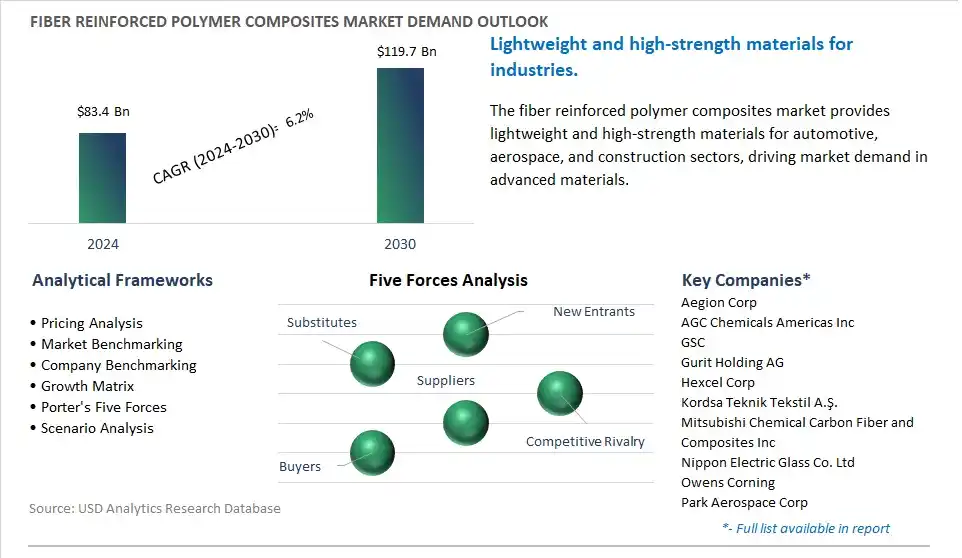
The global Fiber Reinforced Polymer Composites Market is poised to register a 6.2% CAGR from $83.4 Billion in 2024 to $119.7 Billion in 2030.
The global Fiber Reinforced Polymer Composites Market Study analyzes and forecasts the market size across 6 regions and 24 countries for diverse segments -By Type (Glass Fiber-Reinforced Polymer, Carbon Fiber-Reinforced Polymer, Aramid Fiber-Reinforced Polymer, Basalt Fiber-Reinforced Polymer, Others), By End-User (Building and Construction, Transportation, Electrical and Electronics, Others).
An Introduction to Global Fiber Reinforced Polymer Composites Market in 2024
In the fiber reinforced polymer (FRP) composites market, the future is driven by trends such as lightweighting, material innovation, and sustainability driving advancements in composite formulations, manufacturing processes, and end-user applications. Fiber reinforced polymer composites, consisting of fibers such as glass, carbon, or natural fibers embedded in a polymer matrix, offer high strength, stiffness, and corrosion resistance while being lightweight and durable. Key trends shaping this market include advancements in fiber reinforcement technologies such as continuous fibers, chopped fibers, and nanofibers to tailor mechanical properties and optimize performance for specific applications, the development of advanced resin systems with improved cure kinetics, thermal stability, and environmental resistance to enhance composite processing and durability, and the adoption of sustainable practices such as bio-based fibers, recycled resins, and closed-loop manufacturing to reduce environmental impact and promote circular economy principles. As industries seek to improve product performance, reduce lifecycle costs, and minimize carbon footprint, the demand for fiber reinforced polymer composites that offer lightweighting benefits, design flexibility, and sustainability advantages is expected to drive market growth and stimulate further innovation in FRP composite technology and applications.
Fiber Reinforced Polymer Composites Market Competitive Landscape
The market report analyses the leading companies in the industry including Aegion Corp, AGC Chemicals Americas Inc, GSC, Gurit Holding AG, Hexcel Corp, Kordsa Teknik Tekstil A.Åž., Mitsubishi Chemical Carbon Fiber and Composites Inc, Nippon Electric Glass Co. Ltd, Owens Corning, Park Aerospace Corp, SGL Carbon SE, Solvay SA, Teijin Ltd, Toray Industries Inc.
Fiber Reinforced Polymer Composites Market Dynamics
Fiber Reinforced Polymer Composites Market Trend: Increasing Adoption of Fiber Reinforced Polymer Composites in Infrastructure Rehabilitation and Retrofitting Projects
A significant trend in the fiber reinforced polymer composites market is the growing adoption of these materials in infrastructure rehabilitation and retrofitting projects. With aging infrastructure and the need for cost-effective and durable repair solutions, fiber reinforced polymer composites offer a viable alternative to traditional materials such as steel and concrete. These composites provide superior strength-to-weight ratios, corrosion resistance, and durability, making them ideal for strengthening and extending the service life of bridges, buildings, pipelines, and other critical infrastructure assets. This drives the growing recognition of the benefits of fiber reinforced polymer composites in addressing infrastructure challenges and ensuring the long-term sustainability and resilience of civil engineering structures.
Fiber Reinforced Polymer Composites Market Driver: Demand for Lightweight and High-Strength Materials for Sustainable Construction
The primary driver for the fiber reinforced polymer composites market is the demand for lightweight and high-strength materials for sustainable construction practices. As the construction industry seeks to reduce its environmental footprint, improve energy efficiency, and enhance structural performance, there is a growing preference for materials that offer superior mechanical properties while minimizing weight and resource consumption. Fiber reinforced polymer composites, reinforced with fibers such as carbon, glass, or aramid, meet these requirements by providing exceptional strength, durability, and versatility without adding significant weight to structures. This demand for sustainable and high-performance construction materials drives the adoption of fiber reinforced polymer composites in a wide range of applications across the construction sector.
Fiber Reinforced Polymer Composites Market Opportunity: Expansion into Automotive and Aerospace Applications for Lightweighting
An opportunity exists for companies operating in the fiber reinforced polymer composites market to expand into automotive and aerospace applications for lightweighting. With increasing regulatory pressures to improve fuel efficiency, reduce emissions, and enhance performance, manufacturers in the automotive and aerospace industries are increasingly turning to fiber reinforced polymer composites as alternatives to traditional materials such as metals. These composites offer significant weight savings, which translates to improved fuel economy, increased payload capacity, and enhanced maneuverability in vehicles and aircraft. By targeting these industries and offering tailored solutions for lightweighting, companies can capitalize on the growing demand for fiber reinforced polymer composites and diversify their revenue streams in dynamic and high-growth markets.
Fiber Reinforced Polymer Composites Market Ecosystem
The Market Ecosystem of the fiber-reinforced polymer (FRP) composites market encompasses diverse key stages, with raw material sourcing. Fiber suppliers including Owens Corning and resin suppliers including BASF provide essential components for FRP production, while additive suppliers including Evonik Industries offer specialized additives to enhance composite properties. In the manufacturing stage, FRP processors including Solvay and Mitsubishi Chemical utilize various techniques to fabricate FRP parts according to customer specifications. Distribution channels involve distributors and fabricators who distribute pre-made FRP shapes or finished products to end-users. These end-users primarily consist of manufacturing industries across sectors including aerospace, transportation, construction, wind energy, electronics, and sporting goods, leveraging FRP composites for their lightweight, high-strength properties.
Companies including Owens Corning, BASF, and Solvay play crucial roles in different stages of the FRP composites Market Ecosystem, ensuring a steady supply of quality raw materials and manufacturing expertise. Distributors including WESCO International and end-users in various industries complete the chain by integrating FRP composites into diverse applications, ranging from aircraft components and automotive parts to building materials and sporting goods.
Fiber Reinforced Polymer (FRP) Composites Market Share Analysis: Glass Fiber-Reinforced Polymer (GFRP) held the dominant revenue share in 2024
The Glass Fiber-Reinforced Polymer (GFRP) segment holds the title of the largest segment in the Fiber Reinforced Polymer (FRP) Composites Market, primarily due to diverse factors that underscore its widespread adoption and versatile applications. Glass fibers are among the most commonly used reinforcement materials in polymer composites due to their abundance, low cost, and favorable mechanical properties. GFRP offers a compelling combination of strength, stiffness, and durability while remaining lightweight and corrosion-resistant, making it suitable for a broad spectrum of industries and applications. In construction and infrastructure, GFRP finds extensive use in structural components such as rebar, beams, columns, and panels, where its high strength-to-weight ratio and resistance to environmental factors provide significant advantages over traditional materials like steel and concrete. In addition, GFRP's non-conductive nature makes it ideal for applications in electrical and electronics, including circuit boards, insulators, and housings, where it enhances safety and reliability. Additionally, GFRP's versatility extends to automotive, aerospace, marine, and consumer goods sectors, where it contributes to lightweighting initiatives, fuel efficiency, and design flexibility. The established infrastructure for glass fiber production, coupled with ongoing advancements in resin formulations and manufacturing processes, further solidifies GFRP's dominance in the FRP composites market. With its proven performance, cost-effectiveness, and versatility across diverse industries, the Glass Fiber-Reinforced Polymer segment continues to maintain its position as the largest segment in the FRP composites market.
Fiber Reinforced Polymer (FRP) Composites Market Share Analysis: Building and Construction is the fastest growing market segment over the forecast period to 2030
The Building and Construction segment is the fastest-growing segment in the Fiber Reinforced Polymer (FRP) Composites Market, driven by diverse key factors that underscore its rapid expansion. FRP composites offer a compelling alternative to traditional construction materials like steel, concrete, and wood due to their exceptional strength-to-weight ratio, durability, corrosion resistance, and design flexibility. In the construction industry, FRP composites find diverse applications across a wide range of structural and non-structural components, including beams, columns, rebars, panels, facades, bridges, decks, and reinforcements. These materials address critical challenges faced by the construction sector, such as the need for lightweight, high-strength materials that can withstand harsh environmental conditions, seismic activity, and corrosion without compromising structural integrity or requiring extensive maintenance. In addition, the increasing focus on sustainable construction practices and green building initiatives has spurred the adoption of FRP composites, as they offer energy efficiency, recyclability, and reduced environmental impact compared to traditional materials. Additionally, advancements in manufacturing technologies, material formulations, and construction techniques have further accelerated the uptake of FRP composites in building and construction applications. With ongoing investments in infrastructure development, urbanization trends, and the rising demand for high-performance, durable construction materials, the Building and Construction segment is poised for robust growth in the FRP composites market.
Fiber Reinforced Polymer Composites Market Report Scope-
By Type
Glass Fiber-Reinforced Polymer
Carbon Fiber-Reinforced Polymer
Aramid Fiber-Reinforced Polymer
Basalt Fiber-Reinforced Polymer
Others
By End-User
Building and Construction
Transportation
Electrical and Electronics
Others
Fiber Reinforced Polymer Composites Market Companies Profiled
Aegion Corp
AGC Chemicals Americas Inc
GSC
Gurit Holding AG
Hexcel Corp
Kordsa Teknik Tekstil A.Åž.
Mitsubishi Chemical Carbon Fiber and Composites Inc
Nippon Electric Glass Co. Ltd
Owens Corning
Park Aerospace Corp
SGL Carbon SE
Solvay SA
Teijin Ltd
Toray Industries Inc
*- List Not Exhaustive
TABLE OF CONTENTS
1 Introduction to 2024 Fiber Reinforced Polymer Composites Market
1.1 Market Overview
1.2 Quick Facts
1.3 Scope/Objective of the Study
1.4 Market Definition
1.5 Countries and Regions Covered
1.6 Units, Currency, and Conversions
1.7 Industry Value Chain
2 Research Methodology
2.1 Market Size Estimation
2.2 Sources and Research Methodology
2.3 Data Triangulation
2.4 Assumptions and Limitations
3 Executive Summary
3.1 Global Fiber Reinforced Polymer Composites Market Size Outlook, $ Million, 2021 to 2030
3.2 Fiber Reinforced Polymer Composites Market Outlook by Type, $ Million, 2021 to 2030
3.3 Fiber Reinforced Polymer Composites Market Outlook by Product, $ Million, 2021 to 2030
3.4 Fiber Reinforced Polymer Composites Market Outlook by Application, $ Million, 2021 to 2030
3.5 Fiber Reinforced Polymer Composites Market Outlook by Key Countries, $ Million, 2021 to 2030
4 Market Dynamics
4.1 Key Driving Forces of Fiber Reinforced Polymer Composites Industry
4.2 Key Market Trends in Fiber Reinforced Polymer Composites Industry
4.3 Potential Opportunities in Fiber Reinforced Polymer Composites Industry
4.4 Key Challenges in Fiber Reinforced Polymer Composites Industry
5 Market Factor Analysis
5.1 Value Chain Analysis
5.2 Competitive Landscape
5.2.1 Global Fiber Reinforced Polymer Composites Market Share by Company (%), 2023
5.2.2 Product Offerings by Company
5.3 Porter’s Five Forces Analysis
5.4 Pricing Analysis and Outlook
6 Growth Outlook Across Scenarios
6.1 Growth Analysis-Case Scenario Definitions
6.2 Low Growth Scenario Forecasts
6.3 Reference Growth Scenario Forecasts
6.4 High Growth Scenario Forecasts
7 Global Fiber Reinforced Polymer Composites Market Outlook by Segments
7.1 Fiber Reinforced Polymer Composites Market Outlook by Segments, $ Million, 2021- 2030
By Type
Glass Fiber-Reinforced Polymer
Carbon Fiber-Reinforced Polymer
Aramid Fiber-Reinforced Polymer
Basalt Fiber-Reinforced Polymer
Others
By End-User
Building and Construction
Transportation
Electrical and Electronics
Others
8 North America Fiber Reinforced Polymer Composites Market Analysis and Outlook To 2030
8.1 Introduction to North America Fiber Reinforced Polymer Composites Markets in 2024
8.2 North America Fiber Reinforced Polymer Composites Market Size Outlook by Country, 2021-2030
8.2.1 United States
8.2.2 Canada
8.2.3 Mexico
8.3 North America Fiber Reinforced Polymer Composites Market size Outlook by Segments, 2021-2030
By Type
Glass Fiber-Reinforced Polymer
Carbon Fiber-Reinforced Polymer
Aramid Fiber-Reinforced Polymer
Basalt Fiber-Reinforced Polymer
Others
By End-User
Building and Construction
Transportation
Electrical and Electronics
Others
9 Europe Fiber Reinforced Polymer Composites Market Analysis and Outlook To 2030
9.1 Introduction to Europe Fiber Reinforced Polymer Composites Markets in 2024
9.2 Europe Fiber Reinforced Polymer Composites Market Size Outlook by Country, 2021-2030
9.2.1 Germany
9.2.2 France
9.2.3 Spain
9.2.4 United Kingdom
9.2.4 Italy
9.2.5 Russia
9.2.6 Norway
9.2.7 Rest of Europe
9.3 Europe Fiber Reinforced Polymer Composites Market Size Outlook by Segments, 2021-2030
By Type
Glass Fiber-Reinforced Polymer
Carbon Fiber-Reinforced Polymer
Aramid Fiber-Reinforced Polymer
Basalt Fiber-Reinforced Polymer
Others
By End-User
Building and Construction
Transportation
Electrical and Electronics
Others
10 Asia Pacific Fiber Reinforced Polymer Composites Market Analysis and Outlook To 2030
10.1 Introduction to Asia Pacific Fiber Reinforced Polymer Composites Markets in 2024
10.2 Asia Pacific Fiber Reinforced Polymer Composites Market Size Outlook by Country, 2021-2030
10.2.1 China
10.2.2 India
10.2.3 Japan
10.2.4 South Korea
10.2.5 Indonesia
10.2.6 Malaysia
10.2.7 Australia
10.2.8 Rest of Asia Pacific
10.3 Asia Pacific Fiber Reinforced Polymer Composites Market size Outlook by Segments, 2021-2030
By Type
Glass Fiber-Reinforced Polymer
Carbon Fiber-Reinforced Polymer
Aramid Fiber-Reinforced Polymer
Basalt Fiber-Reinforced Polymer
Others
By End-User
Building and Construction
Transportation
Electrical and Electronics
Others
11 South America Fiber Reinforced Polymer Composites Market Analysis and Outlook To 2030
11.1 Introduction to South America Fiber Reinforced Polymer Composites Markets in 2024
11.2 South America Fiber Reinforced Polymer Composites Market Size Outlook by Country, 2021-2030
11.2.1 Brazil
11.2.2 Argentina
11.2.3 Rest of South America
11.3 South America Fiber Reinforced Polymer Composites Market size Outlook by Segments, 2021-2030
By Type
Glass Fiber-Reinforced Polymer
Carbon Fiber-Reinforced Polymer
Aramid Fiber-Reinforced Polymer
Basalt Fiber-Reinforced Polymer
Others
By End-User
Building and Construction
Transportation
Electrical and Electronics
Others
12 Middle East and Africa Fiber Reinforced Polymer Composites Market Analysis and Outlook To 2030
12.1 Introduction to Middle East and Africa Fiber Reinforced Polymer Composites Markets in 2024
12.2 Middle East and Africa Fiber Reinforced Polymer Composites Market Size Outlook by Country, 2021-2030
12.2.1 Saudi Arabia
12.2.2 UAE
12.2.3 Oman
12.2.4 Rest of Middle East
12.2.5 Egypt
12.2.6 Nigeria
12.2.7 South Africa
12.2.8 Rest of Africa
12.3 Middle East and Africa Fiber Reinforced Polymer Composites Market size Outlook by Segments, 2021-2030
By Type
Glass Fiber-Reinforced Polymer
Carbon Fiber-Reinforced Polymer
Aramid Fiber-Reinforced Polymer
Basalt Fiber-Reinforced Polymer
Others
By End-User
Building and Construction
Transportation
Electrical and Electronics
Others
13 Company Profiles
13.1 Company Snapshot
13.2 SWOT Profiles
13.3 Products and Services
13.4 Recent Developments
13.5 Financial Profile
Aegion Corp
AGC Chemicals Americas Inc
GSC
Gurit Holding AG
Hexcel Corp
Kordsa Teknik Tekstil A.Åž.
Mitsubishi Chemical Carbon Fiber and Composites Inc
Nippon Electric Glass Co. Ltd
Owens Corning
Park Aerospace Corp
SGL Carbon SE
Solvay SA
Teijin Ltd
Toray Industries Inc
14 Appendix
14.1 Customization Offerings
14.2 Subscription Services
14.3 Related Reports
14.4 Publisher Expertise
By Type
Glass Fiber-Reinforced Polymer
Carbon Fiber-Reinforced Polymer
Aramid Fiber-Reinforced Polymer
Basalt Fiber-Reinforced Polymer
Others
By End-User
Building and Construction
Transportation
Electrical and Electronics
Others
Countries Analyzed
North America (US, Canada, Mexico)
Europe (Germany, UK, France, Spain, Italy, Russia, Rest of Europe)
Asia Pacific (China, India, Japan, South Korea, Australia, South East Asia, Rest of Asia)
South America (Brazil, Argentina, Rest of South America)
Middle East and Africa (Saudi Arabia, UAE, Rest of Middle East, South Africa, Egypt, Rest of Africa)
