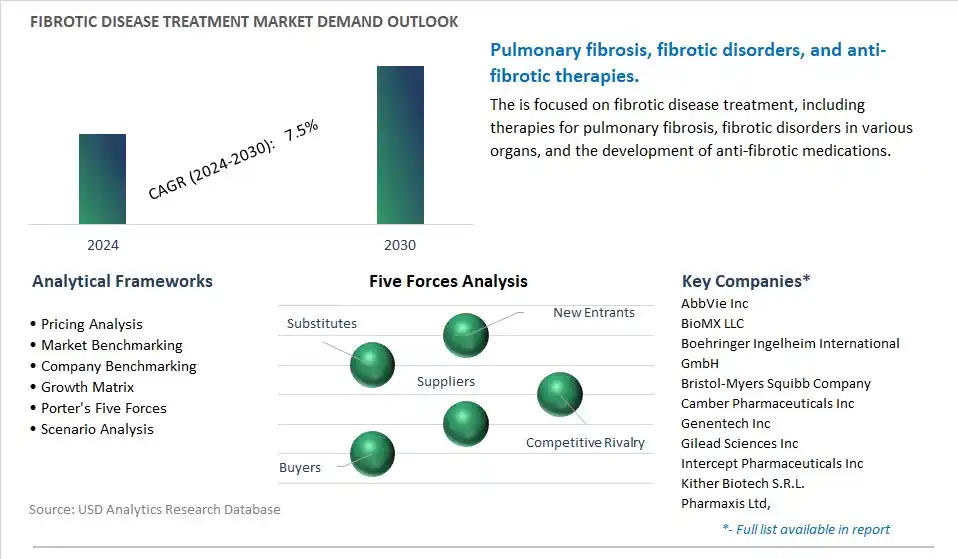
Fibrotic Disease Treatment Market is estimated to increase at a Compounded Annual Growth Rate of 7.5% CAGR over the forecast period from 2024 to 2030
The Fibrotic Disease Treatment Market study analyzes and forecasts the market size across 6 regions and 24 countries for diverse segments- By Treatment (Medication, Organ Transplantation, Oxygen Therapy, Others), By Application (Idiopathic pulmonary fibrosis, Hepatic cirrhosis, Renal fibrosis, Cutaneous fibrosis, Others), By End-User (Hospitals, Academic and research institutes, Others).
An Introduction to Fibrotic Disease Treatment Market in 2024
In 2024, the market for fibrotic disease treatment addresses the therapeutic needs of patients suffering from fibrotic disorders, encompassing a diverse range of chronic and progressive conditions characterized by abnormal fibrous tissue deposition and scarring in various organs and tissues of the body. Fibrotic diseases can affect multiple organ systems, including the lungs (e.g., idiopathic pulmonary fibrosis), liver (e.g., cirrhosis), kidneys (e.g., renal fibrosis), heart (e.g., cardiac fibrosis), skin (e.g., systemic sclerosis), and others, leading to impaired organ function, reduced quality of life, and potentially life-threatening complications. The hallmark of fibrotic diseases is the excessive accumulation of extracellular matrix proteins, such as collagen, fibronectin, and elastin, resulting in tissue remodeling, loss of normal architecture, and organ dysfunction. The treatment of fibrotic diseases aims to halt or slow the progression of fibrosis, alleviate symptoms, and improve organ function through a combination of pharmacological therapies, lifestyle modifications, and supportive care measures. Pharmacological interventions for fibrotic diseases may include anti-fibrotic agents, immunomodulatory drugs, anti-inflammatory agents, antifibrotic cytokines, and targeted therapies aimed at disrupting the fibrotic process, reducing inflammation, and promoting tissue repair. Additionally, supportive therapies such as pulmonary rehabilitation, nutritional support, oxygen therapy, and symptom management play a crucial role in optimizing patient outcomes and quality of life. With a focus on disease modification, symptom relief, and preservation of organ function, fibrotic disease treatments undergo extensive clinical research, drug development, and regulatory evaluation to demonstrate safety, efficacy, and tolerability in clinical trials. Moreover, with advancements in molecular biology, precision medicine, and targeted drug delivery, the fibrotic disease treatment market continues to evolve, offering novel therapeutic approaches, personalized treatment regimens, and innovative strategies for addressing the complex pathophysiology of fibrotic disorders and improving outcomes for patients affected by these debilitating conditions.
Market Trend: Advancements in Targeted Therapies for Fibrotic Diseases
A prominent trend in the fibrotic disease treatment market is the advancements in targeted therapies for fibrotic diseases. Over recent years, there has been significant progress in understanding the molecular mechanisms underlying fibrosis, leading to the identification of novel therapeutic targets and the development of targeted therapies. These therapies aim to disrupt fibrotic pathways, inhibit excessive collagen deposition, and attenuate tissue scarring, thereby slowing or halting the progression of fibrotic diseases such as idiopathic pulmonary fibrosis, liver cirrhosis, and systemic sclerosis. The trend towards targeted therapies reflects a shift from symptomatic management towards disease-modifying treatments, offering hope for improved outcomes and quality of life for patients with fibrotic diseases.
Market Driver: Growing Burden of Fibrotic Diseases and Unmet Medical Needs
A key driver for the fibrotic disease treatment market is the growing burden of fibrotic diseases and the associated unmet medical needs. Fibrotic diseases represent a significant healthcare challenge globally, contributing to morbidity, mortality, and healthcare costs. The prevalence of fibrotic diseases is on the rise due to factors such as aging populations, increasing incidence of chronic diseases, and environmental exposures. Current treatment options for fibrotic diseases often focus on managing symptoms and slowing disease progression, but there remains a substantial unmet need for effective therapies that can halt or reverse fibrosis and improve patient outcomes. The growing recognition of the socioeconomic burden and clinical impact of fibrotic diseases drives research, innovation, and investment in the development of new treatment modalities and therapeutic approaches to address the unmet medical needs of patients with fibrotic diseases.
Market Opportunity: Personalized Medicine Approaches and Biomarker Development
An opportunity for innovation and market growth in the fibrotic disease treatment market lies in personalized medicine approaches and biomarker development. Fibrotic diseases are heterogeneous, with variable disease progression, response to treatment, and clinical outcomes among patients. Personalized medicine approaches, such as precision diagnostics and targeted therapies tailored to individual patient characteristics, offer opportunities to optimize treatment efficacy and minimize adverse effects. Biomarkers play a crucial role in patient stratification, treatment selection, and monitoring response to therapy in fibrotic diseases. By identifying and validating biomarkers that reflect disease activity, progression, and therapeutic response, healthcare providers can better predict patient outcomes, optimize treatment strategies, and improve clinical trial design for new fibrotic disease therapies. The development of personalized medicine approaches and biomarker-driven therapies represents a promising opportunity to advance precision care and improve outcomes for patients with fibrotic diseases, driving innovation and market growth in the fibrotic disease treatment segment.
Fibrotic Disease Treatment Market Share Analysis: Medication
The Medication segment within the Fibrotic Disease Treatment Market is experiencing rapid growth due to several factors driving the demand for pharmacological interventions in the management of fibrotic diseases across diverse patient populations and healthcare settings. Fibrotic diseases encompass a spectrum of chronic conditions characterized by abnormal tissue remodeling and excessive collagen deposition, leading to organ dysfunction and impaired physiological function. With the increasing prevalence and incidence of fibrotic diseases such as idiopathic pulmonary fibrosis (IPF), hepatic cirrhosis, renal fibrosis, and cutaneous fibrosis, there is growing recognition of the importance of early diagnosis and targeted pharmacotherapy to slow disease progression, alleviate symptoms, and improve patient outcomes. Medications play a crucial role in the treatment of fibrotic diseases by modulating key pathways involved in fibrogenesis, inflammation, and tissue repair, thereby reducing fibrosis progression and preserving organ function. Therapeutic agents commonly used in fibrotic disease management include antifibrotic drugs, immunosuppressants, anti-inflammatory agents, and targeted biologics, among others, offering diverse mechanisms of action and therapeutic benefits for patients with different fibrotic conditions. Hospitals, academic and research institutes, and other healthcare facilities are increasingly incorporating pharmacological therapies into comprehensive fibrotic disease management protocols, driven by the growing understanding of disease pathophysiology, advancements in drug discovery and development, and the need for personalized treatment approaches tailored to individual patient needs and disease severity. As pharmaceutical companies continue to invest in the research and development of novel medications targeting fibrotic pathways and emerging biomarkers, the Medication segment is poised for significant growth in the Fibrotic Disease Treatment Market, offering promising therapeutic options and improved disease outcomes for patients affected by fibrotic disorders.
Fibrotic Disease Treatment Competitive Analysis
The market research study provides in-depth insights into leading companies including the SWOT analyses, product profile, financial details, and recent developments acrossAbbVie Inc, BioMX LLC, Boehringer Ingelheim International GmbH, Bristol-Myers Squibb Company, Camber Pharmaceuticals Inc, Genentech Inc, Gilead Sciences Inc, Intercept Pharmaceuticals Inc, Kither Biotech S.R.L., Pharmaxis Ltd,, Redx Pharma Plc, Sandoz International GmbH, Verona Pharma plc
Fibrotic Disease Treatment Market Segmentation
By Treatment
Medication
Organ Transplantation
Oxygen Therapy
Others
By Application
Idiopathic pulmonary fibrosis
Hepatic cirrhosis
Renal fibrosis
Cutaneous fibrosis
Others
By End-User
Hospitals
Academic and research institutes
Others
Geographical Analysis
North America (United States, Canada, Mexico)
Europe (Germany, France, United Kingdom, Spain, Italy, Rest of Europe)
Asia Pacific (China, India, Japan, South Korea, Rest of Asia Pacific)
South America (Brazil, Argentina, Rest of South America)
Middle East and Africa (Saudi Arabia, UAE, Rest of Middle East, South Africa, Egypt, Rest of Africa)
Fibrotic Disease Treatment Market Companies
AbbVie Inc
BioMX LLC
Boehringer Ingelheim International GmbH
Bristol-Myers Squibb Company
Camber Pharmaceuticals Inc
Genentech Inc
Gilead Sciences Inc
Intercept Pharmaceuticals Inc
Kither Biotech S.R.L.
Pharmaxis Ltd,
Redx Pharma Plc
Sandoz International GmbH
Verona Pharma plc
Reasons to Buy the Fibrotic Disease Treatment Market Study
• Deepen your industry insights and navigate uncertainties for strategy formulation, CAPEX, and Operational decisions
• Gain access to detailed insights on the Fibrotic Disease Treatment Market, encompassing current market size, growth trends, and forecasts till 2030.
• Access detailed competitor analysis, enabling competitive advantage through a thorough understanding of market players, strategies, and potential differentiation opportunities
• Stay ahead of the curve with insights on technological advancements, innovations, and upcoming trends
• Identify lucrative investment avenues and expansion opportunities within the Fibrotic Disease Treatment Market industry, guided by robust, data-backed analysis.
• Understand regional and global markets through country-wise analysis, regional market potential, regulatory nuances, and dynamics
• Execute strategies with confidence and speed through information, analytics, and insights on the industry value chain
• Corporate leaders, strategists, financial experts, shareholders, asset managers, and governmental representatives can make long-term planning scenarios and build an integrated and timely understanding of market dynamics
• Benefit from tailored solutions and expert consultation based on report insights, providing personalized strategies aligned with specific business needs.
TABLE OF CONTENTS
1 Introduction to 2024 Fibrotic Disease Treatment Market
1.1 Market Overview
1.2 Quick Facts
1.3 Scope/Objective of the Study
1.4 Market Definition
1.5 Countries and Regions Covered
1.6 Units, Currency, and Conversions
1.7 Industry Value Chain
2 Research Methodology
2.1 Market Size Estimation
2.2 Sources and Research Methodology
2.3 Data Triangulation
2.4 Assumptions and Limitations
3 Executive Summary
3.1 Global Fibrotic Disease Treatment Market Size Outlook, $ Million, 2021 to 2030
3.2 Fibrotic Disease Treatment Market Outlook by Type, $ Million, 2021 to 2030
3.3 Fibrotic Disease Treatment Market Outlook by Product, $ Million, 2021 to 2030
3.4 Fibrotic Disease Treatment Market Outlook by Application, $ Million, 2021 to 2030
3.5 Fibrotic Disease Treatment Market Outlook by Key Countries, $ Million, 2021 to 2030
4 Market Dynamics
4.1 Key Driving Forces of Fibrotic Disease Treatment Industry
4.2 Key Market Trends in Fibrotic Disease Treatment Industry
4.3 Potential Opportunities in Fibrotic Disease Treatment Industry
4.4 Key Challenges in Fibrotic Disease Treatment Industry
5 Market Factor Analysis
5.1 Value Chain Analysis
5.2 Competitive Landscape
5.2.1 Global Fibrotic Disease Treatment Market Share by Company (%), 2023
5.2.2 Product Offerings by Company
5.3 Porter’s Five Forces Analysis
5.4 Pricing Analysis and Outlook
6 Growth Outlook Across Scenarios
6.1 Growth Analysis-Case Scenario Definitions
6.2 Low Growth Scenario Forecasts
6.3 Reference Growth Scenario Forecasts
6.4 High Growth Scenario Forecasts
7 Global Fibrotic Disease Treatment Market Outlook by Segments
7.1 Fibrotic Disease Treatment Market Outlook by Segments, $ Million, 2021- 2030
By Treatment
Medication
Organ Transplantation
Oxygen Therapy
Others
By Application
Idiopathic pulmonary fibrosis
Hepatic cirrhosis
Renal fibrosis
Cutaneous fibrosis
Others
By End-User
Hospitals
Academic and research institutes
Others
8 North America Fibrotic Disease Treatment Market Analysis and Outlook To 2030
8.1 Introduction to North America Fibrotic Disease Treatment Markets in 2024
8.2 North America Fibrotic Disease Treatment Market Size Outlook by Country, 2021-2030
8.2.1 United States
8.2.2 Canada
8.2.3 Mexico
8.3 North America Fibrotic Disease Treatment Market size Outlook by Segments, 2021-2030
By Treatment
Medication
Organ Transplantation
Oxygen Therapy
Others
By Application
Idiopathic pulmonary fibrosis
Hepatic cirrhosis
Renal fibrosis
Cutaneous fibrosis
Others
By End-User
Hospitals
Academic and research institutes
Others
9 Europe Fibrotic Disease Treatment Market Analysis and Outlook To 2030
9.1 Introduction to Europe Fibrotic Disease Treatment Markets in 2024
9.2 Europe Fibrotic Disease Treatment Market Size Outlook by Country, 2021-2030
9.2.1 Germany
9.2.2 France
9.2.3 Spain
9.2.4 United Kingdom
9.2.4 Italy
9.2.5 Russia
9.2.6 Norway
9.2.7 Rest of Europe
9.3 Europe Fibrotic Disease Treatment Market Size Outlook by Segments, 2021-2030
By Treatment
Medication
Organ Transplantation
Oxygen Therapy
Others
By Application
Idiopathic pulmonary fibrosis
Hepatic cirrhosis
Renal fibrosis
Cutaneous fibrosis
Others
By End-User
Hospitals
Academic and research institutes
Others
10 Asia Pacific Fibrotic Disease Treatment Market Analysis and Outlook To 2030
10.1 Introduction to Asia Pacific Fibrotic Disease Treatment Markets in 2024
10.2 Asia Pacific Fibrotic Disease Treatment Market Size Outlook by Country, 2021-2030
10.2.1 China
10.2.2 India
10.2.3 Japan
10.2.4 South Korea
10.2.5 Indonesia
10.2.6 Malaysia
10.2.7 Australia
10.2.8 Rest of Asia Pacific
10.3 Asia Pacific Fibrotic Disease Treatment Market size Outlook by Segments, 2021-2030
By Treatment
Medication
Organ Transplantation
Oxygen Therapy
Others
By Application
Idiopathic pulmonary fibrosis
Hepatic cirrhosis
Renal fibrosis
Cutaneous fibrosis
Others
By End-User
Hospitals
Academic and research institutes
Others
11 South America Fibrotic Disease Treatment Market Analysis and Outlook To 2030
11.1 Introduction to South America Fibrotic Disease Treatment Markets in 2024
11.2 South America Fibrotic Disease Treatment Market Size Outlook by Country, 2021-2030
11.2.1 Brazil
11.2.2 Argentina
11.2.3 Rest of South America
11.3 South America Fibrotic Disease Treatment Market size Outlook by Segments, 2021-2030
By Treatment
Medication
Organ Transplantation
Oxygen Therapy
Others
By Application
Idiopathic pulmonary fibrosis
Hepatic cirrhosis
Renal fibrosis
Cutaneous fibrosis
Others
By End-User
Hospitals
Academic and research institutes
Others
12 Middle East and Africa Fibrotic Disease Treatment Market Analysis and Outlook To 2030
12.1 Introduction to Middle East and Africa Fibrotic Disease Treatment Markets in 2024
12.2 Middle East and Africa Fibrotic Disease Treatment Market Size Outlook by Country, 2021-2030
12.2.1 Saudi Arabia
12.2.2 UAE
12.2.3 Oman
12.2.4 Rest of Middle East
12.2.5 Egypt
12.2.6 Nigeria
12.2.7 South Africa
12.2.8 Rest of Africa
12.3 Middle East and Africa Fibrotic Disease Treatment Market size Outlook by Segments, 2021-2030
By Treatment
Medication
Organ Transplantation
Oxygen Therapy
Others
By Application
Idiopathic pulmonary fibrosis
Hepatic cirrhosis
Renal fibrosis
Cutaneous fibrosis
Others
By End-User
Hospitals
Academic and research institutes
Others
13 Company Profiles
13.1 Company Snapshot
13.2 SWOT Profiles
13.3 Products and Services
13.4 Recent Developments
13.5 Financial Profile
List of Companies
AbbVie Inc
BioMX LLC
Boehringer Ingelheim International GmbH
Bristol-Myers Squibb Company
Camber Pharmaceuticals Inc
Genentech Inc
Gilead Sciences Inc
Intercept Pharmaceuticals Inc
Kither Biotech S.R.L.
Pharmaxis Ltd,
Redx Pharma Plc
Sandoz International GmbH
Verona Pharma plc
14 Appendix
14.1 Customization Offerings
14.2 Subscription Services
14.3 Related Reports
14.4 Publisher Expertise
By Treatment
Medication
Organ Transplantation
Oxygen Therapy
Others
By Application
Idiopathic pulmonary fibrosis
Hepatic cirrhosis
Renal fibrosis
Cutaneous fibrosis
Others
By End-User
Hospitals
Academic and research institutes
Others
Countries Analyzed
North America (United States, Canada, Mexico)
Europe (Germany, France, United Kingdom, Spain, Italy, Rest of Europe)
Asia Pacific (China, India, Japan, South Korea, Rest of Asia Pacific)
South America (Brazil, Argentina, Rest of South America)
Middle East and Africa (Saudi Arabia, UAE, Rest of Middle East, South Africa, Egypt, Rest of Africa)
