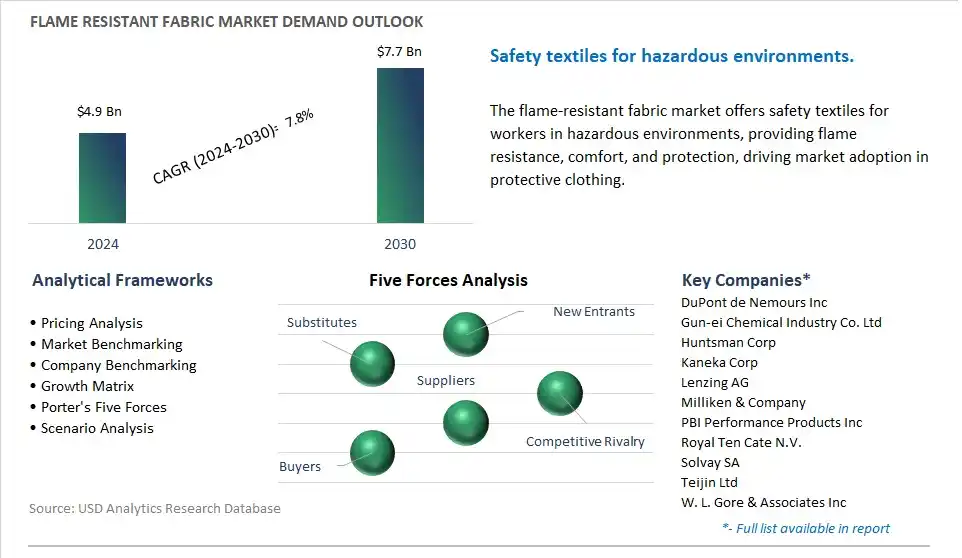
The global Flame Resistant Fabric Market is poised to register a 7.8% CAGR from $4.9 Billion in 2024 to $7.7 Billion in 2030.
The global Flame Resistant Fabric Market Study analyzes and forecasts the market size across 6 regions and 24 countries for diverse segments -By Type (Treated, Inherent), By Application (Protective Clothing, Interior Fabric, Industrial), By End-User (Construction & Manufacturing, Oil & Gas, Military, Transportation, Automotive).
An Introduction to Global Flame Resistant Fabric Market in 2024
In the flame resistant fabric market, the future is shaped by trends such as workplace safety regulations, industrial hazards, and technological advancements driving innovation in fabric materials, flame retardant treatments, and performance testing methods. Flame resistant fabrics are designed to provide protection against heat and flame exposure in various industries such as oil and gas, utilities, and firefighting. Key trends shaping this market include advancements in fabric engineering such as inherently flame-resistant fibers, blended yarns, and multi-layer constructions to enhance flame resistance, durability, and wearer comfort in protective garments, the development of flame retardant finishes and coatings such as phosphorus-based compounds, halogen-free additives, and nanotechnology solutions to improve flame resistance, thermal insulation, and moisture management properties of fabrics, and the adoption of stringent performance standards and certification programs such as NFPA 2112, EN ISO 11612, and ASTM F1959 to ensure compliance with industry regulations and safety requirements. As employers prioritize worker safety, comfort, and regulatory compliance, the demand for flame resistant fabrics that offer reliable protection, performance, and wearer comfort is expected to drive market growth and stimulate further innovation in protective textile technology and applications.
Flame Resistant Fabric Market Competitive Landscape
The market report analyses the leading companies in the industry including DuPont de Nemours Inc, Gun-ei Chemical Industry Co. Ltd, Huntsman Corp, Kaneka Corp, Lenzing AG, Milliken & Company, PBI Performance Products Inc, Royal Ten Cate N.V., Solvay SA, Teijin Ltd, W. L. Gore & Associates Inc.
Flame Resistant Fabric Market Dynamics
Flame Resistant Fabric Market Trend: Increasing Demand for Flame Resistant Fabric in Workwear and Protective Clothing
A significant trend in the flame resistant fabric market is the rising demand for these materials in workwear and protective clothing. With a growing awareness of workplace safety and regulatory requirements for personal protective equipment (PPE), there is an increasing emphasis on the use of flame resistant fabrics to protect workers from fire and heat hazards in various industries such as oil and gas, utilities, manufacturing, and firefighting. Flame resistant fabrics, engineered with flame retardant fibers and advanced textile technologies, offer reliable protection against thermal risks while providing comfort, durability, and breathability, making them essential components of flame resistant workwear and protective garments worn by workers exposed to fire-related hazards.
Flame Resistant Fabric Market Driver: Occupational Safety Regulations and Industry Standards Mandating Flame Resistant Clothing
The primary driver for the flame resistant fabric market is the enforcement of occupational safety regulations and industry standards mandating the use of flame resistant clothing in hazardous work environments. Governments, regulatory agencies, and industry associations worldwide impose strict requirements for employers to provide flame resistant clothing to workers exposed to fire and heat hazards as part of their duty of care obligations. Compliance with safety regulations and standards drives the demand for flame resistant fabrics as essential components of flame resistant workwear and protective clothing, ensuring the safety and well-being of workers in high-risk occupations where fire-related hazards are prevalent.
Flame Resistant Fabric Market Opportunity: Expansion into High-Performance Applications and Specialized Markets
An opportunity exists for companies operating in the flame resistant fabric market to expand into high-performance applications and specialized markets. While flame resistant fabrics are commonly used in industrial workwear and protective clothing, there is a potential to penetrate niche markets such as military, firefighting, aviation, and motorsports, where specialized flame resistant garments are required to meet specific performance criteria and regulatory standards. By developing flame resistant fabrics with enhanced properties such as abrasion resistance, tear resistance, UV protection, and chemical resistance, companies can cater to the unique needs of these specialized markets and offer tailored solutions that provide superior protection and performance in demanding environments. This opportunity allows companies to diversify their product offerings, tap into new customer segments, and capitalize on opportunities for growth and differentiation in the competitive market for flame resistant fabrics.
Flame Resistant Fabric Market Ecosystem
The Market Ecosystem comprises companies including DuPont de Nemours, Inc. and Honeywell International Inc. play critical roles. The flame-resistant fabric Market Ecosystem begins with fiber production, where companies including DuPont de Nemours, Inc. and Teijin Limited manufacture base fibers including Nomex® and Kevlar®, known for their excellent flame resistance. Alternatively, fibers can be treated with flame-retardant chemicals or blended with other materials for added functionality. Yarn spinning is conducted by integrated fiber producers or independent spinners to create yarns suited for flame-resistant fabrics. Fabric manufacturers then weave or knit these yarns into specialized fabrics, with players including W.L. Gore & Associates producing technical textiles including Gore-Tex® FR fabrics.
The flame-resistant fabrics are then utilized by fire-resistant garment manufacturers including Honeywell International Inc. and PBI Performance Products, Inc., which procure these fabrics and other components to produce various protective garments. These garments are distributed by safety equipment distributors including Grainger and WESCO International, Inc. to end-users across industries. Firefighters rely on flame-resistant garments for protection during firefighting operations, while industrial workers in sectors including oil & gas and chemical processing utilize them for hazard protection. Additionally, specialized garments find applications in military and law enforcement scenarios.
Flame Resistant Fabric Market Share Analysis: Treated held the dominant revenue share in 2024
The Treated segment is the largest segment in the Flame Resistant Fabric Market, driven by diverse significant factors. Treated flame-resistant fabrics are conventional textiles treated with flame-retardant chemicals to impart fire resistance properties. These fabrics find extensive applications across various industries, including firefighting, military, industrial, and construction, where protection against fire hazards is crucial. Treated flame-resistant fabrics offer cost-effective solutions for achieving fire safety compliance in a wide range of applications, making them highly sought after by end-users seeking reliable flame-resistant clothing and protective equipment. Additionally, treated fabrics are available in a diverse range of styles, colors, and textures, offering versatility and aesthetics along with fire protection. In addition, advancements in fabric treatment technologies continually improve the performance and durability of treated flame-resistant fabrics, further driving their adoption in industries where fire safety is paramount. As industries prioritize worker safety and regulatory compliance, the Treated segment maintains its dominance in the Flame Resistant Fabric Market.
Flame Resistant Fabric Market Share Analysis: Protective Clothing is the fastest growing market segment over the forecast period to 2030
The Protective Clothing segment is the fastest-growing segment in the Flame Resistant Fabric Market, driven by diverse crucial factors. In industries such as firefighting, oil and gas, electrical utilities, and manufacturing, there is a growing emphasis on ensuring worker safety and compliance with stringent safety regulations regarding fire protection. Protective clothing made from flame-resistant fabrics plays a vital role in safeguarding workers from the hazards of fire and thermal exposure in these high-risk environments. With increasing awareness about occupational safety and advancements in fabric technology, there's a rising demand for flame-resistant fabrics specifically designed for protective clothing applications. These fabrics offer superior flame resistance, thermal insulation, durability, and comfort, enabling workers to perform their tasks safely and effectively even in hazardous conditions. In addition, as industries prioritize employee welfare and risk mitigation, the demand for high-quality flame-resistant fabrics for protective clothing continues to surge, making the Protective Clothing segment the fastest-growing segment in the Flame Resistant Fabric Market.
Flame Resistant Fabric Market Share Analysis: Oil and Gas is the fastest growing market segment over the forecast period to 2030
The Oil and Gas segment is the fastest-growing segment in the Flame Resistant Fabric Market, propelled by diverse key factors. The oil and gas industry operates in environments fraught with fire and explosion risks, making fire safety a paramount concern. Flame-resistant fabrics are essential in this sector to protect workers from the hazards of fire and thermal exposure during drilling, refining, and transportation operations. In addition, stringent safety regulations and industry standards mandate the use of flame-resistant materials in oil and gas facilities to ensure worker safety and compliance. As the global demand for oil and gas continues to rise, driven by factors such as urbanization, industrialization, and energy demand, the need for flame-resistant fabrics in this sector escalates. Additionally, advancements in fabric technology continue to improve the performance, durability, and comfort of flame-resistant fabrics, further driving their adoption in the oil and gas industry. As a result, the Oil and Gas segment experiences rapid growth in the Flame Resistant Fabric Market.
Flame Resistant Fabric Market Report Scope-
By Type
Treated
-Fire-Resistant Cotton
-Fire-Resistant Viscose
-Fire-Resistant Polyester
-Fire-Resistant Nylon 6
Inherent
-Aramid
-Modacrylic
-Polyamide
-Polyimide
-Polybenzimidazole
By Application
Protective Clothing
Interior Fabric
Industrial
By End-User
Construction & Manufacturing
Oil & Gas
Military
Transportation
Automotive
Flame Resistant Fabric Market Companies Profiled
DuPont de Nemours Inc
Gun-ei Chemical Industry Co. Ltd
Huntsman Corp
Kaneka Corp
Lenzing AG
Milliken & Company
PBI Performance Products Inc
Royal Ten Cate N.V.
Solvay SA
Teijin Ltd
W. L. Gore & Associates Inc
*- List Not Exhaustive
TABLE OF CONTENTS
1 Introduction to 2024 Flame Resistant Fabric Market
1.1 Market Overview
1.2 Quick Facts
1.3 Scope/Objective of the Study
1.4 Market Definition
1.5 Countries and Regions Covered
1.6 Units, Currency, and Conversions
1.7 Industry Value Chain
2 Research Methodology
2.1 Market Size Estimation
2.2 Sources and Research Methodology
2.3 Data Triangulation
2.4 Assumptions and Limitations
3 Executive Summary
3.1 Global Flame Resistant Fabric Market Size Outlook, $ Million, 2021 to 2030
3.2 Flame Resistant Fabric Market Outlook by Type, $ Million, 2021 to 2030
3.3 Flame Resistant Fabric Market Outlook by Product, $ Million, 2021 to 2030
3.4 Flame Resistant Fabric Market Outlook by Application, $ Million, 2021 to 2030
3.5 Flame Resistant Fabric Market Outlook by Key Countries, $ Million, 2021 to 2030
4 Market Dynamics
4.1 Key Driving Forces of Flame Resistant Fabric Industry
4.2 Key Market Trends in Flame Resistant Fabric Industry
4.3 Potential Opportunities in Flame Resistant Fabric Industry
4.4 Key Challenges in Flame Resistant Fabric Industry
5 Market Factor Analysis
5.1 Value Chain Analysis
5.2 Competitive Landscape
5.2.1 Global Flame Resistant Fabric Market Share by Company (%), 2023
5.2.2 Product Offerings by Company
5.3 Porter’s Five Forces Analysis
5.4 Pricing Analysis and Outlook
6 Growth Outlook Across Scenarios
6.1 Growth Analysis-Case Scenario Definitions
6.2 Low Growth Scenario Forecasts
6.3 Reference Growth Scenario Forecasts
6.4 High Growth Scenario Forecasts
7 Global Flame Resistant Fabric Market Outlook by Segments
7.1 Flame Resistant Fabric Market Outlook by Segments, $ Million, 2021- 2030
By Type
Treated
-Fire-Resistant Cotton
-Fire-Resistant Viscose
-Fire-Resistant Polyester
-Fire-Resistant Nylon 6
Inherent
-Aramid
-Modacrylic
-Polyamide
-Polyimide
-Polybenzimidazole
By Application
Protective Clothing
Interior Fabric
Industrial
By End-User
Construction & Manufacturing
Oil & Gas
Military
Transportation
Automotive
8 North America Flame Resistant Fabric Market Analysis and Outlook To 2030
8.1 Introduction to North America Flame Resistant Fabric Markets in 2024
8.2 North America Flame Resistant Fabric Market Size Outlook by Country, 2021-2030
8.2.1 United States
8.2.2 Canada
8.2.3 Mexico
8.3 North America Flame Resistant Fabric Market size Outlook by Segments, 2021-2030
By Type
Treated
-Fire-Resistant Cotton
-Fire-Resistant Viscose
-Fire-Resistant Polyester
-Fire-Resistant Nylon 6
Inherent
-Aramid
-Modacrylic
-Polyamide
-Polyimide
-Polybenzimidazole
By Application
Protective Clothing
Interior Fabric
Industrial
By End-User
Construction & Manufacturing
Oil & Gas
Military
Transportation
Automotive
9 Europe Flame Resistant Fabric Market Analysis and Outlook To 2030
9.1 Introduction to Europe Flame Resistant Fabric Markets in 2024
9.2 Europe Flame Resistant Fabric Market Size Outlook by Country, 2021-2030
9.2.1 Germany
9.2.2 France
9.2.3 Spain
9.2.4 United Kingdom
9.2.4 Italy
9.2.5 Russia
9.2.6 Norway
9.2.7 Rest of Europe
9.3 Europe Flame Resistant Fabric Market Size Outlook by Segments, 2021-2030
By Type
Treated
-Fire-Resistant Cotton
-Fire-Resistant Viscose
-Fire-Resistant Polyester
-Fire-Resistant Nylon 6
Inherent
-Aramid
-Modacrylic
-Polyamide
-Polyimide
-Polybenzimidazole
By Application
Protective Clothing
Interior Fabric
Industrial
By End-User
Construction & Manufacturing
Oil & Gas
Military
Transportation
Automotive
10 Asia Pacific Flame Resistant Fabric Market Analysis and Outlook To 2030
10.1 Introduction to Asia Pacific Flame Resistant Fabric Markets in 2024
10.2 Asia Pacific Flame Resistant Fabric Market Size Outlook by Country, 2021-2030
10.2.1 China
10.2.2 India
10.2.3 Japan
10.2.4 South Korea
10.2.5 Indonesia
10.2.6 Malaysia
10.2.7 Australia
10.2.8 Rest of Asia Pacific
10.3 Asia Pacific Flame Resistant Fabric Market size Outlook by Segments, 2021-2030
By Type
Treated
-Fire-Resistant Cotton
-Fire-Resistant Viscose
-Fire-Resistant Polyester
-Fire-Resistant Nylon 6
Inherent
-Aramid
-Modacrylic
-Polyamide
-Polyimide
-Polybenzimidazole
By Application
Protective Clothing
Interior Fabric
Industrial
By End-User
Construction & Manufacturing
Oil & Gas
Military
Transportation
Automotive
11 South America Flame Resistant Fabric Market Analysis and Outlook To 2030
11.1 Introduction to South America Flame Resistant Fabric Markets in 2024
11.2 South America Flame Resistant Fabric Market Size Outlook by Country, 2021-2030
11.2.1 Brazil
11.2.2 Argentina
11.2.3 Rest of South America
11.3 South America Flame Resistant Fabric Market size Outlook by Segments, 2021-2030
By Type
Treated
-Fire-Resistant Cotton
-Fire-Resistant Viscose
-Fire-Resistant Polyester
-Fire-Resistant Nylon 6
Inherent
-Aramid
-Modacrylic
-Polyamide
-Polyimide
-Polybenzimidazole
By Application
Protective Clothing
Interior Fabric
Industrial
By End-User
Construction & Manufacturing
Oil & Gas
Military
Transportation
Automotive
12 Middle East and Africa Flame Resistant Fabric Market Analysis and Outlook To 2030
12.1 Introduction to Middle East and Africa Flame Resistant Fabric Markets in 2024
12.2 Middle East and Africa Flame Resistant Fabric Market Size Outlook by Country, 2021-2030
12.2.1 Saudi Arabia
12.2.2 UAE
12.2.3 Oman
12.2.4 Rest of Middle East
12.2.5 Egypt
12.2.6 Nigeria
12.2.7 South Africa
12.2.8 Rest of Africa
12.3 Middle East and Africa Flame Resistant Fabric Market size Outlook by Segments, 2021-2030
By Type
Treated
-Fire-Resistant Cotton
-Fire-Resistant Viscose
-Fire-Resistant Polyester
-Fire-Resistant Nylon 6
Inherent
-Aramid
-Modacrylic
-Polyamide
-Polyimide
-Polybenzimidazole
By Application
Protective Clothing
Interior Fabric
Industrial
By End-User
Construction & Manufacturing
Oil & Gas
Military
Transportation
Automotive
13 Company Profiles
13.1 Company Snapshot
13.2 SWOT Profiles
13.3 Products and Services
13.4 Recent Developments
13.5 Financial Profile
DuPont de Nemours Inc
Gun-ei Chemical Industry Co. Ltd
Huntsman Corp
Kaneka Corp
Lenzing AG
Milliken & Company
PBI Performance Products Inc
Royal Ten Cate N.V.
Solvay SA
Teijin Ltd
W. L. Gore & Associates Inc
14 Appendix
14.1 Customization Offerings
14.2 Subscription Services
14.3 Related Reports
14.4 Publisher Expertise
By Type
Treated
-Fire-Resistant Cotton
-Fire-Resistant Viscose
-Fire-Resistant Polyester
-Fire-Resistant Nylon 6
Inherent
-Aramid
-Modacrylic
-Polyamide
-Polyimide
-Polybenzimidazole
By Application
Protective Clothing
Interior Fabric
Industrial
By End-User
Construction & Manufacturing
Oil & Gas
Military
Transportation
Automotive
Countries Analyzed
North America (US, Canada, Mexico)
Europe (Germany, UK, France, Spain, Italy, Russia, Rest of Europe)
Asia Pacific (China, India, Japan, South Korea, Australia, South East Asia, Rest of Asia)
South America (Brazil, Argentina, Rest of South America)
Middle East and Africa (Saudi Arabia, UAE, Rest of Middle East, South Africa, Egypt, Rest of Africa)
