The global Flame Retardants For Aerospace Plastics Market is poised to register a 7.3% CAGR from $51.3 Million in 2024 to $78.3 Million in 2030.
The global Flame Retardants For Aerospace Plastics Market Study analyzes and forecasts the market size across 6 regions and 24 countries for diverse segments -By Product (Antimony Oxide, Aluminum Trihydrate, Phosphorous Compounds, Boron Compounds, Others), By Application (Carbon Fiber Reinforced Plastic (CFRP), Glass Reinforced Plastic (GRP), Polycarbonate, Thermoset Polyimide, Acrylonitrile Butadiene Styrene (ABS), Acetal/Polyoxymethylene (POM), Epoxies, Others).
An Introduction to Global Flame Retardants For Aerospace Plastics Market in 2024
The market for flame retardants used in aerospace plastics is experiencing steady growth driven by the stringent safety regulations and performance standards governing aircraft interior materials. Key trends shaping the future of the industry include the development of advanced flame retardant formulations that meet the demanding requirements for flame resistance, smoke suppression, and toxicity reduction while maintaining the lightweight and high-performance characteristics of aerospace plastics. As aerospace manufacturers and suppliers prioritize passenger safety and regulatory compliance, there's a growing need for flame retardants that offer exceptional fire protection properties without compromising material integrity, mechanical strength, or design flexibility. Moreover, advancements in flame retardant chemistry, nanotechnology, and additive manufacturing are driving market expansion by improving the efficacy, processability, and environmental profile of flame retardant additives for aerospace plastics. Additionally, the growing focus on sustainable aviation and circular economy principles is fueling demand for eco-friendly flame retardant solutions that minimize environmental impact and lifecycle costs while enhancing fire safety and performance in aircraft interiors. Furthermore, the integration of flame retardants with innovative materials, manufacturing processes, and design strategies is driving innovation and market growth in the aerospace plastics industry, enabling the development of safer, more sustainable, and more resilient materials and components for next-generation aircraft interiors and cabin furnishings.
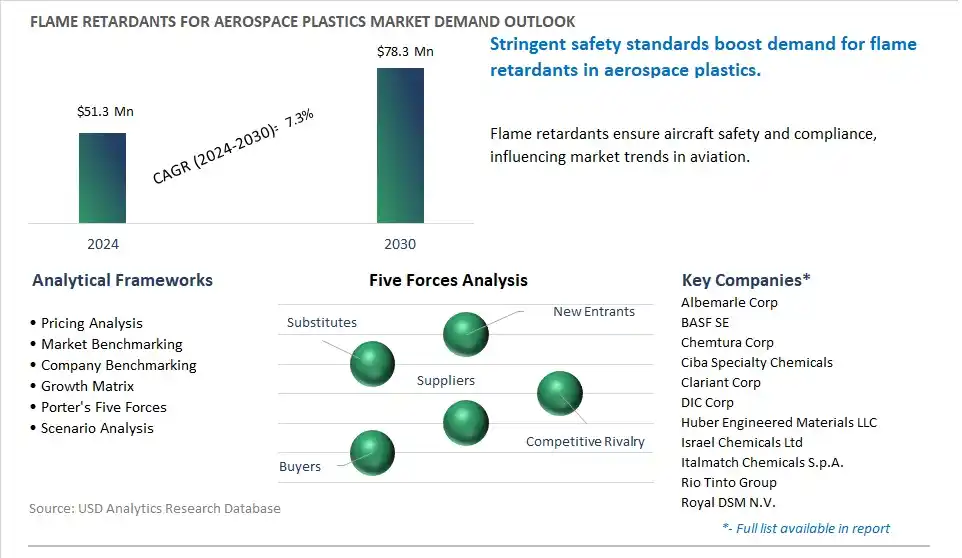
Flame Retardants For Aerospace Plastics Market Competitive Landscape
The market report analyses the leading companies in the industry including Albemarle Corp, BASF SE, Chemtura Corp, Ciba Specialty Chemicals, Clariant Corp, DIC Corp, Huber Engineered Materials LLC, Israel Chemicals Ltd, Italmatch Chemicals S.p.A., Rio Tinto Group, Royal DSM N.V., RTP Company LLC, Sinochem Group, Solvay S.A., Vantage Specialty Chemicals Inc.
Flame Retardants For Aerospace Plastics Market Dynamics
Flame Retardants For Aerospace Plastics Market Trend: Increasing Demand for Lightweight and Fire-Resistant Materials Drives Adoption of Flame Retardants for Aerospace Plastics
One prominent trend in the flame retardants for aerospace plastics market is the increasing demand for lightweight and fire-resistant materials in the aerospace industry. With the aerospace sector constantly seeking ways to enhance fuel efficiency, improve safety standards, and meet stringent regulations, there is a growing preference for plastics that offer both lightweight properties and effective fire protection. Flame retardants play a crucial role in achieving fire safety compliance for aircraft interiors by imparting flame resistance to plastic materials used in cabin components, seating, panels, and electrical enclosures. As aerospace manufacturers prioritize passenger safety and regulatory compliance, the trend towards flame retardants for aerospace plastics drives market growth in the aviation industry.
Flame Retardants For Aerospace Plastics Market Driver: Stringent Aviation Safety Regulations and Certification Standards Propel Demand for Flame Retardants for Aerospace Plastics
The growth of the flame retardants for aerospace plastics market is driven by stringent aviation safety regulations and certification standards governing fire safety requirements for aircraft interiors. Regulatory agencies such as the Federal Aviation Administration (FAA), European Aviation Safety Agency (EASA), and International Civil Aviation Organization (ICAO) mandate compliance with rigorous fire safety standards, such as FAR/CS 25.853, for materials used in aircraft construction and interiors. To obtain airworthiness certification, aerospace manufacturers must ensure that aircraft components and materials, including plastics, meet specific flame spread, smoke generation, and toxicity criteria under various fire scenarios. Flame retardants for aerospace plastics enable compliance with these safety regulations by enhancing the fire performance of plastic materials, thus driving market demand in the aerospace industry.
Flame Retardants For Aerospace Plastics Market Opportunity: Development of Advanced Flame Retardant Formulations for Enhanced Performance and Sustainability
A potential opportunity in the flame retardants for aerospace plastics market lies in the development of advanced formulations that offer enhanced fire protection performance and sustainability features. Manufacturers can capitalize on this opportunity by investing in research and development to create next-generation flame retardant additives tailored to the unique requirements of aerospace applications. This includes developing flame retardants that provide superior flame resistance, reduced smoke and toxicity emissions, and improved compatibility with engineering plastics commonly used in aircraft interiors. Additionally, there is an opportunity to focus on eco-friendly flame retardant technologies, such as phosphorus-based additives and halogen-free formulations, to address environmental concerns and regulatory restrictions on hazardous substances. By offering advanced flame retardant solutions that meet the evolving needs of the aerospace industry for safety, performance, and sustainability, manufacturers can establish a competitive edge and capture new growth opportunities in the global market for flame retardants for aerospace plastics.
Flame Retardants For Aerospace Plastics Market Share Analysis: Aluminum Trihydrate segment generated the highest revenue in the industry
The Aluminum Trihydrate segment is the largest segment in the Flame Retardants For Aerospace Plastics Market due to diverse key reasons. Aluminum trihydrate (ATH) is widely used as a flame retardant in aerospace plastics due to its excellent fire suppression properties, cost-effectiveness, and compatibility with a wide range of polymers used in aerospace applications. ATH functions by releasing water vapor when exposed to heat, which helps cool the material surface and suppress flames, thereby reducing the risk of ignition and flame spread. Additionally, ATH is chemically inert, non-toxic, and environmentally friendly, making it suitable for use in aerospace applications where safety, performance, and regulatory compliance are paramount. In addition, aluminum trihydrate is effective in enhancing the fire resistance of plastics without compromising other material properties such as mechanical strength, thermal stability, and processing characteristics. Further, stringent safety standards and regulations governing the fire safety of materials used in aerospace applications drive the demand for flame retardants like aluminum trihydrate to ensure compliance and mitigate fire-related risks. With its proven effectiveness, versatility, and safety profile, the aluminum trihydrate segment maintains its dominance as the largest segment in the Flame Retardants For Aerospace Plastics Market.
Flame Retardants For Aerospace Plastics Market Share Analysis: Carbon Fiber Reinforced Plastic (CFRP) Segment is poised to register the fastest growth rate (CAGR) over the forecast period to 2030
The Carbon Fiber Reinforced Plastic (CFRP) segment is the fastest-growing segment in the Flame Retardants For Aerospace Plastics Market due to diverse key factors propelling its rapid expansion. CFRP materials are increasingly used in aerospace applications due to their exceptional strength-to-weight ratio, high stiffness, and corrosion resistance, making them ideal for lightweight structural components in aircraft and spacecraft. However, CFRP materials are also susceptible to ignition and combustion, posing fire safety challenges in aerospace environments. As a result, there is a growing demand for flame retardant additives to enhance the fire resistance of CFRP materials and ensure compliance with stringent safety regulations and standards. Flame retardants tailored for CFRP applications are formulated to provide effective fire suppression while maintaining the mechanical properties and performance characteristics of the composite material. Additionally, advancements in flame retardant technologies, such as halogen-free formulations and synergistic combinations of flame retardant additives, further contribute to the growth of the segment. In addition, the increasing adoption of CFRP materials in next-generation aircraft, space exploration vehicles, and unmanned aerial systems drives the demand for flame retardants in aerospace plastics. As aerospace manufacturers prioritize safety and regulatory compliance, the demand for flame retardants for CFRP materials is expected to continue rising, driving the growth of the segment in the Flame Retardants For Aerospace Plastics Market.
Flame Retardants For Aerospace Plastics Market Report Segmentation
By Product
Antimony Oxide
Aluminum Trihydrate
Phosphorous Compounds
Boron Compounds
Others
By Application
Carbon Fiber Reinforced Plastic (CFRP)
Glass Reinforced Plastic (GRP)
Polycarbonate
Thermoset Polyimide
Acrylonitrile Butadiene Styrene (ABS)
Acetal/Polyoxymethylene (POM)
Epoxies
Others
Regions Included
North America (US, Canada, Mexico)
Europe (Germany, UK, France, Spain, Italy, Russia, Rest of Europe)
Asia Pacific (China, India, Japan, South Korea, Australia, South East Asia, Rest of Asia)
South America (Brazil, Argentina, Rest of South America)
Middle East and Africa (Saudi Arabia, UAE, Rest of Middle East, South Africa, Egypt, Rest of Africa)
Flame Retardants For Aerospace Plastics Companies Profiled in the Market Study
Albemarle Corp
BASF SE
Chemtura Corp
Ciba Specialty Chemicals
Clariant Corp
DIC Corp
Huber Engineered Materials LLC
Israel Chemicals Ltd
Italmatch Chemicals S.p.A.
Rio Tinto Group
Royal DSM N.V.
RTP Company LLC
Sinochem Group
Solvay S.A.
Vantage Specialty Chemicals Inc
*- List Not Exhaustive
TABLE OF CONTENTS
1 Introduction to 2024 Flame Retardants For Aerospace Plastics Market
1.1 Market Overview
1.2 Quick Facts
1.3 Scope/Objective of the Study
1.4 Market Definition
1.5 Countries and Regions Covered
1.6 Units, Currency, and Conversions
1.7 Industry Value Chain
2 Research Methodology
2.1 Market Size Estimation
2.2 Sources and Research Methodology
2.3 Data Triangulation
2.4 Assumptions and Limitations
3 Executive Summary
3.1 Global Flame Retardants For Aerospace Plastics Market Size Outlook, $ Million, 2021 to 2030
3.2 Flame Retardants For Aerospace Plastics Market Outlook by Type, $ Million, 2021 to 2030
3.3 Flame Retardants For Aerospace Plastics Market Outlook by Product, $ Million, 2021 to 2030
3.4 Flame Retardants For Aerospace Plastics Market Outlook by Application, $ Million, 2021 to 2030
3.5 Flame Retardants For Aerospace Plastics Market Outlook by Key Countries, $ Million, 2021 to 2030
4 Market Dynamics
4.1 Key Driving Forces of Flame Retardants For Aerospace Plastics Industry
4.2 Key Market Trends in Flame Retardants For Aerospace Plastics Industry
4.3 Potential Opportunities in Flame Retardants For Aerospace Plastics Industry
4.4 Key Challenges in Flame Retardants For Aerospace Plastics Industry
5 Market Factor Analysis
5.1 Value Chain Analysis
5.2 Competitive Landscape
5.2.1 Global Flame Retardants For Aerospace Plastics Market Share by Company (%), 2023
5.2.2 Product Offerings by Company
5.3 Porter’s Five Forces Analysis
5.4 Pricing Analysis and Outlook
6 Growth Outlook Across Scenarios
6.1 Growth Analysis-Case Scenario Definitions
6.2 Low Growth Scenario Forecasts
6.3 Reference Growth Scenario Forecasts
6.4 High Growth Scenario Forecasts
7 Global Flame Retardants For Aerospace Plastics Market Outlook by Segments
7.1 Flame Retardants For Aerospace Plastics Market Outlook by Segments, $ Million, 2021- 2030
By Product
Antimony Oxide
Aluminum Trihydrate
Phosphorous Compounds
Boron Compounds
Others
By Application
Carbon Fiber Reinforced Plastic (CFRP)
Glass Reinforced Plastic (GRP)
Polycarbonate
Thermoset Polyimide
Acrylonitrile Butadiene Styrene (ABS)
Acetal/Polyoxymethylene (POM)
Epoxies
Others
8 North America Flame Retardants For Aerospace Plastics Market Analysis and Outlook To 2030
8.1 Introduction to North America Flame Retardants For Aerospace Plastics Markets in 2024
8.2 North America Flame Retardants For Aerospace Plastics Market Size Outlook by Country, 2021-2030
8.2.1 United States
8.2.2 Canada
8.2.3 Mexico
8.3 North America Flame Retardants For Aerospace Plastics Market size Outlook by Segments, 2021-2030
By Product
Antimony Oxide
Aluminum Trihydrate
Phosphorous Compounds
Boron Compounds
Others
By Application
Carbon Fiber Reinforced Plastic (CFRP)
Glass Reinforced Plastic (GRP)
Polycarbonate
Thermoset Polyimide
Acrylonitrile Butadiene Styrene (ABS)
Acetal/Polyoxymethylene (POM)
Epoxies
Others
9 Europe Flame Retardants For Aerospace Plastics Market Analysis and Outlook To 2030
9.1 Introduction to Europe Flame Retardants For Aerospace Plastics Markets in 2024
9.2 Europe Flame Retardants For Aerospace Plastics Market Size Outlook by Country, 2021-2030
9.2.1 Germany
9.2.2 France
9.2.3 Spain
9.2.4 United Kingdom
9.2.4 Italy
9.2.5 Russia
9.2.6 Norway
9.2.7 Rest of Europe
9.3 Europe Flame Retardants For Aerospace Plastics Market Size Outlook by Segments, 2021-2030
By Product
Antimony Oxide
Aluminum Trihydrate
Phosphorous Compounds
Boron Compounds
Others
By Application
Carbon Fiber Reinforced Plastic (CFRP)
Glass Reinforced Plastic (GRP)
Polycarbonate
Thermoset Polyimide
Acrylonitrile Butadiene Styrene (ABS)
Acetal/Polyoxymethylene (POM)
Epoxies
Others
10 Asia Pacific Flame Retardants For Aerospace Plastics Market Analysis and Outlook To 2030
10.1 Introduction to Asia Pacific Flame Retardants For Aerospace Plastics Markets in 2024
10.2 Asia Pacific Flame Retardants For Aerospace Plastics Market Size Outlook by Country, 2021-2030
10.2.1 China
10.2.2 India
10.2.3 Japan
10.2.4 South Korea
10.2.5 Indonesia
10.2.6 Malaysia
10.2.7 Australia
10.2.8 Rest of Asia Pacific
10.3 Asia Pacific Flame Retardants For Aerospace Plastics Market size Outlook by Segments, 2021-2030
By Product
Antimony Oxide
Aluminum Trihydrate
Phosphorous Compounds
Boron Compounds
Others
By Application
Carbon Fiber Reinforced Plastic (CFRP)
Glass Reinforced Plastic (GRP)
Polycarbonate
Thermoset Polyimide
Acrylonitrile Butadiene Styrene (ABS)
Acetal/Polyoxymethylene (POM)
Epoxies
Others
11 South America Flame Retardants For Aerospace Plastics Market Analysis and Outlook To 2030
11.1 Introduction to South America Flame Retardants For Aerospace Plastics Markets in 2024
11.2 South America Flame Retardants For Aerospace Plastics Market Size Outlook by Country, 2021-2030
11.2.1 Brazil
11.2.2 Argentina
11.2.3 Rest of South America
11.3 South America Flame Retardants For Aerospace Plastics Market size Outlook by Segments, 2021-2030
By Product
Antimony Oxide
Aluminum Trihydrate
Phosphorous Compounds
Boron Compounds
Others
By Application
Carbon Fiber Reinforced Plastic (CFRP)
Glass Reinforced Plastic (GRP)
Polycarbonate
Thermoset Polyimide
Acrylonitrile Butadiene Styrene (ABS)
Acetal/Polyoxymethylene (POM)
Epoxies
Others
12 Middle East and Africa Flame Retardants For Aerospace Plastics Market Analysis and Outlook To 2030
12.1 Introduction to Middle East and Africa Flame Retardants For Aerospace Plastics Markets in 2024
12.2 Middle East and Africa Flame Retardants For Aerospace Plastics Market Size Outlook by Country, 2021-2030
12.2.1 Saudi Arabia
12.2.2 UAE
12.2.3 Oman
12.2.4 Rest of Middle East
12.2.5 Egypt
12.2.6 Nigeria
12.2.7 South Africa
12.2.8 Rest of Africa
12.3 Middle East and Africa Flame Retardants For Aerospace Plastics Market size Outlook by Segments, 2021-2030
By Product
Antimony Oxide
Aluminum Trihydrate
Phosphorous Compounds
Boron Compounds
Others
By Application
Carbon Fiber Reinforced Plastic (CFRP)
Glass Reinforced Plastic (GRP)
Polycarbonate
Thermoset Polyimide
Acrylonitrile Butadiene Styrene (ABS)
Acetal/Polyoxymethylene (POM)
Epoxies
Others
13 Company Profiles
13.1 Company Snapshot
13.2 SWOT Profiles
13.3 Products and Services
13.4 Recent Developments
13.5 Financial Profile
Albemarle Corp
BASF SE
Chemtura Corp
Ciba Specialty Chemicals
Clariant Corp
DIC Corp
Huber Engineered Materials LLC
Israel Chemicals Ltd
Italmatch Chemicals S.p.A.
Rio Tinto Group
Royal DSM N.V.
RTP Company LLC
Sinochem Group
Solvay S.A.
Vantage Specialty Chemicals Inc
14 Appendix
14.1 Customization Offerings
14.2 Subscription Services
14.3 Related Reports
14.4 Publisher Expertise
By Product
Antimony Oxide
Aluminum Trihydrate
Phosphorous Compounds
Boron Compounds
Others
By Application
Carbon Fiber Reinforced Plastic (CFRP)
Glass Reinforced Plastic (GRP)
Polycarbonate
Thermoset Polyimide
Acrylonitrile Butadiene Styrene (ABS)
Acetal/Polyoxymethylene (POM)
Epoxies
Others
Countries Analyzed
North America (US, Canada, Mexico)
Europe (Germany, UK, France, Spain, Italy, Russia, Rest of Europe)
Asia Pacific (China, India, Japan, South Korea, Australia, South East Asia, Rest of Asia)
South America (Brazil, Argentina, Rest of South America)
Middle East and Africa (Saudi Arabia, UAE, Rest of Middle East, South Africa, Egypt, Rest of Africa)
