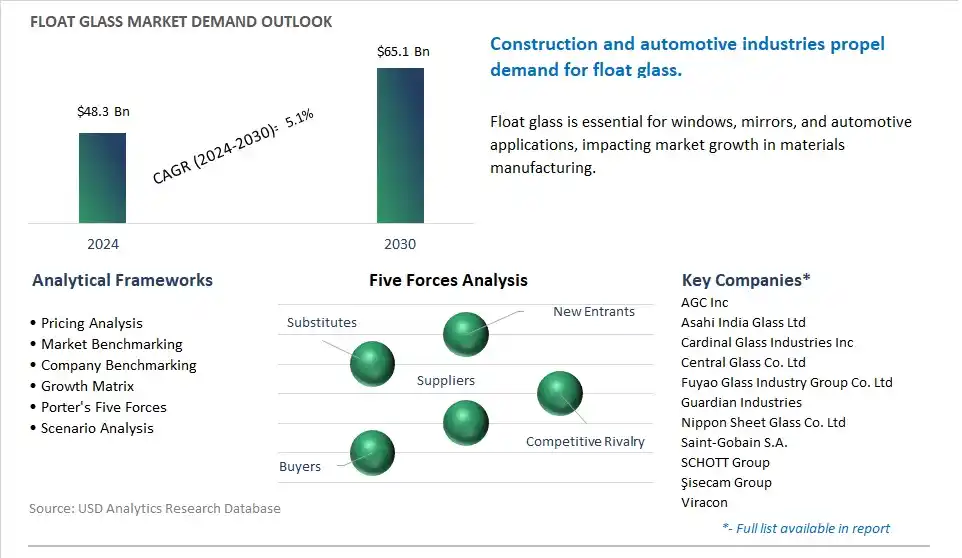
The global Float Glass Market is poised to register a 5.1% CAGR from $48.3 Billion in 2024 to $65.1 Billion in 2030.
The global Float Glass Market Study analyzes and forecasts the market size across 6 regions and 24 countries for diverse segments -By Product (Clear, Tinted, Reflective, Mirror, Others), By End-User (Automotive, Construction, Energy, Others).
An Introduction to Global Float Glass Market in 2024
The float glass market is witnessing steady growth driven by its widespread applications in the construction, automotive, and electronics industries. Key trends shaping the future of the industry include the increasing demand for high-quality, energy-efficient glass products that offer enhanced optical clarity, thermal insulation, and structural performance while meeting sustainability and regulatory requirements. As architects, engineers, and designers prioritize building aesthetics, daylighting, and energy efficiency, there's a growing need for float glass products such as clear glass, low-E glass, and coated glass that provide optimal light transmission, solar control, and thermal insulation properties. Moreover, advancements in float glass manufacturing technology, including continuous glass melting, float glass production lines, and advanced coating techniques, are driving market expansion by improving product quality, thickness uniformity, and surface finish while reducing production costs and environmental impact. Additionally, the growing adoption of float glass in smart windows, façade systems, and automotive glazing applications is fueling demand for innovative glass solutions that enable enhanced comfort, safety, and connectivity features in buildings and vehicles. Furthermore, the integration of float glass with digital design tools, BIM software, and parametric modeling techniques is driving innovation and market growth in the glass industry, enabling the development of customized, high-performance glass products for architectural, automotive, and specialty applications.
Float Glass Market Competitive Landscape
The market report analyses the leading companies in the industry including AGC Inc, Asahi India Glass Ltd, Cardinal Glass Industries Inc, Central Glass Co. Ltd, Fuyao Glass Industry Group Co. Ltd, Guardian Industries, Nippon Sheet Glass Co. Ltd, Saint-Gobain S.A., SCHOTT Group, Åžisecam Group, Viracon, Xinyi Glass Holdings Ltd.
Float Glass Market Dynamics
Float Glass Market Trend: Rising Demand for Energy-Efficient and Sustainable Building Materials Shapes Float Glass Market
One prominent trend in the float glass market is the increasing demand for energy-efficient and sustainable building materials. With growing awareness of environmental sustainability and energy conservation in construction, there is a rising preference for float glass products that offer thermal insulation, natural light transmission, and solar control properties. Float glass, known for its clarity, uniformity, and versatility, is widely used in architectural applications such as windows, doors, facades, and skylights to enhance building aesthetics and performance. As architects, developers, and building owners prioritize green building certifications and energy-efficient design strategies, the trend towards energy-efficient and sustainable float glass products shapes market dynamics and drives innovation in the glass industry.
Float Glass Market Driver: Expansion of Construction and Infrastructure Projects Drives Demand for Float Glass
The growth of the float glass market is driven by the expansion of construction and infrastructure projects worldwide. With rapid urbanization, population growth, and economic development in emerging economies, there is a significant demand for residential, commercial, and industrial buildings, as well as infrastructure developments such as roads, bridges, and airports. Float glass is a fundamental material used in the construction industry for glazing applications due to its optical clarity, durability, and ease of fabrication. Additionally, the adoption of modern architectural designs and building codes that emphasize natural light, transparency, and energy efficiency further fuels the demand for float glass in construction projects. The expansion of construction and infrastructure activities serves as a key driver propelling the demand for float glass in the global glass market.
Float Glass Market Opportunity: Innovation in Specialty and High-Performance Float Glass Products
A potential opportunity in the float glass market lies in innovation in specialty and high-performance float glass products to address evolving customer needs and market trends. Manufacturers can capitalize on this opportunity by investing in research and development to develop advanced float glass formulations with enhanced functionalities such as low-emissivity (low-E) coatings, reflective coatings, self-cleaning properties, and sound insulation capabilities. This includes exploring innovative manufacturing techniques, such as magnetron sputtering and chemical vapor deposition, to apply functional coatings and treatments onto float glass surfaces. Additionally, there is an opportunity to introduce specialty float glass products tailored to specific applications such as energy-efficient glazing systems, fire-resistant glass, bulletproof glass, and decorative glass panels for interior design. By offering innovative and high-performance float glass solutions, manufacturers can differentiate themselves in the competitive market landscape, meet the growing demand for specialty glass products, and capture new growth opportunities in the global glass industry.
Float Glass Market Share Analysis: Clear segment generated the highest revenue in the industry
The Clear segment is the largest segment in the Float Glass Market due to diverse key reasons. Clear float glass is one of the most widely used and versatile types of glass in various architectural, automotive, and industrial applications. It is manufactured using the float glass process, which produces flat, distortion-free sheets of glass with uniform thickness and excellent optical clarity. Clear float glass is preferred for applications where transparency, natural light transmission, and visibility are essential, such as windows, doors, facades, partitions, and automotive windows. Additionally, clear float glass serves as the base material for the production of other types of glass, including tinted, reflective, and coated glass, further driving its demand and dominance in the market. In addition, clear float glass is readily available, cost-effective, and easy to process, making it the preferred choice for a wide range of architectural and automotive glazing projects. Further, advancements in glass manufacturing technology and the development of high-performance coatings and laminates enhance the functionality, energy efficiency, and safety features of clear float glass, further solidifying its position as the largest segment in the Float Glass Market.
Float Glass Market Share Analysis: Energy Segment is poised to register the fastest growth rate (CAGR) over the forecast period to 2030
The Energy segment is the fastest-growing segment in the Float Glass Market due to diverse key factors propelling its rapid expansion. Float glass plays a crucial role in the energy sector, particularly in the production of solar panels and photovoltaic modules. Solar panels and photovoltaic modules require high-quality glass with excellent optical properties, durability, and resistance to environmental factors to maximize energy conversion efficiency and longevity. Float glass serves as the substrate for the fabrication of solar glass, providing the transparent surface that protects and encapsulates the photovoltaic cells while allowing sunlight to penetrate and generate electricity. Additionally, the growing global emphasis on renewable energy sources, such as solar power, to mitigate climate change and reduce dependence on fossil fuels drives the demand for float glass in the energy sector. In addition, technological advancements in glass manufacturing processes, such as thinner and more lightweight glass substrates, anti-reflective coatings, and textured surfaces, further enhance the performance and efficiency of solar panels, contributing to the growth of the segment. Further, supportive government policies, incentives, and subsidies promoting the adoption of solar energy solutions stimulate investment in solar infrastructure projects, driving the demand for float glass in the energy sector. As the world transitions towards a cleaner and more sustainable energy future, the demand for float glass for solar applications is expected to continue rising, making the Energy segment the fastest-growing segment in the Float Glass Market.
Float Glass Market Report Segmentation
By Product
Clear
Tinted
Reflective
Mirror
Others
By End-User
Automotive
Construction
Energy
Others
Regions Included
North America (US, Canada, Mexico)
Europe (Germany, UK, France, Spain, Italy, Russia, Rest of Europe)
Asia Pacific (China, India, Japan, South Korea, Australia, South East Asia, Rest of Asia)
South America (Brazil, Argentina, Rest of South America)
Middle East and Africa (Saudi Arabia, UAE, Rest of Middle East, South Africa, Egypt, Rest of Africa)
Float Glass Companies Profiled in the Market Study
AGC Inc
Asahi India Glass Ltd
Cardinal Glass Industries Inc
Central Glass Co. Ltd
Fuyao Glass Industry Group Co. Ltd
Guardian Industries
Nippon Sheet Glass Co. Ltd
Saint-Gobain S.A.
SCHOTT Group
Åžisecam Group
Viracon
Xinyi Glass Holdings Ltd
*- List Not Exhaustive
TABLE OF CONTENTS
1 Introduction to 2024 Float Glass Market
1.1 Market Overview
1.2 Quick Facts
1.3 Scope/Objective of the Study
1.4 Market Definition
1.5 Countries and Regions Covered
1.6 Units, Currency, and Conversions
1.7 Industry Value Chain
2 Research Methodology
2.1 Market Size Estimation
2.2 Sources and Research Methodology
2.3 Data Triangulation
2.4 Assumptions and Limitations
3 Executive Summary
3.1 Global Float Glass Market Size Outlook, $ Million, 2021 to 2030
3.2 Float Glass Market Outlook by Type, $ Million, 2021 to 2030
3.3 Float Glass Market Outlook by Product, $ Million, 2021 to 2030
3.4 Float Glass Market Outlook by Application, $ Million, 2021 to 2030
3.5 Float Glass Market Outlook by Key Countries, $ Million, 2021 to 2030
4 Market Dynamics
4.1 Key Driving Forces of Float Glass Industry
4.2 Key Market Trends in Float Glass Industry
4.3 Potential Opportunities in Float Glass Industry
4.4 Key Challenges in Float Glass Industry
5 Market Factor Analysis
5.1 Value Chain Analysis
5.2 Competitive Landscape
5.2.1 Global Float Glass Market Share by Company (%), 2023
5.2.2 Product Offerings by Company
5.3 Porter’s Five Forces Analysis
5.4 Pricing Analysis and Outlook
6 Growth Outlook Across Scenarios
6.1 Growth Analysis-Case Scenario Definitions
6.2 Low Growth Scenario Forecasts
6.3 Reference Growth Scenario Forecasts
6.4 High Growth Scenario Forecasts
7 Global Float Glass Market Outlook by Segments
7.1 Float Glass Market Outlook by Segments, $ Million, 2021- 2030
By Product
Clear
Tinted
Reflective
Mirror
Others
By End-User
Automotive
Construction
Energy
Others
8 North America Float Glass Market Analysis and Outlook To 2030
8.1 Introduction to North America Float Glass Markets in 2024
8.2 North America Float Glass Market Size Outlook by Country, 2021-2030
8.2.1 United States
8.2.2 Canada
8.2.3 Mexico
8.3 North America Float Glass Market size Outlook by Segments, 2021-2030
By Product
Clear
Tinted
Reflective
Mirror
Others
By End-User
Automotive
Construction
Energy
Others
9 Europe Float Glass Market Analysis and Outlook To 2030
9.1 Introduction to Europe Float Glass Markets in 2024
9.2 Europe Float Glass Market Size Outlook by Country, 2021-2030
9.2.1 Germany
9.2.2 France
9.2.3 Spain
9.2.4 United Kingdom
9.2.4 Italy
9.2.5 Russia
9.2.6 Norway
9.2.7 Rest of Europe
9.3 Europe Float Glass Market Size Outlook by Segments, 2021-2030
By Product
Clear
Tinted
Reflective
Mirror
Others
By End-User
Automotive
Construction
Energy
Others
10 Asia Pacific Float Glass Market Analysis and Outlook To 2030
10.1 Introduction to Asia Pacific Float Glass Markets in 2024
10.2 Asia Pacific Float Glass Market Size Outlook by Country, 2021-2030
10.2.1 China
10.2.2 India
10.2.3 Japan
10.2.4 South Korea
10.2.5 Indonesia
10.2.6 Malaysia
10.2.7 Australia
10.2.8 Rest of Asia Pacific
10.3 Asia Pacific Float Glass Market size Outlook by Segments, 2021-2030
By Product
Clear
Tinted
Reflective
Mirror
Others
By End-User
Automotive
Construction
Energy
Others
11 South America Float Glass Market Analysis and Outlook To 2030
11.1 Introduction to South America Float Glass Markets in 2024
11.2 South America Float Glass Market Size Outlook by Country, 2021-2030
11.2.1 Brazil
11.2.2 Argentina
11.2.3 Rest of South America
11.3 South America Float Glass Market size Outlook by Segments, 2021-2030
By Product
Clear
Tinted
Reflective
Mirror
Others
By End-User
Automotive
Construction
Energy
Others
12 Middle East and Africa Float Glass Market Analysis and Outlook To 2030
12.1 Introduction to Middle East and Africa Float Glass Markets in 2024
12.2 Middle East and Africa Float Glass Market Size Outlook by Country, 2021-2030
12.2.1 Saudi Arabia
12.2.2 UAE
12.2.3 Oman
12.2.4 Rest of Middle East
12.2.5 Egypt
12.2.6 Nigeria
12.2.7 South Africa
12.2.8 Rest of Africa
12.3 Middle East and Africa Float Glass Market size Outlook by Segments, 2021-2030
By Product
Clear
Tinted
Reflective
Mirror
Others
By End-User
Automotive
Construction
Energy
Others
13 Company Profiles
13.1 Company Snapshot
13.2 SWOT Profiles
13.3 Products and Services
13.4 Recent Developments
13.5 Financial Profile
AGC Inc
Asahi India Glass Ltd
Cardinal Glass Industries Inc
Central Glass Co. Ltd
Fuyao Glass Industry Group Co. Ltd
Guardian Industries
Nippon Sheet Glass Co. Ltd
Saint-Gobain S.A.
SCHOTT Group
Åžisecam Group
Viracon
Xinyi Glass Holdings Ltd
14 Appendix
14.1 Customization Offerings
14.2 Subscription Services
14.3 Related Reports
14.4 Publisher Expertise
By Product
Clear
Tinted
Reflective
Mirror
Others
By End-User
Automotive
Construction
Energy
Others
Countries Analyzed
North America (US, Canada, Mexico)
Europe (Germany, UK, France, Spain, Italy, Russia, Rest of Europe)
Asia Pacific (China, India, Japan, South Korea, Australia, South East Asia, Rest of Asia)
South America (Brazil, Argentina, Rest of South America)
Middle East and Africa (Saudi Arabia, UAE, Rest of Middle East, South Africa, Egypt, Rest of Africa)
