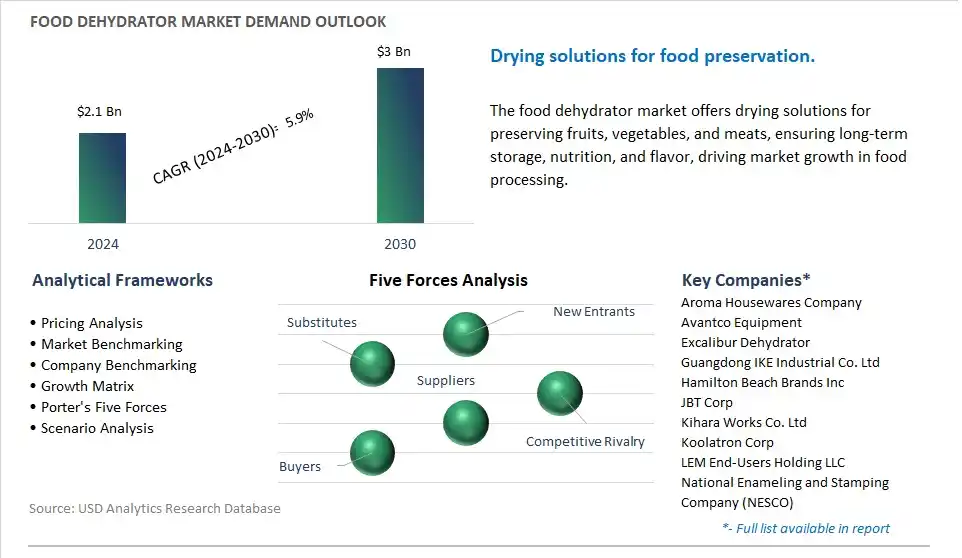
The global Food Dehydrator Market is poised to register a 5.9% CAGR from $2.1 Billion in 2024 to $3 Billion in 2030.
The global Food Dehydrator Market Study analyzes and forecasts the market size across 6 regions and 24 countries for diverse segments -By Technology (Horizontal Airflow, Vertical Airflow), By End-User (Residential, Commercial, Industrial), By Energy Source (Electrical, Solar, Other).
An Introduction to Global Food Dehydrator Market in 2024
In the food dehydrator market, the future is driven by trends such as home cooking, food preservation, and technological advancements driving innovation in dehydrator design, drying technologies, and user-friendly features. Food dehydrators are appliances used to remove moisture from foods, preserving them for longer storage and creating dried snacks such as fruits, vegetables, and jerky. Key trends shaping this market include advancements in dehydrator technology such as heat pump drying, infrared drying, and smart temperature control systems to optimize drying efficiency, preserve nutritional value, and enhance flavor retention in dried foods, the development of compact, space-saving designs with larger capacity trays, adjustable racks, and stackable configurations to accommodate diverse food items and kitchen spaces, and the adoption of user-friendly features such as digital timers, automatic shut-off functions, and touch-screen displays to simplify operation, ensure safety, and enhance user experience. As consumers seek to reduce food waste, eat healthier, and experiment with homemade snacks, the demand for food dehydrators that offer convenience, versatility, and superior drying performance is expected to drive market growth and inspire further innovation in dehydrator technology and applications.
Food Dehydrator Market Competitive Landscape
The market report analyses the leading companies in the industry including Aroma Housewares Company, Avantco Equipment, Excalibur Dehydrator, Guangdong IKE Industrial Co. Ltd, Hamilton Beach Brands Inc, JBT Corp, Kihara Works Co. Ltd, Koolatron Corp, LEM End-Users Holding LLC, National Enameling and Stamping Company (NESCO), National Presto Industries Inc, STX International, The Sausage Maker Inc, Tribest Corp, Vitality4Life Pty Ltd.
Food Dehydrator Market Dynamics
Food Dehydrator Market Trend: Growing Preference for Homemade and Healthy Snacks Driving Demand for Food Dehydrators
A significant trend in the food dehydrator market is the growing preference for homemade and healthy snacks. With increasing awareness of the importance of nutrition and the need for natural, minimally processed foods, consumers are turning to dehydrated fruits, vegetables, and jerky as nutritious alternatives to store-bought snacks. Food dehydrators enable individuals to easily prepare their own snacks at home, preserving the natural flavors and nutrients of fruits and vegetables while eliminating the need for added sugars, preservatives, and artificial ingredients. This drives the shift towards healthier eating habits and DIY food preparation among health-conscious consumers seeking convenient and nutritious snack options.
Food Dehydrator Market Driver: Demand for Extended Shelf Life and Preservation of Food Nutrients
The primary driver for the food dehydrator market is the demand for extended shelf life and preservation of food nutrients. As consumers seek to minimize food waste and maximize the nutritional value of their food purchases, there is a growing interest in food dehydration as a method of food preservation. Dehydrating fruits, vegetables, meats, and herbs removes moisture from food items, inhibiting the growth of bacteria, mold, and yeast, and prolonging their shelf life without the need for refrigeration or freezing. Additionally, the dehydration process retains the natural vitamins, minerals, and antioxidants present in foods, offering a healthier alternative to processed snacks and contributing to the overall quality and nutritional value of the diet.
Food Dehydrator Market Opportunity: Expansion into Commercial and Industrial Food Processing Applications
An opportunity exists for companies operating in the food dehydrator market to expand into commercial and industrial food processing applications. While consumer-grade dehydrators cater to home use and small-scale food preparation, there is a potential to serve the needs of commercial kitchens, food manufacturers, and agricultural producers requiring larger-capacity dehydrators for bulk processing of fruits, vegetables, and meats. By developing commercial-grade dehydrators with higher throughput, advanced temperature and humidity control, and customizable drying programs, companies can address the requirements of food service establishments, catering businesses, snack manufacturers, and food processors looking to enhance production efficiency, extend product shelf life, and capitalize on the growing demand for dehydrated food products in the food industry. This opportunity allows companies to diversify their product offerings, reach new customer segments, and capture opportunities for growth and expansion in the commercial food processing market.
Food Dehydrator Market Ecosystem
The food dehydrator Market Ecosystem begins with raw material suppliers including ArcelorMittal and Formosa Plastics Corporation, providing metals and plastics for components including heating elements and dehydrator housings. Electrical component manufacturers including TE Connectivity and Honeywell produce essential elements including heating elements and thermostats. Motor and fan manufacturers including Nidec Corporation supply components for dehydrators with air circulation systems. Food dehydrator manufacturers including Excalibur Dehydrator Company and Nesco by American Harvest source these components to assemble and manufacture complete dehydrators, catering to both household and commercial needs.
These dehydrators are then distributed and sold through various channels, including online retailers including Amazon, specialty kitchenware stores, and big-box retailers including Walmart. Additionally, wholesale distributors play a role in selling dehydrators in bulk to retailers. Further, consumers purchase food dehydrators for home use, utilizing them for preserving fruits, vegetables, and meats, making healthy snacks, and preparing ingredients for outdoor activities including backpacking and camping.
Food Dehydrator Market Share Analysis: Horizontal Airflow held the dominant revenue share in 2024
The Horizontal Airflow segment is the largest in the Food Dehydrator Market, and this dominance is attributed to diverse significant factors. Horizontal airflow dehydrators employ a design where the heating element and fan are located either at the back or the bottom of the unit, ensuring even distribution of heat and air throughout the drying chamber. This uniform airflow facilitates consistent drying across all trays or shelves, resulting in evenly dried food with minimal rotation or rearrangement required during the dehydration process. Additionally, horizontal airflow dehydrators offer larger drying capacities and more spacious trays, allowing users to dehydrate larger quantities of food in a single batch. These features make horizontal airflow dehydrators particularly suitable for home users, small-scale food processors, and individuals seeking to preserve fruits, vegetables, meats, and herbs efficiently and conveniently. Further, horizontal airflow dehydrators are often favored for their ease of use, versatility, and affordability compared to vertical airflow models. As a result, the Horizontal Airflow segment commands the largest share of the Food Dehydrator Market, reflecting its popularity and widespread adoption among consumers and food enthusiasts alike.
Food Dehydrator Market Share Analysis: Residential is the fastest growing market segment over the forecast period to 2030
The Residential segment is the fastest-growing segment in the Food Dehydrator Market, driven by diverse key factors. Firstly, there is a growing trend toward home food preservation and healthy eating, fueled by increasing consumer awareness about the benefits of homemade, natural, and minimally processed foods. Home dehydrators allow individuals and families to preserve seasonal produce, reduce food waste, and create homemade snacks and ingredients with better nutritional value and flavor compared to store-bought alternatives. Additionally, the rise of home gardening, urban farming, and farm-to-table movements further supports the demand for residential food dehydrators, as consumers seek ways to preserve their homegrown produce and extend their enjoyment throughout the year. In addition, advancements in food dehydrator technology have led to the development of compact, user-friendly, and affordable models tailored for residential use, making them accessible to a wider audience. These modern residential dehydrators offer features such as adjustable temperature settings, multiple drying trays, and energy-efficient operation, enhancing their appeal to home users. As a result, the Residential segment is experiencing rapid growth in the Food Dehydrator Market, driven by increasing consumer interest in homemade and healthy food preservation solutions.
Food Dehydrator Market Share Analysis: Solar is the fastest growing market segment over the forecast period to 2030
The Solar segment is the fastest-growing segment in the Food Dehydrator Market, driven by diverse significant factors. With growing concerns about energy efficiency, sustainability, and environmental impact, there is increasing interest in alternative energy sources for food dehydration processes. Solar-powered food dehydrators harness the abundant and renewable energy of the sun to facilitate the drying of fruits, vegetables, meats, and other food products. These solar dehydrators offer diverse advantages over conventional electrical models, including reduced energy costs, lower carbon footprint, and independence from grid electricity. Additionally, solar dehydrators are particularly well-suited for use in off-grid or remote locations where access to electricity may be limited or unreliable. Further, the rise of sustainable living practices, eco-conscious consumerism, and the desire for self-sufficiency are driving the demand for solar-powered food dehydrators among environmentally conscious individuals, homesteaders, and outdoor enthusiasts. Advancements in solar technology, coupled with the development of innovative and efficient solar dehydrator designs, further contribute to the growth of the Solar segment in the Food Dehydrator Market. Overall, the shift toward renewable energy sources and sustainable food preservation methods positions solar-powered food dehydrators as the fastest-growing segment in the market.
Food Dehydrator Market Report Scope-
By Technology
Horizontal Airflow
Vertical Airflow
By End-User
Residential
Commercial
Industrial
By Energy Source
Electrical
Solar
Other
Food Dehydrator Market Companies Profiled
Aroma Housewares Company
Avantco Equipment
Excalibur Dehydrator
Guangdong IKE Industrial Co. Ltd
Hamilton Beach Brands Inc
JBT Corp
Kihara Works Co. Ltd
Koolatron Corp
LEM End-Users Holding LLC
National Enameling and Stamping Company (NESCO)
National Presto Industries Inc
STX International
The Sausage Maker Inc
Tribest Corp
Vitality4Life Pty Ltd
*- List Not Exhaustive
TABLE OF CONTENTS
1 Introduction to 2024 Food Dehydrator Market
1.1 Market Overview
1.2 Quick Facts
1.3 Scope/Objective of the Study
1.4 Market Definition
1.5 Countries and Regions Covered
1.6 Units, Currency, and Conversions
1.7 Industry Value Chain
2 Research Methodology
2.1 Market Size Estimation
2.2 Sources and Research Methodology
2.3 Data Triangulation
2.4 Assumptions and Limitations
3 Executive Summary
3.1 Global Food Dehydrator Market Size Outlook, $ Million, 2021 to 2030
3.2 Food Dehydrator Market Outlook by Type, $ Million, 2021 to 2030
3.3 Food Dehydrator Market Outlook by Product, $ Million, 2021 to 2030
3.4 Food Dehydrator Market Outlook by Application, $ Million, 2021 to 2030
3.5 Food Dehydrator Market Outlook by Key Countries, $ Million, 2021 to 2030
4 Market Dynamics
4.1 Key Driving Forces of Food Dehydrator Industry
4.2 Key Market Trends in Food Dehydrator Industry
4.3 Potential Opportunities in Food Dehydrator Industry
4.4 Key Challenges in Food Dehydrator Industry
5 Market Factor Analysis
5.1 Value Chain Analysis
5.2 Competitive Landscape
5.2.1 Global Food Dehydrator Market Share by Company (%), 2023
5.2.2 Product Offerings by Company
5.3 Porter’s Five Forces Analysis
5.4 Pricing Analysis and Outlook
6 Growth Outlook Across Scenarios
6.1 Growth Analysis-Case Scenario Definitions
6.2 Low Growth Scenario Forecasts
6.3 Reference Growth Scenario Forecasts
6.4 High Growth Scenario Forecasts
7 Global Food Dehydrator Market Outlook by Segments
7.1 Food Dehydrator Market Outlook by Segments, $ Million, 2021- 2030
By Technology
Horizontal Airflow
Vertical Airflow
By End-User
Residential
Commercial
Industrial
By Energy Source
Electrical
Solar
Other
8 North America Food Dehydrator Market Analysis and Outlook To 2030
8.1 Introduction to North America Food Dehydrator Markets in 2024
8.2 North America Food Dehydrator Market Size Outlook by Country, 2021-2030
8.2.1 United States
8.2.2 Canada
8.2.3 Mexico
8.3 North America Food Dehydrator Market size Outlook by Segments, 2021-2030
By Technology
Horizontal Airflow
Vertical Airflow
By End-User
Residential
Commercial
Industrial
By Energy Source
Electrical
Solar
Other
9 Europe Food Dehydrator Market Analysis and Outlook To 2030
9.1 Introduction to Europe Food Dehydrator Markets in 2024
9.2 Europe Food Dehydrator Market Size Outlook by Country, 2021-2030
9.2.1 Germany
9.2.2 France
9.2.3 Spain
9.2.4 United Kingdom
9.2.4 Italy
9.2.5 Russia
9.2.6 Norway
9.2.7 Rest of Europe
9.3 Europe Food Dehydrator Market Size Outlook by Segments, 2021-2030
By Technology
Horizontal Airflow
Vertical Airflow
By End-User
Residential
Commercial
Industrial
By Energy Source
Electrical
Solar
Other
10 Asia Pacific Food Dehydrator Market Analysis and Outlook To 2030
10.1 Introduction to Asia Pacific Food Dehydrator Markets in 2024
10.2 Asia Pacific Food Dehydrator Market Size Outlook by Country, 2021-2030
10.2.1 China
10.2.2 India
10.2.3 Japan
10.2.4 South Korea
10.2.5 Indonesia
10.2.6 Malaysia
10.2.7 Australia
10.2.8 Rest of Asia Pacific
10.3 Asia Pacific Food Dehydrator Market size Outlook by Segments, 2021-2030
By Technology
Horizontal Airflow
Vertical Airflow
By End-User
Residential
Commercial
Industrial
By Energy Source
Electrical
Solar
Other
11 South America Food Dehydrator Market Analysis and Outlook To 2030
11.1 Introduction to South America Food Dehydrator Markets in 2024
11.2 South America Food Dehydrator Market Size Outlook by Country, 2021-2030
11.2.1 Brazil
11.2.2 Argentina
11.2.3 Rest of South America
11.3 South America Food Dehydrator Market size Outlook by Segments, 2021-2030
By Technology
Horizontal Airflow
Vertical Airflow
By End-User
Residential
Commercial
Industrial
By Energy Source
Electrical
Solar
Other
12 Middle East and Africa Food Dehydrator Market Analysis and Outlook To 2030
12.1 Introduction to Middle East and Africa Food Dehydrator Markets in 2024
12.2 Middle East and Africa Food Dehydrator Market Size Outlook by Country, 2021-2030
12.2.1 Saudi Arabia
12.2.2 UAE
12.2.3 Oman
12.2.4 Rest of Middle East
12.2.5 Egypt
12.2.6 Nigeria
12.2.7 South Africa
12.2.8 Rest of Africa
12.3 Middle East and Africa Food Dehydrator Market size Outlook by Segments, 2021-2030
By Technology
Horizontal Airflow
Vertical Airflow
By End-User
Residential
Commercial
Industrial
By Energy Source
Electrical
Solar
Other
13 Company Profiles
13.1 Company Snapshot
13.2 SWOT Profiles
13.3 Products and Services
13.4 Recent Developments
13.5 Financial Profile
Aroma Housewares Company
Avantco Equipment
Excalibur Dehydrator
Guangdong IKE Industrial Co. Ltd
Hamilton Beach Brands Inc
JBT Corp
Kihara Works Co. Ltd
Koolatron Corp
LEM End-Users Holding LLC
National Enameling and Stamping Company (NESCO)
National Presto Industries Inc
STX International
The Sausage Maker Inc
Tribest Corp
Vitality4Life Pty Ltd
14 Appendix
14.1 Customization Offerings
14.2 Subscription Services
14.3 Related Reports
14.4 Publisher Expertise
By Technology
Horizontal Airflow
Vertical Airflow
By End-User
Residential
Commercial
Industrial
By Energy Source
Electrical
Solar
Other
Countries Analyzed
North America (US, Canada, Mexico)
Europe (Germany, UK, France, Spain, Italy, Russia, Rest of Europe)
Asia Pacific (China, India, Japan, South Korea, Australia, South East Asia, Rest of Asia)
South America (Brazil, Argentina, Rest of South America)
Middle East and Africa (Saudi Arabia, UAE, Rest of Middle East, South Africa, Egypt, Rest of Africa)
