The global Food Grade Alcohol Market is poised to register a 5.7% CAGR from $2.6 Billion in 2024 to $3.6 Billion in 2030.
The global Food Grade Alcohol Market Study analyzes and forecasts the market size across 6 regions and 24 countries for diverse segments -By Product (Ethanol, Polyols), By Source (Molasses & Sugarcane, Fruits, Grains, Others), By Function (Coatings, Preservative, Coloring & Flavoring Agent, Others), By Application (Healthcare & Pharmaceutical, Food, Beverage, Personal Care, Others).
An Introduction to Global Food Grade Alcohol Market in 2024
The food grade alcohol market is experiencing dynamic growth driven by its applications in food and beverage production, flavor extraction, and pharmaceutical formulations. Key trends shaping the future of the industry include the increasing demand for high-purity, food-grade alcohol products that offer superior quality, safety, and sensory attributes while meeting regulatory standards and consumer expectations for purity, authenticity, and sustainability. As food processors, distillers, and pharmaceutical companies seek ingredients that enhance product quality, taste, and safety, there's a growing need for food grade alcohols such as ethanol, methanol, and isopropanol that provide reliable performance in diverse applications such as food flavoring, solvent extraction, sanitization, and medicinal formulations. Moreover, advancements in food grade alcohol production, distillation technology, and purification methods are driving market expansion by improving product purity, consistency, and traceability while reducing impurities, contaminants, and by-products that may affect product safety and sensory properties. Additionally, the growing adoption of food grade alcohol in clean-label foods, natural extracts, and plant-based formulations is fueling demand for sustainable sourcing, organic certification, and transparent supply chains that ensure product integrity and consumer trust. Furthermore, the integration of food grade alcohol with innovative processing techniques, biotechnology, and fermentation technology is driving innovation and market growth in the food ingredients industry, enabling the development of novel, functional, and value-added products for the future of food and beverage innovation.
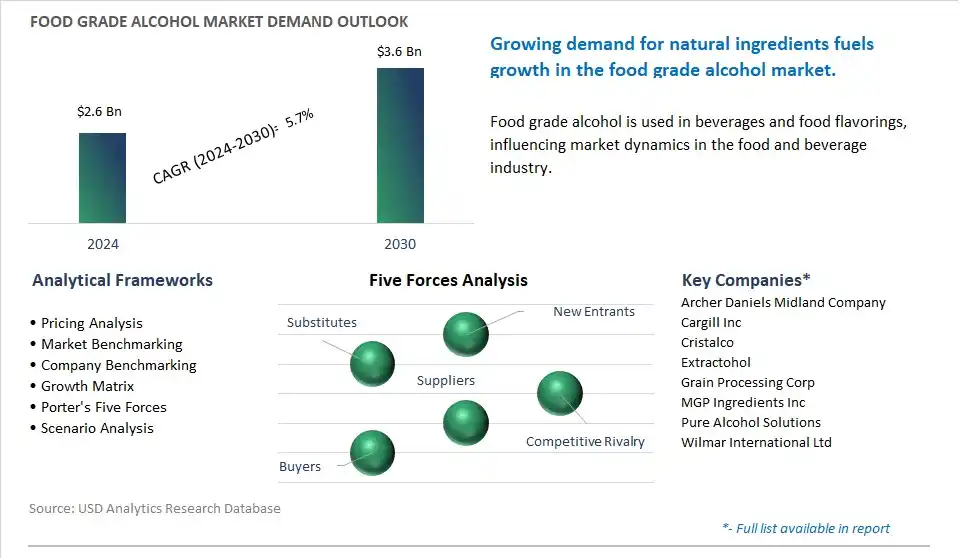
Food Grade Alcohol Market Competitive Landscape
The market report analyses the leading companies in the industry including Archer Daniels Midland Company, Cargill Inc, Cristalco, Extractohol, Grain Processing Corp, MGP Ingredients Inc, Pure Alcohol Solutions, Wilmar International Ltd.
Food Grade Alcohol Market Dynamics
Food Grade Alcohol Market Trend: Growing Demand for Clean Label and Natural Ingredients Drives Food Grade Alcohol Market
One prominent trend in the food grade alcohol market is the growing demand for clean label and natural ingredients in food and beverage products. Consumers are increasingly seeking transparency in ingredient lists and are wary of synthetic additives and artificial flavors. As a result, there is a rising preference for food products formulated with natural and recognizable ingredients, including food grade alcohol derived from natural fermentation processes. This trend towards clean label formulations shapes market dynamics and drives the adoption of food grade alcohol as a key ingredient in various food and beverage applications.
Food Grade Alcohol Market Driver: Expansion of Food and Beverage Industry Stimulates Demand for Food Grade Alcohol
The growth of the food grade alcohol market is primarily driven by the expansion of the food and beverage industry worldwide. Food grade alcohol, also known as ethanol, serves as a versatile ingredient in food and beverage production, offering properties such as solubility, flavor enhancement, and preservation. It is used in the manufacturing of alcoholic beverages, flavor extracts, food extracts, and as a solvent for food colorings and flavorings. With the increasing consumption of alcoholic beverages, flavored extracts, and processed foods globally, the demand for food grade alcohol as a key ingredient continues to rise, stimulating market growth in the food and beverage sector.
Food Grade Alcohol Market Opportunity: Development of Specialty and High-Purity Food Grade Alcohol Products
A potential opportunity in the food grade alcohol market lies in the development of specialty and high-purity alcohol products tailored for specific food and beverage applications. Manufacturers can capitalize on this opportunity by expanding their product offerings to include specialized alcohol formulations with customized flavor profiles, purity levels, and ethanol concentrations to meet the diverse needs of food and beverage manufacturers. Additionally, there is an opportunity to innovate in production processes to enhance the purity and quality of food grade alcohol, ensuring compliance with stringent food safety and quality standards. By providing specialty alcohol products that offer superior sensory attributes, consistency, and performance in food and beverage applications, manufacturers can differentiate themselves in the competitive market landscape and unlock new growth opportunities in the global food grade alcohol market.
Food Grade Alcohol Market Share Analysis: Ethanol segment generated the highest revenue in the industry
The Ethanol segment is the largest segment in the Food Grade Alcohol Market, driven by diverse key factors that underscore its widespread use and significance in various food and beverage applications. Ethanol, a type of alcohol derived from fermentation or synthetic processes, serves as a versatile ingredient in the food industry due to its unique properties and wide-ranging applications. One primary reason for the dominance of the Ethanol segment is its long-standing history and established role as a key ingredient in the production of alcoholic beverages, including spirits, beer, wine, and liqueurs. The alcoholic beverage industry represents a substantial portion of the Over the forecast period food and beverage sector, driving significant demand for ethanol as a primary raw material in beverage manufacturing. In addition, ethanol is widely utilized as a solvent, preservative, and flavor enhancer in food processing, contributing to its pervasive presence in various food products such as extracts, flavorings, and food additives. Additionally, ethanol's antimicrobial properties make it a valuable ingredient in food sanitization and disinfection applications, ensuring product safety and shelf stability. Further, ethanol's status as a Generally Recognized as Safe (GRAS) substance by regulatory authorities further facilitates its use in food and beverage formulations, providing manufacturers with assurance of its safety and compliance with food safety standards. With the food and beverage industry constantly evolving to meet changing consumer preferences and regulatory requirements, ethanol remains a fundamental ingredient that plays a vital role in product formulation, processing, and preservation. As a result, the Ethanol segment maintains its position as the largest segment in the Food Grade Alcohol Market, offering manufacturers a reliable and versatile solution for diverse food and beverage applications.
Food Grade Alcohol Market Share Analysis: Fruits Segment is poised to register the fastest growth rate (CAGR) over the forecast period to 2030
The Fruits segment is the fastest-growing segment in the Food Grade Alcohol Market, propelled by diverse key factors that reflect shifting consumer preferences, technological advancements, and market dynamics within the food and beverage industry. Fruits serve as a rich and natural source of fermentable sugars, making them an attractive raw material for alcohol production. With the growing trend towards natural and clean label ingredients, consumers are increasingly seeking food and beverage products made from wholesome, minimally processed sources. Fruit-derived alcohols align with this trend, offering a natural and flavorful alternative to conventional alcohol sources such as grains and molasses. Additionally, advancements in fruit processing technologies and extraction methods have enabled manufacturers to efficiently extract sugars from a wide variety of fruits, expanding the range of fruits suitable for alcohol production. This diversification in fruit sources opens up opportunities for innovative product formulations and flavor profiles, catering to diverse consumer preferences and culinary trends. In addition, fruit-derived alcohols offer unique sensory characteristics and flavor profiles derived from the specific fruit varieties used, appealing to consumers seeking novel taste experiences and premium quality products. Further, the sustainability aspect of fruit-derived alcohols, including the utilization of by-products and waste streams from fruit processing, resonates with environmentally conscious consumers and supports circular economy initiatives within the food industry. As consumer demand for natural, flavorful, and sustainably sourced food and beverage products continues to grow, the Fruits segment in the Food Grade Alcohol Market is poised for rapid expansion, offering manufacturers opportunities for product innovation, market differentiation, and value creation.
Food Grade Alcohol Market Share Analysis: Coloring & Flavoring Agent Segment is poised to register the fastest growth rate (CAGR) over the forecast period to 2030
The Coloring & Flavoring Agent segment is the fastest-growing segment in the Food Grade Alcohol Market, driven by diverse key factors that reflect changing consumer preferences, culinary trends, and industry dynamics within the food and beverage sector. Coloring and flavoring agents play a critical role in enhancing the sensory attributes, visual appeal, and taste profile of food and beverage products, influencing consumer perception and purchase decisions. With the growing emphasis on sensory experience and indulgent consumption, there is increasing demand for innovative and premium-quality food and beverage offerings that deliver unique flavors, aromas, and visual aesthetics. Alcohol serves as a versatile carrier for natural and artificial flavors and colors, allowing manufacturers to create a wide range of exciting and differentiated products tailored to evolving consumer tastes and preferences. Additionally, alcohol's solvent properties facilitate the extraction, dispersion, and stabilization of flavor and color compounds from natural sources such as fruits, herbs, spices, and botanicals, enabling the creation of authentic and vibrant flavor profiles in food and beverage formulations. Further, alcohol-based flavoring and coloring agents offer functional benefits beyond sensory enhancement, including preservation, shelf-life extension, and microbial control, contributing to product safety and quality assurance. In addition, the versatility and compatibility of alcohol-based flavoring and coloring agents with a diverse range of food and beverage applications, including beverages, confectionery, bakery, dairy, and savory products, drive their widespread adoption and market growth. As consumer demand for premium, indulgent, and experiential food and beverage products continues to rise, the Coloring & Flavoring Agent segment in the Food Grade Alcohol Market is poised for rapid expansion, offering manufacturers opportunities for product differentiation, innovation, and market success.
Food Grade Alcohol Market Report Segmentation
By Product
Ethanol
Polyols
By Source
Molasses & Sugarcane
Fruits
Grains
Others
By Function
Coatings
Preservative
Coloring & Flavoring Agent
Others
By Application
Healthcare & Pharmaceutical
Food
Beverage
Personal Care
Others
Regions Included
North America (US, Canada, Mexico)
Europe (Germany, UK, France, Spain, Italy, Russia, Rest of Europe)
Asia Pacific (China, India, Japan, South Korea, Australia, South East Asia, Rest of Asia)
South America (Brazil, Argentina, Rest of South America)
Middle East and Africa (Saudi Arabia, UAE, Rest of Middle East, South Africa, Egypt, Rest of Africa)
Food Grade Alcohol Companies Profiled in the Market Study
Archer Daniels Midland Company
Cargill Inc
Cristalco
Extractohol
Grain Processing Corp
MGP Ingredients Inc
Pure Alcohol Solutions
Wilmar International Ltd
*- List Not Exhaustive
TABLE OF CONTENTS
1 Introduction to 2024 Food Grade Alcohol Market
1.1 Market Overview
1.2 Quick Facts
1.3 Scope/Objective of the Study
1.4 Market Definition
1.5 Countries and Regions Covered
1.6 Units, Currency, and Conversions
1.7 Industry Value Chain
2 Research Methodology
2.1 Market Size Estimation
2.2 Sources and Research Methodology
2.3 Data Triangulation
2.4 Assumptions and Limitations
3 Executive Summary
3.1 Global Food Grade Alcohol Market Size Outlook, $ Million, 2021 to 2030
3.2 Food Grade Alcohol Market Outlook by Type, $ Million, 2021 to 2030
3.3 Food Grade Alcohol Market Outlook by Product, $ Million, 2021 to 2030
3.4 Food Grade Alcohol Market Outlook by Application, $ Million, 2021 to 2030
3.5 Food Grade Alcohol Market Outlook by Key Countries, $ Million, 2021 to 2030
4 Market Dynamics
4.1 Key Driving Forces of Food Grade Alcohol Industry
4.2 Key Market Trends in Food Grade Alcohol Industry
4.3 Potential Opportunities in Food Grade Alcohol Industry
4.4 Key Challenges in Food Grade Alcohol Industry
5 Market Factor Analysis
5.1 Value Chain Analysis
5.2 Competitive Landscape
5.2.1 Global Food Grade Alcohol Market Share by Company (%), 2023
5.2.2 Product Offerings by Company
5.3 Porter’s Five Forces Analysis
5.4 Pricing Analysis and Outlook
6 Growth Outlook Across Scenarios
6.1 Growth Analysis-Case Scenario Definitions
6.2 Low Growth Scenario Forecasts
6.3 Reference Growth Scenario Forecasts
6.4 High Growth Scenario Forecasts
7 Global Food Grade Alcohol Market Outlook by Segments
7.1 Food Grade Alcohol Market Outlook by Segments, $ Million, 2021- 2030
By Product
Ethanol
Polyols
By Source
Molasses & Sugarcane
Fruits
Grains
Others
By Function
Coatings
Preservative
Coloring & Flavoring Agent
Others
By Application
Healthcare & Pharmaceutical
Food
Beverage
Personal Care
Others
8 North America Food Grade Alcohol Market Analysis and Outlook To 2030
8.1 Introduction to North America Food Grade Alcohol Markets in 2024
8.2 North America Food Grade Alcohol Market Size Outlook by Country, 2021-2030
8.2.1 United States
8.2.2 Canada
8.2.3 Mexico
8.3 North America Food Grade Alcohol Market size Outlook by Segments, 2021-2030
By Product
Ethanol
Polyols
By Source
Molasses & Sugarcane
Fruits
Grains
Others
By Function
Coatings
Preservative
Coloring & Flavoring Agent
Others
By Application
Healthcare & Pharmaceutical
Food
Beverage
Personal Care
Others
9 Europe Food Grade Alcohol Market Analysis and Outlook To 2030
9.1 Introduction to Europe Food Grade Alcohol Markets in 2024
9.2 Europe Food Grade Alcohol Market Size Outlook by Country, 2021-2030
9.2.1 Germany
9.2.2 France
9.2.3 Spain
9.2.4 United Kingdom
9.2.4 Italy
9.2.5 Russia
9.2.6 Norway
9.2.7 Rest of Europe
9.3 Europe Food Grade Alcohol Market Size Outlook by Segments, 2021-2030
By Product
Ethanol
Polyols
By Source
Molasses & Sugarcane
Fruits
Grains
Others
By Function
Coatings
Preservative
Coloring & Flavoring Agent
Others
By Application
Healthcare & Pharmaceutical
Food
Beverage
Personal Care
Others
10 Asia Pacific Food Grade Alcohol Market Analysis and Outlook To 2030
10.1 Introduction to Asia Pacific Food Grade Alcohol Markets in 2024
10.2 Asia Pacific Food Grade Alcohol Market Size Outlook by Country, 2021-2030
10.2.1 China
10.2.2 India
10.2.3 Japan
10.2.4 South Korea
10.2.5 Indonesia
10.2.6 Malaysia
10.2.7 Australia
10.2.8 Rest of Asia Pacific
10.3 Asia Pacific Food Grade Alcohol Market size Outlook by Segments, 2021-2030
By Product
Ethanol
Polyols
By Source
Molasses & Sugarcane
Fruits
Grains
Others
By Function
Coatings
Preservative
Coloring & Flavoring Agent
Others
By Application
Healthcare & Pharmaceutical
Food
Beverage
Personal Care
Others
11 South America Food Grade Alcohol Market Analysis and Outlook To 2030
11.1 Introduction to South America Food Grade Alcohol Markets in 2024
11.2 South America Food Grade Alcohol Market Size Outlook by Country, 2021-2030
11.2.1 Brazil
11.2.2 Argentina
11.2.3 Rest of South America
11.3 South America Food Grade Alcohol Market size Outlook by Segments, 2021-2030
By Product
Ethanol
Polyols
By Source
Molasses & Sugarcane
Fruits
Grains
Others
By Function
Coatings
Preservative
Coloring & Flavoring Agent
Others
By Application
Healthcare & Pharmaceutical
Food
Beverage
Personal Care
Others
12 Middle East and Africa Food Grade Alcohol Market Analysis and Outlook To 2030
12.1 Introduction to Middle East and Africa Food Grade Alcohol Markets in 2024
12.2 Middle East and Africa Food Grade Alcohol Market Size Outlook by Country, 2021-2030
12.2.1 Saudi Arabia
12.2.2 UAE
12.2.3 Oman
12.2.4 Rest of Middle East
12.2.5 Egypt
12.2.6 Nigeria
12.2.7 South Africa
12.2.8 Rest of Africa
12.3 Middle East and Africa Food Grade Alcohol Market size Outlook by Segments, 2021-2030
By Product
Ethanol
Polyols
By Source
Molasses & Sugarcane
Fruits
Grains
Others
By Function
Coatings
Preservative
Coloring & Flavoring Agent
Others
By Application
Healthcare & Pharmaceutical
Food
Beverage
Personal Care
Others
13 Company Profiles
13.1 Company Snapshot
13.2 SWOT Profiles
13.3 Products and Services
13.4 Recent Developments
13.5 Financial Profile
Archer Daniels Midland Company
Cargill Inc
Cristalco
Extractohol
Grain Processing Corp
MGP Ingredients Inc
Pure Alcohol Solutions
Wilmar International Ltd
14 Appendix
14.1 Customization Offerings
14.2 Subscription Services
14.3 Related Reports
14.4 Publisher Expertise
By Product
Ethanol
Polyols
By Source
Molasses & Sugarcane
Fruits
Grains
Others
By Function
Coatings
Preservative
Coloring & Flavoring Agent
Others
By Application
Healthcare & Pharmaceutical
Food
Beverage
Personal Care
Others
Countries Analyzed
North America (US, Canada, Mexico)
Europe (Germany, UK, France, Spain, Italy, Russia, Rest of Europe)
Asia Pacific (China, India, Japan, South Korea, Australia, South East Asia, Rest of Asia)
South America (Brazil, Argentina, Rest of South America)
Middle East and Africa (Saudi Arabia, UAE, Rest of Middle East, South Africa, Egypt, Rest of Africa)
