
The global Forestry Equipment Market Study analyzes and forecasts the market size across 6 regions and 24 countries for diverse segments -By Product (Felling Equipment (Chainsaws, Harvesters, Feller Bunchers), Extracting Equipment (Forwarders, Skidders, Others), On-Site Processing Equipment (Chippers and Grinders, Delimbers and Slashers, Others), Others).
The forestry equipment market is witnessing robust growth driven by the increasing demand for mechanized solutions in timber harvesting, logging operations, and forest management activities. Key trends shaping the future of the industry include the adoption of advanced forestry equipment technologies that improve productivity, safety, and environmental sustainability while addressing labor shortages, regulatory constraints, and market volatility in the forestry sector. As forest owners, logging contractors, and forest management agencies seek to optimize resource utilization, minimize environmental impact, and ensure worker safety, there's a growing need for forestry equipment such as harvesters, forwarders, skidders, and chippers that offer higher efficiency, precision, and versatility in harvesting, processing, and transportation operations. Moreover, advancements in forestry equipment design, automation, and digitalization are driving market expansion by enhancing equipment performance, operator comfort, and data-driven decision-making capabilities while reducing fuel consumption, emissions, and operational costs associated with traditional logging methods. Additionally, the growing adoption of sustainable forestry practices, forest certification schemes, and ecosystem restoration initiatives is fueling demand for forestry equipment that supports responsible forest management, biodiversity conservation, and carbon sequestration goals. Furthermore, the integration of forestry equipment with GPS tracking, remote sensing technologies, and forest inventory software is driving innovation and market growth in the forestry industry, enabling the development of smarter, more efficient, and more sustainable solutions for timber harvesting, wood processing, and forest ecosystem management.
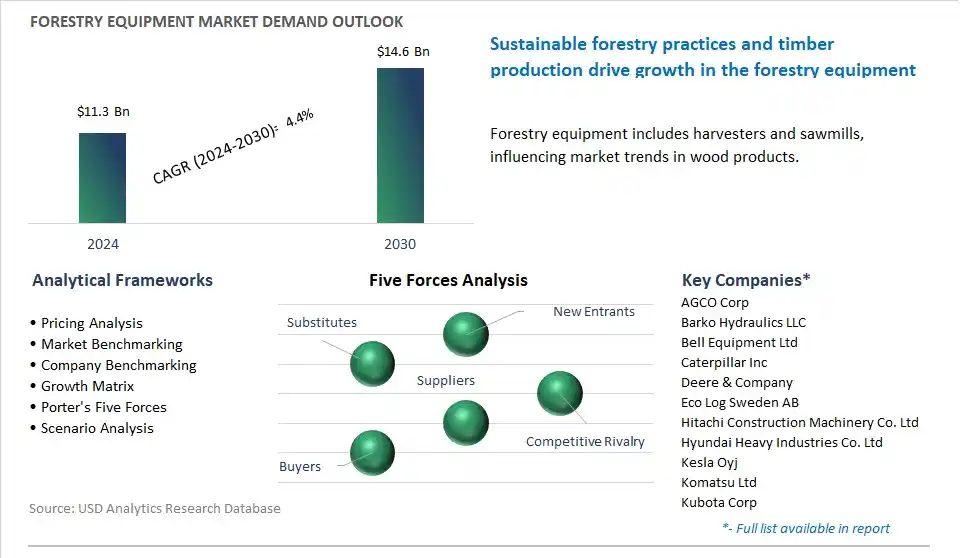
The market report analyses the leading companies in the industry including AGCO Corp, Barko Hydraulics LLC, Bell Equipment Ltd, Caterpillar Inc, Deere & Company, Eco Log Sweden AB, Hitachi Construction Machinery Co. Ltd, Hyundai Heavy Industries Co. Ltd, Kesla Oyj, Komatsu Ltd, Kubota Corp, Mahindra & Mahindra Ltd, Ponsse Oyj, Rottne Industri AB, Volvo Construction Equipment.
Technological innovations are revolutionizing the forestry equipment market, driving efficiency, safety, and sustainability. From the integration of IoT sensors for real-time monitoring to the development of autonomous machinery, the industry is witnessing a shift towards smarter, more connected equipment. These advancements are streamlining operations, enhancing precision in forestry activities such as logging and harvesting, and reducing the environmental impact through optimized resource utilization and minimized fuel consumption. As forestry companies seek to improve productivity and minimize costs, the adoption of cutting-edge technology in equipment is becoming increasingly prevalent, shaping the future landscape of the forestry industry.
The escalating global concern for environmental conservation and sustainable forestry practices is a key driver propelling the demand for forestry equipment. Governments, environmental organizations, and consumers are placing greater emphasis on responsible forest management to mitigate deforestation, preserve biodiversity, and combat climate change. Consequently, forestry companies are under increasing pressure to adopt sustainable practices and invest in equipment that enables efficient and eco-friendly forestry operations. This demand is driving manufacturers to develop equipment with lower emissions, reduced environmental footprint, and enhanced capabilities for selective logging and reforestation, aligning with the growing preference for sustainable forestry solutions.
An untapped opportunity lies in expanding the market for forestry equipment into emerging economies with burgeoning forestry sectors. Countries experiencing rapid industrialization and urbanization are witnessing a corresponding rise in demand for timber, wood products, and raw materials sourced from forests. This presents an opportunity for forestry equipment manufacturers to capitalize on growing market potential by establishing strategic partnerships, distribution networks, and localized production facilities. By offering tailored solutions that cater to the unique challenges and requirements of these emerging markets, such as affordability, adaptability to varied terrain, and ease of maintenance, companies can penetrate new regions and unlock significant growth opportunities in the global forestry equipment market.
The Extracting Equipment segment is the largest segment in the Forestry Equipment Market, driven by diverse key factors that underscore its critical role in timber harvesting operations and forest management practices. Extracting equipment, including forwarders, skidders, and other specialized machinery, plays a pivotal role in the transportation of harvested timber from the forest to processing facilities or collection points. One primary reason for the dominance of the Extracting Equipment segment is the fundamental need for efficient and reliable machinery to extract timber from forested areas, irrespective of terrain conditions, tree sizes, or environmental challenges. Extracting equipment enables the efficient removal of felled trees from the forest floor, minimizing damage to remaining vegetation and soil, and ensuring sustainable forest management practices. Additionally, the increasing demand for timber and wood products globally drives the need for advanced extracting equipment capable of handling large volumes of harvested timber efficiently and economically. Extracting equipment offers significant advantages in terms of productivity, labor savings, and operational efficiency compared to manual or traditional extraction methods, making it indispensable in modern forestry operations. In addition, technological advancements in extracting equipment, such as improved traction systems, ergonomic designs, and enhanced automation features, further contribute to the segment's dominance by improving operational efficiency, safety, and environmental performance. Further, the Extracting Equipment segment encompasses a wide range of specialized machinery designed to meet specific application requirements and operational preferences, including wheeled and tracked vehicles, cable and winch systems, and multi-functional carriers, catering to the diverse needs of forestry professionals and contractors worldwide. With the global demand for timber and wood products projected to continue growing, driven by population growth, urbanization, and construction activities, the Extracting Equipment segment in the Forestry Equipment Market is expected to maintain its position as the largest and most essential segment, offering manufacturers and suppliers opportunities for innovation, product development, and market expansion in the forestry sector.
By Product
Felling Equipment
-Chainsaws
-Harvesters
-Feller Bunchers
Extracting Equipment
-Forwarders
-Skidders
-Others
On-Site Processing Equipment
-Chippers and Grinders
-Delimbers and Slashers
-Others
Others
Regions Included
North America (US, Canada, Mexico)
Europe (Germany, UK, France, Spain, Italy, Russia, Rest of Europe)
Asia Pacific (China, India, Japan, South Korea, Australia, South East Asia, Rest of Asia)
South America (Brazil, Argentina, Rest of South America)
Middle East and Africa (Saudi Arabia, UAE, Rest of Middle East, South Africa, Egypt, Rest of Africa)
AGCO Corp
Barko Hydraulics LLC
Bell Equipment Ltd
Caterpillar Inc
Deere & Company
Eco Log Sweden AB
Hitachi Construction Machinery Co. Ltd
Hyundai Heavy Industries Co. Ltd
Kesla Oyj
Komatsu Ltd
Kubota Corp
Mahindra & Mahindra Ltd
Ponsse Oyj
Rottne Industri AB
Volvo Construction Equipment
*- List Not Exhaustive
TABLE OF CONTENTS
1 Introduction to 2024 Forestry Equipment Market
1.1 Market Overview
1.2 Quick Facts
1.3 Scope/Objective of the Study
1.4 Market Definition
1.5 Countries and Regions Covered
1.6 Units, Currency, and Conversions
1.7 Industry Value Chain
2 Research Methodology
2.1 Market Size Estimation
2.2 Sources and Research Methodology
2.3 Data Triangulation
2.4 Assumptions and Limitations
3 Executive Summary
3.1 Global Forestry Equipment Market Size Outlook, $ Million, 2021 to 2030
3.2 Forestry Equipment Market Outlook by Type, $ Million, 2021 to 2030
3.3 Forestry Equipment Market Outlook by Product, $ Million, 2021 to 2030
3.4 Forestry Equipment Market Outlook by Application, $ Million, 2021 to 2030
3.5 Forestry Equipment Market Outlook by Key Countries, $ Million, 2021 to 2030
4 Market Dynamics
4.1 Key Driving Forces of Forestry Equipment Industry
4.2 Key Market Trends in Forestry Equipment Industry
4.3 Potential Opportunities in Forestry Equipment Industry
4.4 Key Challenges in Forestry Equipment Industry
5 Market Factor Analysis
5.1 Value Chain Analysis
5.2 Competitive Landscape
5.2.1 Global Forestry Equipment Market Share by Company (%), 2023
5.2.2 Product Offerings by Company
5.3 Porter’s Five Forces Analysis
5.4 Pricing Analysis and Outlook
6 Growth Outlook Across Scenarios
6.1 Growth Analysis-Case Scenario Definitions
6.2 Low Growth Scenario Forecasts
6.3 Reference Growth Scenario Forecasts
6.4 High Growth Scenario Forecasts
7 Global Forestry Equipment Market Outlook by Segments
7.1 Forestry Equipment Market Outlook by Segments, $ Million, 2021- 2030
By Product
Felling Equipment
-Chainsaws
-Harvesters
-Feller Bunchers
Extracting Equipment
-Forwarders
-Skidders
-Others
On-Site Processing Equipment
-Chippers and Grinders
-Delimbers and Slashers
-Others
Others
8 North America Forestry Equipment Market Analysis and Outlook To 2030
8.1 Introduction to North America Forestry Equipment Markets in 2024
8.2 North America Forestry Equipment Market Size Outlook by Country, 2021-2030
8.2.1 United States
8.2.2 Canada
8.2.3 Mexico
8.3 North America Forestry Equipment Market size Outlook by Segments, 2021-2030
By Product
Felling Equipment
-Chainsaws
-Harvesters
-Feller Bunchers
Extracting Equipment
-Forwarders
-Skidders
-Others
On-Site Processing Equipment
-Chippers and Grinders
-Delimbers and Slashers
-Others
Others
9 Europe Forestry Equipment Market Analysis and Outlook To 2030
9.1 Introduction to Europe Forestry Equipment Markets in 2024
9.2 Europe Forestry Equipment Market Size Outlook by Country, 2021-2030
9.2.1 Germany
9.2.2 France
9.2.3 Spain
9.2.4 United Kingdom
9.2.4 Italy
9.2.5 Russia
9.2.6 Norway
9.2.7 Rest of Europe
9.3 Europe Forestry Equipment Market Size Outlook by Segments, 2021-2030
By Product
Felling Equipment
-Chainsaws
-Harvesters
-Feller Bunchers
Extracting Equipment
-Forwarders
-Skidders
-Others
On-Site Processing Equipment
-Chippers and Grinders
-Delimbers and Slashers
-Others
Others
10 Asia Pacific Forestry Equipment Market Analysis and Outlook To 2030
10.1 Introduction to Asia Pacific Forestry Equipment Markets in 2024
10.2 Asia Pacific Forestry Equipment Market Size Outlook by Country, 2021-2030
10.2.1 China
10.2.2 India
10.2.3 Japan
10.2.4 South Korea
10.2.5 Indonesia
10.2.6 Malaysia
10.2.7 Australia
10.2.8 Rest of Asia Pacific
10.3 Asia Pacific Forestry Equipment Market size Outlook by Segments, 2021-2030
By Product
Felling Equipment
-Chainsaws
-Harvesters
-Feller Bunchers
Extracting Equipment
-Forwarders
-Skidders
-Others
On-Site Processing Equipment
-Chippers and Grinders
-Delimbers and Slashers
-Others
Others
11 South America Forestry Equipment Market Analysis and Outlook To 2030
11.1 Introduction to South America Forestry Equipment Markets in 2024
11.2 South America Forestry Equipment Market Size Outlook by Country, 2021-2030
11.2.1 Brazil
11.2.2 Argentina
11.2.3 Rest of South America
11.3 South America Forestry Equipment Market size Outlook by Segments, 2021-2030
By Product
Felling Equipment
-Chainsaws
-Harvesters
-Feller Bunchers
Extracting Equipment
-Forwarders
-Skidders
-Others
On-Site Processing Equipment
-Chippers and Grinders
-Delimbers and Slashers
-Others
Others
12 Middle East and Africa Forestry Equipment Market Analysis and Outlook To 2030
12.1 Introduction to Middle East and Africa Forestry Equipment Markets in 2024
12.2 Middle East and Africa Forestry Equipment Market Size Outlook by Country, 2021-2030
12.2.1 Saudi Arabia
12.2.2 UAE
12.2.3 Oman
12.2.4 Rest of Middle East
12.2.5 Egypt
12.2.6 Nigeria
12.2.7 South Africa
12.2.8 Rest of Africa
12.3 Middle East and Africa Forestry Equipment Market size Outlook by Segments, 2021-2030
By Product
Felling Equipment
-Chainsaws
-Harvesters
-Feller Bunchers
Extracting Equipment
-Forwarders
-Skidders
-Others
On-Site Processing Equipment
-Chippers and Grinders
-Delimbers and Slashers
-Others
Others
13 Company Profiles
13.1 Company Snapshot
13.2 SWOT Profiles
13.3 Products and Services
13.4 Recent Developments
13.5 Financial Profile
AGCO Corp
Barko Hydraulics LLC
Bell Equipment Ltd
Caterpillar Inc
Deere & Company
Eco Log Sweden AB
Hitachi Construction Machinery Co. Ltd
Hyundai Heavy Industries Co. Ltd
Kesla Oyj
Komatsu Ltd
Kubota Corp
Mahindra & Mahindra Ltd
Ponsse Oyj
Rottne Industri AB
Volvo Construction Equipment
14 Appendix
14.1 Customization Offerings
14.2 Subscription Services
14.3 Related Reports
14.4 Publisher Expertise
By Product
Felling Equipment
-Chainsaws
-Harvesters
-Feller Bunchers
Extracting Equipment
-Forwarders
-Skidders
-Others
On-Site Processing Equipment
-Chippers and Grinders
-Delimbers and Slashers
-Others
Others
Countries Analyzed
North America (US, Canada, Mexico)
Europe (Germany, UK, France, Spain, Italy, Russia, Rest of Europe)
Asia Pacific (China, India, Japan, South Korea, Australia, South East Asia, Rest of Asia)
South America (Brazil, Argentina, Rest of South America)
Middle East and Africa (Saudi Arabia, UAE, Rest of Middle East, South Africa, Egypt, Rest of Africa)
Global Forestry Equipment is forecast to reach $14.6 Billion in 2030 from $11.3 Billion in 2024, registering a CAGR of 4.4%
Emerging Markets across Asia Pacific, Europe, and Americas present robust growth prospects.
AGCO Corp, Barko Hydraulics LLC, Bell Equipment Ltd, Caterpillar Inc, Deere & Company, Eco Log Sweden AB, Hitachi Construction Machinery Co. Ltd, Hyundai Heavy Industries Co. Ltd, Kesla Oyj, Komatsu Ltd, Kubota Corp, Mahindra & Mahindra Ltd, Ponsse Oyj, Rottne Industri AB, Volvo Construction Equipment
Base Year- 2023; Estimated Year- 2024; Historic Period- 2018-2023; Forecast period- 2024 to 2030; Currency: Revenue (USD); Volume