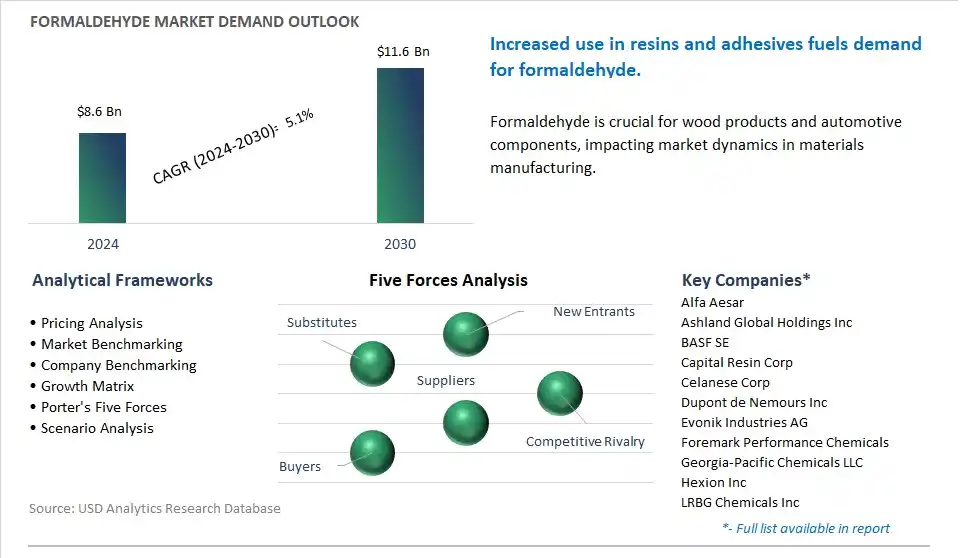
The global Formaldehyde Market is poised to register a 5.1% CAGR from $8.6 Billion in 2024 to $11.6 Billion in 2030.
The global Formaldehyde Market Study analyzes and forecasts the market size across 6 regions and 24 countries for diverse segments -By Derivative (Urea Formaldehyde, Phenol Formaldehyde, Melamine Formaldehyde, Polyacetal Resins, Pentaerythritol, 1,4 Butanediol, Methylenebis, Hexamethylenetetramine, Others), By End-User (Building & Construction, Automotive, Furniture, Textile, Healthcare, Oil & Gas, Agriculture, Water Treatment, Cleaning Products, HVAC, Others).
An Introduction to Global Formaldehyde Market in 2024
The formaldehyde market is experiencing steady growth driven by its applications in various industries such as adhesives, resins, textiles, and personal care products. Key trends shaping the future of the industry include the increasing demand for formaldehyde-based products that offer high performance, durability, and sustainability while meeting regulatory standards and environmental requirements. As manufacturers and end-users seek materials that provide strong bonding, dimensional stability, and low emissions, there's a growing need for formaldehyde-based resins such as urea-formaldehyde, phenol-formaldehyde, and melamine-formaldehyde that are used in composite wood products, insulation materials, coatings, and decorative laminates. Moreover, advancements in formaldehyde production processes, catalytic technologies, and waste management practices are driving market expansion by improving resource efficiency, energy utilization, and environmental performance while reducing emissions of volatile organic compounds (VOCs) and hazardous air pollutants (HAPs) associated with formaldehyde manufacturing and usage. Additionally, the growing adoption of formaldehyde-based chemicals in emerging applications such as 3D printing, biocides, and pharmaceutical intermediates is fueling demand for innovative solutions that enable new product development and performance enhancement across various industries. Furthermore, the integration of formaldehyde with sustainable forestry practices, bio-based feedstocks, and circular economy initiatives is driving innovation and market growth in the formaldehyde industry, enabling the development of eco-friendly, cost-effective, and regulatory-compliant solutions for the future of manufacturing, construction, and consumer products.
Formaldehyde Market Competitive Landscape
The market report analyses the leading companies in the industry including Alfa Aesar, Ashland Global Holdings Inc, BASF SE, Capital Resin Corp, Celanese Corp, Dupont de Nemours Inc, Evonik Industries AG, Foremark Performance Chemicals, Georgia-Pacific Chemicals LLC, Hexion Inc, LRBG Chemicals Inc, Perstorp Holding AB.
Formaldehyde Market Dynamics
Formaldehyde Market Trend: Increasing Adoption of Formaldehyde-Free Products
A notable trend in the formaldehyde market is the rising adoption of formaldehyde-free products across various industries. Concerns over the health hazards associated with formaldehyde exposure have led to stringent regulations and heightened consumer awareness regarding its use in manufacturing processes. As a result, industries such as furniture, construction, and automotive are shifting towards alternative materials and production methods that eliminate or minimize formaldehyde emissions. This trend is driving research and development efforts towards eco-friendly substitutes and innovative manufacturing techniques, shaping the market landscape towards safer and more sustainable solutions.
Formaldehyde Market Driver: Stringent Regulatory Standards on Formaldehyde Emissions
Stringent regulatory standards on formaldehyde emissions are a significant driver influencing the formaldehyde market. Governments worldwide are imposing stricter regulations aimed at reducing formaldehyde emissions in various applications, particularly in wood products, textiles, and adhesives. These regulations are driven by health concerns, as formaldehyde exposure has been linked to respiratory issues, carcinogenicity, and indoor air quality issues. Compliance with these standards necessitates investments in technology, production processes, and raw materials to meet or exceed regulatory requirements, thereby driving market demand for low-emission formaldehyde products and catalyzing innovation in the industry.
Formaldehyde Market Opportunity: Expansion in Developing Countries' Construction and Furniture Sectors
An opportunity for market growth lies in expanding the formaldehyde market into developing countries with burgeoning construction and furniture sectors. As these economies undergo rapid urbanization and infrastructure development, the demand for formaldehyde-based products such as plywood, particleboard, and adhesives is on the rise. By leveraging this opportunity, formaldehyde manufacturers can establish partnerships, distribution networks, and production facilities in emerging markets to cater to growing demand. Moreover, there is potential to introduce sustainable and low-emission formaldehyde solutions tailored to the specific needs and regulatory environments of these regions, thereby capitalizing on market expansion opportunities while promoting environmental consciousness and public health.
Formaldehyde Market Share Analysis: Urea Formaldehyde segment generated the highest revenue in the industry
The Urea Formaldehyde segment is the largest segment in the Formaldehyde Market, driven by diverse key factors that highlight its extensive use and significance in various industries and applications. Urea formaldehyde resin is one of the most widely used derivatives of formaldehyde, valued for its versatility, durability, and cost-effectiveness in a wide range of applications. One primary reason for the dominance of the Urea Formaldehyde segment is its widespread use in the manufacturing of engineered wood products, including particleboard, medium-density fiberboard (MDF), and plywood. These engineered wood products are essential building materials used in construction, furniture manufacturing, cabinetry, flooring, and other structural and decorative applications. Urea formaldehyde resin serves as a key adhesive binder in the production of these engineered wood products, providing strong bonding strength, moisture resistance, and dimensional stability to the finished products. Additionally, the affordability and availability of urea formaldehyde resin make it a preferred choice for manufacturers seeking cost-effective and high-performance adhesive solutions for wood composite manufacturing. In addition, urea formaldehyde resin finds applications in other industries, including automotive, textiles, insulation, and electrical appliances, where it is used as a binding agent, insulation material, coating, or molding compound. Further, regulatory requirements and consumer preferences for sustainable and low-emission products have driven advancements in urea formaldehyde resin formulations, leading to the development of low-formaldehyde or formaldehyde-free alternatives that meet stringent environmental and health standards. With its versatile properties, wide-ranging applications, and continuous innovation, the Urea Formaldehyde segment maintains its position as the largest and most essential segment in the Formaldehyde Market, offering manufacturers and end-users reliable and cost-effective solutions for various industrial and commercial applications.
Formaldehyde Market Share Analysis: Healthcare Segment is poised to register the fastest growth rate (CAGR) over the forecast period to 2030
The Healthcare segment is the fastest-growing segment in the Formaldehyde Market, driven by diverse key factors that reflect increasing demand for formaldehyde-based products and solutions in healthcare applications. Formaldehyde, despite its reputation as a chemical with potential health risks, finds essential uses in various healthcare-related industries due to its unique properties and versatile applications. One primary reason for the rapid growth of the Healthcare segment is the critical role of formaldehyde in medical and laboratory settings. Formaldehyde serves as a key ingredient in the production of histology and pathology reagents used for tissue fixation and preservation in anatomical pathology laboratories. These reagents are essential for preserving tissue samples, facilitating microscopic examination, and aiding in disease diagnosis and research. Additionally, formaldehyde-based disinfectants and sterilants are widely used in healthcare facilities for surface disinfection, medical equipment sterilization, and infection control purposes. Formaldehyde's strong antimicrobial properties make it effective against a wide range of pathogens, including bacteria, viruses, and fungi, contributing to its widespread use in healthcare settings, especially during infectious disease outbreaks and pandemics. In addition, formaldehyde-based products are utilized in medical device manufacturing, pharmaceutical production, and biotechnology research, where they serve as chemical intermediates, solvents, and preservatives in various formulations. Further, advancements in formaldehyde-based technologies, including low-emission formulations, improved safety protocols, and enhanced application methods, are driving the adoption of formaldehyde-based solutions in healthcare settings while addressing concerns related to worker safety, environmental impact, and regulatory compliance. With healthcare infrastructure development, increasing investments in medical research and innovation, and growing emphasis on infection control and patient safety, the Healthcare segment in the Formaldehyde Market is poised for rapid growth, offering manufacturers and suppliers opportunities for innovation, collaboration, and market expansion in the healthcare industry.
Formaldehyde Market Report Segmentation
By Derivative
Urea Formaldehyde
Phenol Formaldehyde
Melamine Formaldehyde
Polyacetal Resins
Pentaerythritol
1,4 Butanediol
Methylenebis
Hexamethylenetetramine
Others
By End-User
Building & Construction
Automotive
Furniture
Textile
Healthcare
Oil & Gas
Agriculture
Water Treatment
Cleaning Products
HVAC
Others
Regions Included
North America (US, Canada, Mexico)
Europe (Germany, UK, France, Spain, Italy, Russia, Rest of Europe)
Asia Pacific (China, India, Japan, South Korea, Australia, South East Asia, Rest of Asia)
South America (Brazil, Argentina, Rest of South America)
Middle East and Africa (Saudi Arabia, UAE, Rest of Middle East, South Africa, Egypt, Rest of Africa)
Formaldehyde Companies Profiled in the Market Study
Alfa Aesar
Ashland Global Holdings Inc
BASF SE
Capital Resin Corp
Celanese Corp
Dupont de Nemours Inc
Evonik Industries AG
Foremark Performance Chemicals
Georgia-Pacific Chemicals LLC
Hexion Inc
LRBG Chemicals Inc
Perstorp Holding AB
*- List Not Exhaustive
TABLE OF CONTENTS
1 Introduction to 2024 Formaldehyde Market
1.1 Market Overview
1.2 Quick Facts
1.3 Scope/Objective of the Study
1.4 Market Definition
1.5 Countries and Regions Covered
1.6 Units, Currency, and Conversions
1.7 Industry Value Chain
2 Research Methodology
2.1 Market Size Estimation
2.2 Sources and Research Methodology
2.3 Data Triangulation
2.4 Assumptions and Limitations
3 Executive Summary
3.1 Global Formaldehyde Market Size Outlook, $ Million, 2021 to 2030
3.2 Formaldehyde Market Outlook by Type, $ Million, 2021 to 2030
3.3 Formaldehyde Market Outlook by Product, $ Million, 2021 to 2030
3.4 Formaldehyde Market Outlook by Application, $ Million, 2021 to 2030
3.5 Formaldehyde Market Outlook by Key Countries, $ Million, 2021 to 2030
4 Market Dynamics
4.1 Key Driving Forces of Formaldehyde Industry
4.2 Key Market Trends in Formaldehyde Industry
4.3 Potential Opportunities in Formaldehyde Industry
4.4 Key Challenges in Formaldehyde Industry
5 Market Factor Analysis
5.1 Value Chain Analysis
5.2 Competitive Landscape
5.2.1 Global Formaldehyde Market Share by Company (%), 2023
5.2.2 Product Offerings by Company
5.3 Porter’s Five Forces Analysis
5.4 Pricing Analysis and Outlook
6 Growth Outlook Across Scenarios
6.1 Growth Analysis-Case Scenario Definitions
6.2 Low Growth Scenario Forecasts
6.3 Reference Growth Scenario Forecasts
6.4 High Growth Scenario Forecasts
7 Global Formaldehyde Market Outlook by Segments
7.1 Formaldehyde Market Outlook by Segments, $ Million, 2021- 2030
By Derivative
Urea Formaldehyde
Phenol Formaldehyde
Melamine Formaldehyde
Polyacetal Resins
Pentaerythritol
1,4 Butanediol
Methylenebis
Hexamethylenetetramine
Others
By End-User
Building & Construction
Automotive
Furniture
Textile
Healthcare
Oil & Gas
Agriculture
Water Treatment
Cleaning Products
HVAC
Others
8 North America Formaldehyde Market Analysis and Outlook To 2030
8.1 Introduction to North America Formaldehyde Markets in 2024
8.2 North America Formaldehyde Market Size Outlook by Country, 2021-2030
8.2.1 United States
8.2.2 Canada
8.2.3 Mexico
8.3 North America Formaldehyde Market size Outlook by Segments, 2021-2030
By Derivative
Urea Formaldehyde
Phenol Formaldehyde
Melamine Formaldehyde
Polyacetal Resins
Pentaerythritol
1,4 Butanediol
Methylenebis
Hexamethylenetetramine
Others
By End-User
Building & Construction
Automotive
Furniture
Textile
Healthcare
Oil & Gas
Agriculture
Water Treatment
Cleaning Products
HVAC
Others
9 Europe Formaldehyde Market Analysis and Outlook To 2030
9.1 Introduction to Europe Formaldehyde Markets in 2024
9.2 Europe Formaldehyde Market Size Outlook by Country, 2021-2030
9.2.1 Germany
9.2.2 France
9.2.3 Spain
9.2.4 United Kingdom
9.2.4 Italy
9.2.5 Russia
9.2.6 Norway
9.2.7 Rest of Europe
9.3 Europe Formaldehyde Market Size Outlook by Segments, 2021-2030
By Derivative
Urea Formaldehyde
Phenol Formaldehyde
Melamine Formaldehyde
Polyacetal Resins
Pentaerythritol
1,4 Butanediol
Methylenebis
Hexamethylenetetramine
Others
By End-User
Building & Construction
Automotive
Furniture
Textile
Healthcare
Oil & Gas
Agriculture
Water Treatment
Cleaning Products
HVAC
Others
10 Asia Pacific Formaldehyde Market Analysis and Outlook To 2030
10.1 Introduction to Asia Pacific Formaldehyde Markets in 2024
10.2 Asia Pacific Formaldehyde Market Size Outlook by Country, 2021-2030
10.2.1 China
10.2.2 India
10.2.3 Japan
10.2.4 South Korea
10.2.5 Indonesia
10.2.6 Malaysia
10.2.7 Australia
10.2.8 Rest of Asia Pacific
10.3 Asia Pacific Formaldehyde Market size Outlook by Segments, 2021-2030
By Derivative
Urea Formaldehyde
Phenol Formaldehyde
Melamine Formaldehyde
Polyacetal Resins
Pentaerythritol
1,4 Butanediol
Methylenebis
Hexamethylenetetramine
Others
By End-User
Building & Construction
Automotive
Furniture
Textile
Healthcare
Oil & Gas
Agriculture
Water Treatment
Cleaning Products
HVAC
Others
11 South America Formaldehyde Market Analysis and Outlook To 2030
11.1 Introduction to South America Formaldehyde Markets in 2024
11.2 South America Formaldehyde Market Size Outlook by Country, 2021-2030
11.2.1 Brazil
11.2.2 Argentina
11.2.3 Rest of South America
11.3 South America Formaldehyde Market size Outlook by Segments, 2021-2030
By Derivative
Urea Formaldehyde
Phenol Formaldehyde
Melamine Formaldehyde
Polyacetal Resins
Pentaerythritol
1,4 Butanediol
Methylenebis
Hexamethylenetetramine
Others
By End-User
Building & Construction
Automotive
Furniture
Textile
Healthcare
Oil & Gas
Agriculture
Water Treatment
Cleaning Products
HVAC
Others
12 Middle East and Africa Formaldehyde Market Analysis and Outlook To 2030
12.1 Introduction to Middle East and Africa Formaldehyde Markets in 2024
12.2 Middle East and Africa Formaldehyde Market Size Outlook by Country, 2021-2030
12.2.1 Saudi Arabia
12.2.2 UAE
12.2.3 Oman
12.2.4 Rest of Middle East
12.2.5 Egypt
12.2.6 Nigeria
12.2.7 South Africa
12.2.8 Rest of Africa
12.3 Middle East and Africa Formaldehyde Market size Outlook by Segments, 2021-2030
By Derivative
Urea Formaldehyde
Phenol Formaldehyde
Melamine Formaldehyde
Polyacetal Resins
Pentaerythritol
1,4 Butanediol
Methylenebis
Hexamethylenetetramine
Others
By End-User
Building & Construction
Automotive
Furniture
Textile
Healthcare
Oil & Gas
Agriculture
Water Treatment
Cleaning Products
HVAC
Others
13 Company Profiles
13.1 Company Snapshot
13.2 SWOT Profiles
13.3 Products and Services
13.4 Recent Developments
13.5 Financial Profile
Alfa Aesar
Ashland Global Holdings Inc
BASF SE
Capital Resin Corp
Celanese Corp
Dupont de Nemours Inc
Evonik Industries AG
Foremark Performance Chemicals
Georgia-Pacific Chemicals LLC
Hexion Inc
LRBG Chemicals Inc
Perstorp Holding AB
14 Appendix
14.1 Customization Offerings
14.2 Subscription Services
14.3 Related Reports
14.4 Publisher Expertise
By Derivative
Urea Formaldehyde
Phenol Formaldehyde
Melamine Formaldehyde
Polyacetal Resins
Pentaerythritol
1,4 Butanediol
Methylenebis
Hexamethylenetetramine
Others
By End-User
Building & Construction
Automotive
Furniture
Textile
Healthcare
Oil & Gas
Agriculture
Water Treatment
Cleaning Products
HVAC
Others
Countries Analyzed
North America (US, Canada, Mexico)
Europe (Germany, UK, France, Spain, Italy, Russia, Rest of Europe)
Asia Pacific (China, India, Japan, South Korea, Australia, South East Asia, Rest of Asia)
South America (Brazil, Argentina, Rest of South America)
Middle East and Africa (Saudi Arabia, UAE, Rest of Middle East, South Africa, Egypt, Rest of Africa)
