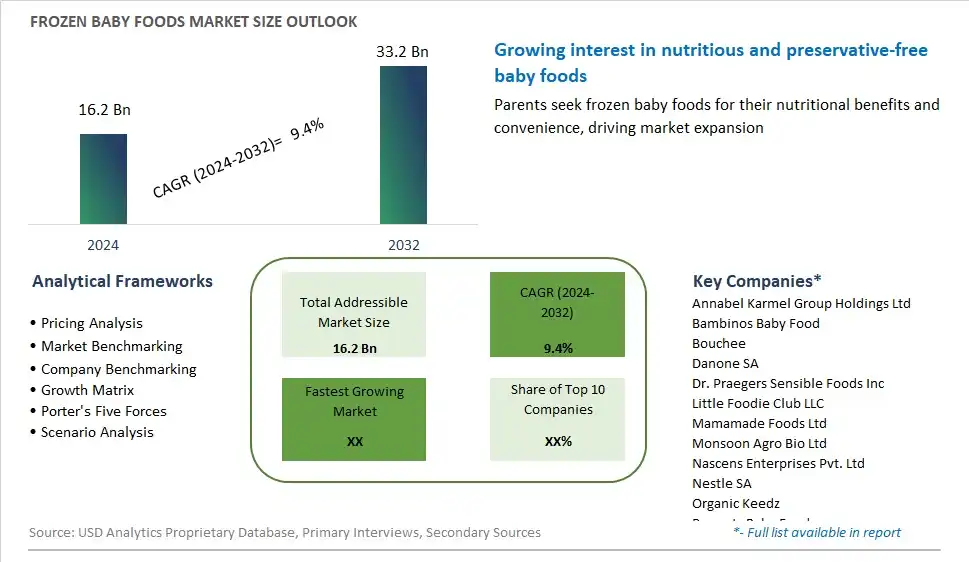
Global Frozen Baby Foods Market Size is valued at $16.2 Billion in 2024 and is forecast to register a growth rate (CAGR) of 9.4% to reach $33.2 Billion by 2032.
The global Frozen Baby Foods Market Comprehensive Study analyzes and forecasts the market size across 6 regions and 24 countries for diverse segments -By Type (Frozen Fruits & Vegetables, Frozen Confectioneries, Others), By Distribution Channel (Online Retail, Supermarkets/ Hypermarkets, Departmental Stores, Others)
An Introduction to Frozen Baby Foods Market
Frozen baby foods are gaining popularity among parents seeking convenient, nutritious, and safe options for feeding their infants and toddlers in 2024. Frozen baby foods offer several advantages over traditional homemade or jarred baby foods, including longer shelf life, minimal processing, and retention of nutrients and flavors. Moreover, frozen baby foods are free from additives, preservatives, and artificial ingredients, providing parents with peace of mind about the quality and safety of the foods they feed their children. With the rise of baby-led weaning and the growing demand for organic and allergy-friendly options, frozen baby food manufacturers are innovating with a wide range of nutrient-dense ingredients and flavor combinations to cater to diverse dietary needs and preferences. Additionally, the convenience and portability of frozen baby food pouches and trays make them ideal for on-the-go feeding and travel. As parents continue to seek convenient and nutritious options for feeding their little ones, the market for frozen baby foods is expected to continue its growth trajectory, offering parents a convenient and reliable solution for nourishing their children.
Frozen Baby Foods Competitive Landscape
The market report analyses the leading companies in the industry including Annabel Karmel Group Holdings Ltd, Bambinos Baby Food, Bouchee, Danone SA, Dr. Praegers Sensible Foods Inc, Little Foodie Club LLC, Mamamade Foods Ltd, Monsoon Agro Bio Ltd, Nascens Enterprises Pvt. Ltd, Nestle SA, Organic Keedz, Poppets Baby Food, Square Foods LLC, Sun Maid Growers of California, The Hain Celestial Group Inc, Upon A Farm PBC, YUM Baby, and Others.
Frozen Baby Foods Market Dynamics
Frozen Baby Foods Market Trend: Growing Demand for Convenient and Nutritious Baby Food Options
A notable trend in the frozen baby foods market is the growing demand for convenient and nutritious options, driven by changing parental lifestyles, increased awareness of the importance of early childhood nutrition, and the desire for time-saving solutions. Busy parents are seeking convenient alternatives to homemade baby food that offer the same level of nutrition and quality but with the added convenience of ready-to-serve or easy-to-prep options. Frozen baby foods provide a convenient solution for parents looking to provide their infants and toddlers with wholesome, balanced meals without the need for extensive meal preparation or cooking. This trend towards convenience-driven consumption patterns reflects a broader societal shift towards time-saving solutions and the prioritization of health and nutrition in early childhood development, driving market growth and innovation in the frozen baby foods segment as parents seek out convenient, nutritious, and flavorful options for their little ones.
Market Driver: Busy Parental Lifestyles and On-the-Go Eating Habits
A key driver of the frozen baby foods market is busy parental lifestyles and on-the-go eating habits, fueled by demographic shifts, dual-income households, and changing family dynamics that have reshaped how parents approach feeding their infants and toddlers. With more parents balancing work, childcare, and other responsibilities, there's a demand for convenient meal solutions that cater to busy schedules and offer peace of mind regarding nutrition and safety. Frozen baby foods offer a convenient and reliable option for parents to provide their children with nutritious meals and snacks, whether at home, on outings, or during travel. Additionally, frozen baby foods allow for portion control and waste reduction, as parents can serve only what their child needs at each mealtime, minimizing leftovers and ensuring freshness. This driver underscores the importance of convenience and practicality in meeting the needs of modern parents, driving market growth and innovation in the frozen baby foods sector as manufacturers strive to provide solutions that align with busy parental lifestyles and on-the-go eating habits.
Market Opportunity: Expansion into Organic, Allergen-Free, and Customizable Options
An opportunity for growth in the frozen baby foods market lies in the expansion into organic, allergen-free, and customizable options that cater to diverse parental preferences and dietary needs. While convenience is a primary consideration for parents, there's also a growing demand for baby foods that are made with organic ingredients, free from common allergens such as dairy, gluten, and nuts, and customizable to accommodate specific dietary restrictions and preferences. Manufacturers can capitalize on this opportunity by offering a wide range of frozen baby food options that meet these criteria, including single-ingredient purees, multi-ingredient blends, and textured meals that cater to different stages of infant and toddler development. Moreover, there's potential to introduce innovative packaging formats, such as resealable pouches and portioned trays, that enhance convenience, portion control, and storage options for busy parents. By providing a variety of nutritious, safe, and convenient options that meet the diverse needs of modern families, frozen baby food brands can differentiate themselves in the market and establish themselves as trusted partners in early childhood nutrition and development.
Frozen Baby Foods Market Share Analysis: Frozen Confectioneries held the dominant market share in 2024
Among the segments outlined in the Frozen Baby Foods Market, Frozen Confectioneries emerge as the largest segment, spearheading the industry's growth trajectory. With an increasing trend towards convenience and health-conscious choices among consumers, Frozen Confectioneries offer a tantalizing blend of taste and nutrition for infants. This segment encompasses a diverse range of products, including frozen yogurt bites, fruit puree popsicles, and organic ice cream treats, catering to the evolving preferences of modern parents. The surge in demand for indulgent yet wholesome snacks for babies has propelled the rapid expansion of Frozen Confectioneries, with manufacturers innovating to introduce new flavors, textures, and packaging formats to captivate discerning consumers. Further, the convenience factor of these products aligns with the busy lifestyles of parents, driving further adoption across global markets. As health-conscious consumers seek alternatives to traditional sugary treats, Frozen Confectioneries stand out as a viable option, offering guilt-free indulgence without compromising on nutritional value. With sustained innovation and strategic marketing initiatives, this segment is poised to maintain its dominance, contributing significantly to the overall growth of the Frozen Baby Foods Market.
Frozen Baby Foods Market Share Analysis: Online Retail market is poised to register the fastest growth rae over the forecast period to 2032
Among the distribution channels delineated in the Frozen Baby Foods Market, Online Retail is the fastest-growing segment, propelled by the seamless integration of technology into consumer shopping habits. The exponential rise of e-commerce platforms has revolutionized the retail landscape, offering unparalleled convenience and accessibility to a wide array of products, including baby foods. Parents, often balancing busy schedules, find the convenience of browsing and purchasing baby foods online irresistible. Further, the advent of mobile shopping apps and personalized recommendations has streamlined the shopping experience, enhancing customer satisfaction and loyalty. Additionally, the COVID-19 pandemic further accelerated the shift towards online shopping, as consumers prioritize safety and social distancing measures. As a result, Online Retail has witnessed a surge in demand for frozen baby foods, with consumers appreciating the convenience of doorstep delivery and the ability to compare prices and product reviews effortlessly. With continuous advancements in logistics and digital infrastructure, coupled with evolving consumer preferences, Online Retail is poised to maintain its rapid growth trajectory, reshaping the landscape of the Frozen Baby Foods Market.
Frozen Baby Foods Market Segmentation
By Type
Frozen Fruits & Vegetables
Frozen Confectioneries
Others
By Distribution Channel
Online Retail
Supermarkets/ Hypermarkets
Departmental Stores
Others
Countries Analyzed
North America (US, Canada, Mexico)
Europe (Germany, UK, France, Spain, Italy, Russia, Rest of Europe)
Asia Pacific (China, India, Japan, South Korea, Australia, South East Asia, Rest of Asia)
South America (Brazil, Argentina, Rest of South America)
Middle East and Africa (Saudi Arabia, UAE, Rest of Middle East, South Africa, Egypt, Rest of Africa)
Frozen Baby Foods Companies Profiled in the Study
Annabel Karmel Group Holdings Ltd
Bambinos Baby Food
Bouchee
Danone SA
Dr. Praegers Sensible Foods Inc
Little Foodie Club LLC
Mamamade Foods Ltd
Monsoon Agro Bio Ltd
Nascens Enterprises Pvt. Ltd
Nestle SA
Organic Keedz
Poppets Baby Food
Square Foods LLC
Sun Maid Growers of California
The Hain Celestial Group Inc
Upon A Farm PBC
YUM Baby
*- List Not Exhaustive
Chapter 1. TABLE OF CONTENTS
Chapter 2. Introduction to Frozen Baby Foods Market
2.1. Market Overview
2.2. Key Statistics and Report Highlights
2.3. Scope of the Comprehensive Study
2.3.1. Market Definition
2.3.2 Countries and Regions Covered
2.3.3 Research Objective
2.3.4 Units, Currency, and Conversions
2.3.5 Industry Value Chain
2.4. Key Market Segments
2.5. Key Companies
2.6. Study Period
Chapter 3. Strategic Analysis Review
3.1. Frozen Baby Foods Pricing Analysis and Forecast
3.2. Porter’s Five Forces
3.3. Market Ecosystem
3.4. SWOT Analysis
3.5. Regulatory Scenario
3.3. Effects of Inflation, Russia-Ukraine War, moderating economic growth, and other macroeconomic factors
Chapter 4. Competitive Landscape
4.1. Market Share Analysis
4.1.1. Global Frozen Baby Foods Market Share by Company, 2023
4.1.2. Product Offerings of Leading Frozen Baby Foods Companies
4.2. Market Entropy
4.2.1. New Product Launches in the Industry
4.2.2. Mergers, Acquisitions, Joint ventures, and Partnerships
4.3. Key Strategies and Best Practices
Chapter 5. Global Market Projections: Best, Reference, and Low Case Scenarios
5.1. Growth Analysis- Case Scenario Definitions
5.2. Low Growth Case Scenario Forecasts
5.3. Reference Growth Case Scenario Forecasts
5.4. High Growth Case Scenario Forecasts
Chapter 6. Market Dynamics
6.1. Frozen Baby Foods Market Drivers
6.2. Frozen Baby Foods Market Challenges
6.6. Frozen Baby Foods Market Opportunities
6.4. Frozen Baby Foods Market Trends
Chapter 7. Global Frozen Baby Foods Market Outlook Trends
7.1. Global Frozen Baby Foods Revenue (USD Million) and CAGR (%) by Type (2021-2032)
7.2. Global Frozen Baby Foods Revenue (USD Million) and CAGR (%) by Application (2021-2032)
7.3. Global Frozen Baby Foods Revenue (USD Million) and CAGR (%) by Product (2021-2032)
By Type
Frozen Fruits & Vegetables
Frozen Confectioneries
Others
By Distribution Channel
Online Retail
Supermarkets/ Hypermarkets
Departmental Stores
Others
Chapter 8. Global Frozen Baby Foods Regional Analysis and Outlook
8.1. Global Frozen Baby Foods Revenue (USD Million) By Regions (2021- 2032)
8.2. North America Frozen Baby Foods Revenue (USD Million) by Country (2021-2032)
8.2.1. United States Frozen Baby Foods Regional Analysis and Outlook
8.2.2. Canada Frozen Baby Foods Regional Analysis and Outlook
8.2.3. Mexico Frozen Baby Foods Regional Analysis and Outlook
8.3. Europe Frozen Baby Foods Revenue (USD Million), by Country (2021-2032)
8.3.1. Germany Frozen Baby Foods Regional Analysis and Outlook
8.3.2. France Frozen Baby Foods Regional Analysis and Outlook
8.3.3. United Kingdom Frozen Baby Foods Regional Analysis and Outlook
8.3.4. Spain Frozen Baby Foods Regional Analysis and Outlook
8.3.5. Italy Frozen Baby Foods Regional Analysis and Outlook
8.3.6. Russia Frozen Baby Foods Regional Analysis and Outlook
8.3.7. Rest of Europe Frozen Baby Foods Regional Analysis and Outlook
8.4. Asia Pacific Frozen Baby Foods Revenue (USD Million) by Country (2021-2032)
8.4.1. China Frozen Baby Foods Regional Analysis and Outlook
8.4.2. Japan Frozen Baby Foods Regional Analysis and Outlook
8.4.3. India Frozen Baby Foods Regional Analysis and Outlook
8.4.4. South Korea Frozen Baby Foods Regional Analysis and Outlook
8.4.5. Australia Frozen Baby Foods Regional Analysis and Outlook
8.4.6. South East Asia Frozen Baby Foods Regional Analysis and Outlook
8.4.7. Rest of Asia Pacific Frozen Baby Foods Regional Analysis and Outlook
8.5. South America Frozen Baby Foods Revenue (USD Million), by Country (2021-2032)
8.5.1. Brazil Frozen Baby Foods Regional Analysis and Outlook
8.5.2. Argentina Frozen Baby Foods Regional Analysis and Outlook
8.5.3. Rest of South America Frozen Baby Foods Regional Analysis and Outlook
8.6. Middle East and Africa Frozen Baby Foods Revenue (USD Million) by Country (2021-2032)
8.6.1. Middle East Frozen Baby Foods Regional Analysis and Outlook
8.6.2. Africa Frozen Baby Foods Regional Analysis and Outlook
Chapter 9. North America Frozen Baby Foods Analysis and Outlook
9.1. North America Frozen Baby Foods Revenue (USD Million) by Segments (2021-2032)
9.1.1. North America Frozen Baby Foods Revenue (USD Million) by Type (2021-2032)
9.1.2. North America Frozen Baby Foods Revenue (USD Million) by Application (2021-2032)
9.1.3. North America Frozen Baby Foods Revenue (USD Million) by Product (2021-2032)
By Type
Frozen Fruits & Vegetables
Frozen Confectioneries
Others
By Distribution Channel
Online Retail
Supermarkets/ Hypermarkets
Departmental Stores
Others
Chapter 10. Europe Frozen Baby Foods Analysis and Outlook
10.1. Europe Frozen Baby Foods Revenue (USD Million), by Segments (USD Million) (2021-2032)
10.1.1. Europe Frozen Baby Foods Revenue (USD Million) by Type (2021-2032)
10.1.2. Europe Frozen Baby Foods Revenue (USD Million) by Application (2021-2032)
10.1.3. Europe Frozen Baby Foods Revenue (USD Million) by Product (2021-2032)
By Type
Frozen Fruits & Vegetables
Frozen Confectioneries
Others
By Distribution Channel
Online Retail
Supermarkets/ Hypermarkets
Departmental Stores
Others
Chapter 11. Asia Pacific Frozen Baby Foods Analysis and Outlook
11.1. Asia Pacific Frozen Baby Foods Revenue (USD Million), and Revenue (USD Million) by Segments (2021-2032)
11.1.1. Asia Pacific Frozen Baby Foods Revenue (USD Million) by Type (2021-2032)
11.1.2. Asia Pacific Frozen Baby Foods Revenue (USD Million) by Application (2021-2032)
11.1.3. Asia Pacific Frozen Baby Foods Revenue (USD Million) by Product (2021-2032)
By Type
Frozen Fruits & Vegetables
Frozen Confectioneries
Others
By Distribution Channel
Online Retail
Supermarkets/ Hypermarkets
Departmental Stores
Others
Chapter 12. South America Frozen Baby Foods Analysis and Outlook
12.1. South America Frozen Baby Foods Revenue (USD Million), by Segments (2021-2032)
12.1.1. South America Frozen Baby Foods Revenue (USD Million) by Type (2021-2032)
12.1.2. South America Frozen Baby Foods Revenue (USD Million) by Application (2021-2032)
12.1.3. South America Frozen Baby Foods Revenue (USD Million) by Product (2021-2032)
By Type
Frozen Fruits & Vegetables
Frozen Confectioneries
Others
By Distribution Channel
Online Retail
Supermarkets/ Hypermarkets
Departmental Stores
Others
Chapter 13. Middle East and Africa Frozen Baby Foods Analysis and Outlook
13.1. Middle East and Africa Frozen Baby Foods Revenue (USD Million), by Segments (2021-2032)
13.1.1. Middle East and Africa Frozen Baby Foods Revenue (USD Million) by Type (2021-2032)
13.1.2. Middle East and Africa Frozen Baby Foods Revenue (USD Million) by Application (2021-2032)
13.1.3. Middle East and Africa Frozen Baby Foods Revenue (USD Million) by Product (2021-2032)
By Type
Frozen Fruits & Vegetables
Frozen Confectioneries
Others
By Distribution Channel
Online Retail
Supermarkets/ Hypermarkets
Departmental Stores
Others
Chapter 14. Frozen Baby Foods Company Profiles
14.1 Business Overview
14.2 Product Profiles
14.3 SWOT Profiles
14.5 Recent Developments
14.6 Financial Profile
List of Companies
Annabel Karmel Group Holdings Ltd
Bambinos Baby Food
Bouchee
Danone SA
Dr. Praegers Sensible Foods Inc
Little Foodie Club LLC
Mamamade Foods Ltd
Monsoon Agro Bio Ltd
Nascens Enterprises Pvt. Ltd
Nestle SA
Organic Keedz
Poppets Baby Food
Square Foods LLC
Sun Maid Growers of California
The Hain Celestial Group Inc
Upon A Farm PBC
YUM Baby
15. Methodology and Data Sources
15.1 Customization Offerings
15.2 Subscription Services
15.3 Related Reports
15.4 Publisher Expertise
LIST OF TABLES
Table 1 Market Segmentation Analysis
Table 2 Global Frozen Baby Foods Market Share of Leading Companies, 2023
Table 3 Product Offerings of Leading Companies
Table 4 Low Growth Scenario Forecasts
Table 5 Reference Case Growth Scenario
Table 6 High Growth Case Scenario
Table 7 Global Frozen Baby Foods Revenue (USD Million) And CAGR (%) By Type (2021-2032)
Table 8 Global Frozen Baby Foods Revenue (USD Million) And CAGR (%) By Application (2021-2032)
Table 9 Global Frozen Baby Foods Revenue (USD Million) And CAGR (%) By Product (2021-2032)
Table 10 Global Frozen Baby Foods Market Revenue (USD Million) By Regions (2021-2032)
Table 11 Global Frozen Baby Foods Market Share (%) By Regions (2021-2032)
Table 12 North America Frozen Baby Foods Revenue (USD Million) By Country (2021-2032)
Table 13 Europe Frozen Baby Foods Revenue (USD Million) By Country (2021-2032)
Table 14 Asia Pacific Frozen Baby Foods Revenue (USD Million) By Country (2021-2032)
Table 15 South America Frozen Baby Foods Revenue (USD Million) By Country (2021-2032)
Table 16 Middle East and Africa Frozen Baby Foods Revenue (USD Million) By Region (2021-2032)
Table 17 North America Frozen Baby Foods Revenue (USD Million) By Type (2021-2032)
Table 18 North America Frozen Baby Foods Revenue (USD Million) By Application (2021-2032)
Table 19 North America Frozen Baby Foods Revenue (USD Million) By Product (2021-2032)
Table 20 Europe Frozen Baby Foods Revenue (USD Million) By Type (2021-2032)
Table 21 Europe Frozen Baby Foods Revenue (USD Million) By Application (2021-2032)
Table 22 Europe Frozen Baby Foods Revenue (USD Million) By Product (2021-2032)
Table 23 Asia Pacific Frozen Baby Foods Revenue (USD Million) By Type (2021-2032)
Table 24 Asia Pacific Frozen Baby Foods Revenue (USD Million) By Application (2021-2032)
Table 25 Asia Pacific Frozen Baby Foods Revenue (USD Million) By Product (2021-2032)
Table 26 South America Frozen Baby Foods Revenue (USD Million) By Type (2021-2032)
Table 27 South America Frozen Baby Foods Revenue (USD Million) By Application (2021-2032)
Table 28 South America Frozen Baby Foods Revenue (USD Million) By Product (2021-2032)
Table 29 Middle East and Africa Frozen Baby Foods Revenue (USD Million) By Type (2021-2032)
Table 30 Middle East and Africa Frozen Baby Foods Revenue (USD Million) By Application (2021-2032)
Table 31 Middle East and Africa Frozen Baby Foods Revenue (USD Million) By Product (2021-2032)
LIST OF FIGURES
Figure 1. Market Scope
Figure 2. Pricing Forecasts Per Unit, 2023- 2032
Figure 3. Porter’s Five Forces
Figure 4. Global Frozen Baby Foods Market Revenue (USD Million) By Regions (2021-2032)
Figure 5. Global Frozen Baby Foods Market Share (%) By Regions (2023)
Figure 6. North America Frozen Baby Foods Revenue (USD Million) By Country (2021-2032)
Figure 7. United States Frozen Baby Foods Revenue (USD Million) By Country (2021-2032)
Figure 8. Canada Frozen Baby Foods Revenue (USD Million) By Country (2021-2032)
Figure 9. Mexico Frozen Baby Foods Revenue (USD Million) By Country (2021-2032)
Figure 10. Europe Frozen Baby Foods Revenue (USD Million) By Country (2021-2032)
Figure 11. Germany Frozen Baby Foods Revenue (USD Million) By Country (2021-2032)
Figure 12. France Frozen Baby Foods Revenue (USD Million) By Country (2021-2032)
Figure 13. United Kingdom Frozen Baby Foods Revenue (USD Million) By Country (2021-2032)
Figure 14. Spain Frozen Baby Foods Revenue (USD Million) By Country (2021-2032)
Figure 15. Italy Frozen Baby Foods Revenue (USD Million) By Country (2021-2032)
Figure 16. Russia Frozen Baby Foods Revenue (USD Million) By Country (2021-2032)
Figure 17. Rest of Europe Frozen Baby Foods Revenue (USD Million) By Country (2021-2032)
Figure 11. Asia Pacific Frozen Baby Foods Revenue (USD Million) By Country (2021-2032)
Figure 12. China Frozen Baby Foods Revenue (USD Million) By Country (2021-2032)
Figure 13. Japan Frozen Baby Foods Revenue (USD Million) By Country (2021-2032)
Figure 14. India Frozen Baby Foods Revenue (USD Million) By Country (2021-2032)
Figure 15. South Korea Frozen Baby Foods Revenue (USD Million) By Country (2021-2032)
Figure 16. Australia Frozen Baby Foods Revenue (USD Million) By Country (2021-2032)
Figure 17. South East Asia Frozen Baby Foods Revenue (USD Million) By Country (2021-2032)
Figure 18. South America Frozen Baby Foods Revenue (USD Million) By Country (2021-2032)
Figure 19. Brazil Frozen Baby Foods Revenue (USD Million) By Country (2021-2032)
Figure 20. Argentina Frozen Baby Foods Revenue (USD Million) By Country (2021-2032)
Figure 21. Rest of Asia Pacific Frozen Baby Foods Revenue (USD Million) By Country (2021-2032)
Figure 22. Middle East and Africa Frozen Baby Foods Revenue (USD Million) By Region (2021-2032)
Figure 23. Saudi Arabia Frozen Baby Foods Revenue (USD Million) By Region (2021-2032)
Figure 24. The UAE Frozen Baby Foods Revenue (USD Million) By Region (2021-2032)
Figure 25. Rest of Middle East Frozen Baby Foods Revenue (USD Million) By Region (2021-2032)
Figure 26. South Africa Frozen Baby Foods Revenue (USD Million) By Region (2021-2032)
Figure 27. Africa Frozen Baby Foods Revenue (USD Million) By Region (2021-2032)
Figure 28. North America Frozen Baby Foods Revenue (USD Million) By Type (2021-2032)
Figure 29. North America Frozen Baby Foods Revenue (USD Million) By Application (2021-2032)
Figure 30. North America Frozen Baby Foods Revenue (USD Million) By Product (2021-2032)
Figure 31. Europe Frozen Baby Foods Revenue (USD Million) By Type (2021-2032)
Figure 32. Europe Frozen Baby Foods Revenue (USD Million) By Application (2021-2032)
Figure 33. Europe Frozen Baby Foods Revenue (USD Million) By Product (2021-2032)
Figure 34. Asia Pacific Frozen Baby Foods Revenue (USD Million) By Type (2021-2032)
Figure 35. Asia Pacific Frozen Baby Foods Revenue (USD Million) By Application (2021-2032)
Figure 36. Asia Pacific Frozen Baby Foods Revenue (USD Million) By Product (2021-2032)
Figure 37. South America Frozen Baby Foods Revenue (USD Million) By Type (2021-2032)
Figure 38. South America Frozen Baby Foods Revenue (USD Million) By Application (2021-2032)
Figure 39. South America Frozen Baby Foods Revenue (USD Million) By Product (2021-2032)
Figure 40. Middle East and Africa Frozen Baby Foods Revenue (USD Million) By Type (2021-2032)
Figure 41. Middle East and Africa Frozen Baby Foods Revenue (USD Million) By Application (2021-2032)
Figure 42. Middle East and Africa Frozen Baby Foods Revenue (USD Million) By Product (2021-2032)
By Type
Frozen Fruits & Vegetables
Frozen Confectioneries
Others
By Distribution Channel
Online Retail
Supermarkets/ Hypermarkets
Departmental Stores
Others
Countries Analyzed
North America (US, Canada, Mexico)
Europe (Germany, UK, France, Spain, Italy, Russia, Rest of Europe)
Asia Pacific (China, India, Japan, South Korea, Australia, South East Asia, Rest of Asia)
South America (Brazil, Argentina, Rest of South America)
Middle East and Africa (Saudi Arabia, UAE, Rest of Middle East, South Africa, Egypt, Rest of Africa)
