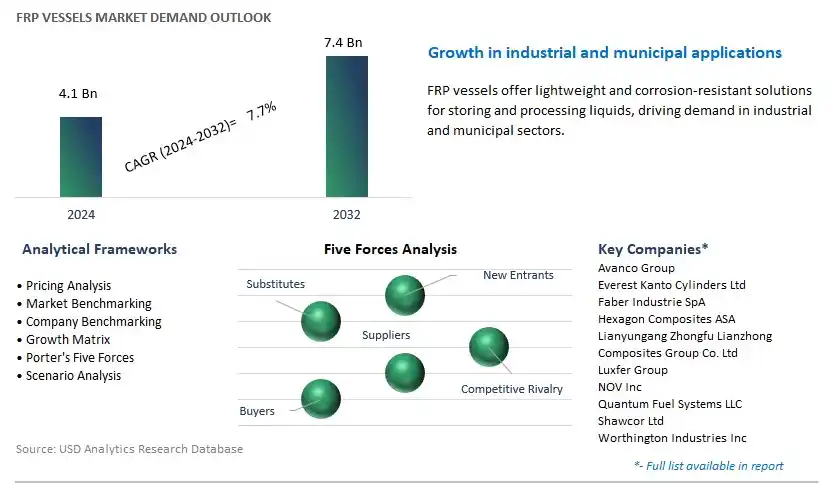
Global FRP Vessels Market Size is valued at $4.1 Billion in 2024 and is forecast to register a growth rate (CAGR) of 7.7% to reach $7.4 Billion by 2032.
The global FRP Vessels Market Study analyzes and forecasts the market size across 6 regions and 24 countries for diverse segments -By Rein Type (Polyester, Epoxy, Others), By Fiber (Glass, Carbon, Others), By Application (Water & Wastewater, Chemical, Automotive & Transportation, Oil & Gas, Industrial, Others).
An Introduction to FRP Vessels Market in 2024
Fiber Reinforced Polymer (FRP) vessels serve as robust and corrosion-resistant containers for storing and transporting various liquids and gases in industrial, chemical processing, and water treatment applications. In 2024, the market for FRP vessels is witnessing dynamic growth driven by the increasing demand for lightweight, durable, and environmentally friendly alternatives to traditional metal vessels. These vessels, composed of fiberglass reinforced with resin, offer advantages such as corrosion resistance, high strength-to-weight ratio, and customization options for size and configuration, meeting diverse application requirements. Further, advancements in FRP vessel manufacturing processes, including filament winding and compression molding, ensure compliance with stringent industry standards and regulatory specifications. As industries prioritize safety, reliability, and sustainability in handling hazardous materials, the demand for FRP vessels is expected to escalate, driving further innovation and market expansion.
FRP Vessels Market Competitive Landscape
The market report analyses the leading companies in the industry including Avanco Group, Everest Kanto Cylinders Ltd, Faber Industrie SpA, Hexagon Composites ASA, Lianyungang Zhongfu Lianzhong Composites Group Co. Ltd, Luxfer Group, NOV Inc, Quantum Fuel Systems LLC, Shawcor Ltd, Worthington Industries Inc, and others.
FRP Vessels Market Dynamics
Market Trend: Increasing Adoption of FRP Vessels in Water Treatment and Desalination
A prominent trend in the FRP (Fiber-Reinforced Polymer) vessels market is the increasing adoption of FRP vessels in water treatment and desalination applications. With growing global demand for clean water and the need to address water scarcity challenges, there is a rising requirement for reliable and durable vessels for water treatment processes such as filtration, ion exchange, and reverse osmosis. FRP vessels offer advantages such as corrosion resistance, lightweight design, and customizable configurations, making them well-suited for use in harsh environments and corrosive media. Water treatment plants, desalination facilities, and municipal utilities are increasingly choosing FRP vessels to enhance the efficiency, reliability, and longevity of their water treatment systems. This trend reflects the industry's recognition of the benefits of FRP vessels in improving water quality, reducing operating costs, and ensuring the sustainability of water supply infrastructure.
Market Driver: Expansion of Water Infrastructure Projects and Regulatory Compliance
A key driver fueling the demand for FRP vessels is the expansion of water infrastructure projects and regulatory compliance requirements governing water quality and safety. With aging water treatment facilities, growing population pressures, and increasing environmental concerns, governments and utilities are investing in upgrading and expanding water treatment and desalination capacity to meet growing demand and comply with regulatory standards. FRP vessels play a crucial role in these infrastructure projects by providing reliable containment vessels for various water treatment processes, ensuring efficient operation and compliance with drinking water quality regulations such as the Safe Drinking Water Act (SDWA) and the World Health Organization (WHO) guidelines. The imperative for regulatory compliance, coupled with the need for sustainable water management practices, drives market demand for FRP vessels as a trusted solution for water treatment and desalination applications.
Market Opportunity: Innovation in Large-Scale and Specialty Vessel Designs
Amidst the evolving landscape of the FRP vessels market, there exists a significant opportunity for innovation in large-scale and specialty vessel designs. Manufacturers can capitalize on this opportunity by developing advanced FRP vessel solutions tailored to meet the evolving needs of water treatment, desalination, and industrial process applications. For example, there is a growing demand for large-capacity FRP vessels for bulk water storage, chemical processing, and industrial wastewater treatment, offering opportunities to provide customized solutions for municipal and industrial customers. Additionally, there are opportunities to develop specialty FRP vessels for niche applications such as biopharmaceutical manufacturing, food and beverage processing, and semiconductor fabrication, where stringent purity, cleanliness, and corrosion resistance requirements are essential. By investing in research and development to innovate vessel designs, materials, and manufacturing processes, companies can address emerging market needs, differentiate their offerings, and capture new opportunities in the dynamic FRP vessels market.
FRP Vessels Market Share Analysis: Polyester segment generated the highest revenue in 2024
The Polyester segment is the largest in the FRP Vessels. Polyester resin is widely used in the manufacturing of FRP vessels due to its versatility, cost-effectiveness, and favorable mechanical properties. Polyester resin offers excellent corrosion resistance to a wide range of chemicals, making it suitable for storing various liquids in industries such as water treatment, chemical processing, wastewater management, and food and beverage production. Additionally, polyester resin provides good UV resistance, ensuring long-term durability and minimal maintenance requirements for outdoor storage applications. Moreover, polyester resin is easy to handle, process, and fabricate, allowing for the production of large, complex vessel structures with intricate designs and customized features. Furthermore, polyester resin offers good adhesion to reinforcing fibers, resulting in high-strength composite structures capable of withstanding high internal pressures and external loads. Additionally, polyester resin is available in different formulations, including orthophthalic, isophthalic, and vinyl ester-modified resins, to meet specific performance requirements for chemical resistance, fire resistance, and temperature resistance. Moreover, polyester resin is cost-effective compared to other resin types such as epoxy resin, making FRP vessels manufactured with polyester resin more economical for a wide range of industrial applications. Furthermore, advancements in polyester resin formulations and manufacturing processes have led to the development of high-performance FRP vessel products with enhanced durability, impact resistance, and design flexibility, further driving their adoption in various end-use industries. Over the forecast period, the corrosion resistance, durability, versatility, and cost-effectiveness of polyester resin solidify its position as the largest segment in the FRP Vessels Market.
FRP Vessels Market Share Analysis: Carbon is poised to register the fastest CAGR over the forecast period
The Carbon segment is the fastest-growing segment in the FRP Vessels Market. Carbon fiber-reinforced polymer (CFRP) vessels offer superior mechanical properties compared to vessels reinforced with other types of fibers, such as glass fiber. Carbon fiber boasts exceptional tensile strength, stiffness, and lightweight characteristics, making CFRP vessels ideal for applications where high performance and weight reduction are critical factors. In particular, carbon fiber offers significantly higher strength-to-weight ratios compared to glass fiber, enabling the production of lightweight yet structurally robust vessels capable of withstanding high internal pressures and external loads. This property is particularly advantageous in industries such as aerospace, automotive, and sports equipment, where weight savings directly translate into improved fuel efficiency, performance, and maneuverability. Additionally, carbon fiber exhibits excellent fatigue resistance and impact resistance, ensuring the long-term durability and reliability of CFRP vessels under cyclic loading conditions and harsh operating environments. Moreover, carbon fiber provides superior chemical resistance to a wide range of corrosive substances, including acids, alkalis, and solvents, making CFRP vessels suitable for storing aggressive chemicals in chemical processing, petrochemical, and wastewater management industries. Furthermore, carbon fiber offers excellent thermal conductivity, allowing for efficient heat transfer and temperature control in vessel contents, reducing energy consumption and operational costs. Additionally, carbon fiber-reinforced polymer (CFRP) vessels are resistant to UV exposure and weathering, ensuring long-term performance and minimal maintenance requirements in outdoor applications. Moreover, advancements in carbon fiber manufacturing processes, resin formulations, and composite technologies have led to the development of high-performance CFRP vessel products with enhanced mechanical properties, corrosion resistance, and design flexibility, further driving their adoption across various end-use industries. Over the forecast period, the superior mechanical properties, lightweight design, corrosion resistance, and versatility of carbon fiber solidify its position as the fastest-growing segment in the FRP Vessels Market.
FRP Vessels Market Share Analysis: Water & Wastewater segment generated the highest revenue in 2024
The Water & Wastewater segment is the largest in the FRP Vessels. FRP vessels find extensive use in water and wastewater treatment facilities for various applications, including water purification, desalination, chemical dosing, and effluent treatment. In particular, FRP vessels offer excellent corrosion resistance to a wide range of chemicals commonly found in water and wastewater treatment processes, including acids, alkalis, and chlorinated compounds. This corrosion resistance ensures the long-term durability and reliability of FRP vessels in harsh operating environments. Additionally, FRP vessels are lightweight and easy to handle, transport, and install, reducing construction time and costs associated with infrastructure projects in water treatment plants, sewage treatment plants, and industrial wastewater facilities. Moreover, FRP vessels provide design flexibility, allowing for the customization of vessel sizes, shapes, and configurations to meet specific application requirements and space constraints in water and wastewater treatment facilities. Furthermore, FRP vessels are non-porous and have smooth internal surfaces, preventing bacterial growth, sediment build-up, and fouling, thereby ensuring hygienic storage conditions for treated water and reducing the risk of contamination in water distribution systems. Additionally, FRP vessels offer thermal insulation properties, helping to maintain consistent temperatures for stored liquids and reducing energy consumption in heating and cooling processes. Furthermore, FRP vessels are resistant to UV exposure and weathering, making them suitable for outdoor installations in water and wastewater treatment facilities. Moreover, advancements in FRP vessel manufacturing processes, resin formulations, and composite technologies have led to the development of high-performance products with enhanced mechanical properties, corrosion resistance, and design flexibility, further driving their adoption in water and wastewater applications. Over the forecast period, the corrosion resistance, durability, design flexibility, and cost-effectiveness of FRP vessels solidify their position as the largest segment in the FRP Vessels Market, particularly in the Water & Wastewater application segment.
FRP Vessels Market
By Rein Type
Polyester
Epoxy
Others
By Fiber
Glass
Carbon
Others
By Application
Water & Wastewater
Chemical
Automotive & Transportation
Oil & Gas
Industrial
Others
Countries Analyzed
North America (US, Canada, Mexico)
Europe (Germany, UK, France, Spain, Italy, Russia, Rest of Europe)
Asia Pacific (China, India, Japan, South Korea, Australia, South East Asia, Rest of Asia)
South America (Brazil, Argentina, Rest of South America)
Middle East and Africa (Saudi Arabia, UAE, Rest of Middle East, South Africa, Egypt, Rest of Africa)
FRP Vessels Companies Profiled in the Study
Avanco Group
Everest Kanto Cylinders Ltd
Faber Industrie SpA
Hexagon Composites ASA
Lianyungang Zhongfu Lianzhong Composites Group Co. Ltd
Luxfer Group
NOV Inc
Quantum Fuel Systems LLC
Shawcor Ltd
Worthington Industries Inc
*- List Not Exhaustive
TABLE OF CONTENTS
1 Introduction to 2024 FRP Vessels Market
1.1 Market Overview
1.2 Quick Facts
1.3 Scope/Objective of the Study
1.4 Market Definition
1.5 Countries and Regions Covered
1.6 Units, Currency, and Conversions
1.7 Industry Value Chain
2 Research Methodology
2.1 Market Size Estimation
2.2 Sources and Research Methodology
2.3 Data Triangulation
2.4 Assumptions and Limitations
3 Executive Summary
3.1 Global FRP Vessels Market Size Outlook, $ Million, 2021 to 2032
3.2 FRP Vessels Market Outlook by Type, $ Million, 2021 to 2032
3.3 FRP Vessels Market Outlook by Product, $ Million, 2021 to 2032
3.4 FRP Vessels Market Outlook by Application, $ Million, 2021 to 2032
3.5 FRP Vessels Market Outlook by Key Countries, $ Million, 2021 to 2032
4 Market Dynamics
4.1 Key Driving Forces of FRP Vessels Industry
4.2 Key Market Trends in FRP Vessels Industry
4.3 Potential Opportunities in FRP Vessels Industry
4.4 Key Challenges in FRP Vessels Industry
5 Market Factor Analysis
5.1 Value Chain Analysis
5.2 Competitive Landscape
5.2.1 Global FRP Vessels Market Share by Company (%), 2023
5.2.2 Product Offerings by Company
5.3 Porter’s Five Forces Analysis
5.4 Pricing Analysis and Outlook
6 Growth Outlook Across Scenarios
6.1 Growth Analysis-Case Scenario Definitions
6.2 Low Growth Scenario Forecasts
6.3 Reference Growth Scenario Forecasts
6.4 High Growth Scenario Forecasts
7 Global FRP Vessels Market Outlook by Segments
7.1 FRP Vessels Market Outlook by Segments, $ Million, 2021- 2032
By Rein Type
Polyester
Epoxy
Others
By Fiber
Glass
Carbon
Others
By Application
Water & Wastewater
Chemical
Automotive & Transportation
Oil & Gas
Industrial
Others
8 North America FRP Vessels Market Analysis and Outlook To 2032
8.1 Introduction to North America FRP Vessels Markets in 2024
8.2 North America FRP Vessels Market Size Outlook by Country, 2021-2032
8.2.1 United States
8.2.2 Canada
8.2.3 Mexico
8.3 North America FRP Vessels Market size Outlook by Segments, 2021-2032
By Rein Type
Polyester
Epoxy
Others
By Fiber
Glass
Carbon
Others
By Application
Water & Wastewater
Chemical
Automotive & Transportation
Oil & Gas
Industrial
Others
9 Europe FRP Vessels Market Analysis and Outlook To 2032
9.1 Introduction to Europe FRP Vessels Markets in 2024
9.2 Europe FRP Vessels Market Size Outlook by Country, 2021-2032
9.2.1 Germany
9.2.2 France
9.2.3 Spain
9.2.4 United Kingdom
9.2.4 Italy
9.2.5 Russia
9.2.6 Norway
9.2.7 Rest of Europe
9.3 Europe FRP Vessels Market Size Outlook by Segments, 2021-2032
By Rein Type
Polyester
Epoxy
Others
By Fiber
Glass
Carbon
Others
By Application
Water & Wastewater
Chemical
Automotive & Transportation
Oil & Gas
Industrial
Others
10 Asia Pacific FRP Vessels Market Analysis and Outlook To 2032
10.1 Introduction to Asia Pacific FRP Vessels Markets in 2024
10.2 Asia Pacific FRP Vessels Market Size Outlook by Country, 2021-2032
10.2.1 China
10.2.2 India
10.2.3 Japan
10.2.4 South Korea
10.2.5 Indonesia
10.2.6 Malaysia
10.2.7 Australia
10.2.8 Rest of Asia Pacific
10.3 Asia Pacific FRP Vessels Market size Outlook by Segments, 2021-2032
By Rein Type
Polyester
Epoxy
Others
By Fiber
Glass
Carbon
Others
By Application
Water & Wastewater
Chemical
Automotive & Transportation
Oil & Gas
Industrial
Others
11 South America FRP Vessels Market Analysis and Outlook To 2032
11.1 Introduction to South America FRP Vessels Markets in 2024
11.2 South America FRP Vessels Market Size Outlook by Country, 2021-2032
11.2.1 Brazil
11.2.2 Argentina
11.2.3 Rest of South America
11.3 South America FRP Vessels Market size Outlook by Segments, 2021-2032
By Rein Type
Polyester
Epoxy
Others
By Fiber
Glass
Carbon
Others
By Application
Water & Wastewater
Chemical
Automotive & Transportation
Oil & Gas
Industrial
Others
12 Middle East and Africa FRP Vessels Market Analysis and Outlook To 2032
12.1 Introduction to Middle East and Africa FRP Vessels Markets in 2024
12.2 Middle East and Africa FRP Vessels Market Size Outlook by Country, 2021-2032
12.2.1 Saudi Arabia
12.2.2 UAE
12.2.3 Oman
12.2.4 Rest of Middle East
12.2.5 Egypt
12.2.6 Nigeria
12.2.7 South Africa
12.2.8 Rest of Africa
12.3 Middle East and Africa FRP Vessels Market size Outlook by Segments, 2021-2032
By Rein Type
Polyester
Epoxy
Others
By Fiber
Glass
Carbon
Others
By Application
Water & Wastewater
Chemical
Automotive & Transportation
Oil & Gas
Industrial
Others
13 Company Profiles
13.1 Company Snapshot
13.2 SWOT Profiles
13.3 Products and Services
13.4 Recent Developments
13.5 Financial Profile
Avanco Group
Everest Kanto Cylinders Ltd
Faber Industrie SpA
Hexagon Composites ASA
Lianyungang Zhongfu Lianzhong Composites Group Co. Ltd
Luxfer Group
NOV Inc
Quantum Fuel Systems LLC
Shawcor Ltd
Worthington Industries Inc
14 Appendix
14.1 Customization Offerings
14.2 Subscription Services
14.3 Related Reports
14.4 Publisher Expertise
