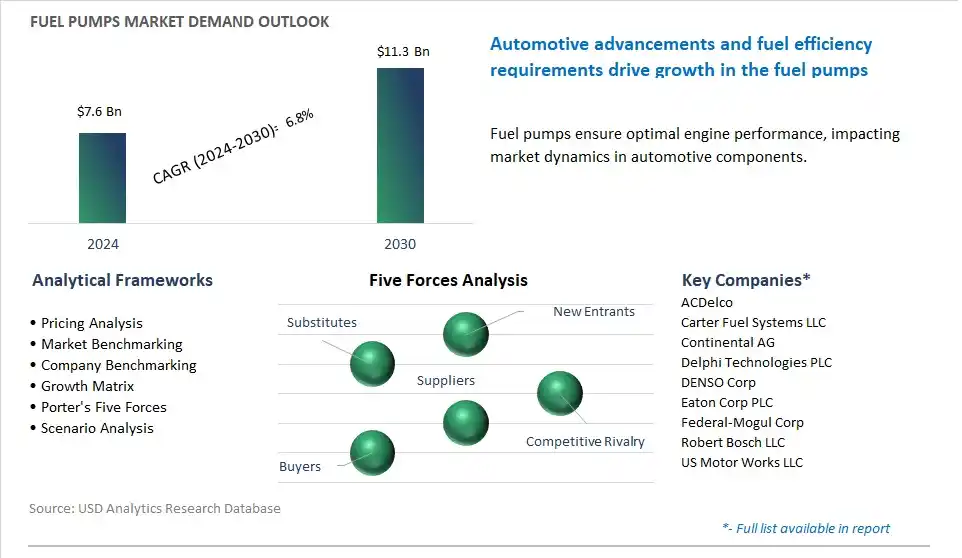
The global Fuel Pumps Market is poised to register a 6.8% CAGR from $7.6 Billion in 2024 to $11.3 Billion in 2030.
The global Fuel Pumps Market Study analyzes and forecasts the market size across 6 regions and 24 countries for diverse segments -By Type (Mechanical, Electrical, Turbo), By End-User (Automotive, Aerospace and Defense, Marine, Others).
An Introduction to Global Fuel Pumps Market in 2024
The fuel pumps market is witnessing steady growth driven by the increasing demand for efficient, reliable, and environmentally friendly fuel dispensing solutions in automotive, marine, and industrial applications. Key trends shaping the future of the industry include the growing emphasis on energy efficiency, safety compliance, and digital connectivity in fuel pump designs and operations to meet regulatory requirements, consumer expectations, and industry standards for fueling infrastructure and vehicle technology. As fuel retailers, fleet operators, and equipment manufacturers seek to optimize fueling processes, minimize emissions, and enhance user experience, there's a growing need for fuel pumps that offer high flow rates, accurate metering, and robust construction while incorporating features such as vapor recovery, spill containment, and contactless payment options to improve fueling efficiency, safety, and convenience for end-users. Moreover, advancements in fuel pump technology, including variable speed drives, smart sensors, and data analytics, are driving market expansion by improving pump performance, uptime, and predictive maintenance capabilities while reducing energy consumption, operational costs, and environmental impact associated with traditional fuel dispensing systems. Additionally, the growing adoption of alternative fuels such as hydrogen, electric, and natural gas is fueling demand for multi-fuel dispensers and alternative fueling infrastructure that accommodate diverse fueling needs and promote sustainability in transportation and energy sectors. Furthermore, the integration of fuel pumps with IoT platforms, fleet management systems, and smart grid infrastructure is driving innovation and market growth in the fueling industry, enabling the development of smarter, more connected, and more sustainable solutions for the future of fueling infrastructure and mobility.
Fuel Pumps Market Competitive Landscape
The market report analyses the leading companies in the industry including ACDelco, Carter Fuel Systems LLC, Continental AG, Delphi Technologies PLC, DENSO Corp, Eaton Corp PLC, Federal-Mogul Corp, Robert Bosch LLC, US Motor Works LLC.
Fuel Pumps Market Dynamics
Fuel Pumps Market Trend: Transition to Electric and Hybrid Vehicles
A significant trend in the fuel pumps market is the transition towards electric and hybrid vehicles, driven by increasing environmental awareness and government regulations aimed at reducing carbon emissions. As consumers and automakers prioritize sustainability and seek alternatives to traditional internal combustion engine vehicles, there is a growing demand for fuel pumps that support electric vehicle charging infrastructure. This trend is reshaping the market towards electric vehicle charging stations, fast chargers, and other infrastructure components, reflecting the shift towards cleaner and more energy-efficient transportation solutions.
Fuel Pumps Market Driver: Automotive Industry Innovation and Technological Advancements
A key driver propelling the fuel pumps market is the continuous innovation and technological advancements in the automotive industry, particularly in engine efficiency, fuel economy, and emissions reduction. Automakers are investing in research and development to improve engine performance, optimize fuel delivery systems, and enhance overall vehicle efficiency. This driver fuels the demand for fuel pumps that meet stringent performance standards, deliver precise fuel delivery, and ensure optimal combustion efficiency. Additionally, advancements in fuel pump technologies, such as variable-displacement pumps, direct injection systems, and electronic fuel pumps, are driving market growth by offering improved reliability, durability, and energy efficiency in automotive applications.
Fuel Pumps Market Opportunity: Expansion into Alternative Fuel Infrastructure
An opportunity for market expansion lies in the expansion into alternative fuel infrastructure beyond traditional gasoline and diesel fuel pumps. As the demand for alternative fuels such as natural gas, hydrogen, and biofuels grows, there is a need for infrastructure development to support their adoption in the transportation sector. Fuel pump manufacturers have an opportunity to capitalize on this trend by diversifying their product offerings to include equipment for dispensing alternative fuels, such as compressed natural gas (CNG) pumps, hydrogen fueling stations, and biofuel blending systems. By investing in alternative fuel infrastructure solutions, companies can tap into new markets, address emerging customer needs, and contribute to the transition towards cleaner and more sustainable energy sources in the transportation industry.
Fuel Pumps Market Share Analysis: Electrical segment generated the highest revenue in the industry
The Electrical segment is the largest segment in the Fuel Pumps Market, driven by diverse key factors that highlight the increasing adoption of electric fuel pumps in modern vehicles and their superior performance compared to mechanical and turbo pumps. Electric fuel pumps have become the preferred choice for automotive manufacturers due to their efficiency, reliability, and versatility in meeting the stringent fuel system requirements of modern vehicles. One primary reason for the dominance of the Electrical segment is the growing demand for fuel-efficient vehicles equipped with advanced engine management systems, electronic fuel injection (EFI), and variable valve timing (VVT), which rely on electric fuel pumps for precise fuel delivery, pressure regulation, and engine performance optimization. Electric fuel pumps offer advantages such as consistent fuel flow, higher pressure capabilities, and quieter operation compared to mechanical pumps, making them suitable for a wide range of vehicle applications, including passenger cars, light trucks, SUVs, and hybrid vehicles. Additionally, electric fuel pumps enable automotive manufacturers to design compact fuel systems, reduce weight, and improve vehicle packaging efficiency, enhancing Over the forecast period vehicle performance, handling, and fuel economy. In addition, advancements in electric fuel pump technologies, such as brushless motor designs, variable-speed controllers, and integrated fuel level sensors, have further enhanced the functionality, durability, and diagnostic capabilities of electric fuel pumps, driving their adoption in the automotive industry. Further, electric fuel pumps offer opportunities for vehicle electrification, hybridization, and connectivity, as automakers transition towards electrified powertrains, autonomous driving technologies, and integrated vehicle systems that require sophisticated fuel delivery solutions. With the increasing focus on emissions reduction, energy efficiency, and electrification in the automotive industry, the Electrical segment is expected to maintain its leadership position in the Fuel Pumps Market, offering manufacturers, suppliers, and OEMs opportunities for innovation, market expansion, and value creation in the dynamic and competitive automotive market landscape.
Fuel Pumps Market Share Analysis: Automotive Segment is poised to register the fastest growth rate (CAGR) over the forecast period to 2030
The Automotive segment is the fastest-growing segment in the Fuel Pumps Market, driven by diverse key factors that reflect the increasing vehicle production, technological advancements, and regulatory mandates shaping the automotive industry worldwide. One primary reason for the rapid growth of the Automotive segment is the rising demand for fuel-efficient, low-emission vehicles equipped with advanced engine technologies, electrified powertrains, and integrated fuel delivery systems. Automotive manufacturers are continuously innovating to meet stringent emissions regulations, improve fuel economy, and enhance vehicle performance, driving the adoption of high-performance fuel pumps designed to deliver precise fuel delivery, pressure regulation, and system reliability. Additionally, the growing popularity of hybrid electric vehicles (HEVs), plug-in hybrid electric vehicles (PHEVs), and electric vehicles (EVs) has created opportunities for electric fuel pumps, fuel cell pumps, and advanced fuel delivery technologies that support alternative fueling methods, battery charging, and hydrogen refueling infrastructure. In addition, the increasing vehicle electrification, connectivity, and autonomous driving trends have led to the integration of fuel pumps with vehicle control systems, telematics, and predictive maintenance solutions, offering enhanced functionality, diagnostics, and efficiency in fuel management and vehicle operation. Further, the expansion of the global automotive market, particularly in emerging economies such as China, India, and Brazil, has driven the demand for fuel pumps in passenger cars, commercial vehicles, and two-wheelers, as rising disposable incomes, urbanization, and infrastructure development spur vehicle ownership and mobility demand. With the automotive industry's ongoing transformation towards electrification, connectivity, and sustainability, the Automotive segment is expected to continue its rapid growth trajectory in the Fuel Pumps Market, offering manufacturers, suppliers, and OEMs opportunities for innovation, market expansion, and value creation in the dynamic and competitive automotive market landscape.
Fuel Pumps Market Report Segmentation
By Type
Mechanical
Electrical
Turbo
By End-User
Automotive
Aerospace and Defense
Marine
Others
Regions Included
North America (US, Canada, Mexico)
Europe (Germany, UK, France, Spain, Italy, Russia, Rest of Europe)
Asia Pacific (China, India, Japan, South Korea, Australia, South East Asia, Rest of Asia)
South America (Brazil, Argentina, Rest of South America)
Middle East and Africa (Saudi Arabia, UAE, Rest of Middle East, South Africa, Egypt, Rest of Africa)
Fuel Pumps Companies Profiled in the Market Study
ACDelco
Carter Fuel Systems LLC
Continental AG
Delphi Technologies PLC
DENSO Corp
Eaton Corp PLC
Federal-Mogul Corp
Robert Bosch LLC
US Motor Works LLC
*- List Not Exhaustive
TABLE OF CONTENTS
1 Introduction to 2024 Fuel Pumps Market
1.1 Market Overview
1.2 Quick Facts
1.3 Scope/Objective of the Study
1.4 Market Definition
1.5 Countries and Regions Covered
1.6 Units, Currency, and Conversions
1.7 Industry Value Chain
2 Research Methodology
2.1 Market Size Estimation
2.2 Sources and Research Methodology
2.3 Data Triangulation
2.4 Assumptions and Limitations
3 Executive Summary
3.1 Global Fuel Pumps Market Size Outlook, $ Million, 2021 to 2030
3.2 Fuel Pumps Market Outlook by Type, $ Million, 2021 to 2030
3.3 Fuel Pumps Market Outlook by Product, $ Million, 2021 to 2030
3.4 Fuel Pumps Market Outlook by Application, $ Million, 2021 to 2030
3.5 Fuel Pumps Market Outlook by Key Countries, $ Million, 2021 to 2030
4 Market Dynamics
4.1 Key Driving Forces of Fuel Pumps Industry
4.2 Key Market Trends in Fuel Pumps Industry
4.3 Potential Opportunities in Fuel Pumps Industry
4.4 Key Challenges in Fuel Pumps Industry
5 Market Factor Analysis
5.1 Value Chain Analysis
5.2 Competitive Landscape
5.2.1 Global Fuel Pumps Market Share by Company (%), 2023
5.2.2 Product Offerings by Company
5.3 Porter’s Five Forces Analysis
5.4 Pricing Analysis and Outlook
6 Growth Outlook Across Scenarios
6.1 Growth Analysis-Case Scenario Definitions
6.2 Low Growth Scenario Forecasts
6.3 Reference Growth Scenario Forecasts
6.4 High Growth Scenario Forecasts
7 Global Fuel Pumps Market Outlook by Segments
7.1 Fuel Pumps Market Outlook by Segments, $ Million, 2021- 2030
By Type
Mechanical
Electrical
Turbo
By End-User
Automotive
Aerospace and Defense
Marine
Others
8 North America Fuel Pumps Market Analysis and Outlook To 2030
8.1 Introduction to North America Fuel Pumps Markets in 2024
8.2 North America Fuel Pumps Market Size Outlook by Country, 2021-2030
8.2.1 United States
8.2.2 Canada
8.2.3 Mexico
8.3 North America Fuel Pumps Market size Outlook by Segments, 2021-2030
By Type
Mechanical
Electrical
Turbo
By End-User
Automotive
Aerospace and Defense
Marine
Others
9 Europe Fuel Pumps Market Analysis and Outlook To 2030
9.1 Introduction to Europe Fuel Pumps Markets in 2024
9.2 Europe Fuel Pumps Market Size Outlook by Country, 2021-2030
9.2.1 Germany
9.2.2 France
9.2.3 Spain
9.2.4 United Kingdom
9.2.4 Italy
9.2.5 Russia
9.2.6 Norway
9.2.7 Rest of Europe
9.3 Europe Fuel Pumps Market Size Outlook by Segments, 2021-2030
By Type
Mechanical
Electrical
Turbo
By End-User
Automotive
Aerospace and Defense
Marine
Others
10 Asia Pacific Fuel Pumps Market Analysis and Outlook To 2030
10.1 Introduction to Asia Pacific Fuel Pumps Markets in 2024
10.2 Asia Pacific Fuel Pumps Market Size Outlook by Country, 2021-2030
10.2.1 China
10.2.2 India
10.2.3 Japan
10.2.4 South Korea
10.2.5 Indonesia
10.2.6 Malaysia
10.2.7 Australia
10.2.8 Rest of Asia Pacific
10.3 Asia Pacific Fuel Pumps Market size Outlook by Segments, 2021-2030
By Type
Mechanical
Electrical
Turbo
By End-User
Automotive
Aerospace and Defense
Marine
Others
11 South America Fuel Pumps Market Analysis and Outlook To 2030
11.1 Introduction to South America Fuel Pumps Markets in 2024
11.2 South America Fuel Pumps Market Size Outlook by Country, 2021-2030
11.2.1 Brazil
11.2.2 Argentina
11.2.3 Rest of South America
11.3 South America Fuel Pumps Market size Outlook by Segments, 2021-2030
By Type
Mechanical
Electrical
Turbo
By End-User
Automotive
Aerospace and Defense
Marine
Others
12 Middle East and Africa Fuel Pumps Market Analysis and Outlook To 2030
12.1 Introduction to Middle East and Africa Fuel Pumps Markets in 2024
12.2 Middle East and Africa Fuel Pumps Market Size Outlook by Country, 2021-2030
12.2.1 Saudi Arabia
12.2.2 UAE
12.2.3 Oman
12.2.4 Rest of Middle East
12.2.5 Egypt
12.2.6 Nigeria
12.2.7 South Africa
12.2.8 Rest of Africa
12.3 Middle East and Africa Fuel Pumps Market size Outlook by Segments, 2021-2030
By Type
Mechanical
Electrical
Turbo
By End-User
Automotive
Aerospace and Defense
Marine
Others
13 Company Profiles
13.1 Company Snapshot
13.2 SWOT Profiles
13.3 Products and Services
13.4 Recent Developments
13.5 Financial Profile
ACDelco
Carter Fuel Systems LLC
Continental AG
Delphi Technologies PLC
DENSO Corp
Eaton Corp PLC
Federal-Mogul Corp
Robert Bosch LLC
US Motor Works LLC
14 Appendix
14.1 Customization Offerings
14.2 Subscription Services
14.3 Related Reports
14.4 Publisher Expertise
By Type
Mechanical
Electrical
Turbo
By End-User
Automotive
Aerospace and Defense
Marine
Others
Countries Analyzed
North America (US, Canada, Mexico)
Europe (Germany, UK, France, Spain, Italy, Russia, Rest of Europe)
Asia Pacific (China, India, Japan, South Korea, Australia, South East Asia, Rest of Asia)
South America (Brazil, Argentina, Rest of South America)
Middle East and Africa (Saudi Arabia, UAE, Rest of Middle East, South Africa, Egypt, Rest of Africa)
