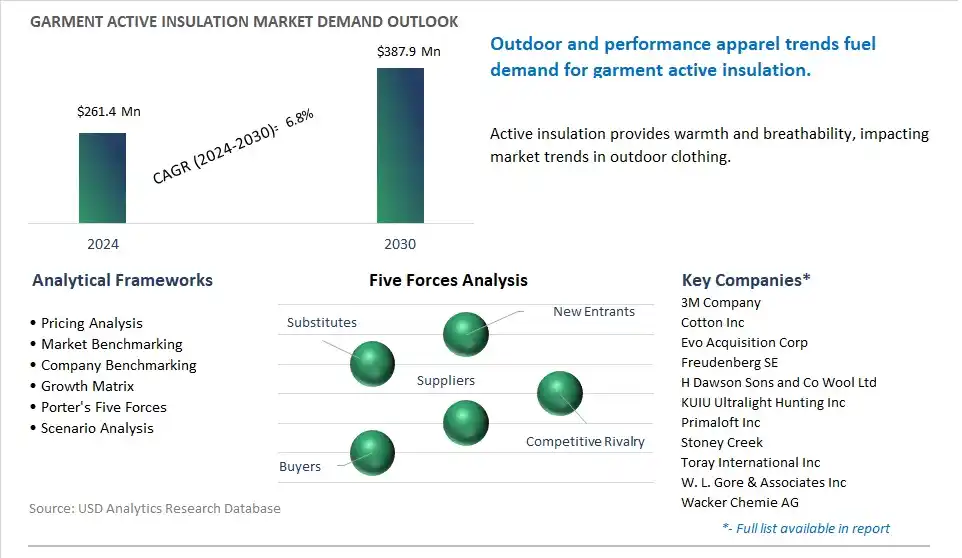
The global Garment Active Insulation Market is poised to register a 6.8% CAGR from $261.4 Million in 2024 to $387.9 Million in 2030.
The global Garment Active Insulation Market Study analyzes and forecasts the market size across 6 regions and 24 countries for diverse segments -By Product (Polyester, Cotton, Wool, Nylon), By Sourcing (Branded, Non-Branded), By Application (Outerwear, Footwear, Handwear, Others).
An Introduction to Global Garment Active Insulation Market in 2024
The market for garment active insulation is experiencing significant growth driven by the increasing demand for high-performance, versatile clothing solutions that offer thermal regulation, moisture management, and comfort in various outdoor and active wear applications. Key trends shaping the future of the industry include the development of innovative insulation materials and garment designs that optimize warmth-to-weight ratio, breathability, and packability while meeting consumer expectations for sustainability, durability, and multifunctionality. As outdoor enthusiasts, athletes, and adventurers seek apparel that adapts to changing weather conditions and activity levels, there's a growing need for garment active insulation solutions such as synthetic fibers, natural down alternatives, and hybrid materials that provide warmth when needed and ventilation when overheating, without compromising freedom of movement or moisture management capabilities. Moreover, advancements in garment active insulation technology, including engineered fibers, seamless construction, and 3D knitting techniques, are driving market expansion by improving garment performance, fit, and durability while reducing environmental impact, waste generation, and resource consumption associated with traditional insulation materials and manufacturing processes. Additionally, the growing adoption of garment active insulation in sports performance wear, outdoor gear, and urban fashion is fueling demand for innovative solutions that combine technical performance with aesthetic appeal, allowing consumers to transition seamlessly between activities and environments with confidence and style. Furthermore, the integration of garment active insulation with sustainable sourcing, ethical manufacturing, and circular economy principles is driving innovation and market growth in the apparel industry, enabling the development of smarter, more eco-friendly, and more resilient solutions for the future of active wear, outdoor apparel, and performance clothing.
Garment Active Insulation Market Competitive Landscape
The market report analyses the leading companies in the industry including 3M Company, Cotton Inc, Evo Acquisition Corp, Freudenberg SE, H Dawson Sons and Co Wool Ltd, KUIU Ultralight Hunting Inc, Primaloft Inc, Stoney Creek, Toray International Inc, W. L. Gore & Associates Inc, Wacker Chemie AG.
Garment Active Insulation Market Dynamics
Garment Active Insulation Market Trend: Growing Demand for Versatile and Functional Clothing
A significant trend in the garment active insulation market is the increasing demand for versatile and functional clothing driven by changing consumer lifestyles and outdoor activities. Garment active insulation, designed to provide warmth, breathability, and moisture management in a wide range of weather conditions, is gaining popularity among outdoor enthusiasts, athletes, and urban commuters. As consumers seek apparel that offers performance benefits without compromising style or comfort, there is a rising demand for active insulation garments that can adapt to diverse activities and environments. This trend is reshaping the garment industry towards innovative designs that combine insulation with flexibility, breathability, and moisture-wicking properties, catering to the needs of active individuals seeking high-performance clothing for various outdoor and indoor pursuits.
Garment Active Insulation Market Driver: Rise of Outdoor Recreation and Adventure Travel
A key driver propelling the garment active insulation market is the rise of outdoor recreation and adventure travel, where functional clothing plays a crucial role in enhancing comfort, safety, and performance during outdoor activities. With increasing participation in activities such as hiking, camping, skiing, and mountaineering, there is a growing demand for apparel that provides insulation without bulkiness, allowing for freedom of movement and versatility. Garment active insulation fills this need by offering lightweight, packable, and thermoregulating solutions that keep wearers comfortable and protected in changing weather conditions. Additionally, the popularity of adventure travel and outdoor experiences drives market demand for active insulation garments that can perform in diverse climates and terrains, catering to the needs of travelers seeking versatile and reliable clothing options for their outdoor adventures.
Garment Active Insulation Market Opportunity: Expansion into Urban and Everyday Wear
An opportunity for market expansion lies in the expansion of garment active insulation into urban and everyday wear segments, offering functional and stylish clothing solutions for urban commuters, professionals, and active individuals. While active insulation garments have traditionally been associated with outdoor and sportswear markets, there is potential to tap into urban lifestyle trends where consumers prioritize functionality, performance, and style in their everyday clothing choices. By incorporating active insulation technologies into jackets, coats, vests, and other urban apparel items, manufacturers can offer wearers versatile and weather-resistant options suitable for commuting, travel, and daily activities. This opportunity involves leveraging innovative designs, materials, and branding strategies to position active insulation garments as essential wardrobe staples for urban dwellers seeking comfort, performance, and protection in their everyday lives.
Garment Active Insulation Market Share Analysis: Polyester segment generated the highest revenue in the industry
The Polyester segment is the largest segment in the Garment Active Insulation Market, propelled by diverse key factors that highlight its widespread use, versatility, and performance advantages in active insulation garments. Polyester, a synthetic fiber derived from petroleum-based polymers, offers diverse characteristics that make it an ideal choice for active insulation garments, including lightweight, moisture-wicking properties, durability, and thermal insulation capabilities. One primary reason for the dominance of the Polyester segment is the widespread adoption of polyester-based fabrics and insulating materials by garment manufacturers and outdoor apparel brands due to their affordability, availability, and performance benefits. Polyester fabrics are known for their moisture management properties, allowing sweat and moisture to be quickly transported away from the skin to the garment's outer surface, where it can evaporate, keeping the wearer dry and comfortable during physical activity. Additionally, polyester fibers can be engineered with thermal insulation features, such as lofted constructions and brushed finishes, to enhance warmth and heat retention, making them suitable for use in active insulation garments designed for outdoor activities in cold and wet conditions. In addition, polyester fabrics offer excellent abrasion resistance, colorfastness, and ease of care, making them practical choices for high-performance outdoor apparel, sportswear, and athleisure wear that require frequent washing and wear. Further, advancements in textile technology, fiber engineering, and fabric finishes have further improved the performance and functionality of polyester-based active insulation garments, driving their adoption in diverse outdoor recreation activities, including hiking, skiing, snowboarding, and mountaineering. With the increasing demand for lightweight, breathable, and weather-resistant apparel that provides warmth and comfort during active pursuits, the Polyester segment is expected to maintain its leadership position in the Garment Active Insulation Market, offering manufacturers, brands, and consumers a reliable and cost-effective solution for outdoor performance apparel needs.
Garment Active Insulation Market Share Analysis: Outerwear Segment is poised to register the fastest growth rate (CAGR) over the forecast period to 2030
The Outerwear segment is the fastest-growing segment in the Garment Active Insulation Market, propelled by diverse key factors that highlight the increasing demand for active insulation technology in outdoor apparel designed for various outdoor activities and environments. Outerwear garments, including jackets, coats, vests, and parkas, serve as the primary protective layer against external elements such as cold temperatures, wind, rain, and snow, making them essential gear for outdoor enthusiasts, athletes, and adventurers. One primary reason for the rapid growth of the Outerwear segment is the growing popularity of outdoor recreation activities and adventure sports, driven by trends such as urbanization, wellness lifestyles, and a desire for immersive outdoor experiences. As more individuals engage in outdoor activities year-round, there is a heightened demand for high-performance outerwear that provides warmth, comfort, and weather protection without sacrificing mobility or breathability. Active insulation technology addresses these needs by offering lightweight, breathable, and thermally efficient insulation solutions that regulate body temperature and moisture management during dynamic outdoor pursuits. Additionally, the versatility and adaptability of active insulation materials, such as synthetic fibers and hybrid constructions, allow outerwear manufacturers to design innovative garments that cater to specific activity requirements, climates, and performance preferences. In addition, advancements in garment construction techniques, seam sealing, and fabric treatments have enhanced the durability, weather resistance, and functionality of outerwear garments, further driving their appeal among outdoor enthusiasts and athletes seeking reliable gear for challenging conditions. Further, the rise of sustainable and eco-conscious consumer preferences has spurred innovation in sustainable outerwear materials and manufacturing processes, leading to the development of eco-friendly active insulation solutions derived from recycled fibers, bio-based materials, and environmentally responsible production methods. With the increasing demand for performance-driven outerwear that offers versatility, protection, and sustainability, the Outerwear segment is poised for significant growth in the Garment Active Insulation Market, offering manufacturers, retailers, and consumers opportunities for product innovation, market expansion, and value creation in the dynamic and competitive outdoor apparel industry landscape.
Garment Active Insulation Market Report Segmentation
By Product
Polyester
Cotton
Wool
Nylon
By Sourcing
Branded
Non-Branded
By Application
Outerwear
Footwear
Handwear
Others
Regions Included
North America (US, Canada, Mexico)
Europe (Germany, UK, France, Spain, Italy, Russia, Rest of Europe)
Asia Pacific (China, India, Japan, South Korea, Australia, South East Asia, Rest of Asia)
South America (Brazil, Argentina, Rest of South America)
Middle East and Africa (Saudi Arabia, UAE, Rest of Middle East, South Africa, Egypt, Rest of Africa)
Garment Active Insulation Companies Profiled in the Market Study
3M Company
Cotton Inc
Evo Acquisition Corp
Freudenberg SE
H Dawson Sons and Co Wool Ltd
KUIU Ultralight Hunting Inc
Primaloft Inc
Stoney Creek
Toray International Inc
W. L. Gore & Associates Inc
Wacker Chemie AG
*- List Not Exhaustive
TABLE OF CONTENTS
1 Introduction to 2024 Garment Active Insulation Market
1.1 Market Overview
1.2 Quick Facts
1.3 Scope/Objective of the Study
1.4 Market Definition
1.5 Countries and Regions Covered
1.6 Units, Currency, and Conversions
1.7 Industry Value Chain
2 Research Methodology
2.1 Market Size Estimation
2.2 Sources and Research Methodology
2.3 Data Triangulation
2.4 Assumptions and Limitations
3 Executive Summary
3.1 Global Garment Active Insulation Market Size Outlook, $ Million, 2021 to 2030
3.2 Garment Active Insulation Market Outlook by Type, $ Million, 2021 to 2030
3.3 Garment Active Insulation Market Outlook by Product, $ Million, 2021 to 2030
3.4 Garment Active Insulation Market Outlook by Application, $ Million, 2021 to 2030
3.5 Garment Active Insulation Market Outlook by Key Countries, $ Million, 2021 to 2030
4 Market Dynamics
4.1 Key Driving Forces of Garment Active Insulation Industry
4.2 Key Market Trends in Garment Active Insulation Industry
4.3 Potential Opportunities in Garment Active Insulation Industry
4.4 Key Challenges in Garment Active Insulation Industry
5 Market Factor Analysis
5.1 Value Chain Analysis
5.2 Competitive Landscape
5.2.1 Global Garment Active Insulation Market Share by Company (%), 2023
5.2.2 Product Offerings by Company
5.3 Porter’s Five Forces Analysis
5.4 Pricing Analysis and Outlook
6 Growth Outlook Across Scenarios
6.1 Growth Analysis-Case Scenario Definitions
6.2 Low Growth Scenario Forecasts
6.3 Reference Growth Scenario Forecasts
6.4 High Growth Scenario Forecasts
7 Global Garment Active Insulation Market Outlook by Segments
7.1 Garment Active Insulation Market Outlook by Segments, $ Million, 2021- 2030
By Product
Polyester
Cotton
Wool
Nylon
By Sourcing
Branded
Non-Branded
By Application
Outerwear
Footwear
Handwear
Others
8 North America Garment Active Insulation Market Analysis and Outlook To 2030
8.1 Introduction to North America Garment Active Insulation Markets in 2024
8.2 North America Garment Active Insulation Market Size Outlook by Country, 2021-2030
8.2.1 United States
8.2.2 Canada
8.2.3 Mexico
8.3 North America Garment Active Insulation Market size Outlook by Segments, 2021-2030
By Product
Polyester
Cotton
Wool
Nylon
By Sourcing
Branded
Non-Branded
By Application
Outerwear
Footwear
Handwear
Others
9 Europe Garment Active Insulation Market Analysis and Outlook To 2030
9.1 Introduction to Europe Garment Active Insulation Markets in 2024
9.2 Europe Garment Active Insulation Market Size Outlook by Country, 2021-2030
9.2.1 Germany
9.2.2 France
9.2.3 Spain
9.2.4 United Kingdom
9.2.4 Italy
9.2.5 Russia
9.2.6 Norway
9.2.7 Rest of Europe
9.3 Europe Garment Active Insulation Market Size Outlook by Segments, 2021-2030
By Product
Polyester
Cotton
Wool
Nylon
By Sourcing
Branded
Non-Branded
By Application
Outerwear
Footwear
Handwear
Others
10 Asia Pacific Garment Active Insulation Market Analysis and Outlook To 2030
10.1 Introduction to Asia Pacific Garment Active Insulation Markets in 2024
10.2 Asia Pacific Garment Active Insulation Market Size Outlook by Country, 2021-2030
10.2.1 China
10.2.2 India
10.2.3 Japan
10.2.4 South Korea
10.2.5 Indonesia
10.2.6 Malaysia
10.2.7 Australia
10.2.8 Rest of Asia Pacific
10.3 Asia Pacific Garment Active Insulation Market size Outlook by Segments, 2021-2030
By Product
Polyester
Cotton
Wool
Nylon
By Sourcing
Branded
Non-Branded
By Application
Outerwear
Footwear
Handwear
Others
11 South America Garment Active Insulation Market Analysis and Outlook To 2030
11.1 Introduction to South America Garment Active Insulation Markets in 2024
11.2 South America Garment Active Insulation Market Size Outlook by Country, 2021-2030
11.2.1 Brazil
11.2.2 Argentina
11.2.3 Rest of South America
11.3 South America Garment Active Insulation Market size Outlook by Segments, 2021-2030
By Product
Polyester
Cotton
Wool
Nylon
By Sourcing
Branded
Non-Branded
By Application
Outerwear
Footwear
Handwear
Others
12 Middle East and Africa Garment Active Insulation Market Analysis and Outlook To 2030
12.1 Introduction to Middle East and Africa Garment Active Insulation Markets in 2024
12.2 Middle East and Africa Garment Active Insulation Market Size Outlook by Country, 2021-2030
12.2.1 Saudi Arabia
12.2.2 UAE
12.2.3 Oman
12.2.4 Rest of Middle East
12.2.5 Egypt
12.2.6 Nigeria
12.2.7 South Africa
12.2.8 Rest of Africa
12.3 Middle East and Africa Garment Active Insulation Market size Outlook by Segments, 2021-2030
By Product
Polyester
Cotton
Wool
Nylon
By Sourcing
Branded
Non-Branded
By Application
Outerwear
Footwear
Handwear
Others
13 Company Profiles
13.1 Company Snapshot
13.2 SWOT Profiles
13.3 Products and Services
13.4 Recent Developments
13.5 Financial Profile
3M Company
Cotton Inc
Evo Acquisition Corp
Freudenberg SE
H Dawson Sons and Co Wool Ltd
KUIU Ultralight Hunting Inc
Primaloft Inc
Stoney Creek
Toray International Inc
W. L. Gore & Associates Inc
Wacker Chemie AG
14 Appendix
14.1 Customization Offerings
14.2 Subscription Services
14.3 Related Reports
14.4 Publisher Expertise
By Product
Polyester
Cotton
Wool
Nylon
By Sourcing
Branded
Non-Branded
By Application
Outerwear
Footwear
Handwear
Others
Countries Analyzed
North America (US, Canada, Mexico)
Europe (Germany, UK, France, Spain, Italy, Russia, Rest of Europe)
Asia Pacific (China, India, Japan, South Korea, Australia, South East Asia, Rest of Asia)
South America (Brazil, Argentina, Rest of South America)
Middle East and Africa (Saudi Arabia, UAE, Rest of Middle East, South Africa, Egypt, Rest of Africa)
