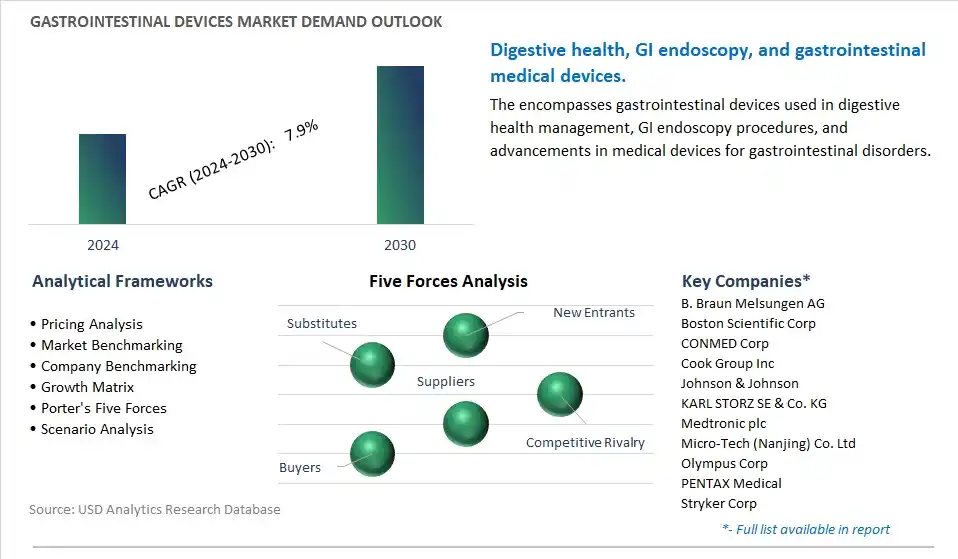
Gastrointestinal Devices Market is estimated to increase at a Compounded Annual Growth Rate of 7.9% CAGR over the forecast period from 2024 to 2030
The Gastrointestinal Devices Market study analyzes and forecasts the market size across 6 regions and 24 countries for diverse segments- By Product (Gi Videoscopes, Biopsy Devices, Endoscopic Retrograde Cholangiopancreatography Devices (ERCP), Capsule Endoscopy, Endoscopic Ultrasound, Others), By End-User (Hospitals, Clinics, Others).
An Introduction to Gastrointestinal Devices Market in 2024
The market for gastrointestinal devices in 2024 is marked by a diverse range of innovative products aimed at improving diagnostic accuracy, therapeutic outcomes, and patient comfort. From advanced endoscopic imaging systems to minimally invasive surgical instruments, gastrointestinal devices are revolutionizing the diagnosis and treatment of gastrointestinal disorders. Key trends shaping the market include the miniaturization of devices, integration of robotics and artificial intelligence, and the development of disposable endoscopic accessories to reduce the risk of cross-contamination. With a growing emphasis on value-based healthcare delivery, gastrointestinal devices that offer improved efficiency and cost-effectiveness are expected to gain traction in the coming years.
Market Trend: Technological Advancements in Minimally Invasive Procedures
A significant trend in the market for gastrointestinal devices is the continuous evolution of technological advancements in minimally invasive procedures. With a growing emphasis on reducing patient discomfort, shortening recovery times, and improving procedural outcomes, there's a notable shift towards the development of innovative devices that enable less invasive approaches to gastrointestinal interventions. From endoscopic instruments equipped with advanced imaging capabilities to novel endoluminal devices for tissue sampling and treatment, these technological advancements are revolutionizing the field of gastrointestinal medicine, offering patients and healthcare providers more options for effective diagnosis and treatment while minimizing the need for traditional surgical interventions.
Market Driver: Increasing Incidence of Gastrointestinal Disorders and Chronic Diseases
The primary driver propelling the market for gastrointestinal devices is the rising incidence of gastrointestinal disorders and chronic diseases worldwide. Conditions such as gastroesophageal reflux disease (GERD), inflammatory bowel disease (IBD), colorectal cancer, and gastrointestinal bleeding are becoming increasingly prevalent, contributing to a growing demand for diagnostic and therapeutic devices to manage these conditions effectively. As the global population ages and lifestyles become more sedentary, there's a heightened awareness of gastrointestinal health and a greater need for advanced medical devices to diagnose, treat, and manage a wide range of gastrointestinal ailments, thus driving the growth of the gastrointestinal devices market.
Market Opportunity: Integration of Artificial Intelligence and Data Analytics
An untapped opportunity within the market for gastrointestinal devices lies in the integration of artificial intelligence (AI) and data analytics to enhance diagnostic accuracy, treatment efficacy, and patient outcomes. By leveraging AI algorithms and machine learning techniques, gastrointestinal devices can analyze vast amounts of patient data, imaging studies, and procedural videos to provide real-time insights, aid in decision-making, and optimize treatment strategies. Furthermore, incorporating predictive analytics into gastrointestinal devices can enable early detection of disease progression, personalized risk assessment, and proactive interventions, thereby improving patient care and reducing healthcare costs. Embracing AI-driven innovations in gastrointestinal devices presents a significant opportunity for manufacturers and healthcare providers to stay at the forefront of medical technology and deliver more precise, efficient, and patient-centered gastrointestinal care.
Gastrointestinal Devices Market Share Analysis: Capsule Endoscopy
The Capsule Endoscopy segment within the Gastrointestinal Devices Market is experiencing rapid growth due to several factors driving the demand for non-invasive and minimally invasive diagnostic tools for gastrointestinal (GI) tract evaluation and disease detection. Capsule endoscopy involves the ingestion of a small, pill-sized capsule containing a miniature camera that captures images as it passes through the digestive tract, providing detailed visualizations of the esophagus, stomach, small intestine, and colon. Unlike traditional endoscopic procedures that require the insertion of a flexible or rigid scope through the mouth or rectum, capsule endoscopy offers a less invasive and more patient-friendly approach to GI tract examination, eliminating the need for sedation, anesthesia, or uncomfortable insertion procedures. Capsule endoscopy is particularly valuable for diagnosing small bowel disorders, such as obscure gastrointestinal bleeding, Crohn's disease, small bowel tumors, and malabsorption syndromes, which may not be adequately visualized with conventional endoscopy or imaging modalities. With advancements in capsule technology, including improved imaging resolution, longer battery life, and enhanced maneuverability, capsule endoscopy has become an indispensable tool in the diagnosis and management of various GI conditions, contributing to its widespread adoption in hospitals, clinics, and other healthcare settings. Capsule endoscopy offers advantages such as high diagnostic yield, improved patient comfort and compliance, reduced procedure times, and enhanced visualization of mucosal abnormalities and lesions throughout the entire small bowel. As gastroenterologists, surgeons, and other healthcare professionals increasingly recognize the clinical benefits and diagnostic utility of capsule endoscopy in evaluating GI symptoms and guiding therapeutic interventions, the Capsule Endoscopy segment is poised for significant growth in the Gastrointestinal Devices Market, offering innovative solutions for enhanced GI tract imaging and patient care.
Gastrointestinal Devices Competitive Analysis
The market research study provides in-depth insights into leading companies including the SWOT analyses, product profile, financial details, and recent developments acrossB. Braun Melsungen AG, Boston Scientific Corp, CONMED Corp, Cook Group Inc, Johnson & Johnson, KARL STORZ SE & Co. KG, Medtronic plc, Micro-Tech (Nanjing) Co. Ltd, Olympus Corp, PENTAX Medical, Stryker Corp
Gastrointestinal Devices Market Segmentation
By Product
Gi Videoscopes
Biopsy Devices
Endoscopic Retrograde Cholangiopancreatography Devices (ERCP)
Capsule Endoscopy
Endoscopic Ultrasound
Others
By End-User
Hospitals
Clinics
Others
Geographical Analysis
North America (United States, Canada, Mexico)
Europe (Germany, France, United Kingdom, Spain, Italy, Rest of Europe)
Asia Pacific (China, India, Japan, South Korea, Rest of Asia Pacific)
South America (Brazil, Argentina, Rest of South America)
Middle East and Africa (Saudi Arabia, UAE, Rest of Middle East, South Africa, Egypt, Rest of Africa)
Gastrointestinal Devices Market Companies
B. Braun Melsungen AG
Boston Scientific Corp
CONMED Corp
Cook Group Inc
Johnson & Johnson
KARL STORZ SE & Co. KG
Medtronic plc
Micro-Tech (Nanjing) Co. Ltd
Olympus Corp
PENTAX Medical
Stryker Corp
Reasons to Buy the Gastrointestinal Devices Market Study
• Deepen your industry insights and navigate uncertainties for strategy formulation, CAPEX, and Operational decisions
• Gain access to detailed insights on the Gastrointestinal Devices Market, encompassing current market size, growth trends, and forecasts till 2030.
• Access detailed competitor analysis, enabling competitive advantage through a thorough understanding of market players, strategies, and potential differentiation opportunities
• Stay ahead of the curve with insights on technological advancements, innovations, and upcoming trends
• Identify lucrative investment avenues and expansion opportunities within the Gastrointestinal Devices Market industry, guided by robust, data-backed analysis.
• Understand regional and global markets through country-wise analysis, regional market potential, regulatory nuances, and dynamics
• Execute strategies with confidence and speed through information, analytics, and insights on the industry value chain
• Corporate leaders, strategists, financial experts, shareholders, asset managers, and governmental representatives can make long-term planning scenarios and build an integrated and timely understanding of market dynamics
• Benefit from tailored solutions and expert consultation based on report insights, providing personalized strategies aligned with specific business needs.
TABLE OF CONTENTS
1 Introduction to 2024 Gastrointestinal Devices Market
1.1 Market Overview
1.2 Quick Facts
1.3 Scope/Objective of the Study
1.4 Market Definition
1.5 Countries and Regions Covered
1.6 Units, Currency, and Conversions
1.7 Industry Value Chain
2 Research Methodology
2.1 Market Size Estimation
2.2 Sources and Research Methodology
2.3 Data Triangulation
2.4 Assumptions and Limitations
3 Executive Summary
3.1 Global Gastrointestinal Devices Market Size Outlook, $ Million, 2021 to 2030
3.2 Gastrointestinal Devices Market Outlook by Type, $ Million, 2021 to 2030
3.3 Gastrointestinal Devices Market Outlook by Product, $ Million, 2021 to 2030
3.4 Gastrointestinal Devices Market Outlook by Application, $ Million, 2021 to 2030
3.5 Gastrointestinal Devices Market Outlook by Key Countries, $ Million, 2021 to 2030
4 Market Dynamics
4.1 Key Driving Forces of Gastrointestinal Devices Industry
4.2 Key Market Trends in Gastrointestinal Devices Industry
4.3 Potential Opportunities in Gastrointestinal Devices Industry
4.4 Key Challenges in Gastrointestinal Devices Industry
5 Market Factor Analysis
5.1 Value Chain Analysis
5.2 Competitive Landscape
5.2.1 Global Gastrointestinal Devices Market Share by Company (%), 2023
5.2.2 Product Offerings by Company
5.3 Porter’s Five Forces Analysis
5.4 Pricing Analysis and Outlook
6 Growth Outlook Across Scenarios
6.1 Growth Analysis-Case Scenario Definitions
6.2 Low Growth Scenario Forecasts
6.3 Reference Growth Scenario Forecasts
6.4 High Growth Scenario Forecasts
7 Global Gastrointestinal Devices Market Outlook by Segments
7.1 Gastrointestinal Devices Market Outlook by Segments, $ Million, 2021- 2030
By Product
Gi Videoscopes
Biopsy Devices
Endoscopic Retrograde Cholangiopancreatography Devices (ERCP)
Capsule Endoscopy
Endoscopic Ultrasound
Others
By End-User
Hospitals
Clinics
Others
8 North America Gastrointestinal Devices Market Analysis and Outlook To 2030
8.1 Introduction to North America Gastrointestinal Devices Markets in 2024
8.2 North America Gastrointestinal Devices Market Size Outlook by Country, 2021-2030
8.2.1 United States
8.2.2 Canada
8.2.3 Mexico
8.3 North America Gastrointestinal Devices Market size Outlook by Segments, 2021-2030
By Product
Gi Videoscopes
Biopsy Devices
Endoscopic Retrograde Cholangiopancreatography Devices (ERCP)
Capsule Endoscopy
Endoscopic Ultrasound
Others
By End-User
Hospitals
Clinics
Others
9 Europe Gastrointestinal Devices Market Analysis and Outlook To 2030
9.1 Introduction to Europe Gastrointestinal Devices Markets in 2024
9.2 Europe Gastrointestinal Devices Market Size Outlook by Country, 2021-2030
9.2.1 Germany
9.2.2 France
9.2.3 Spain
9.2.4 United Kingdom
9.2.4 Italy
9.2.5 Russia
9.2.6 Norway
9.2.7 Rest of Europe
9.3 Europe Gastrointestinal Devices Market Size Outlook by Segments, 2021-2030
By Product
Gi Videoscopes
Biopsy Devices
Endoscopic Retrograde Cholangiopancreatography Devices (ERCP)
Capsule Endoscopy
Endoscopic Ultrasound
Others
By End-User
Hospitals
Clinics
Others
10 Asia Pacific Gastrointestinal Devices Market Analysis and Outlook To 2030
10.1 Introduction to Asia Pacific Gastrointestinal Devices Markets in 2024
10.2 Asia Pacific Gastrointestinal Devices Market Size Outlook by Country, 2021-2030
10.2.1 China
10.2.2 India
10.2.3 Japan
10.2.4 South Korea
10.2.5 Indonesia
10.2.6 Malaysia
10.2.7 Australia
10.2.8 Rest of Asia Pacific
10.3 Asia Pacific Gastrointestinal Devices Market size Outlook by Segments, 2021-2030
By Product
Gi Videoscopes
Biopsy Devices
Endoscopic Retrograde Cholangiopancreatography Devices (ERCP)
Capsule Endoscopy
Endoscopic Ultrasound
Others
By End-User
Hospitals
Clinics
Others
11 South America Gastrointestinal Devices Market Analysis and Outlook To 2030
11.1 Introduction to South America Gastrointestinal Devices Markets in 2024
11.2 South America Gastrointestinal Devices Market Size Outlook by Country, 2021-2030
11.2.1 Brazil
11.2.2 Argentina
11.2.3 Rest of South America
11.3 South America Gastrointestinal Devices Market size Outlook by Segments, 2021-2030
By Product
Gi Videoscopes
Biopsy Devices
Endoscopic Retrograde Cholangiopancreatography Devices (ERCP)
Capsule Endoscopy
Endoscopic Ultrasound
Others
By End-User
Hospitals
Clinics
Others
12 Middle East and Africa Gastrointestinal Devices Market Analysis and Outlook To 2030
12.1 Introduction to Middle East and Africa Gastrointestinal Devices Markets in 2024
12.2 Middle East and Africa Gastrointestinal Devices Market Size Outlook by Country, 2021-2030
12.2.1 Saudi Arabia
12.2.2 UAE
12.2.3 Oman
12.2.4 Rest of Middle East
12.2.5 Egypt
12.2.6 Nigeria
12.2.7 South Africa
12.2.8 Rest of Africa
12.3 Middle East and Africa Gastrointestinal Devices Market size Outlook by Segments, 2021-2030
By Product
Gi Videoscopes
Biopsy Devices
Endoscopic Retrograde Cholangiopancreatography Devices (ERCP)
Capsule Endoscopy
Endoscopic Ultrasound
Others
By End-User
Hospitals
Clinics
Others
13 Company Profiles
13.1 Company Snapshot
13.2 SWOT Profiles
13.3 Products and Services
13.4 Recent Developments
13.5 Financial Profile
List of Companies
B. Braun Melsungen AG
Boston Scientific Corp
CONMED Corp
Cook Group Inc
Johnson & Johnson
KARL STORZ SE & Co. KG
Medtronic plc
Micro-Tech (Nanjing) Co. Ltd
Olympus Corp
PENTAX Medical
Stryker Corp
14 Appendix
14.1 Customization Offerings
14.2 Subscription Services
14.3 Related Reports
14.4 Publisher Expertise
By Product
Gi Videoscopes
Biopsy Devices
Endoscopic Retrograde Cholangiopancreatography Devices (ERCP)
Capsule Endoscopy
Endoscopic Ultrasound
Others
By End-User
Hospitals
Clinics
Others
Countries Analyzed
North America (United States, Canada, Mexico)
Europe (Germany, France, United Kingdom, Spain, Italy, Rest of Europe)
Asia Pacific (China, India, Japan, South Korea, Rest of Asia Pacific)
South America (Brazil, Argentina, Rest of South America)
Middle East and Africa (Saudi Arabia, UAE, Rest of Middle East, South Africa, Egypt, Rest of Africa)
