The global Geotextiles Market is poised to register a 7.2% CAGR from $7.5 Billion in 2024 to $11.4 Billion in 2030.
The global Geotextiles Market Study analyzes and forecasts the market size across 6 regions and 24 countries for diverse segments -By Material (Natural, Synthetic, Geotextiles Product, Woven, Non-Woven, Knitted), By Application (Erosion Control, Reinforcement, Drainage System, Lining System, Asphalt Overlays, Separation & Stabilization, Silt Fences).
An Introduction to Global Geotextiles Market in 2024
In the geotextiles market, the future is driven by trends such as infrastructure development, environmental conservation, and technological advancements driving innovation in material properties, manufacturing processes, and application versatility. Geotextiles are permeable fabrics used in civil engineering and environmental applications such as soil stabilization, erosion control, and drainage management. Key trends shaping this market include advancements in geotextile materials such as polypropylene, polyester, and natural fibers to meet performance requirements such as strength, durability, and filtration while minimizing environmental impact and enhancing compatibility with different soil types and environmental conditions, the development of innovative manufacturing techniques such as needle punching, thermal bonding, and weaving to produce geotextiles with tailored properties and functionalities to address specific project needs and regulatory requirements, and the adoption of geotextile applications such as road construction, landfill liners, and coastal protection systems to improve project efficiency, reduce costs, and mitigate environmental risks in civil engineering and environmental projects. As governments invest in infrastructure upgrades, sustainable development initiatives, and climate resilience measures, the demand for geotextiles that offer superior performance, durability, and environmental sustainability is expected to drive market growth and inspire further innovation in geotextile technology and applications.
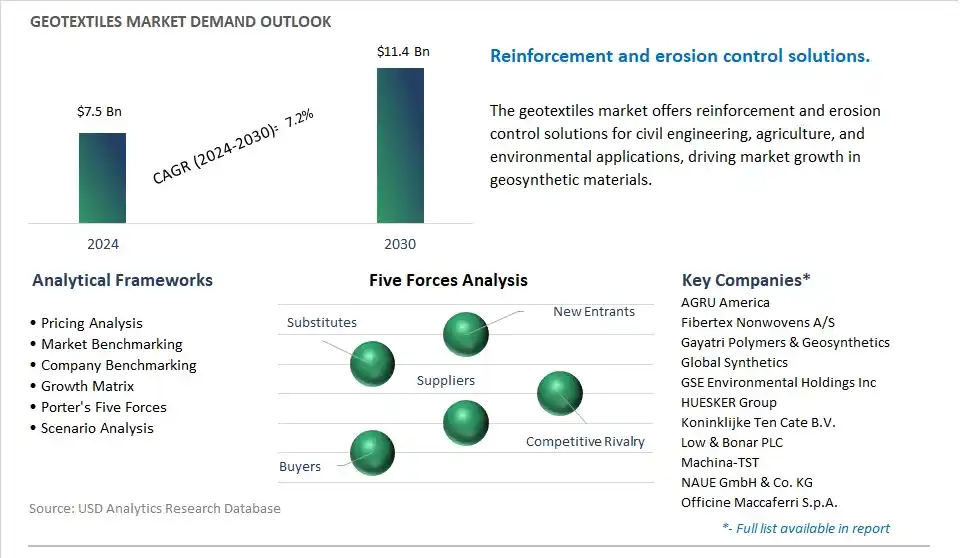
Geotextiles Market Competitive Landscape
The market report analyses the leading companies in the industry including AGRU America, Fibertex Nonwovens A/S, Gayatri Polymers & Geosynthetics, Global Synthetics, GSE Environmental Holdings Inc, HUESKER Group, Koninklijke Ten Cate B.V., Low & Bonar PLC, Machina-TST, NAUE GmbH & Co. KG, Officine Maccaferri S.p.A., Propex Operating Company LLC, TENAX Group, TYPAR (Berry Global).
Geotextiles Market Dynamics
Geotextiles Market Trend: Growing Adoption in Infrastructure and Construction Projects
A significant trend in the geotextiles market is the growing adoption of geotextiles in infrastructure and construction projects. With increasing investments in transportation, water management, and environmental protection initiatives worldwide, there is a rising demand for geotextiles as versatile and cost-effective solutions for soil stabilization, erosion control, drainage, and filtration. Geotextiles are being increasingly used in roadways, railways, embankments, retaining walls, landfills, and coastal protection projects to improve soil performance, enhance durability, and reduce maintenance costs. The trend towards sustainable and resilient infrastructure drives market growth for geotextiles, as they offer durable and environmentally friendly solutions to address complex engineering challenges in construction and civil engineering applications.
Geotextiles Market Driver: Need for Soil Reinforcement and Environmental Protection
The primary driver for the geotextiles market is the need for soil reinforcement and environmental protection in infrastructure development and land management projects. With urbanization, population growth, and climate change exacerbating soil erosion, sedimentation, and flooding issues, there is a growing emphasis on implementing geosynthetic solutions to mitigate these challenges and enhance the resilience of built and natural environments. Geotextiles provide effective reinforcement, stabilization, and erosion control in various geotechnical applications, helping to prevent soil erosion, improve slope stability, and protect water resources. The demand for geotextiles is driven by regulatory requirements, environmental concerns, and the need to enhance infrastructure resilience against natural hazards, driving market growth and innovation in geosynthetic materials and technologies.
Geotextiles Market Opportunity: Expansion into Sustainable Agriculture and Landscaping Applications
An opportunity exists for companies operating in the geotextiles market to expand into sustainable agriculture and landscaping applications. While geotextiles are widely used in civil engineering and infrastructure projects, there is potential to explore new markets and applications where geotextiles can provide valuable solutions. In agriculture, geotextiles can be used for weed suppression, soil moisture retention, and erosion control in crop production, orchards, and nurseries, helping farmers improve crop yield, reduce water usage, and minimize soil degradation. Additionally, geotextiles can be employed in landscaping projects for weed barrier, soil stabilization, and vegetation reinforcement in parks, gardens, and green spaces, enhancing aesthetic appeal and promoting environmental sustainability. By diversifying into agriculture and landscaping applications, companies can leverage their expertise in geotextile technology to address emerging market needs, expand their product portfolios, and capture new opportunities for growth in the geosynthetic materials market.
Geotextiles Market Ecosystem
The Geotextiles Market Ecosystem begins with raw material production by polymer producers including Dow Chemical Company, BASF SE, Exxon Mobil Corporation, and LyondellBasell Industries NV, which manufacture base polymers including polypropylene (PP) and polyester (PET), primarily utilized in geotextile manufacturing. Geotextile manufacturers including Tensar International Corporation, Solvay SA, Huesker Synthetic GmbH, and PECOLTEX Geosynthetics then convert these raw polymers into geotextiles using various techniques including weaving, nonwoven bonding, and heat bonding, catering to diverse civil engineering and construction applications.
Quality control and testing ensure geotextile properties meet industry standards for tensile strength, permeability, puncture resistance, and UV resistance, conducted by testing laboratories accredited by organizations including the American Society for Testing and Materials (ASTM International).
Distribution and sales are managed by geotechnical distributors specializing in supplying geotextiles and other geosynthetic products to construction companies and contractors, with both national and regional distributors focusing on geotechnical supplies participating in this stage. Geotextiles find extensive use in civil engineering and construction projects, serving various purposes including separating dissimilar soil layers, filtration to allow water flow while retaining soil particles, drainage facilitation, reinforcement for enhancing soil stability on slopes or embankments, and erosion control to reduce soil erosion from wind or water. Major end users include large construction companies and civil engineering firms involved in infrastructure, road construction, and land development projects, emphasizing geotextiles' pivotal role in enhancing soil stability, drainage, and separation in various construction applications.
Geotextiles Market Share Analysis: Synthetic Segment held the dominant revenue share in 2024
The synthetic segment is the largest segment in the Geotextiles Market. This dominance is driven by synthetic geotextiles offer superior properties such as high tensile strength, durability, and resistance to environmental factors compared to natural materials. Synthetic geotextiles are commonly manufactured from polymers such as polypropylene, polyester, and polyethylene, which provide excellent mechanical properties and chemical resistance required for various geotechnical applications. Additionally, synthetic geotextiles exhibit consistent performance characteristics across different environmental conditions, making them suitable for a wide range of civil engineering and construction projects. In addition, synthetic geotextiles are available in a variety of forms, including woven, non-woven, and knitted, offering flexibility in design and application. Further, the widespread availability and cost-effectiveness of synthetic materials compared to natural alternatives contribute to the segment's dominance in the Geotextiles Market. As infrastructure development projects continue to grow globally, driven by urbanization, transportation upgrades, and environmental conservation efforts, the demand for synthetic geotextiles is expected to remain strong, solidifying its position as the largest segment in the market.
Geotextiles Market Share Analysis: Reinforcement Segment is the fastest growing market segment over the forecast period to 2030
The reinforcement segment is the fastest-growing segment in the Geotextiles Market. This rapid growth is driven by geotextiles are widely used for reinforcement applications in various civil engineering and construction projects. Geotextiles provide mechanical reinforcement to soil structures, enhancing their load-bearing capacity and stability. Reinforcement applications include soil stabilization for embankments, slopes, and retaining walls, as well as reinforcement of paved and unpaved roads, railways, and airport runways. Additionally, the increasing demand for infrastructure development, particularly in urban areas and emerging economies, drives the need for geotextiles as reinforcement materials to support heavy loads and reduce construction costs. In addition, the versatility and durability of geotextiles make them an attractive solution for reinforcement applications in challenging environmental conditions, such as soft soils, high water tables, and seismic-prone regions. Further, advancements in geotextile technology, including the development of high-strength and engineered reinforcement products, further accelerate the growth of the reinforcement segment in the Geotextiles Market. As infrastructure projects continue to expand globally, driven by population growth, urbanization, and transportation upgrades, the demand for geotextiles for reinforcement applications is expected to witness robust growth, making it the fastest-growing segment in the market.
Geotextiles Market Report Scope-
By Material
Natural
-Jute
-Others
Synthetic
-Polypropylene
-Polyester
-Polyethylene
Geotextiles Product
Woven
Non-Woven
Knitted
By Application
Erosion Control
Reinforcement
Drainage System
Lining System
Asphalt Overlays
Separation & Stabilization
Silt Fences
Geotextiles Market Companies Profiled
AGRU America
Fibertex Nonwovens A/S
Gayatri Polymers & Geosynthetics
Global Synthetics
GSE Environmental Holdings Inc
HUESKER Group
Koninklijke Ten Cate B.V.
Low & Bonar PLC
Machina-TST
NAUE GmbH & Co. KG
Officine Maccaferri S.p.A.
Propex Operating Company LLC
TENAX Group
TYPAR (Berry Global)
*- List Not Exhaustive
TABLE OF CONTENTS
1 Introduction to 2024 Geotextiles Market
1.1 Market Overview
1.2 Quick Facts
1.3 Scope/Objective of the Study
1.4 Market Definition
1.5 Countries and Regions Covered
1.6 Units, Currency, and Conversions
1.7 Industry Value Chain
2 Research Methodology
2.1 Market Size Estimation
2.2 Sources and Research Methodology
2.3 Data Triangulation
2.4 Assumptions and Limitations
3 Executive Summary
3.1 Global Geotextiles Market Size Outlook, $ Million, 2021 to 2030
3.2 Geotextiles Market Outlook by Type, $ Million, 2021 to 2030
3.3 Geotextiles Market Outlook by Product, $ Million, 2021 to 2030
3.4 Geotextiles Market Outlook by Application, $ Million, 2021 to 2030
3.5 Geotextiles Market Outlook by Key Countries, $ Million, 2021 to 2030
4 Market Dynamics
4.1 Key Driving Forces of Geotextiles Industry
4.2 Key Market Trends in Geotextiles Industry
4.3 Potential Opportunities in Geotextiles Industry
4.4 Key Challenges in Geotextiles Industry
5 Market Factor Analysis
5.1 Value Chain Analysis
5.2 Competitive Landscape
5.2.1 Global Geotextiles Market Share by Company (%), 2023
5.2.2 Product Offerings by Company
5.3 Porter’s Five Forces Analysis
5.4 Pricing Analysis and Outlook
6 Growth Outlook Across Scenarios
6.1 Growth Analysis-Case Scenario Definitions
6.2 Low Growth Scenario Forecasts
6.3 Reference Growth Scenario Forecasts
6.4 High Growth Scenario Forecasts
7 Global Geotextiles Market Outlook by Segments
7.1 Geotextiles Market Outlook by Segments, $ Million, 2021- 2030
By Material
Natural
-Jute
-Others
Synthetic
-Polypropylene
-Polyester
-Polyethylene
Geotextiles Product
Woven
Non-Woven
Knitted
By Application
Erosion Control
Reinforcement
Drainage System
Lining System
Asphalt Overlays
Separation & Stabilization
Silt Fences
8 North America Geotextiles Market Analysis and Outlook To 2030
8.1 Introduction to North America Geotextiles Markets in 2024
8.2 North America Geotextiles Market Size Outlook by Country, 2021-2030
8.2.1 United States
8.2.2 Canada
8.2.3 Mexico
8.3 North America Geotextiles Market size Outlook by Segments, 2021-2030
By Material
Natural
-Jute
-Others
Synthetic
-Polypropylene
-Polyester
-Polyethylene
Geotextiles Product
Woven
Non-Woven
Knitted
By Application
Erosion Control
Reinforcement
Drainage System
Lining System
Asphalt Overlays
Separation & Stabilization
Silt Fences
9 Europe Geotextiles Market Analysis and Outlook To 2030
9.1 Introduction to Europe Geotextiles Markets in 2024
9.2 Europe Geotextiles Market Size Outlook by Country, 2021-2030
9.2.1 Germany
9.2.2 France
9.2.3 Spain
9.2.4 United Kingdom
9.2.4 Italy
9.2.5 Russia
9.2.6 Norway
9.2.7 Rest of Europe
9.3 Europe Geotextiles Market Size Outlook by Segments, 2021-2030
By Material
Natural
-Jute
-Others
Synthetic
-Polypropylene
-Polyester
-Polyethylene
Geotextiles Product
Woven
Non-Woven
Knitted
By Application
Erosion Control
Reinforcement
Drainage System
Lining System
Asphalt Overlays
Separation & Stabilization
Silt Fences
10 Asia Pacific Geotextiles Market Analysis and Outlook To 2030
10.1 Introduction to Asia Pacific Geotextiles Markets in 2024
10.2 Asia Pacific Geotextiles Market Size Outlook by Country, 2021-2030
10.2.1 China
10.2.2 India
10.2.3 Japan
10.2.4 South Korea
10.2.5 Indonesia
10.2.6 Malaysia
10.2.7 Australia
10.2.8 Rest of Asia Pacific
10.3 Asia Pacific Geotextiles Market size Outlook by Segments, 2021-2030
By Material
Natural
-Jute
-Others
Synthetic
-Polypropylene
-Polyester
-Polyethylene
Geotextiles Product
Woven
Non-Woven
Knitted
By Application
Erosion Control
Reinforcement
Drainage System
Lining System
Asphalt Overlays
Separation & Stabilization
Silt Fences
11 South America Geotextiles Market Analysis and Outlook To 2030
11.1 Introduction to South America Geotextiles Markets in 2024
11.2 South America Geotextiles Market Size Outlook by Country, 2021-2030
11.2.1 Brazil
11.2.2 Argentina
11.2.3 Rest of South America
11.3 South America Geotextiles Market size Outlook by Segments, 2021-2030
By Material
Natural
-Jute
-Others
Synthetic
-Polypropylene
-Polyester
-Polyethylene
Geotextiles Product
Woven
Non-Woven
Knitted
By Application
Erosion Control
Reinforcement
Drainage System
Lining System
Asphalt Overlays
Separation & Stabilization
Silt Fences
12 Middle East and Africa Geotextiles Market Analysis and Outlook To 2030
12.1 Introduction to Middle East and Africa Geotextiles Markets in 2024
12.2 Middle East and Africa Geotextiles Market Size Outlook by Country, 2021-2030
12.2.1 Saudi Arabia
12.2.2 UAE
12.2.3 Oman
12.2.4 Rest of Middle East
12.2.5 Egypt
12.2.6 Nigeria
12.2.7 South Africa
12.2.8 Rest of Africa
12.3 Middle East and Africa Geotextiles Market size Outlook by Segments, 2021-2030
By Material
Natural
-Jute
-Others
Synthetic
-Polypropylene
-Polyester
-Polyethylene
Geotextiles Product
Woven
Non-Woven
Knitted
By Application
Erosion Control
Reinforcement
Drainage System
Lining System
Asphalt Overlays
Separation & Stabilization
Silt Fences
13 Company Profiles
13.1 Company Snapshot
13.2 SWOT Profiles
13.3 Products and Services
13.4 Recent Developments
13.5 Financial Profile
AGRU America
Fibertex Nonwovens A/S
Gayatri Polymers & Geosynthetics
Global Synthetics
GSE Environmental Holdings Inc
HUESKER Group
Koninklijke Ten Cate B.V.
Low & Bonar PLC
Machina-TST
NAUE GmbH & Co. KG
Officine Maccaferri S.p.A.
Propex Operating Company LLC
TENAX Group
TYPAR (Berry Global)
14 Appendix
14.1 Customization Offerings
14.2 Subscription Services
14.3 Related Reports
14.4 Publisher Expertise
By Material
Natural
-Jute
-Others
Synthetic
-Polypropylene
-Polyester
-Polyethylene
Geotextiles Product
Woven
Non-Woven
Knitted
By Application
Erosion Control
Reinforcement
Drainage System
Lining System
Asphalt Overlays
Separation & Stabilization
Silt Fences
Countries Analyzed
North America (US, Canada, Mexico)
Europe (Germany, UK, France, Spain, Italy, Russia, Rest of Europe)
Asia Pacific (China, India, Japan, South Korea, Australia, South East Asia, Rest of Asia)
South America (Brazil, Argentina, Rest of South America)
Middle East and Africa (Saudi Arabia, UAE, Rest of Middle East, South Africa, Egypt, Rest of Africa)
