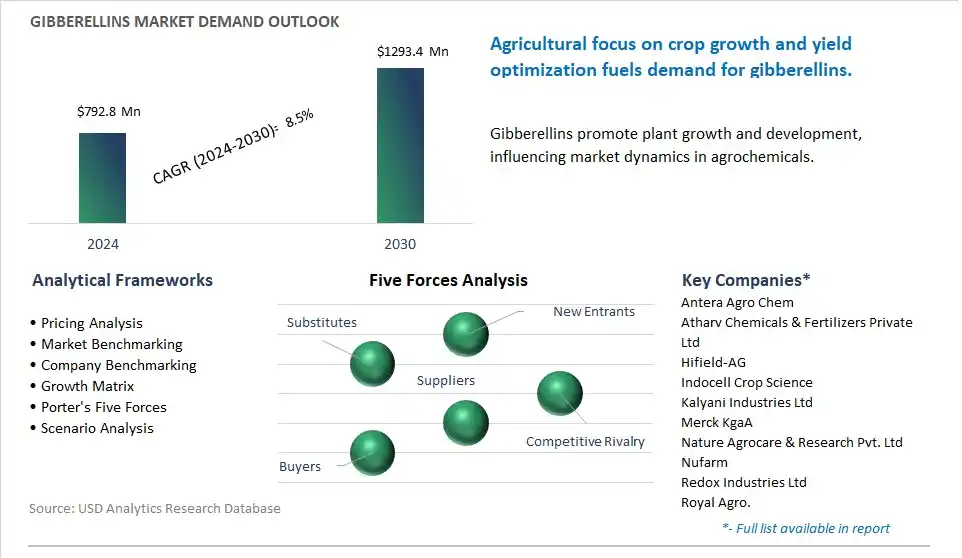
The global Gibberellins Market is poised to register a 8.5% CAGR from $792.8 Million in 2024 to $1293.4 Million in 2030.
The global Gibberellins Market Study analyzes and forecasts the market size across 6 regions and 24 countries for diverse segments -By Application (Fruit Production, Seed Production), By Type (19-Carbon Gibberellins, 20-Carbon Gibberellins), By Method (Methylerythritol Phosphate (MEP) Pathway, Trans-Geranylgeranyl Diphosphate (GGDP) Pathway), By Distribution Channel (Online, Offline).
An Introduction to Global Gibberellins Market in 2024
The market for gibberellins is witnessing growth driven by their applications in agriculture, horticulture, and plant biotechnology. Key trends shaping the future of the industry include the increasing demand for gibberellin-based plant growth regulators (PGRs) that enhance crop yield, fruit quality, and stress tolerance while meeting regulatory standards and consumer preferences for sustainable farming practices and food safety. As growers, nurseries, and greenhouse operators seek to optimize plant growth, flowering, and fruiting processes, there's a growing need for gibberellins that offer precise control over plant development, dormancy breaking, and flowering induction, allowing for better crop management, yield optimization, and resource efficiency. Moreover, advancements in gibberellin formulation, application methods, and delivery systems are driving market expansion by improving product efficacy, stability, and environmental compatibility while reducing application rates, off-target effects, and phytotoxicity risks associated with traditional PGRs and chemical fertilizers. Additionally, the growing adoption of gibberellins in specialty crops, fruit orchards, and turfgrass management is fueling demand for specialized formulations and application techniques that address specific agronomic challenges, market requirements, and environmental conditions while promoting sustainable agriculture and ecosystem health. Furthermore, the integration of gibberellins with precision farming technologies, remote sensing, and digital agronomy is driving innovation and market growth in the agrochemical industry, enabling the development of smarter, more efficient, and more sustainable solutions for the future of crop production, food security, and environmental stewardship.
Gibberellins Market Competitive Landscape
The market report analyses the leading companies in the industry including Antera Agro Chem, Atharv Chemicals & Fertilizers Private Ltd, Hifield-AG, Indocell Crop Science, Kalyani Industries Ltd, Merck KgaA, Nature Agrocare & Research Pvt. Ltd, Nufarm, Redox Industries Ltd, Royal Agro., Sahajchem Products, Sepro Corp, Sichuan Guoguang Agrochemical Co. Ltd, STAR BIO SCIENCE, Sumitomo Chemical Co. Ltd, Unicrop Biochem, Valent Biosciences LLC, Zhengzhou Delong Chemical Co. Ltd.
Gibberellins Market Dynamics
Gibberellins Market Trend: Increasing Adoption in Agriculture for Crop Yield Enhancement
A significant trend in the gibberellins market is the growing adoption of gibberellin-based products in agriculture for crop yield enhancement and plant growth regulation. Gibberellins, a group of plant hormones, play a vital role in regulating various physiological processes in plants, including seed germination, stem elongation, flowering, and fruit development. With the global population expected to reach 9 billion by 2050, there is mounting pressure on agricultural productivity to meet food demand. Farmers are increasingly turning to gibberellin-based formulations to stimulate plant growth, improve fruit set, increase fruit size, and enhance crop yields. This trend is reshaping the gibberellins market towards innovative formulations and application methods that offer growers effective tools for optimizing crop production and maximizing agricultural output.
Gibberellins Market Driver: Need for Sustainable Agricultural Practices and Crop Management
A key driver propelling the gibberellins market is the need for sustainable agricultural practices and crop management strategies to address challenges such as climate change, soil degradation, and water scarcity. Gibberellins offer farmers an environmentally friendly and cost-effective solution for improving crop performance and resilience in challenging growing conditions. By promoting root development, flowering induction, and fruit enlargement, gibberellin-based products help crops withstand abiotic stress factors such as drought, heat, and salinity, thereby enhancing yield stability and quality. Additionally, gibberellins play a role in crop management practices such as fruit thinning, seed dormancy breaking, and canopy management, providing growers with tools to optimize resource utilization, reduce input costs, and improve overall farm profitability.
Gibberellins Market Opportunity: Expansion into Horticulture and Turf Management
An opportunity for market expansion lies in diversifying gibberellins applications into horticulture and turf management sectors, offering solutions for plant propagation, ornamental production, and turfgrass maintenance. Gibberellin-based formulations can be used to promote vegetative growth, induce flowering, and enhance fruiting in ornamental plants, flowers, and fruit trees, catering to the needs of nurseries, landscapers, and greenhouse growers. Additionally, gibberellins can be applied in turfgrass management to promote turf establishment, stimulate tillering, and improve turf quality in sports fields, golf courses, and residential lawns. By exploring new application areas and collaborating with stakeholders in the horticulture and turf industries, gibberellins manufacturers can capitalize on opportunities to expand their market reach and offer tailored solutions that address the specific needs of ornamental plant production and turfgrass maintenance, driving growth and diversification in the gibberellins market.
Gibberellins Market Share Analysis: Fruit Production segment generated the highest revenue in the industry
The Fruit Production segment is the largest segment in the Gibberellins Market, driven by diverse key factors that highlight the essential role of gibberellins in regulating plant growth, development, and fruit production. Gibberellins are a group of plant hormones that play crucial roles in various physiological processes, including stem elongation, seed germination, flowering, and fruit development. One primary reason for the dominance of the Fruit Production segment is the significant impact of gibberellins on fruit set, fruit size, fruit quality, and fruit maturation processes in a wide range of fruit-bearing crops, including citrus fruits, grapes, apples, strawberries, and tomatoes. Gibberellins stimulate cell division and cell elongation in fruit tissues, leading to increased fruit size, improved fruit shape, and enhanced marketable yields, which are essential factors for commercial fruit production and profitability. Additionally, gibberellin applications can promote uniform fruit ripening, reduce fruit drop, and extend the shelf life of harvested fruits, contributing to improved fruit quality, post-harvest handling, and marketability. In addition, gibberellins play critical roles in overcoming physiological disorders and growth abnormalities in fruit crops, such as seedlessness in grapes, fruit cracking in cherries, and fruit thinning in apples, by regulating hormone balance and metabolic processes in plant tissues. Further, the effectiveness of gibberellin treatments in enhancing fruit production and quality has led to widespread adoption by fruit growers, orchardists, and horticulturalists worldwide, who rely on gibberellin-based products and formulations to optimize fruit yields, crop profitability, and farm sustainability. With the growing global demand for fresh fruits, processed fruits, and value-added fruit products driven by population growth, urbanization, and changing consumer preferences for healthy and convenient food options, the Fruit Production segment of the Gibberellins Market is expected to maintain its leadership position, offering growers, producers, and stakeholders reliable and effective solutions for maximizing fruit production, quality, and market competitiveness in the dynamic and competitive fruit industry landscape.
Gibberellins Market Share Analysis: 20-Carbon Gibberellins Segment is poised to register the fastest growth rate (CAGR) over the forecast period to 2030
The 20-Carbon Gibberellins segment is the fastest-growing segment in the Gibberellins Market, driven by diverse key factors that highlight the increasing demand for specific gibberellin compounds with unique properties and applications in agriculture and horticulture. Gibberellins are a group of plant hormones that regulate various physiological processes, including stem elongation, seed germination, flowering, and fruit development. One primary reason for the rapid growth of the 20-Carbon Gibberellins segment is the growing recognition of the specific roles and functions of 20-carbon gibberellins in modulating plant growth, development, and productivity compared to other gibberellin compounds. 20-Carbon gibberellins, such as GA3 (gibberellic acid), GA4, and GA7, are among the most studied and commercially utilized gibberellins due to their potent effects on promoting cell elongation, stem growth, and fruit development in a wide range of crops and ornamental plants. These gibberellin compounds are particularly effective in overcoming growth limitations, stimulating flowering, and improving fruit set and fruit size in fruit-bearing crops such as grapes, citrus fruits, apples, and cherries, where they play critical roles in optimizing yield potential and marketable fruit quality. Additionally, 20-carbon gibberellins are used in seed treatment applications to promote uniform germination, seedling vigor, and early establishment in crops such as cereals, legumes, and oilseeds, contributing to improved stand establishment, crop uniformity, and yield stability. In addition, advancements in gibberellin synthesis, formulation technologies, and application methods have expanded the availability and accessibility of 20-carbon gibberellin-based products and formulations to growers, agronomists, and horticulturalists worldwide, who rely on these compounds to enhance crop performance, productivity, and profitability in diverse agricultural and horticultural systems. Further, the increasing adoption of precision agriculture practices, integrated crop management strategies, and sustainable production methods is driving the demand for targeted and efficient plant growth regulators such as 20-carbon gibberellins, which offer growers opportunities to optimize resource use efficiency, minimize environmental impacts, and achieve consistent and reliable crop yields in a changing and challenging agricultural landscape. With the growing emphasis on crop productivity, quality, and sustainability in global agriculture, the 20-Carbon Gibberellins segment of the Gibberellins Market is poised for significant growth, offering stakeholders innovative and effective solutions for maximizing crop performance and profitability in diverse cropping systems and environmental conditions.
Gibberellins Market Share Analysis: Methylerythritol Phosphate (MEP) Pathway Segment is poised to register the fastest growth rate (CAGR) over the forecast period to 2030
The Methylerythritol Phosphate (MEP) Pathway segment is the fastest-growing segment in the Gibberellins Market, driven by diverse key factors that highlight the increasing importance of this biosynthetic pathway in the production of gibberellin compounds and the growing demand for gibberellin-based products in agriculture and horticulture. The MEP pathway is one of the primary biosynthetic routes involved in the synthesis of isoprenoid compounds, including gibberellins, in plants. One primary reason for the rapid growth of the MEP Pathway segment is the growing interest and research focus on understanding the molecular mechanisms and metabolic pathways involved in gibberellin biosynthesis, regulation, and signaling in plants. The elucidation of the MEP pathway and its role in gibberellin production has provided insights into the biosynthetic steps and key enzymes involved in gibberellin synthesis, enabling researchers and biotechnologists to develop novel strategies for enhancing gibberellin production, modifying gibberellin profiles, and optimizing plant growth and development for agricultural and horticultural applications. Additionally, advancements in biotechnology, genetic engineering, and metabolic engineering have enabled the manipulation and engineering of the MEP pathway in plants to enhance gibberellin content, improve gibberellin bioactivity, and tailor gibberellin profiles to specific crop traits, environmental conditions, and agronomic requirements. These innovations have led to the development of genetically modified crops, transgenic plants, and microbial bioproduction systems capable of producing high levels of gibberellins efficiently and sustainably, offering growers and producers access to cost-effective and reliable sources of gibberellin-based products for crop enhancement, yield improvement, and stress tolerance in diverse agricultural and horticultural settings. In addition, the increasing demand for sustainable agriculture practices, climate-resilient crops, and eco-friendly plant growth regulators is driving the adoption of gibberellin-based products derived from the MEP pathway, which offer advantages such as biodegradability, eco-toxicity, and safety for humans, animals, and the environment. With the growing recognition of the MEP pathway as a promising target for gibberellin enhancement and the expanding applications of gibberellins in crop production, the MEP Pathway segment of the Gibberellins Market is expected to experience robust growth, offering stakeholders opportunities for innovation, collaboration, and market expansion in the dynamic and competitive agricultural biotechnology landscape.
Gibberellins Market Report Segmentation
By Application
Fruit Production
Seed Production
By Type
19-Carbon Gibberellins
20-Carbon Gibberellins
By Method
Methylerythritol Phosphate (MEP) Pathway
Trans-Geranylgeranyl Diphosphate (GGDP) Pathway
By Distribution Channel
Online
Offline
Regions Included
North America (US, Canada, Mexico)
Europe (Germany, UK, France, Spain, Italy, Russia, Rest of Europe)
Asia Pacific (China, India, Japan, South Korea, Australia, South East Asia, Rest of Asia)
South America (Brazil, Argentina, Rest of South America)
Middle East and Africa (Saudi Arabia, UAE, Rest of Middle East, South Africa, Egypt, Rest of Africa)
Gibberellins Companies Profiled in the Market Study
Antera Agro Chem
Atharv Chemicals & Fertilizers Private Ltd
Hifield-AG
Indocell Crop Science
Kalyani Industries Ltd
Merck KgaA
Nature Agrocare & Research Pvt. Ltd
Nufarm
Redox Industries Ltd
Royal Agro.
Sahajchem Products
Sepro Corp
Sichuan Guoguang Agrochemical Co. Ltd
STAR BIO SCIENCE
Sumitomo Chemical Co. Ltd
Unicrop Biochem
Valent Biosciences LLC
Zhengzhou Delong Chemical Co. Ltd
*- List Not Exhaustive
