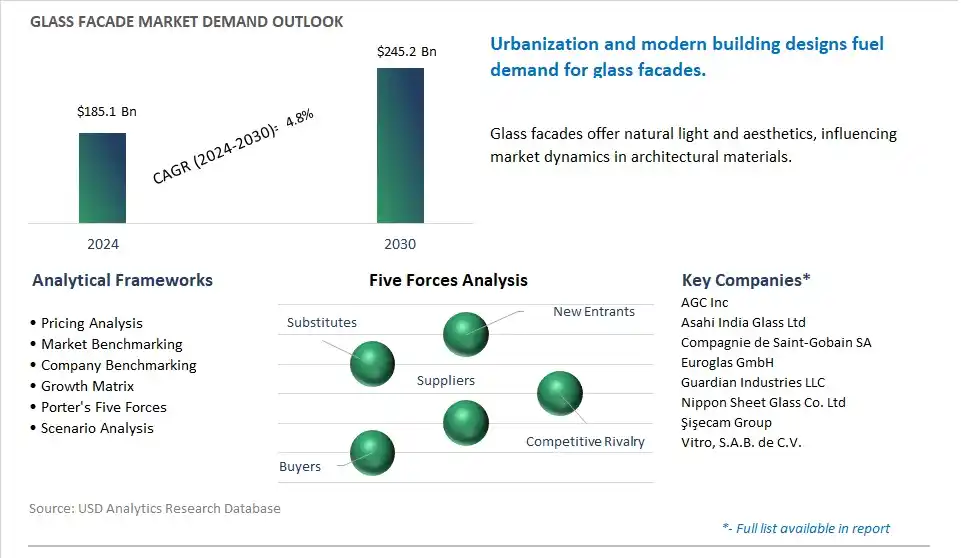
The global Glass Facade Market is poised to register a 4.8% CAGR from $185.1 Billion in 2024 to $245.2 Billion in 2030.
The global Glass Facade Market Study analyzes and forecasts the market size across 6 regions and 24 countries for diverse segments -By Product (Tempered, Insulated, Laminated, Others), By Application (Residential, Non-Residential).
An Introduction to Global Glass Facade Market in 2024
The glass facade market is witnessing robust growth driven by the increasing demand for innovative, energy-efficient, and visually striking building envelope solutions in urban landscapes, commercial complexes, and iconic architectural projects. Key trends shaping the future of the industry include the adoption of advanced glass technologies, facade engineering principles, and sustainability strategies to optimize daylighting, thermal comfort, and indoor environmental quality while meeting regulatory requirements, occupant preferences, and project sustainability goals. As developers, architects, and urban planners seek to create iconic landmarks, high-performance buildings, and vibrant urban spaces, there's a growing need for glass facades that offer seamless integration with architectural design concepts, structural systems, and building functions while enhancing visual connectivity, transparency, and aesthetic appeal. Moreover, advancements in glass facade design, manufacturing, and installation are driving market expansion by enabling the customization of facade systems, glass types, and performance parameters to meet specific project requirements, site conditions, and climate challenges while reducing energy consumption, carbon footprint, and lifecycle costs associated with conventional building envelopes. Additionally, the growing adoption of glass facades in green buildings, mixed-use developments, and smart cities is fueling demand for sustainable solutions that promote occupant well-being, community resilience, and environmental stewardship while addressing challenges such as urban heat island effect, air pollution, and resource depletion. Furthermore, the integration of glass facades with digital design tools, parametric modeling, and Building Information Modeling (BIM) is driving innovation and market growth in the construction industry, enabling the development of smarter, more resilient, and more sustainable solutions for the future of urban architecture, building performance, and environmental sustainability.
Glass Facade Market Competitive Landscape
The market report analyses the leading companies in the industry including AGC Inc, Asahi India Glass Ltd, Compagnie de Saint-Gobain SA, Euroglas GmbH, Guardian Industries LLC, Nippon Sheet Glass Co. Ltd, ÅžiÅŸecam Group, Vitro, S.A.B. de C.V..
Glass Facade Market Dynamics
Glass Facade Market Trend: Growing Demand for Sustainable and Aesthetically Pleasing Building Solutions
A significant trend in the glass facade market is the increasing demand for sustainable and aesthetically pleasing building solutions driven by urbanization, environmental concerns, and architectural preferences. Glass facades, renowned for their transparency, sleek appearance, and ability to maximize natural light, are becoming increasingly popular in commercial, residential, and institutional buildings worldwide. With the construction industry facing pressure to reduce carbon emissions, improve energy efficiency, and enhance occupant comfort, there is a rising interest in green building practices and high-performance facade systems. Glass facades offer benefits such as daylighting, thermal insulation, and solar control, helping to create visually stunning buildings while minimizing energy consumption and environmental impact. This trend is reshaping the glass facade market towards innovative designs, materials, and technologies that prioritize sustainability, functionality, and aesthetics in building construction.
Glass Facade Market Driver: Urbanization and Skyscraper Construction
A key driver propelling the glass facade market is urbanization and the construction of skyscrapers and high-rise buildings in urban centers worldwide. As cities grow and populations concentrate in urban areas, there is a demand for taller and more efficient buildings that optimize land use and accommodate diverse functions such as offices, residential units, hotels, and retail spaces. Glass facades offer architects and developers the flexibility to design iconic skyscrapers with panoramic views, abundant natural light, and striking visual appeal. Additionally, glass facades contribute to the revitalization of urban landscapes, creating vibrant cityscapes and landmarks that attract investment, tourism, and economic development. The ongoing trend towards urbanization and the construction of high-rise buildings drive market demand for glass facades as a key architectural element in modern urban environments.
Glass Facade Market Opportunity: Integration of Smart Technologies and Building Performance Solutions
An opportunity for market expansion lies in the integration of smart technologies and building performance solutions into glass facade designs, offering enhanced functionality, efficiency, and comfort for building occupants. With the advent of the Internet of Things (IoT) and digitalization trends in the construction industry, there is increasing demand for intelligent building solutions that optimize energy usage, enhance occupant well-being, and provide personalized experiences. Glass facades can be equipped with sensors, actuators, and control systems to monitor environmental conditions, adjust shading and ventilation, and optimize building performance in real time. Additionally, smart glass technologies such as electrochromic glass, thermochromic glass, and photovoltaic glass offer opportunities to enhance the functionality and versatility of glass facades, providing occupants with dynamic views, glare control, and energy harvesting capabilities. By embracing innovation and collaborating with technology providers, glass facade manufacturers can seize opportunities to differentiate their products, add value for customers, and drive market growth in the era of smart and sustainable buildings.
Glass Facade Market Share Analysis: Insulated Glass segment generated the highest revenue in the industry
Insulated glass is the largest segment in the glass facade market, and this can be attributed to diverse key reasons. The insulated glass offers superior thermal performance compared to other types of glass facades. The design of insulated glass involves multiple panes of glass separated by a spacer filled with air or gas, creating a barrier that significantly reduces heat transfer and improves energy efficiency. This thermal insulation capability makes insulated glass highly desirable for buildings in various climates, as it helps to maintain comfortable indoor temperatures year-round while reducing heating and cooling costs. In addition, the growing emphasis on sustainability and green building practices has led to increased demand for energy-efficient building materials like insulated glass. Building codes and regulations around the world are also increasingly stringent regarding energy efficiency, further driving the adoption of insulated glass facades. Additionally, advancements in technology and manufacturing processes have made insulated glass more affordable and readily available, making it the preferred choice for architects, developers, and building owners looking to optimize both energy performance and aesthetics in their projects. Consequently, the insulated glass segment continues to dominate the glass facade market due to its unparalleled thermal performance and widespread applicability in modern building design.
Glass Facade Market Share Analysis: Non-Residential Segment is poised to register the fastest growth rate (CAGR) over the forecast period to 2030
The non-residential segment is experiencing rapid growth in the glass facade market, and diverse factors contribute to this trend. The urbanization and population growth have led to an increase in commercial and institutional construction projects globally. Office buildings, shopping malls, hotels, educational institutions, healthcare facilities, and other non-residential structures are being erected at a significant pace to cater to the needs of expanding urban populations. Additionally, there's a growing preference for modern architectural designs that incorporate glass facades due to their aesthetic appeal, ability to maximize natural light, and create visually stunning environments. In addition, glass facades offer benefits such as energy efficiency, thermal insulation, and soundproofing, which are highly valued in non-residential buildings seeking to enhance occupant comfort and operational efficiency. Further, the rise of smart building technologies and the integration of sustainable building practices have further fueled the demand for glass facades in non-residential applications. As a result, the non-residential segment of the glass facade market is witnessing rapid growth as developers and building owners increasingly opt for innovative glass solutions to meet the evolving demands of modern urban environments.
Glass Facade Market Report Segmentation
By Product
Tempered
Insulated
Laminated
Others
By Application
Residential
Non-Residential
Regions Included
North America (US, Canada, Mexico)
Europe (Germany, UK, France, Spain, Italy, Russia, Rest of Europe)
Asia Pacific (China, India, Japan, South Korea, Australia, South East Asia, Rest of Asia)
South America (Brazil, Argentina, Rest of South America)
Middle East and Africa (Saudi Arabia, UAE, Rest of Middle East, South Africa, Egypt, Rest of Africa)
Glass Facade Companies Profiled in the Market Study
AGC Inc
Asahi India Glass Ltd
Compagnie de Saint-Gobain SA
Euroglas GmbH
Guardian Industries LLC
Nippon Sheet Glass Co. Ltd
ÅžiÅŸecam Group
Vitro, S.A.B. de C.V.
*- List Not Exhaustive
TABLE OF CONTENTS
1 Introduction to 2024 Glass Facade Market
1.1 Market Overview
1.2 Quick Facts
1.3 Scope/Objective of the Study
1.4 Market Definition
1.5 Countries and Regions Covered
1.6 Units, Currency, and Conversions
1.7 Industry Value Chain
2 Research Methodology
2.1 Market Size Estimation
2.2 Sources and Research Methodology
2.3 Data Triangulation
2.4 Assumptions and Limitations
3 Executive Summary
3.1 Global Glass Facade Market Size Outlook, $ Million, 2021 to 2030
3.2 Glass Facade Market Outlook by Type, $ Million, 2021 to 2030
3.3 Glass Facade Market Outlook by Product, $ Million, 2021 to 2030
3.4 Glass Facade Market Outlook by Application, $ Million, 2021 to 2030
3.5 Glass Facade Market Outlook by Key Countries, $ Million, 2021 to 2030
4 Market Dynamics
4.1 Key Driving Forces of Glass Facade Industry
4.2 Key Market Trends in Glass Facade Industry
4.3 Potential Opportunities in Glass Facade Industry
4.4 Key Challenges in Glass Facade Industry
5 Market Factor Analysis
5.1 Value Chain Analysis
5.2 Competitive Landscape
5.2.1 Global Glass Facade Market Share by Company (%), 2023
5.2.2 Product Offerings by Company
5.3 Porter’s Five Forces Analysis
5.4 Pricing Analysis and Outlook
6 Growth Outlook Across Scenarios
6.1 Growth Analysis-Case Scenario Definitions
6.2 Low Growth Scenario Forecasts
6.3 Reference Growth Scenario Forecasts
6.4 High Growth Scenario Forecasts
7 Global Glass Facade Market Outlook by Segments
7.1 Glass Facade Market Outlook by Segments, $ Million, 2021- 2030
By Product
Tempered
Insulated
Laminated
Others
By Application
Residential
Non-Residential
8 North America Glass Facade Market Analysis and Outlook To 2030
8.1 Introduction to North America Glass Facade Markets in 2024
8.2 North America Glass Facade Market Size Outlook by Country, 2021-2030
8.2.1 United States
8.2.2 Canada
8.2.3 Mexico
8.3 North America Glass Facade Market size Outlook by Segments, 2021-2030
By Product
Tempered
Insulated
Laminated
Others
By Application
Residential
Non-Residential
9 Europe Glass Facade Market Analysis and Outlook To 2030
9.1 Introduction to Europe Glass Facade Markets in 2024
9.2 Europe Glass Facade Market Size Outlook by Country, 2021-2030
9.2.1 Germany
9.2.2 France
9.2.3 Spain
9.2.4 United Kingdom
9.2.4 Italy
9.2.5 Russia
9.2.6 Norway
9.2.7 Rest of Europe
9.3 Europe Glass Facade Market Size Outlook by Segments, 2021-2030
By Product
Tempered
Insulated
Laminated
Others
By Application
Residential
Non-Residential
10 Asia Pacific Glass Facade Market Analysis and Outlook To 2030
10.1 Introduction to Asia Pacific Glass Facade Markets in 2024
10.2 Asia Pacific Glass Facade Market Size Outlook by Country, 2021-2030
10.2.1 China
10.2.2 India
10.2.3 Japan
10.2.4 South Korea
10.2.5 Indonesia
10.2.6 Malaysia
10.2.7 Australia
10.2.8 Rest of Asia Pacific
10.3 Asia Pacific Glass Facade Market size Outlook by Segments, 2021-2030
By Product
Tempered
Insulated
Laminated
Others
By Application
Residential
Non-Residential
11 South America Glass Facade Market Analysis and Outlook To 2030
11.1 Introduction to South America Glass Facade Markets in 2024
11.2 South America Glass Facade Market Size Outlook by Country, 2021-2030
11.2.1 Brazil
11.2.2 Argentina
11.2.3 Rest of South America
11.3 South America Glass Facade Market size Outlook by Segments, 2021-2030
By Product
Tempered
Insulated
Laminated
Others
By Application
Residential
Non-Residential
12 Middle East and Africa Glass Facade Market Analysis and Outlook To 2030
12.1 Introduction to Middle East and Africa Glass Facade Markets in 2024
12.2 Middle East and Africa Glass Facade Market Size Outlook by Country, 2021-2030
12.2.1 Saudi Arabia
12.2.2 UAE
12.2.3 Oman
12.2.4 Rest of Middle East
12.2.5 Egypt
12.2.6 Nigeria
12.2.7 South Africa
12.2.8 Rest of Africa
12.3 Middle East and Africa Glass Facade Market size Outlook by Segments, 2021-2030
By Product
Tempered
Insulated
Laminated
Others
By Application
Residential
Non-Residential
13 Company Profiles
13.1 Company Snapshot
13.2 SWOT Profiles
13.3 Products and Services
13.4 Recent Developments
13.5 Financial Profile
AGC Inc
Asahi India Glass Ltd
Compagnie de Saint-Gobain SA
Euroglas GmbH
Guardian Industries LLC
Nippon Sheet Glass Co. Ltd
ÅžiÅŸecam Group
Vitro, S.A.B. de C.V.
14 Appendix
14.1 Customization Offerings
14.2 Subscription Services
14.3 Related Reports
14.4 Publisher Expertise
By Product
Tempered
Insulated
Laminated
Others
By Application
Residential
Non-Residential
Countries Analyzed
North America (US, Canada, Mexico)
Europe (Germany, UK, France, Spain, Italy, Russia, Rest of Europe)
Asia Pacific (China, India, Japan, South Korea, Australia, South East Asia, Rest of Asia)
South America (Brazil, Argentina, Rest of South America)
Middle East and Africa (Saudi Arabia, UAE, Rest of Middle East, South Africa, Egypt, Rest of Africa)
