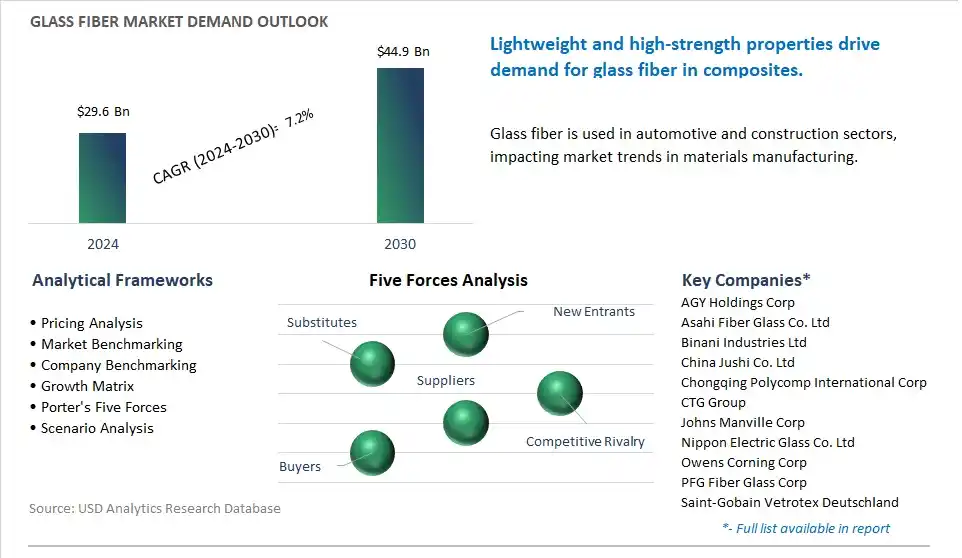
The global Glass Fiber Market is poised to register a 7.2% CAGR from $29.6 Billion in 2024 to $44.9 Billion in 2030.
The global Glass Fiber Market Study analyzes and forecasts the market size across 6 regions and 24 countries for diverse segments -By Resin (Chopped Strands, Glass Wool, Roving, Yarn), By Application (Composites, Insulation), By End-User (Buildings and Construction, Automotive, Aerospace and Defense, Alternative Energy, Consumer Goods, Industrial, Others).
An Introduction to Global Glass Fiber Market in 2024
The glass fiber market is experiencing robust growth driven by its extensive applications in various industries such as automotive, construction, aerospace, and wind energy. Key trends shaping the future of the industry include the increasing demand for lightweight, high-strength materials to improve fuel efficiency, reduce carbon emissions, and enhance structural integrity in transportation, infrastructure, and renewable energy sectors. As manufacturers and designers seek to address challenges related to sustainability, performance, and cost-effectiveness, there's a growing need for glass fibers that offer superior mechanical properties, corrosion resistance, and thermal insulation while meeting stringent industry standards and regulatory requirements. Moreover, advancements in glass fiber manufacturing processes, including melt spinning, fiber forming, and surface treatment, are driving market expansion by improving product quality, consistency, and compatibility with resin matrices such as thermosets, thermoplastics, and bio-based polymers, enabling the development of lightweight, durable, and eco-friendly composite materials for various applications. Additionally, the growing adoption of glass fiber composites in electric vehicles, green buildings, and renewable energy infrastructure is fueling demand for advanced materials that offer design flexibility, energy efficiency, and lifecycle sustainability, contributing to the transition towards a low-carbon economy and circular manufacturing practices. Furthermore, the integration of glass fiber technology with digital design tools, simulation software, and additive manufacturing techniques is driving innovation and market growth in the materials science industry, enabling the development of smarter, more efficient, and more sustainable solutions for the future of transportation, infrastructure, and industrial manufacturing.
Glass Fiber Market Competitive Landscape
The market report analyses the leading companies in the industry including AGY Holdings Corp, Asahi Fiber Glass Co. Ltd, Binani Industries Ltd, China Jushi Co. Ltd, Chongqing Polycomp International Corp, CTG Group, Johns Manville Corp, Nippon Electric Glass Co. Ltd, Owens Corning Corp, PFG Fiber Glass Corp, Saint-Gobain Vetrotex Deutschland GmbH, Taiwan Glass Ind. Corp.
Glass Fiber Market Dynamics
Glass Fiber Market Trend: Rising Demand for Lightweight and High-Strength Materials
A significant trend in the glass fiber market is the increasing demand for lightweight and high-strength materials driven by industries such as automotive, aerospace, construction, and wind energy. Glass fibers, known for their exceptional strength-to-weight ratio and versatility, are becoming increasingly popular as a reinforcement material in composites used for various applications. With the emphasis on fuel efficiency, performance optimization, and sustainability, there is a growing preference for lightweight materials that offer structural integrity and durability while reducing overall weight. Glass fibers play a crucial role in meeting these requirements by providing superior mechanical properties, corrosion resistance, and design flexibility, making them ideal for replacing traditional materials such as steel, aluminum, and wood in a wide range of products and industries. This trend is reshaping the glass fiber market towards increased adoption of advanced composite materials that offer lightweight solutions without compromising on performance or durability.
Glass Fiber Market Driver: Growth in Composites Manufacturing and Innovation
A key driver propelling the glass fiber market is the growth in composites manufacturing and innovation, where glass fibers are extensively used as a reinforcement material in polymer matrices to create composite materials with enhanced properties. As industries seek to develop products with superior strength, stiffness, and corrosion resistance, there is a rising demand for composite materials that offer lightweight solutions while meeting stringent performance requirements. Glass fibers, available in various forms such as rovings, mats, fabrics, and chopped strands, provide designers and engineers with options to tailor composite structures to specific application needs. Additionally, advancements in glass fiber technology, such as surface treatment, sizing, and fiber orientation, enable the production of composites with improved mechanical properties, processing efficiency, and cost-effectiveness. The continuous innovation and expansion of composites manufacturing capabilities drive market demand for glass fibers as a key component in composite materials used in diverse industries and applications.
Glass Fiber Market Opportunity: Penetration into Emerging Applications and Markets
An opportunity for market expansion lies in penetrating emerging applications and markets where glass fibers can offer value-added solutions and address unmet needs. Industries such as infrastructure, marine, sports and leisure, and electrical and electronics present opportunities for glass fiber manufacturers to diversify their product offerings and tap into new market segments. For example, glass fibers can be used in infrastructure applications such as bridge decks, road pavements, and pipelines to provide reinforcement, reduce maintenance costs, and extend service life. In the marine sector, glass fibers are employed in boat hulls, decks, and components to improve strength, stiffness, and durability, offering lightweight and corrosion-resistant alternatives to traditional materials. By identifying emerging trends, collaborating with industry stakeholders, and investing in research and development, glass fiber manufacturers can explore new applications and markets, expand their customer base, and drive growth and innovation in the glass fiber market.
Glass Fiber Market Share Analysis: Glass Wool segment generated the highest revenue in the industry
Glass wool is the largest segment in the glass fiber market, primarily due to its versatile applications and superior insulation properties. Glass wool, also known as fiberglass insulation, is widely used in various industries, including construction, automotive, and aerospace, for thermal and acoustic insulation purposes. Its popularity stems from its ability to effectively trap air, providing excellent thermal insulation while also offering sound absorption properties, making it invaluable for enhancing the energy efficiency and comfort of buildings and vehicles. In addition, glass wool is lightweight, non-combustible, and resistant to moisture and corrosion, making it a durable and long-lasting insulation solution. In construction, glass wool is commonly used in walls, ceilings, roofs, and HVAC systems to improve energy efficiency and meet building code requirements. In the automotive sector, it is used for insulating vehicle cabins and mufflers, reducing noise and enhancing comfort. Additionally, glass wool finds applications in industrial equipment, marine vessels, and aircraft for its thermal and acoustic insulation properties. Over the forecast period, the widespread use of glass wool across various industries, coupled with its excellent insulation performance and durability, positions it as the largest segment in the glass fiber market.
Glass Fiber Market Share Analysis: Composites Segment is poised to register the fastest growth rate (CAGR) over the forecast period to 2030
The composites segment is the fastest-growing segment in the glass fiber market, driven by diverse key factors. The the increasing demand for lightweight and high-strength materials across industries such as automotive, aerospace, construction, and wind energy is fueling the adoption of glass fiber composites. Glass fiber-reinforced composites offer exceptional strength-to-weight ratios, making them ideal for replacing traditional materials like metal and wood in various applications. In the automotive sector, for example, glass fiber composites are used to manufacture lightweight and fuel-efficient components such as body panels, chassis parts, and interior trim. Similarly, in aerospace, glass fiber composites are employed to produce aircraft components that are both lightweight and structurally robust, contributing to fuel efficiency and performance. Additionally, the construction industry is increasingly incorporating glass fiber composites into infrastructure projects for their durability, corrosion resistance, and design flexibility. Further, the growing focus on sustainability and environmental conservation is driving the shift towards composites, as they offer the potential for reduced material consumption, lower energy consumption during manufacturing, and improved recyclability compared to traditional materials. Over the forecast period, the versatility, performance, and eco-friendly attributes of glass fiber composites are driving their rapid growth across diverse applications, making them the fastest-growing segment in the glass fiber market.
Glass Fiber Market Share Analysis: Alternative Energy Segment is poised to register the fastest growth rate (CAGR) over the forecast period to 2030
The alternative energy segment is the fastest-growing segment in the glass fiber market, propelled by the global shift towards renewable energy sources and sustainable practices. One of the key applications driving this growth is the production of wind turbine blades. Glass fiber-reinforced composites are essential in the manufacturing of wind turbine blades due to their excellent strength-to-weight ratio, corrosion resistance, and fatigue performance. As the demand for wind energy continues to rise worldwide, driven by concerns over climate change and the need to reduce greenhouse gas emissions, there is a corresponding surge in the construction of wind farms and the production of wind turbines. This increased deployment of wind turbines directly translates to a growing demand for glass fibers used in their manufacturing. Additionally, glass fibers find applications in other alternative energy sectors such as solar energy, where they are used in the production of lightweight and durable components for solar panels and solar thermal systems. The continued expansion of renewable energy infrastructure, coupled with ongoing technological advancements in the design and manufacturing of alternative energy systems, further accelerates the demand for glass fibers in this segment. Over the forecast period, the alternative energy segment represents a rapidly growing market opportunity for glass fiber manufacturers, driven by the global transition towards sustainable energy sources.
Glass Fiber Market Report Segmentation
By Resin
Chopped Strands
Glass Wool
Roving
Yarn
By Application
Composites
Insulation
By End-User
Buildings and Construction
Automotive
Aerospace and Defense
Alternative Energy
Consumer Goods
Industrial
Others
Regions Included
North America (US, Canada, Mexico)
Europe (Germany, UK, France, Spain, Italy, Russia, Rest of Europe)
Asia Pacific (China, India, Japan, South Korea, Australia, South East Asia, Rest of Asia)
South America (Brazil, Argentina, Rest of South America)
Middle East and Africa (Saudi Arabia, UAE, Rest of Middle East, South Africa, Egypt, Rest of Africa)
Glass Fiber Companies Profiled in the Market Study
AGY Holdings Corp
Asahi Fiber Glass Co. Ltd
Binani Industries Ltd
China Jushi Co. Ltd
Chongqing Polycomp International Corp
CTG Group
Johns Manville Corp
Nippon Electric Glass Co. Ltd
Owens Corning Corp
PFG Fiber Glass Corp
Saint-Gobain Vetrotex Deutschland GmbH
Taiwan Glass Ind. Corp
*- List Not Exhaustive
TABLE OF CONTENTS
1 Introduction to 2024 Glass Fiber Market
1.1 Market Overview
1.2 Quick Facts
1.3 Scope/Objective of the Study
1.4 Market Definition
1.5 Countries and Regions Covered
1.6 Units, Currency, and Conversions
1.7 Industry Value Chain
2 Research Methodology
2.1 Market Size Estimation
2.2 Sources and Research Methodology
2.3 Data Triangulation
2.4 Assumptions and Limitations
3 Executive Summary
3.1 Global Glass Fiber Market Size Outlook, $ Million, 2021 to 2030
3.2 Glass Fiber Market Outlook by Type, $ Million, 2021 to 2030
3.3 Glass Fiber Market Outlook by Product, $ Million, 2021 to 2030
3.4 Glass Fiber Market Outlook by Application, $ Million, 2021 to 2030
3.5 Glass Fiber Market Outlook by Key Countries, $ Million, 2021 to 2030
4 Market Dynamics
4.1 Key Driving Forces of Glass Fiber Industry
4.2 Key Market Trends in Glass Fiber Industry
4.3 Potential Opportunities in Glass Fiber Industry
4.4 Key Challenges in Glass Fiber Industry
5 Market Factor Analysis
5.1 Value Chain Analysis
5.2 Competitive Landscape
5.2.1 Global Glass Fiber Market Share by Company (%), 2023
5.2.2 Product Offerings by Company
5.3 Porter’s Five Forces Analysis
5.4 Pricing Analysis and Outlook
6 Growth Outlook Across Scenarios
6.1 Growth Analysis-Case Scenario Definitions
6.2 Low Growth Scenario Forecasts
6.3 Reference Growth Scenario Forecasts
6.4 High Growth Scenario Forecasts
7 Global Glass Fiber Market Outlook by Segments
7.1 Glass Fiber Market Outlook by Segments, $ Million, 2021- 2030
By Resin
Chopped Strands
Glass Wool
Roving
Yarn
By Application
Composites
Insulation
By End-User
Buildings and Construction
Automotive
Aerospace and Defense
Alternative Energy
Consumer Goods
Industrial
Others
8 North America Glass Fiber Market Analysis and Outlook To 2030
8.1 Introduction to North America Glass Fiber Markets in 2024
8.2 North America Glass Fiber Market Size Outlook by Country, 2021-2030
8.2.1 United States
8.2.2 Canada
8.2.3 Mexico
8.3 North America Glass Fiber Market size Outlook by Segments, 2021-2030
By Resin
Chopped Strands
Glass Wool
Roving
Yarn
By Application
Composites
Insulation
By End-User
Buildings and Construction
Automotive
Aerospace and Defense
Alternative Energy
Consumer Goods
Industrial
Others
9 Europe Glass Fiber Market Analysis and Outlook To 2030
9.1 Introduction to Europe Glass Fiber Markets in 2024
9.2 Europe Glass Fiber Market Size Outlook by Country, 2021-2030
9.2.1 Germany
9.2.2 France
9.2.3 Spain
9.2.4 United Kingdom
9.2.4 Italy
9.2.5 Russia
9.2.6 Norway
9.2.7 Rest of Europe
9.3 Europe Glass Fiber Market Size Outlook by Segments, 2021-2030
By Resin
Chopped Strands
Glass Wool
Roving
Yarn
By Application
Composites
Insulation
By End-User
Buildings and Construction
Automotive
Aerospace and Defense
Alternative Energy
Consumer Goods
Industrial
Others
10 Asia Pacific Glass Fiber Market Analysis and Outlook To 2030
10.1 Introduction to Asia Pacific Glass Fiber Markets in 2024
10.2 Asia Pacific Glass Fiber Market Size Outlook by Country, 2021-2030
10.2.1 China
10.2.2 India
10.2.3 Japan
10.2.4 South Korea
10.2.5 Indonesia
10.2.6 Malaysia
10.2.7 Australia
10.2.8 Rest of Asia Pacific
10.3 Asia Pacific Glass Fiber Market size Outlook by Segments, 2021-2030
By Resin
Chopped Strands
Glass Wool
Roving
Yarn
By Application
Composites
Insulation
By End-User
Buildings and Construction
Automotive
Aerospace and Defense
Alternative Energy
Consumer Goods
Industrial
Others
11 South America Glass Fiber Market Analysis and Outlook To 2030
11.1 Introduction to South America Glass Fiber Markets in 2024
11.2 South America Glass Fiber Market Size Outlook by Country, 2021-2030
11.2.1 Brazil
11.2.2 Argentina
11.2.3 Rest of South America
11.3 South America Glass Fiber Market size Outlook by Segments, 2021-2030
By Resin
Chopped Strands
Glass Wool
Roving
Yarn
By Application
Composites
Insulation
By End-User
Buildings and Construction
Automotive
Aerospace and Defense
Alternative Energy
Consumer Goods
Industrial
Others
12 Middle East and Africa Glass Fiber Market Analysis and Outlook To 2030
12.1 Introduction to Middle East and Africa Glass Fiber Markets in 2024
12.2 Middle East and Africa Glass Fiber Market Size Outlook by Country, 2021-2030
12.2.1 Saudi Arabia
12.2.2 UAE
12.2.3 Oman
12.2.4 Rest of Middle East
12.2.5 Egypt
12.2.6 Nigeria
12.2.7 South Africa
12.2.8 Rest of Africa
12.3 Middle East and Africa Glass Fiber Market size Outlook by Segments, 2021-2030
By Resin
Chopped Strands
Glass Wool
Roving
Yarn
By Application
Composites
Insulation
By End-User
Buildings and Construction
Automotive
Aerospace and Defense
Alternative Energy
Consumer Goods
Industrial
Others
13 Company Profiles
13.1 Company Snapshot
13.2 SWOT Profiles
13.3 Products and Services
13.4 Recent Developments
13.5 Financial Profile
AGY Holdings Corp
Asahi Fiber Glass Co. Ltd
Binani Industries Ltd
China Jushi Co. Ltd
Chongqing Polycomp International Corp
CTG Group
Johns Manville Corp
Nippon Electric Glass Co. Ltd
Owens Corning Corp
PFG Fiber Glass Corp
Saint-Gobain Vetrotex Deutschland GmbH
Taiwan Glass Ind. Corp
14 Appendix
14.1 Customization Offerings
14.2 Subscription Services
14.3 Related Reports
14.4 Publisher Expertise
By Resin
Chopped Strands
Glass Wool
Roving
Yarn
By Application
Composites
Insulation
By End-User
Buildings and Construction
Automotive
Aerospace and Defense
Alternative Energy
Consumer Goods
Industrial
Others
Countries Analyzed
North America (US, Canada, Mexico)
Europe (Germany, UK, France, Spain, Italy, Russia, Rest of Europe)
Asia Pacific (China, India, Japan, South Korea, Australia, South East Asia, Rest of Asia)
South America (Brazil, Argentina, Rest of South America)
Middle East and Africa (Saudi Arabia, UAE, Rest of Middle East, South Africa, Egypt, Rest of Africa)
