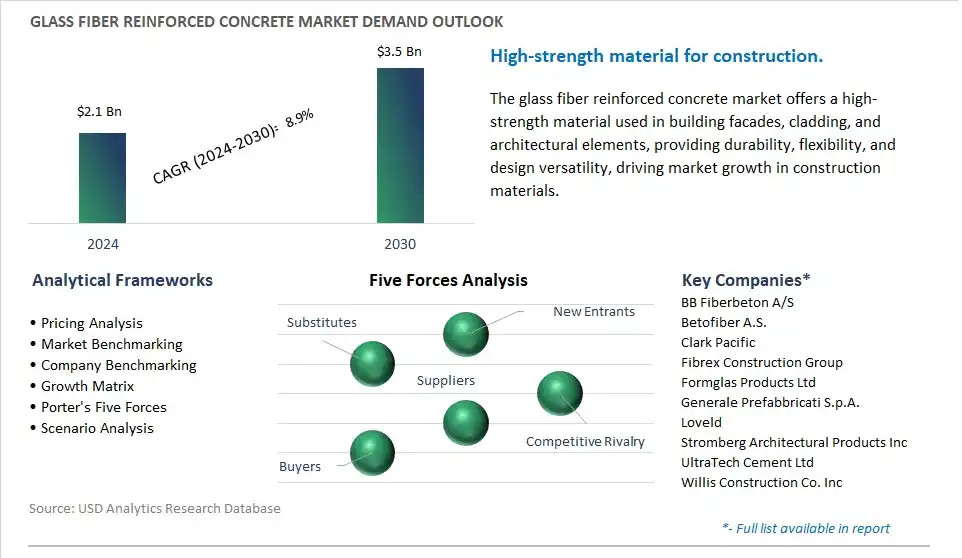
The global Glass Fiber Reinforced Concrete Market is poised to register a 8.9% CAGR from $2.1 Billion in 2024 to $3.5 Billion in 2030.
The global Glass Fiber Reinforced Concrete Market Study analyzes and forecasts the market size across 6 regions and 24 countries for diverse segments -By Process (Spray, Premix, Hybrid), By Application (Commercial, Residential).
An Introduction to Global Glass Fiber Reinforced Concrete Market in 2024
The future of the glass fiber reinforced concrete (GFRC) market is influenced by trends such as sustainable construction, architectural innovation, and advancements in material science driving innovation in GFRC formulations, manufacturing processes, and application versatility. GFRC is a composite material comprised of cement, fine aggregates, water, and alkali-resistant glass fibers, offering enhanced strength, durability, and flexibility compared to traditional concrete. Key trends shaping this market include advancements in GFRC formulations such as high-performance additives, recycled materials, and nano-reinforcements to improve mechanical properties, durability, and environmental sustainability while reducing material consumption and carbon footprint, the development of innovative manufacturing techniques such as spray-up, premix, and automated production systems to optimize material distribution, fiber orientation, and surface finish for diverse architectural and structural applications, and the adoption of GFRC in innovative construction projects such as facade panels, cladding systems, and lightweight architectural elements to achieve design flexibility, structural performance, and aesthetic appeal while minimizing construction time, cost, and environmental impact. As architects, engineers, and developers seek sustainable, cost-effective solutions for building construction and renovation projects, the demand for GFRC that offers superior performance, design flexibility, and environmental sustainability is expected to drive market growth and stimulate further innovation in GFRC technology and applications.
Glass Fiber Reinforced Concrete Market Competitive Landscape
The market report analyses the leading companies in the industry including BB Fiberbeton A/S, Betofiber A.S., Clark Pacific, Fibrex Construction Group, Formglas Products Ltd, Generale Prefabbricati S.p.A., Loveld, Stromberg Architectural Products Inc, UltraTech Cement Ltd, Willis Construction Co. Inc.
Glass Fiber Reinforced Concrete Market Dynamics
Glass Fiber Reinforced Concrete Market Trend: Increasing Demand for Lightweight and Durable Construction Materials
A significant trend in the glass fiber reinforced concrete (GFRC) market is the increasing demand for lightweight and durable construction materials. As the construction industry continues to prioritize sustainability, energy efficiency, and resilience, there is a growing interest in alternative building materials that offer superior strength-to-weight ratios, durability, and design flexibility. GFRC, which consists of cement, fine aggregates, water, and glass fibers, provides these desirable characteristics, making it an attractive choice for a wide range of architectural and structural applications. The trend towards lightweight and durable construction materials drives market growth for GFRC, as architects, engineers, and developers seek innovative solutions to meet the evolving needs of modern construction projects, fostering opportunities for market expansion and product development in the building materials industry.
Glass Fiber Reinforced Concrete Market Driver: Advantages in Construction Performance and Design Flexibility
The primary driver for the glass fiber reinforced concrete market is the advantages it offers in construction performance and design flexibility. GFRC combines the strength and durability of concrete with the lightweight properties and tensile strength of glass fibers, resulting in a material that is highly resistant to cracking, weathering, and impact damage while being significantly lighter than traditional concrete. This combination of properties allows GFRC to be used in a variety of applications, including cladding panels, architectural facades, countertops, decorative elements, and structural components, where its versatility and design flexibility enable the realization of complex shapes, intricate details, and innovative architectural designs. The superior performance and design versatility of GFRC drive market demand, as construction professionals seek materials that offer both structural integrity and aesthetic appeal, creating opportunities for GFRC manufacturers and suppliers to provide innovative solutions to the construction industry.
Glass Fiber Reinforced Concrete Market Opportunity: Expansion into Sustainable Building Projects and Green Construction Practices
An opportunity exists for companies operating in the glass fiber reinforced concrete market to expand into sustainable building projects and green construction practices. With growing awareness of environmental issues and increasing regulations aimed at reducing carbon emissions and energy consumption in the construction sector, there is a rising demand for sustainable building materials that offer environmental benefits and contribute to green building certifications such as LEED (Leadership in Energy and Environmental Design). GFRC, with its lower environmental impact, recyclability, and potential for energy savings during transportation and installation, aligns well with the principles of sustainable construction and presents opportunities for use in eco-friendly building projects. By promoting the sustainability advantages of GFRC and positioning it as a green building material, companies can capitalize on the growing market for sustainable construction solutions, differentiate themselves from competitors, and drive adoption of GFRC in environmentally conscious building projects, driving growth and market penetration in the construction industry.
Glass Fiber Reinforced Concrete Market Ecosystem
The Market Ecosystem of the Glass Fiber Reinforced Concrete (GFRC) market commences with the production of raw materials, notably AR glass fibers, sourced from leading manufacturers including Owens Corning, Saint-Gobain S.A., and Asahi Glass Co., Ltd. Cement, and sand, essential components for the concrete matrix, are supplied by regional producers including LafargeHolcim and Vulcan Materials Company. Optional additives are provided by construction chemical companies including BASF SE and Sika AG to enhance specific properties of the GFRC mix. GFRC mix production involves either pre-mixed formulations offered by companies including GCP Applied Technologies Inc. and Euclid Chemical Company or on-site mixing, which is prevalent in many applications.
GFRC fabrication companies, utilizing wet-cast or spray-up processes, manufacture various architectural elements and precast shapes. Quality control and testing occur to ensure compliance with industry standards for strength, durability, and surface quality. Distribution channels include direct sales from GFRC fabricators to construction companies and architects, which are the end users utilizing GFRC in diverse architectural and construction applications including cladding, decorative elements, roofing, and restoration projects, benefiting from its strength and compatibility with existing concrete structures.
Glass Fiber Reinforced Concrete Market Share Analysis: Premix Segment held the dominant revenue share in 2024
The Premix segment is the largest segment in the Glass Fiber Reinforced Concrete (GFRC) Market. This dominance is driven by premix GFRC offers convenience and consistency in manufacturing processes, making it a preferred choice for many construction projects. Premix GFRC consists of a pre-blended mixture of cement, sand, aggregates, additives, and glass fibers, which are precisely proportioned and controlled to ensure uniformity and quality in the final product. Additionally, premix GFRC reduces on-site labor and time requirements compared to spray or hybrid processes, making it ideal for both small-scale and large-scale construction applications. In addition, premix GFRC allows for better control over material properties, such as compressive strength, flexural strength, and durability, leading to enhanced structural performance and longevity of concrete elements. Further, the versatility of premix GFRC enables the production of a wide range of architectural and decorative elements, including panels, cladding, countertops, facades, and ornamental features, contributing to its widespread adoption in the construction industry. As the construction sector continues to embrace innovative materials and techniques for architectural design and structural applications, the Premix segment maintains its position as the largest in the GFRC Market.
Glass Fiber Reinforced Concrete Market Share Analysis: Commercial Segment is the fastest growing market segment over the forecast period to 2030
The Commercial segment is the fastest-growing segment in the Glass Fiber Reinforced Concrete (GFRC) Market. This rapid growth is driven by the commercial construction sector is experiencing significant growth globally, driven by urbanization, infrastructure development, and commercial real estate investments. GFRC offers numerous advantages for commercial applications, including its lightweight nature, high strength-to-weight ratio, and versatility in design and customization. Additionally, GFRC panels, cladding, and facade elements are increasingly preferred by architects and developers for their aesthetic appeal, durability, and ease of installation, contributing to their widespread adoption in commercial building projects such as office complexes, retail centers, hotels, and institutional buildings. In addition, the demand for sustainable and energy-efficient construction materials continues to rise in the commercial sector, with GFRC offering eco-friendly and energy-saving benefits compared to traditional building materials. Further, the ability of GFRC to replicate the look and texture of natural stone, wood, or metal finishes further enhances its appeal for commercial applications, driving its rapid growth in the GFRC Market. As commercial construction projects continue to expand globally, fueled by economic growth and urban development, the Commercial segment experiences significant growth in the adoption of GFRC solutions.
Glass Fiber Reinforced Concrete Market Report Scope-
By Process
Spray
Premix
Hybrid
By Application
Commercial
Residential
Glass Fiber Reinforced Concrete Market Companies Profiled
BB Fiberbeton A/S
Betofiber A.S.
Clark Pacific
Fibrex Construction Group
Formglas Products Ltd
Generale Prefabbricati S.p.A.
Loveld
Stromberg Architectural Products Inc
UltraTech Cement Ltd
Willis Construction Co. Inc
*- List Not Exhaustive
TABLE OF CONTENTS
1 Introduction to 2024 Glass Fiber Reinforced Concrete Market
1.1 Market Overview
1.2 Quick Facts
1.3 Scope/Objective of the Study
1.4 Market Definition
1.5 Countries and Regions Covered
1.6 Units, Currency, and Conversions
1.7 Industry Value Chain
2 Research Methodology
2.1 Market Size Estimation
2.2 Sources and Research Methodology
2.3 Data Triangulation
2.4 Assumptions and Limitations
3 Executive Summary
3.1 Global Glass Fiber Reinforced Concrete Market Size Outlook, $ Million, 2021 to 2030
3.2 Glass Fiber Reinforced Concrete Market Outlook by Type, $ Million, 2021 to 2030
3.3 Glass Fiber Reinforced Concrete Market Outlook by Product, $ Million, 2021 to 2030
3.4 Glass Fiber Reinforced Concrete Market Outlook by Application, $ Million, 2021 to 2030
3.5 Glass Fiber Reinforced Concrete Market Outlook by Key Countries, $ Million, 2021 to 2030
4 Market Dynamics
4.1 Key Driving Forces of Glass Fiber Reinforced Concrete Industry
4.2 Key Market Trends in Glass Fiber Reinforced Concrete Industry
4.3 Potential Opportunities in Glass Fiber Reinforced Concrete Industry
4.4 Key Challenges in Glass Fiber Reinforced Concrete Industry
5 Market Factor Analysis
5.1 Value Chain Analysis
5.2 Competitive Landscape
5.2.1 Global Glass Fiber Reinforced Concrete Market Share by Company (%), 2023
5.2.2 Product Offerings by Company
5.3 Porter’s Five Forces Analysis
5.4 Pricing Analysis and Outlook
6 Growth Outlook Across Scenarios
6.1 Growth Analysis-Case Scenario Definitions
6.2 Low Growth Scenario Forecasts
6.3 Reference Growth Scenario Forecasts
6.4 High Growth Scenario Forecasts
7 Global Glass Fiber Reinforced Concrete Market Outlook by Segments
7.1 Glass Fiber Reinforced Concrete Market Outlook by Segments, $ Million, 2021- 2030
By Process
Spray
Premix
Hybrid
By Application
Commercial
Residential
8 North America Glass Fiber Reinforced Concrete Market Analysis and Outlook To 2030
8.1 Introduction to North America Glass Fiber Reinforced Concrete Markets in 2024
8.2 North America Glass Fiber Reinforced Concrete Market Size Outlook by Country, 2021-2030
8.2.1 United States
8.2.2 Canada
8.2.3 Mexico
8.3 North America Glass Fiber Reinforced Concrete Market size Outlook by Segments, 2021-2030
By Process
Spray
Premix
Hybrid
By Application
Commercial
Residential
9 Europe Glass Fiber Reinforced Concrete Market Analysis and Outlook To 2030
9.1 Introduction to Europe Glass Fiber Reinforced Concrete Markets in 2024
9.2 Europe Glass Fiber Reinforced Concrete Market Size Outlook by Country, 2021-2030
9.2.1 Germany
9.2.2 France
9.2.3 Spain
9.2.4 United Kingdom
9.2.4 Italy
9.2.5 Russia
9.2.6 Norway
9.2.7 Rest of Europe
9.3 Europe Glass Fiber Reinforced Concrete Market Size Outlook by Segments, 2021-2030
By Process
Spray
Premix
Hybrid
By Application
Commercial
Residential
10 Asia Pacific Glass Fiber Reinforced Concrete Market Analysis and Outlook To 2030
10.1 Introduction to Asia Pacific Glass Fiber Reinforced Concrete Markets in 2024
10.2 Asia Pacific Glass Fiber Reinforced Concrete Market Size Outlook by Country, 2021-2030
10.2.1 China
10.2.2 India
10.2.3 Japan
10.2.4 South Korea
10.2.5 Indonesia
10.2.6 Malaysia
10.2.7 Australia
10.2.8 Rest of Asia Pacific
10.3 Asia Pacific Glass Fiber Reinforced Concrete Market size Outlook by Segments, 2021-2030
By Process
Spray
Premix
Hybrid
By Application
Commercial
Residential
11 South America Glass Fiber Reinforced Concrete Market Analysis and Outlook To 2030
11.1 Introduction to South America Glass Fiber Reinforced Concrete Markets in 2024
11.2 South America Glass Fiber Reinforced Concrete Market Size Outlook by Country, 2021-2030
11.2.1 Brazil
11.2.2 Argentina
11.2.3 Rest of South America
11.3 South America Glass Fiber Reinforced Concrete Market size Outlook by Segments, 2021-2030
By Process
Spray
Premix
Hybrid
By Application
Commercial
Residential
12 Middle East and Africa Glass Fiber Reinforced Concrete Market Analysis and Outlook To 2030
12.1 Introduction to Middle East and Africa Glass Fiber Reinforced Concrete Markets in 2024
12.2 Middle East and Africa Glass Fiber Reinforced Concrete Market Size Outlook by Country, 2021-2030
12.2.1 Saudi Arabia
12.2.2 UAE
12.2.3 Oman
12.2.4 Rest of Middle East
12.2.5 Egypt
12.2.6 Nigeria
12.2.7 South Africa
12.2.8 Rest of Africa
12.3 Middle East and Africa Glass Fiber Reinforced Concrete Market size Outlook by Segments, 2021-2030
By Process
Spray
Premix
Hybrid
By Application
Commercial
Residential
13 Company Profiles
13.1 Company Snapshot
13.2 SWOT Profiles
13.3 Products and Services
13.4 Recent Developments
13.5 Financial Profile
BB Fiberbeton A/S
Betofiber A.S.
Clark Pacific
Fibrex Construction Group
Formglas Products Ltd
Generale Prefabbricati S.p.A.
Loveld
Stromberg Architectural Products Inc
UltraTech Cement Ltd
Willis Construction Co. Inc
14 Appendix
14.1 Customization Offerings
14.2 Subscription Services
14.3 Related Reports
14.4 Publisher Expertise
By Process
Spray
Premix
Hybrid
By Application
Commercial
Residential
Countries Analyzed
North America (US, Canada, Mexico)
Europe (Germany, UK, France, Spain, Italy, Russia, Rest of Europe)
Asia Pacific (China, India, Japan, South Korea, Australia, South East Asia, Rest of Asia)
South America (Brazil, Argentina, Rest of South America)
Middle East and Africa (Saudi Arabia, UAE, Rest of Middle East, South Africa, Egypt, Rest of Africa)
