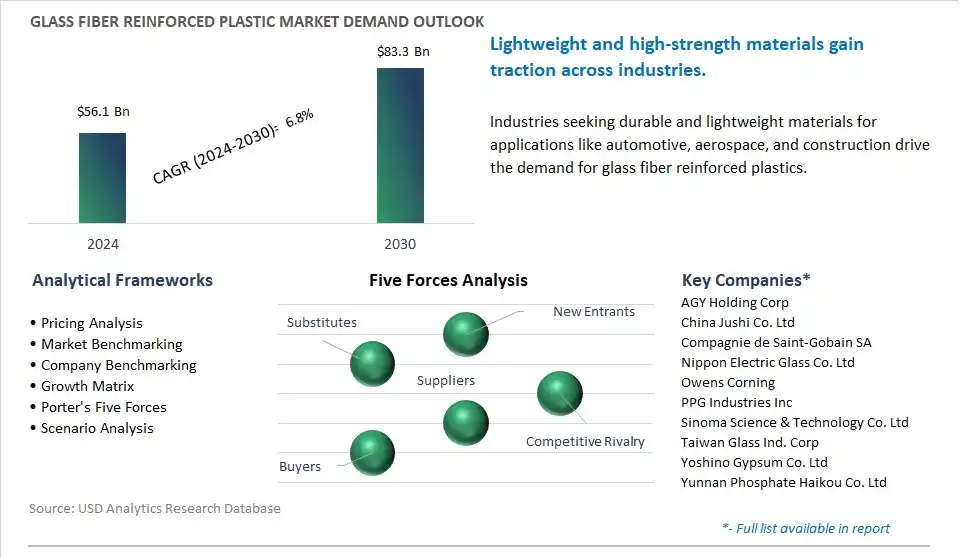
The global Glass Fiber Reinforced Plastic Market is poised to register a 6.8% CAGR from $56.1 Billion in 2024 to $83.3 Billion in 2030.
The global Glass Fiber Reinforced Plastic Market Study analyzes and forecasts the market size across 6 regions and 24 countries for diverse segments -By Resin (Polyester resin, Vinyl ester resin, Epoxy resin, Polyurethane resin, Others), By Process (Manual process, Continuous process, Compression molding, Injection molding), By End-User (Aerospace, Construction, Wind energy, Automotive, Electronics, Others).
An Introduction to Global Glass Fiber Reinforced Plastic Market in 2024
Glass Fiber Reinforced Plastic Market: The glass fiber reinforced plastic (GRP) market in 2024 experiences growth driven by its lightweight, high strength-to-weight ratio, and corrosion-resistant properties, making it a preferred material in automotive, aerospace, construction, and marine applications. GRP offers benefits such as design flexibility, durability, and energy efficiency, replacing traditional materials like metal and wood in various structural components and composite parts. With sustainability goals, regulatory standards, and technological advancements shaping material choices, the GRP market witnesses innovations in resin formulations, composite manufacturing processes, and applications in sustainable infrastructure, renewable energy, and transportation sectors, driving market expansion and adoption of GRP solutions globally.
Glass Fiber Reinforced Plastic Market Competitive Landscape
The market report analyses the leading companies in the industry including AGY Holding Corp, China Jushi Co. Ltd, Compagnie de Saint-Gobain SA, Nippon Electric Glass Co. Ltd, Owens Corning, PPG Industries Inc, Sinoma Science & Technology Co. Ltd, Taiwan Glass Ind. Corp, Yoshino Gypsum Co. Ltd, Yunnan Phosphate Haikou Co. Ltd.
Glass Fiber Reinforced Plastic Market Dynamics
Glass Fiber Reinforced Plastic Market Trend: Increased Demand for Lightweight and Durable Materials
One prominent market trend in the glass fiber reinforced plastic (GRP) industry is the heightened demand for lightweight and durable materials across various sectors. Industries such as automotive, aerospace, construction, and marine are increasingly turning to GRP composites for their superior strength-to-weight ratio, corrosion resistance, and versatility. This trend is driven by the need to reduce overall weight without compromising on performance, fuel efficiency, or structural integrity. As regulations focus on emission reduction and sustainability, GRP materials offer a viable solution by enabling manufacturers to produce lighter vehicles, aircraft, infrastructure components, and equipment, thereby shaping the future of lightweight engineering and advanced materials.
Glass Fiber Reinforced Plastic Market Driver: Growing Emphasis on Infrastructure Development
A significant driver propelling the growth of the glass fiber reinforced plastic market is the global emphasis on infrastructure development and modernization. Governments worldwide are investing in infrastructure projects such as bridges, tunnels, railways, and utilities to address urbanization, transportation challenges, and sustainability goals. GRP composites play a vital role in these projects due to their durability, corrosion resistance, and low maintenance requirements, making them ideal for harsh environments and long-term structural applications. As infrastructure spending continues to rise, the demand for GRP materials is expected to soar, driving market expansion and innovation in construction and civil engineering sectors.
Glass Fiber Reinforced Plastic Market Opportunity: Advancements in Renewable Energy Technologies
An emerging opportunity for the glass fiber reinforced plastic market lies in the advancements in renewable energy technologies, particularly in wind energy. Wind turbines, essential components of wind power generation, rely heavily on GRP composites for their blades, nacelles, and other structural elements. As the global shift towards clean energy accelerates, there's a growing demand for larger, more efficient wind turbines capable of harnessing stronger winds at higher altitudes. GRP materials offer the necessary strength, flexibility, and fatigue resistance to withstand the dynamic forces encountered in wind turbine applications. By leveraging these capabilities and investing in research and development, manufacturers can capitalize on the opportunity to cater to the expanding renewable energy sector, driving market growth and sustainability initiatives.
Glass Fiber Reinforced Plastic Market Share Analysis: Polyester resin held the highest revenue share in 2024
The largest segment in Glass Fiber Reinforced Plastic (GRP) is Polyester resin. Polyester resin is widely used in the GRP industry due to its excellent mechanical properties, chemical resistance, and cost-effectiveness. It is commonly utilized in various applications such as automotive components, marine structures, construction materials, and recreational products. The popularity of Polyester resin in GRP manufacturing can be attributed to its versatility, ease of processing, and ability to achieve different mechanical properties by adjusting formulation parameters. While other resins like Vinyl ester resin, Epoxy resin, Polyurethane resin, and others also find applications in specific industries, Polyester resin remains the dominant choice in the GRP market.
Glass Fiber Reinforced Plastic Market Share Analysis: Continuous process segment is poised to register the fastest growth rate (CAGR) over the forecast period to 2030
The fastest-growing segment in Glass Fiber Reinforced Plastic (GRP) is the Continuous process. Continuous process technology offers several advantages over traditional manual processes, compression molding, and injection molding in GRP manufacturing. It allows for the continuous production of GRP products, resulting in higher production efficiency, reduced labor costs, and improved product consistency. The continuous process also enables the production of complex shapes and large-sized components with uniform mechanical properties and surface finish. These benefits have led to an increased adoption of continuous process technology in various industries such as automotive, aerospace, construction, and marine for manufacturing lightweight, high-strength GRP components.
Glass Fiber Reinforced Plastic Market Share Analysis: Construction held the highest revenue share in 2024
The largest segment in Glass Fiber Reinforced Plastic (GRP) by end-user is the Construction industry. GRP materials find extensive use in construction applications due to their excellent mechanical properties, such as high strength-to-weight ratio, corrosion resistance, and durability. In the construction sector, GRP is used for manufacturing roofing panels, wall cladding, structural profiles, pipes, and tanks. Its ability to withstand harsh environmental conditions, including exposure to chemicals and weathering, makes it a preferred choice for infrastructure projects. Additionally, GRP's versatility allows architects and engineers to design complex structures efficiently while ensuring long-term performance and reduced maintenance costs.
Glass Fiber Reinforced Plastic Market Report Segmentation
By Resin
Polyester resin
Vinyl ester resin
Epoxy resin
Polyurethane resin
Others
By Process
Manual process
Continuous process
Compression molding
Injection molding
By End-User
Aerospace
Construction
Wind energy
Automotive
Electronics
Others
Regions Included
North America (US, Canada, Mexico)
Europe (Germany, UK, France, Spain, Italy, Russia, Rest of Europe)
Asia Pacific (China, India, Japan, South Korea, Australia, South East Asia, Rest of Asia)
South America (Brazil, Argentina, Rest of South America)
Middle East and Africa (Saudi Arabia, UAE, Rest of Middle East, South Africa, Egypt, Rest of Africa)
Glass Fiber Reinforced Plastic Companies Profiled in the Market Study
AGY Holding Corp
China Jushi Co. Ltd
Compagnie de Saint-Gobain SA
Nippon Electric Glass Co. Ltd
Owens Corning
PPG Industries Inc
Sinoma Science & Technology Co. Ltd
Taiwan Glass Ind. Corp
Yoshino Gypsum Co. Ltd
Yunnan Phosphate Haikou Co. Ltd
*- List Not Exhaustive
TABLE OF CONTENTS
1 Introduction to 2024 Glass Fiber Reinforced Plastic Market
1.1 Market Overview
1.2 Quick Facts
1.3 Scope/Objective of the Study
1.4 Market Definition
1.5 Countries and Regions Covered
1.6 Units, Currency, and Conversions
1.7 Industry Value Chain
2 Research Methodology
2.1 Market Size Estimation
2.2 Sources and Research Methodology
2.3 Data Triangulation
2.4 Assumptions and Limitations
3 Executive Summary
3.1 Global Glass Fiber Reinforced Plastic Market Size Outlook, $ Million, 2021 to 2030
3.2 Glass Fiber Reinforced Plastic Market Outlook by Type, $ Million, 2021 to 2030
3.3 Glass Fiber Reinforced Plastic Market Outlook by Product, $ Million, 2021 to 2030
3.4 Glass Fiber Reinforced Plastic Market Outlook by Application, $ Million, 2021 to 2030
3.5 Glass Fiber Reinforced Plastic Market Outlook by Key Countries, $ Million, 2021 to 2030
4 Market Dynamics
4.1 Key Driving Forces of Glass Fiber Reinforced Plastic Industry
4.2 Key Market Trends in Glass Fiber Reinforced Plastic Industry
4.3 Potential Opportunities in Glass Fiber Reinforced Plastic Industry
4.4 Key Challenges in Glass Fiber Reinforced Plastic Industry
5 Market Factor Analysis
5.1 Value Chain Analysis
5.2 Competitive Landscape
5.2.1 Global Glass Fiber Reinforced Plastic Market Share by Company (%), 2023
5.2.2 Product Offerings by Company
5.3 Porter’s Five Forces Analysis
5.4 Pricing Analysis and Outlook
6 Growth Outlook Across Scenarios
6.1 Growth Analysis-Case Scenario Definitions
6.2 Low Growth Scenario Forecasts
6.3 Reference Growth Scenario Forecasts
6.4 High Growth Scenario Forecasts
7 Global Glass Fiber Reinforced Plastic Market Outlook by Segments
7.1 Glass Fiber Reinforced Plastic Market Outlook by Segments, $ Million, 2021- 2030
By Resin
Polyester resin
Vinyl ester resin
Epoxy resin
Polyurethane resin
Others
By Process
Manual process
Continuous process
Compression molding
Injection molding
By End-User
Aerospace
Construction
Wind energy
Automotive
Electronics
Others
8 North America Glass Fiber Reinforced Plastic Market Analysis and Outlook To 2030
8.1 Introduction to North America Glass Fiber Reinforced Plastic Markets in 2024
8.2 North America Glass Fiber Reinforced Plastic Market Size Outlook by Country, 2021-2030
8.2.1 United States
8.2.2 Canada
8.2.3 Mexico
8.3 North America Glass Fiber Reinforced Plastic Market size Outlook by Segments, 2021-2030
By Resin
Polyester resin
Vinyl ester resin
Epoxy resin
Polyurethane resin
Others
By Process
Manual process
Continuous process
Compression molding
Injection molding
By End-User
Aerospace
Construction
Wind energy
Automotive
Electronics
Others
9 Europe Glass Fiber Reinforced Plastic Market Analysis and Outlook To 2030
9.1 Introduction to Europe Glass Fiber Reinforced Plastic Markets in 2024
9.2 Europe Glass Fiber Reinforced Plastic Market Size Outlook by Country, 2021-2030
9.2.1 Germany
9.2.2 France
9.2.3 Spain
9.2.4 United Kingdom
9.2.4 Italy
9.2.5 Russia
9.2.6 Norway
9.2.7 Rest of Europe
9.3 Europe Glass Fiber Reinforced Plastic Market Size Outlook by Segments, 2021-2030
By Resin
Polyester resin
Vinyl ester resin
Epoxy resin
Polyurethane resin
Others
By Process
Manual process
Continuous process
Compression molding
Injection molding
By End-User
Aerospace
Construction
Wind energy
Automotive
Electronics
Others
10 Asia Pacific Glass Fiber Reinforced Plastic Market Analysis and Outlook To 2030
10.1 Introduction to Asia Pacific Glass Fiber Reinforced Plastic Markets in 2024
10.2 Asia Pacific Glass Fiber Reinforced Plastic Market Size Outlook by Country, 2021-2030
10.2.1 China
10.2.2 India
10.2.3 Japan
10.2.4 South Korea
10.2.5 Indonesia
10.2.6 Malaysia
10.2.7 Australia
10.2.8 Rest of Asia Pacific
10.3 Asia Pacific Glass Fiber Reinforced Plastic Market size Outlook by Segments, 2021-2030
By Resin
Polyester resin
Vinyl ester resin
Epoxy resin
Polyurethane resin
Others
By Process
Manual process
Continuous process
Compression molding
Injection molding
By End-User
Aerospace
Construction
Wind energy
Automotive
Electronics
Others
11 South America Glass Fiber Reinforced Plastic Market Analysis and Outlook To 2030
11.1 Introduction to South America Glass Fiber Reinforced Plastic Markets in 2024
11.2 South America Glass Fiber Reinforced Plastic Market Size Outlook by Country, 2021-2030
11.2.1 Brazil
11.2.2 Argentina
11.2.3 Rest of South America
11.3 South America Glass Fiber Reinforced Plastic Market size Outlook by Segments, 2021-2030
By Resin
Polyester resin
Vinyl ester resin
Epoxy resin
Polyurethane resin
Others
By Process
Manual process
Continuous process
Compression molding
Injection molding
By End-User
Aerospace
Construction
Wind energy
Automotive
Electronics
Others
12 Middle East and Africa Glass Fiber Reinforced Plastic Market Analysis and Outlook To 2030
12.1 Introduction to Middle East and Africa Glass Fiber Reinforced Plastic Markets in 2024
12.2 Middle East and Africa Glass Fiber Reinforced Plastic Market Size Outlook by Country, 2021-2030
12.2.1 Saudi Arabia
12.2.2 UAE
12.2.3 Oman
12.2.4 Rest of Middle East
12.2.5 Egypt
12.2.6 Nigeria
12.2.7 South Africa
12.2.8 Rest of Africa
12.3 Middle East and Africa Glass Fiber Reinforced Plastic Market size Outlook by Segments, 2021-2030
By Resin
Polyester resin
Vinyl ester resin
Epoxy resin
Polyurethane resin
Others
By Process
Manual process
Continuous process
Compression molding
Injection molding
By End-User
Aerospace
Construction
Wind energy
Automotive
Electronics
Others
13 Company Profiles
13.1 Company Snapshot
13.2 SWOT Profiles
13.3 Products and Services
13.4 Recent Developments
13.5 Financial Profile
AGY Holding Corp
China Jushi Co. Ltd
Compagnie de Saint-Gobain SA
Nippon Electric Glass Co. Ltd
Owens Corning
PPG Industries Inc
Sinoma Science & Technology Co. Ltd
Taiwan Glass Ind. Corp
Yoshino Gypsum Co. Ltd
Yunnan Phosphate Haikou Co. Ltd
14 Appendix
14.1 Customization Offerings
14.2 Subscription Services
14.3 Related Reports
14.4 Publisher Expertise
By Resin
Polyester resin
Vinyl ester resin
Epoxy resin
Polyurethane resin
Others
By Process
Manual process
Continuous process
Compression molding
Injection molding
By End-User
Aerospace
Construction
Wind energy
Automotive
Electronics
Others
Countries Analyzed
North America (US, Canada, Mexico)
Europe (Germany, UK, France, Spain, Italy, Russia, Rest of Europe)
Asia Pacific (China, India, Japan, South Korea, Australia, South East Asia, Rest of Asia)
South America (Brazil, Argentina, Rest of South America)
Middle East and Africa (Saudi Arabia, UAE, Rest of Middle East, South Africa, Egypt, Rest of Africa)
