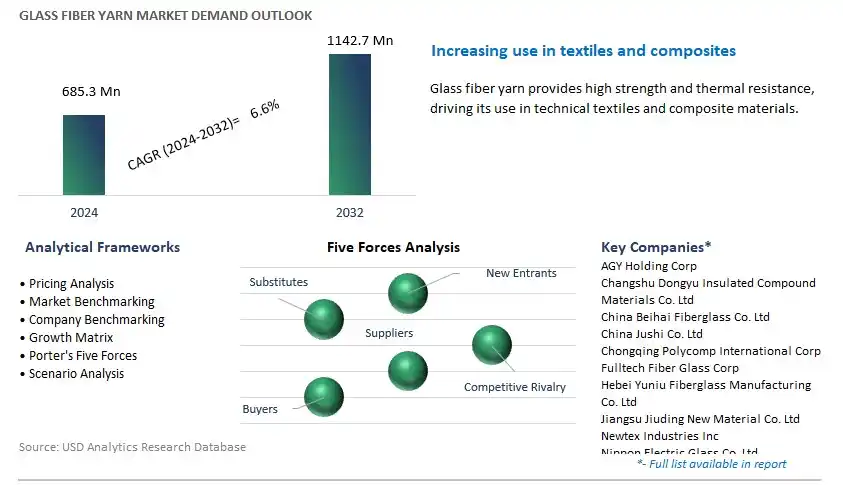
Global Glass Fiber Yarn Market Size is valued at $685.3 Million in 2024 and is forecast to register a growth rate (CAGR) of 6.6% to reach $1142.7 Million by 2032.
The global Glass Fiber Yarn Market Study analyzes and forecasts the market size across 6 regions and 24 countries for diverse segments -By Glass Fiber Type (E-Glass type, S-Glass type, Others), By Yarn Type (Single Yarn, Piled Yarn, Others), By End-User (Wind Energy, Automotive & Transportation, Building & Construction, Marine, Electrical & Electronics, Others), By Application (PCB, Structural Parts, Facade, Marble & Mosaic Tiles, Others).
An Introduction to Glass Fiber Yarn Market in 2024
Glass fiber yarn serves as a fundamental building block for various composite materials used in aerospace, automotive, marine, construction, and textile industries. In 2024, the market for glass fiber yarn is witnessing steady growth driven by increasing demand for lightweight, high-strength reinforcement materials in structural and functional applications. These yarns, composed of continuous strands of glass filaments, offer advantages such as high tensile strength, dimensional stability, and corrosion resistance, meeting diverse performance requirements. Further, advancements in glass fiber yarn manufacturing processes, including multi-end roving and direct roving technologies, ensure uniformity and consistency in yarn properties for downstream processing. As industries seek reliable and cost-effective solutions for product innovation and performance enhancement, the demand for glass fiber yarn is expected to remain strong, supporting d research and development in the field.
Glass Fiber Yarn Market Competitive Landscape
The market report analyses the leading companies in the industry including AGY Holding Corp, Changshu Dongyu Insulated Compound Materials Co. Ltd, China Beihai Fiberglass Co. Ltd, China Jushi Co. Ltd, Chongqing Polycomp International Corp, Fulltech Fiber Glass Corp, Hebei Yuniu Fiberglass Manufacturing Co. Ltd, Jiangsu Jiuding New Material Co. Ltd, Newtex Industries Inc, Nippon Electric Glass Co. Ltd, Nitto Boseki Co. Ltd, Owens Corning, Parabeam BV, PFG Fiber Glass Corp, PPG Industries Inc, Saint-Gobain S.A., Shree Laxmi Udyog, Taishan Fiberglass Inc, Taiwan Glass Industry Corp, Valmieras Stikla Siedra, and others.
Glass Fiber Yarn Market Dynamics
Market Trend: Increasing Demand for Lightweight and High-Strength Materials
A prominent trend in the glass fiber yarn market is the increasing demand for lightweight and high-strength materials across various industries. With a focus on improving product performance, fuel efficiency, and sustainability, there is a growing preference for materials that offer superior strength-to-weight ratios and durability. Glass fiber yarn, characterized by its excellent tensile strength, corrosion resistance, and thermal stability, is witnessing rising adoption in applications such as aerospace, automotive, construction, and wind energy. Industries are leveraging glass fiber yarn to reduce weight, enhance structural integrity, and improve overall product efficiency, reflecting a broader market trend towards lightweighting and material optimization.
Market Driver: Growth in Wind Energy and Composite Manufacturing
A key driver fueling the demand for glass fiber yarn is the growth in wind energy and composite manufacturing industries, where glass fibers serve as a fundamental component in the production of composite materials. With the increasing deployment of wind turbines and the expansion of composite manufacturing facilities worldwide, there is a growing need for glass fiber yarn to reinforce composite structures such as turbine blades, automotive components, marine vessels, and infrastructure elements. Glass fiber yarn's superior mechanical properties, chemical resistance, and compatibility with resin systems make it an essential reinforcement material in composite manufacturing processes such as filament winding, pultrusion, and resin infusion. Additionally, the rising demand for lightweight and durable materials in aerospace, automotive, and construction sectors further drives market growth for glass fiber yarn as a preferred reinforcement solution.
Market Opportunity: Expansion into High-Temperature and Specialty Applications
Amidst the evolving landscape of the glass fiber yarn market, there exists a significant opportunity for expansion into high-temperature and specialty applications. Manufacturers can capitalize on this opportunity by developing glass fiber yarn products tailored to meet the unique requirements of industries such as aerospace, defense, and industrial manufacturing, where high-temperature resistance, flame retardancy, and chemical stability are critical. Glass fiber yarns with enhanced heat-resistant coatings, ceramic additives, or specialty finishes can be utilized in applications such as thermal insulation, fire protection, and reinforcement in extreme environments. Additionally, there are opportunities to develop glass fiber yarns with specialized properties such as electrical conductivity, electromagnetic shielding, and corrosion resistance for applications in electronics, telecommunications, and chemical processing industries. By leveraging their expertise in glass fiber technology and collaborating with stakeholders in niche markets, companies can address emerging market needs, diversify their product offerings, and unlock growth opportunities in the dynamic glass fiber yarn market.
Glass Fiber Yarn Market Share Analysis: E-Glass Type segment generated the highest revenue in 2024
The E-Glass type segment stands as the largest in the Glass Fiber Yarn market. E-Glass, also known as electrical glass, is the most commonly used type of glass fiber due to its excellent electrical insulation properties, high tensile strength, and chemical resistance. These properties make E-Glass fibers suitable for a wide range of applications across various industries, including aerospace, automotive, construction, and electronics. In the aerospace industry, E-Glass fibers are used for manufacturing lightweight and high-strength composite materials for aircraft components such as fuselage panels and interior structures. In the automotive sector, E-Glass fibers are utilized for reinforcing polymer composites in components such as bumpers, body panels, and under-the-hood parts, contributing to vehicle lightweighting and fuel efficiency. Moreover, E-Glass fibers are extensively used in the construction industry for reinforcing concrete and composite materials in structures such as bridges, buildings, and pipelines, enhancing their mechanical properties and durability. Additionally, E-Glass fibers find applications in electrical insulation materials, textiles, and filtration media, further expanding their market reach. As industries continue to seek lightweight, durable, and cost-effective materials for various applications, the versatility and performance characteristics of E-Glass fibers solidify their position as the largest segment in the Glass Fiber Yarn market.
Glass Fiber Yarn Market Share Analysis: Piled Yarn is poised to register the fastest CAGR over the forecast period
The piled yarn segment is the fastest-growing segment in the Glass Fiber Yarn market. Piled yarns are composed of multiple individual yarns twisted together to form a thicker and stronger yarn with enhanced properties compared to single yarns. This construction method allows piled yarns to exhibit superior tensile strength, abrasion resistance, and dimensional stability, making them ideal for demanding applications that require high-performance materials. In industries such as aerospace, automotive, and wind energy, piled yarns are utilized for manufacturing composite materials used in critical structural components such as aircraft fuselages, automotive chassis, and wind turbine blades. The increased demand for lightweight and durable materials in these sectors, coupled with the growing trend towards composite materials for lightweighting and fuel efficiency, drives the adoption of piled yarns. Moreover, advancements in manufacturing technologies, such as precision winding and twisting processes, enable the production of piled yarns with consistent quality and performance characteristics, further fuelling their growth. Additionally, as industries continue to prioritize sustainability and environmental responsibility, piled yarns offer benefits such as reduced material waste and improved resource efficiency, contributing to their increasing popularity in the Glass Fiber Yarn market. Over the forecast period, the superior properties and growing demand for piled yarns in high-performance applications make them the fastest-growing segment in the market.
Glass Fiber Yarn Market
By Glass Fiber Type
E-Glass type
S-Glass type
Others
By Yarn Type
Single Yarn
Piled Yarn
Others
By End-User
Wind Energy
Automotive & Transportation
Building & Construction
Marine
Electrical & Electronics
Others
By Application
PCB
Structural Parts
Facade
Marble & Mosaic Tiles
Others
Countries Analyzed
North America (US, Canada, Mexico)
Europe (Germany, UK, France, Spain, Italy, Russia, Rest of Europe)
Asia Pacific (China, India, Japan, South Korea, Australia, South East Asia, Rest of Asia)
South America (Brazil, Argentina, Rest of South America)
Middle East and Africa (Saudi Arabia, UAE, Rest of Middle East, South Africa, Egypt, Rest of Africa)
Glass Fiber Yarn Companies Profiled in the Study
AGY Holding Corp
Changshu Dongyu Insulated Compound Materials Co. Ltd
China Beihai Fiberglass Co. Ltd
China Jushi Co. Ltd
Chongqing Polycomp International Corp
Fulltech Fiber Glass Corp
Hebei Yuniu Fiberglass Manufacturing Co. Ltd
Jiangsu Jiuding New Material Co. Ltd
Newtex Industries Inc
Nippon Electric Glass Co. Ltd
Nitto Boseki Co. Ltd
Owens Corning
Parabeam BV
PFG Fiber Glass Corp
PPG Industries Inc
Saint-Gobain S.A.
Shree Laxmi Udyog
Taishan Fiberglass Inc
Taiwan Glass Industry Corp
Valmieras Stikla Siedra
*- List Not Exhaustive
TABLE OF CONTENTS
1 Introduction to 2024 Glass Fiber Yarn Market
1.1 Market Overview
1.2 Quick Facts
1.3 Scope/Objective of the Study
1.4 Market Definition
1.5 Countries and Regions Covered
1.6 Units, Currency, and Conversions
1.7 Industry Value Chain
2 Research Methodology
2.1 Market Size Estimation
2.2 Sources and Research Methodology
2.3 Data Triangulation
2.4 Assumptions and Limitations
3 Executive Summary
3.1 Global Glass Fiber Yarn Market Size Outlook, $ Million, 2021 to 2032
3.2 Glass Fiber Yarn Market Outlook by Type, $ Million, 2021 to 2032
3.3 Glass Fiber Yarn Market Outlook by Product, $ Million, 2021 to 2032
3.4 Glass Fiber Yarn Market Outlook by Application, $ Million, 2021 to 2032
3.5 Glass Fiber Yarn Market Outlook by Key Countries, $ Million, 2021 to 2032
4 Market Dynamics
4.1 Key Driving Forces of Glass Fiber Yarn Industry
4.2 Key Market Trends in Glass Fiber Yarn Industry
4.3 Potential Opportunities in Glass Fiber Yarn Industry
4.4 Key Challenges in Glass Fiber Yarn Industry
5 Market Factor Analysis
5.1 Value Chain Analysis
5.2 Competitive Landscape
5.2.1 Global Glass Fiber Yarn Market Share by Company (%), 2023
5.2.2 Product Offerings by Company
5.3 Porter’s Five Forces Analysis
5.4 Pricing Analysis and Outlook
6 Growth Outlook Across Scenarios
6.1 Growth Analysis-Case Scenario Definitions
6.2 Low Growth Scenario Forecasts
6.3 Reference Growth Scenario Forecasts
6.4 High Growth Scenario Forecasts
7 Global Glass Fiber Yarn Market Outlook by Segments
7.1 Glass Fiber Yarn Market Outlook by Segments, $ Million, 2021- 2032
By Glass Fiber Type
E-Glass type
S-Glass type
Others
By Yarn Type
Single Yarn
Piled Yarn
Others
By End-User
Wind Energy
Automotive & Transportation
Building & Construction
Marine
Electrical & Electronics
Others
By Application
PCB
Structural Parts
Facade
Marble & Mosaic Tiles
Others
8 North America Glass Fiber Yarn Market Analysis and Outlook To 2032
8.1 Introduction to North America Glass Fiber Yarn Markets in 2024
8.2 North America Glass Fiber Yarn Market Size Outlook by Country, 2021-2032
8.2.1 United States
8.2.2 Canada
8.2.3 Mexico
8.3 North America Glass Fiber Yarn Market size Outlook by Segments, 2021-2032
By Glass Fiber Type
E-Glass type
S-Glass type
Others
By Yarn Type
Single Yarn
Piled Yarn
Others
By End-User
Wind Energy
Automotive & Transportation
Building & Construction
Marine
Electrical & Electronics
Others
By Application
PCB
Structural Parts
Facade
Marble & Mosaic Tiles
Others
9 Europe Glass Fiber Yarn Market Analysis and Outlook To 2032
9.1 Introduction to Europe Glass Fiber Yarn Markets in 2024
9.2 Europe Glass Fiber Yarn Market Size Outlook by Country, 2021-2032
9.2.1 Germany
9.2.2 France
9.2.3 Spain
9.2.4 United Kingdom
9.2.4 Italy
9.2.5 Russia
9.2.6 Norway
9.2.7 Rest of Europe
9.3 Europe Glass Fiber Yarn Market Size Outlook by Segments, 2021-2032
By Glass Fiber Type
E-Glass type
S-Glass type
Others
By Yarn Type
Single Yarn
Piled Yarn
Others
By End-User
Wind Energy
Automotive & Transportation
Building & Construction
Marine
Electrical & Electronics
Others
By Application
PCB
Structural Parts
Facade
Marble & Mosaic Tiles
Others
10 Asia Pacific Glass Fiber Yarn Market Analysis and Outlook To 2032
10.1 Introduction to Asia Pacific Glass Fiber Yarn Markets in 2024
10.2 Asia Pacific Glass Fiber Yarn Market Size Outlook by Country, 2021-2032
10.2.1 China
10.2.2 India
10.2.3 Japan
10.2.4 South Korea
10.2.5 Indonesia
10.2.6 Malaysia
10.2.7 Australia
10.2.8 Rest of Asia Pacific
10.3 Asia Pacific Glass Fiber Yarn Market size Outlook by Segments, 2021-2032
By Glass Fiber Type
E-Glass type
S-Glass type
Others
By Yarn Type
Single Yarn
Piled Yarn
Others
By End-User
Wind Energy
Automotive & Transportation
Building & Construction
Marine
Electrical & Electronics
Others
By Application
PCB
Structural Parts
Facade
Marble & Mosaic Tiles
Others
11 South America Glass Fiber Yarn Market Analysis and Outlook To 2032
11.1 Introduction to South America Glass Fiber Yarn Markets in 2024
11.2 South America Glass Fiber Yarn Market Size Outlook by Country, 2021-2032
11.2.1 Brazil
11.2.2 Argentina
11.2.3 Rest of South America
11.3 South America Glass Fiber Yarn Market size Outlook by Segments, 2021-2032
By Glass Fiber Type
E-Glass type
S-Glass type
Others
By Yarn Type
Single Yarn
Piled Yarn
Others
By End-User
Wind Energy
Automotive & Transportation
Building & Construction
Marine
Electrical & Electronics
Others
By Application
PCB
Structural Parts
Facade
Marble & Mosaic Tiles
Others
12 Middle East and Africa Glass Fiber Yarn Market Analysis and Outlook To 2032
12.1 Introduction to Middle East and Africa Glass Fiber Yarn Markets in 2024
12.2 Middle East and Africa Glass Fiber Yarn Market Size Outlook by Country, 2021-2032
12.2.1 Saudi Arabia
12.2.2 UAE
12.2.3 Oman
12.2.4 Rest of Middle East
12.2.5 Egypt
12.2.6 Nigeria
12.2.7 South Africa
12.2.8 Rest of Africa
12.3 Middle East and Africa Glass Fiber Yarn Market size Outlook by Segments, 2021-2032
By Glass Fiber Type
E-Glass type
S-Glass type
Others
By Yarn Type
Single Yarn
Piled Yarn
Others
By End-User
Wind Energy
Automotive & Transportation
Building & Construction
Marine
Electrical & Electronics
Others
By Application
PCB
Structural Parts
Facade
Marble & Mosaic Tiles
Others
13 Company Profiles
13.1 Company Snapshot
13.2 SWOT Profiles
13.3 Products and Services
13.4 Recent Developments
13.5 Financial Profile
AGY Holding Corp
Changshu Dongyu Insulated Compound Materials Co. Ltd
China Beihai Fiberglass Co. Ltd
China Jushi Co. Ltd
Chongqing Polycomp International Corp
Fulltech Fiber Glass Corp
Hebei Yuniu Fiberglass Manufacturing Co. Ltd
Jiangsu Jiuding New Material Co. Ltd
Newtex Industries Inc
Nippon Electric Glass Co. Ltd
Nitto Boseki Co. Ltd
Owens Corning
Parabeam BV
PFG Fiber Glass Corp
PPG Industries Inc
Saint-Gobain S.A.
Shree Laxmi Udyog
Taishan Fiberglass Inc
Taiwan Glass Industry Corp
Valmieras Stikla Siedra
14 Appendix
14.1 Customization Offerings
14.2 Subscription Services
14.3 Related Reports
14.4 Publisher Expertise
By Glass Fiber Type
E-Glass type
S-Glass type
Others
By Yarn Type
Single Yarn
Piled Yarn
Others
By End-User
Wind Energy
Automotive & Transportation
Building & Construction
Marine
Electrical & Electronics
Others
By Application
PCB
Structural Parts
Facade
Marble & Mosaic Tiles
Others
Countries Analyzed
North America (US, Canada, Mexico)
Europe (Germany, UK, France, Spain, Italy, Russia, Rest of Europe)
Asia Pacific (China, India, Japan, South Korea, Australia, South East Asia, Rest of Asia)
South America (Brazil, Argentina, Rest of South America)
Middle East and Africa (Saudi Arabia, UAE, Rest of Middle East, South Africa, Egypt, Rest of Africa)
