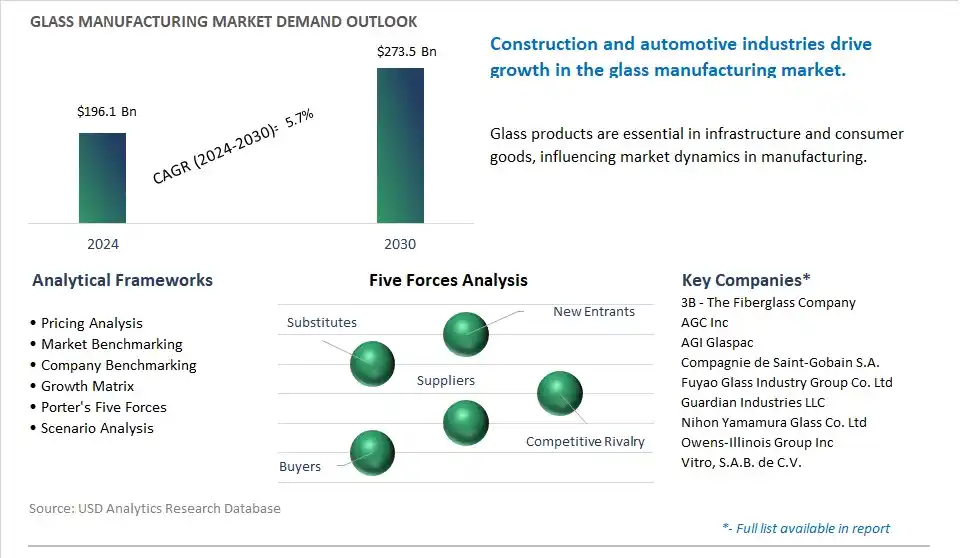
The global Glass Manufacturing Market is poised to register a 5.7% CAGR from $196.1 Billion in 2024 to $273.5 Billion in 2030.
The global Glass Manufacturing Market Study analyzes and forecasts the market size across 6 regions and 24 countries for diverse segments -By Product (Container Glass, Flat Glass, Fiber Glass, Others), By Application (Packaging, Construction, Transportation, Electrical & Electronics, Telecommunication, Others).
An Introduction to Global Glass Manufacturing Market in 2024
The glass manufacturing market is witnessing steady growth driven by the increasing demand for glass products in construction, automotive, packaging, and consumer electronics industries. Key trends shaping the future of the industry include the adoption of advanced glassmaking technologies, sustainable manufacturing practices, and circular economy principles to improve energy efficiency, reduce emissions, and minimize waste generation throughout the glass production lifecycle. As glass manufacturers strive to meet growing market demand while addressing environmental and regulatory challenges, there's a growing need for innovative glass formulations, melting technologies, and process optimization strategies that enhance productivity, quality, and environmental performance while reducing resource consumption, raw material costs, and carbon footprint associated with traditional glassmaking methods. Moreover, advancements in glass manufacturing equipment, such as furnaces, forming machines, and coating systems, are driving market expansion by improving production efficiency, yield, and product diversity while enabling the development of specialty glass products with enhanced functionalities such as strength, transparency, and thermal insulation for specific applications. Additionally, the growing adoption of digitalization, automation, and data analytics in glass production processes is fueling demand for smart manufacturing solutions that offer real-time monitoring, predictive maintenance, and process optimization capabilities, leading to higher throughput, lower downtime, and improved product consistency. Furthermore, the integration of glass manufacturing with renewable energy sources, waste heat recovery systems, and closed-loop recycling technologies is driving innovation and market growth in the glass industry, enabling the development of smarter, greener, and more sustainable solutions for the future of materials science, construction, and manufacturing.
Glass Manufacturing Market Competitive Landscape
The market report analyses the leading companies in the industry including 3B - The Fiberglass Company, AGC Inc, AGI Glaspac, Compagnie de Saint-Gobain S.A., Fuyao Glass Industry Group Co. Ltd, Guardian Industries LLC, Nihon Yamamura Glass Co. Ltd, Owens-Illinois Group Inc, Vitro, S.A.B. de C.V..
Glass Manufacturing Market Dynamics
Glass Manufacturing Market Trend: Adoption of Advanced Technologies for Efficiency and Sustainability
A significant trend in the glass manufacturing market is the adoption of advanced technologies to improve efficiency, reduce energy consumption, and enhance sustainability throughout the production process. Glass manufacturers are increasingly investing in innovative solutions such as advanced furnace designs, energy-efficient melting technologies, and emissions control systems to optimize operations and minimize environmental impact. With sustainability becoming a key focus for industries worldwide, there is a growing demand for glass products manufactured using eco-friendly processes and raw materials. Additionally, the integration of digitalization, automation, and data analytics technologies enables real-time monitoring and optimization of manufacturing processes, leading to higher productivity, quality, and cost-effectiveness. This trend is reshaping the glass manufacturing industry towards more sustainable and technologically advanced production methods that meet the evolving needs of customers and regulatory requirements.
Glass Manufacturing Market Driver: Demand from Construction, Automotive, and Packaging Industries
A key driver propelling the glass manufacturing market is the demand from industries such as construction, automotive, and packaging for high-quality glass products used in building materials, automotive components, and packaging containers. With urbanization, infrastructure development, and consumer preferences driving market demand for glass-based solutions, manufacturers are under pressure to meet growing customer expectations for performance, aesthetics, and sustainability. In the construction sector, glass is used in facades, windows, doors, and interior partitions to enhance natural light, energy efficiency, and architectural appeal. In the automotive industry, glass is employed in windshields, windows, and sunroofs for safety, visibility, and aesthetics. In the packaging industry, glass containers are favored for their inertness, barrier properties, and recyclability. The continued growth of these industries fuels market demand for glass manufacturing as a critical component of their supply chains, driving investment and innovation in glass production technologies and capabilities.
Glass Manufacturing Market Opportunity: Expansion into Specialty Glass Products and Niche Markets
An opportunity for market expansion lies in diversifying into specialty glass products and niche markets where there is demand for customized solutions and high-value applications. Specialty glass products such as tempered glass, laminated glass, coated glass, and glass ceramics offer enhanced properties such as strength, safety, thermal insulation, and optical clarity, catering to specific industry needs and applications. Additionally, niche markets such as electronics, healthcare, aerospace, and renewable energy present opportunities for glass manufacturers to develop customized solutions for specialized applications such as display panels, medical devices, aircraft windows, and solar panels. By leveraging their expertise in glass manufacturing and collaborating with customers to understand their unique requirements, manufacturers can capitalize on opportunities to expand their product portfolio, enter new markets, and differentiate themselves from competitors, driving growth and profitability in the glass manufacturing market.
Glass Manufacturing Market Share Analysis: Container Glass segment generated the highest revenue in the industry
Container glass is the largest segment in the glass manufacturing market, and this dominance can be attributed to its extensive use in packaging various consumer goods and beverages. Container glass, also known as glass packaging, is widely utilized for bottling a diverse range of products, including alcoholic and non-alcoholic beverages, food items, pharmaceuticals, and cosmetics. Its popularity stems from diverse key factors. The container glass offers exceptional transparency, allowing consumers to view the contents of the package, which is particularly crucial for products where visual appeal is important, such as beverages. In addition, glass packaging is inert and impermeable, ensuring that the contents remain unaffected by external factors like moisture, oxygen, or contaminants, thus preserving the quality and freshness of the packaged products. Additionally, glass is 100% recyclable without any loss in quality, making it a sustainable packaging option that aligns with the growing consumer demand for eco-friendly products and packaging solutions. Further, the versatility of glass allows for various customization options in terms of shape, size, and design, catering to the branding and marketing requirements of different products and brands. Over the forecast period, the widespread use of container glass across numerous industries, coupled with its inherent qualities of transparency, inertness, recyclability, and versatility, solidifies its position as the largest segment in the glass manufacturing market.
Glass Manufacturing Market Share Analysis: Construction Segment is poised to register the fastest growth rate (CAGR) over the forecast period to 2030
The construction segment is the fastest-growing segment in the glass manufacturing market, driven by diverse key factors. The the global construction industry is experiencing significant growth due to urbanization, population growth, and infrastructure development projects. Glass is increasingly being incorporated into building designs to enhance aesthetics, energy efficiency, and sustainability. Glass facades, windows, doors, and partitions are becoming ubiquitous in modern architectural designs, allowing for ample natural light, improved thermal insulation, and visually appealing structures. In addition, advancements in glass manufacturing technology have led to the development of high-performance architectural glass products with enhanced strength, safety, and energy efficiency features, further fueling their adoption in construction projects. Additionally, the growing focus on green building practices and sustainability is driving the demand for energy-efficient building materials like glass, which can help reduce energy consumption and carbon emissions. Further, government initiatives and regulations promoting energy-efficient and environmentally friendly construction practices are encouraging the use of glass in building projects. Over the forecast period, the construction segment of the glass manufacturing market is experiencing rapid growth due to the increasing adoption of glass in modern building designs and the demand for energy-efficient and sustainable construction materials.
Glass Manufacturing Market Report Segmentation
By Product
Container Glass
Flat Glass
Fiber Glass
Others
By Application
Packaging
Construction
Transportation
Electrical & Electronics
Telecommunication
Others
Regions Included
North America (US, Canada, Mexico)
Europe (Germany, UK, France, Spain, Italy, Russia, Rest of Europe)
Asia Pacific (China, India, Japan, South Korea, Australia, South East Asia, Rest of Asia)
South America (Brazil, Argentina, Rest of South America)
Middle East and Africa (Saudi Arabia, UAE, Rest of Middle East, South Africa, Egypt, Rest of Africa)
Glass Manufacturing Companies Profiled in the Market Study
3B - The Fiberglass Company
AGC Inc
AGI Glaspac
Compagnie de Saint-Gobain S.A.
Fuyao Glass Industry Group Co. Ltd
Guardian Industries LLC
Nihon Yamamura Glass Co. Ltd
Owens-Illinois Group Inc
Vitro, S.A.B. de C.V.
*- List Not Exhaustive
TABLE OF CONTENTS
1 Introduction to 2024 Glass Manufacturing Market
1.1 Market Overview
1.2 Quick Facts
1.3 Scope/Objective of the Study
1.4 Market Definition
1.5 Countries and Regions Covered
1.6 Units, Currency, and Conversions
1.7 Industry Value Chain
2 Research Methodology
2.1 Market Size Estimation
2.2 Sources and Research Methodology
2.3 Data Triangulation
2.4 Assumptions and Limitations
3 Executive Summary
3.1 Global Glass Manufacturing Market Size Outlook, $ Million, 2021 to 2030
3.2 Glass Manufacturing Market Outlook by Type, $ Million, 2021 to 2030
3.3 Glass Manufacturing Market Outlook by Product, $ Million, 2021 to 2030
3.4 Glass Manufacturing Market Outlook by Application, $ Million, 2021 to 2030
3.5 Glass Manufacturing Market Outlook by Key Countries, $ Million, 2021 to 2030
4 Market Dynamics
4.1 Key Driving Forces of Glass Manufacturing Industry
4.2 Key Market Trends in Glass Manufacturing Industry
4.3 Potential Opportunities in Glass Manufacturing Industry
4.4 Key Challenges in Glass Manufacturing Industry
5 Market Factor Analysis
5.1 Value Chain Analysis
5.2 Competitive Landscape
5.2.1 Global Glass Manufacturing Market Share by Company (%), 2023
5.2.2 Product Offerings by Company
5.3 Porter’s Five Forces Analysis
5.4 Pricing Analysis and Outlook
6 Growth Outlook Across Scenarios
6.1 Growth Analysis-Case Scenario Definitions
6.2 Low Growth Scenario Forecasts
6.3 Reference Growth Scenario Forecasts
6.4 High Growth Scenario Forecasts
7 Global Glass Manufacturing Market Outlook by Segments
7.1 Glass Manufacturing Market Outlook by Segments, $ Million, 2021- 2030
By Product
Container Glass
Flat Glass
Fiber Glass
Others
By Application
Packaging
Construction
Transportation
Electrical & Electronics
Telecommunication
Others
8 North America Glass Manufacturing Market Analysis and Outlook To 2030
8.1 Introduction to North America Glass Manufacturing Markets in 2024
8.2 North America Glass Manufacturing Market Size Outlook by Country, 2021-2030
8.2.1 United States
8.2.2 Canada
8.2.3 Mexico
8.3 North America Glass Manufacturing Market size Outlook by Segments, 2021-2030
By Product
Container Glass
Flat Glass
Fiber Glass
Others
By Application
Packaging
Construction
Transportation
Electrical & Electronics
Telecommunication
Others
9 Europe Glass Manufacturing Market Analysis and Outlook To 2030
9.1 Introduction to Europe Glass Manufacturing Markets in 2024
9.2 Europe Glass Manufacturing Market Size Outlook by Country, 2021-2030
9.2.1 Germany
9.2.2 France
9.2.3 Spain
9.2.4 United Kingdom
9.2.4 Italy
9.2.5 Russia
9.2.6 Norway
9.2.7 Rest of Europe
9.3 Europe Glass Manufacturing Market Size Outlook by Segments, 2021-2030
By Product
Container Glass
Flat Glass
Fiber Glass
Others
By Application
Packaging
Construction
Transportation
Electrical & Electronics
Telecommunication
Others
10 Asia Pacific Glass Manufacturing Market Analysis and Outlook To 2030
10.1 Introduction to Asia Pacific Glass Manufacturing Markets in 2024
10.2 Asia Pacific Glass Manufacturing Market Size Outlook by Country, 2021-2030
10.2.1 China
10.2.2 India
10.2.3 Japan
10.2.4 South Korea
10.2.5 Indonesia
10.2.6 Malaysia
10.2.7 Australia
10.2.8 Rest of Asia Pacific
10.3 Asia Pacific Glass Manufacturing Market size Outlook by Segments, 2021-2030
By Product
Container Glass
Flat Glass
Fiber Glass
Others
By Application
Packaging
Construction
Transportation
Electrical & Electronics
Telecommunication
Others
11 South America Glass Manufacturing Market Analysis and Outlook To 2030
11.1 Introduction to South America Glass Manufacturing Markets in 2024
11.2 South America Glass Manufacturing Market Size Outlook by Country, 2021-2030
11.2.1 Brazil
11.2.2 Argentina
11.2.3 Rest of South America
11.3 South America Glass Manufacturing Market size Outlook by Segments, 2021-2030
By Product
Container Glass
Flat Glass
Fiber Glass
Others
By Application
Packaging
Construction
Transportation
Electrical & Electronics
Telecommunication
Others
12 Middle East and Africa Glass Manufacturing Market Analysis and Outlook To 2030
12.1 Introduction to Middle East and Africa Glass Manufacturing Markets in 2024
12.2 Middle East and Africa Glass Manufacturing Market Size Outlook by Country, 2021-2030
12.2.1 Saudi Arabia
12.2.2 UAE
12.2.3 Oman
12.2.4 Rest of Middle East
12.2.5 Egypt
12.2.6 Nigeria
12.2.7 South Africa
12.2.8 Rest of Africa
12.3 Middle East and Africa Glass Manufacturing Market size Outlook by Segments, 2021-2030
By Product
Container Glass
Flat Glass
Fiber Glass
Others
By Application
Packaging
Construction
Transportation
Electrical & Electronics
Telecommunication
Others
13 Company Profiles
13.1 Company Snapshot
13.2 SWOT Profiles
13.3 Products and Services
13.4 Recent Developments
13.5 Financial Profile
3B - The Fiberglass Company
AGC Inc
AGI Glaspac
Compagnie de Saint-Gobain S.A.
Fuyao Glass Industry Group Co. Ltd
Guardian Industries LLC
Nihon Yamamura Glass Co. Ltd
Owens-Illinois Group Inc
Vitro, S.A.B. de C.V.
14 Appendix
14.1 Customization Offerings
14.2 Subscription Services
14.3 Related Reports
14.4 Publisher Expertise
By Product
Container Glass
Flat Glass
Fiber Glass
Others
By Application
Packaging
Construction
Transportation
Electrical & Electronics
Telecommunication
Others
Countries Analyzed
North America (US, Canada, Mexico)
Europe (Germany, UK, France, Spain, Italy, Russia, Rest of Europe)
Asia Pacific (China, India, Japan, South Korea, Australia, South East Asia, Rest of Asia)
South America (Brazil, Argentina, Rest of South America)
Middle East and Africa (Saudi Arabia, UAE, Rest of Middle East, South Africa, Egypt, Rest of Africa)
