The global Glass Market is poised to register a 7.1% CAGR from $123.4 Billion in 2024 to $186.2 Billion in 2030.
The global Glass Market Study analyzes and forecasts the market size across 6 regions and 24 countries for diverse segments -By Type (Container Glass, Flat Glass, Others), By Application (Packaging, Construction, Automotive, Electrical and Electronics, Others).
An Introduction to Global Glass Market in 2024
In the glass market, the future is driven by trends such as sustainability, technological advancements, and architectural innovation driving innovation in glass composition, manufacturing processes, and application versatility. Glass, a versatile material composed of silica, soda ash, and lime, is used in various industries such as construction, automotive, and electronics for applications such as windows, packaging, and display screens. Key trends shaping this market include advancements in glass manufacturing technologies such as float glass, tempered glass, and laminated glass to achieve superior strength, durability, and optical clarity while minimizing energy consumption and environmental impact during production, the development of specialty glass compositions such as low-emissivity (low-E) glass, self-cleaning glass, and smart glass to meet specific performance requirements such as thermal insulation, solar control, and interactive displays in diverse applications, and the adoption of innovative glass applications such as architectural facades, automotive glazing, and wearable technology to enhance functionality, aesthetics, and user experience in various industries. As industries prioritize sustainability, performance, and design flexibility, the demand for glass products that offer superior quality, functionality, and environmental sustainability is expected to drive market growth and inspire further innovation in glass technology and applications.
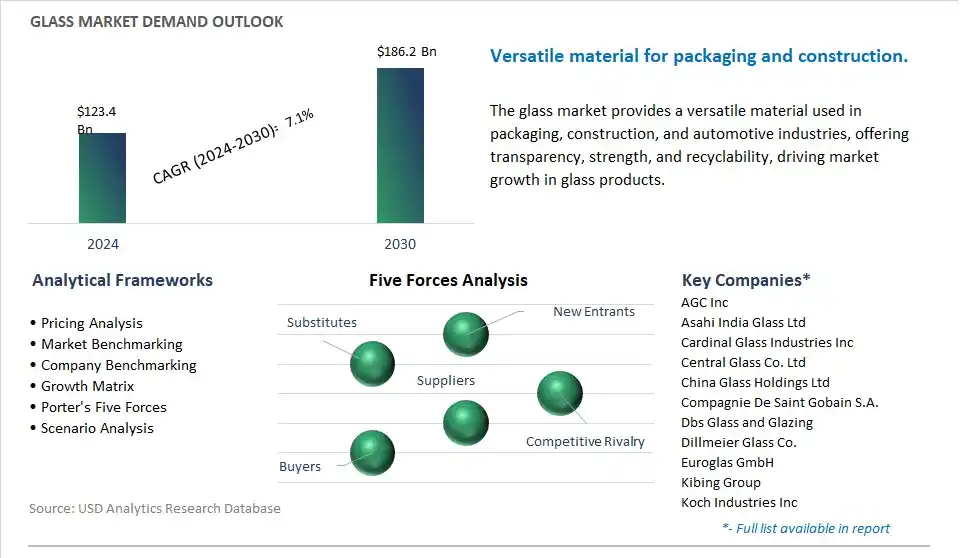
Glass Market Competitive Landscape
The market report analyses the leading companies in the industry including AGC Inc, Asahi India Glass Ltd, Cardinal Glass Industries Inc, Central Glass Co. Ltd, China Glass Holdings Ltd, Compagnie De Saint Gobain S.A., Dbs Glass and Glazing, Dillmeier Glass Co., Euroglas GmbH, Kibing Group, Koch Industries Inc, Nippon Sheet Glass Co. Ltd, Schott AG, Shebei Huajinde Glass Co. Ltd, Sisecam.
Glass Market Dynamics
Glass Market Trend: Increasing Demand for Sustainable and Recyclable Packaging Solutions
A significant trend in the glass market is the increasing demand for sustainable and recyclable packaging solutions. As environmental concerns regarding plastic pollution and waste management escalate, there is a growing preference among consumers and industries for eco-friendly packaging materials such as glass. Glass packaging offers several advantages, including recyclability, inertness, and preservation of product integrity, making it a preferred choice for beverages, food products, cosmetics, and pharmaceuticals. The trend towards sustainable packaging solutions drives market growth for glass, as manufacturers and brands seek alternatives to single-use plastics and prioritize environmental sustainability in their packaging strategies, fostering opportunities for market expansion and innovation in the glass industry.
Glass Market Driver: Growth in Beverage and Food Packaging Industries
The primary driver for the glass market is the growth in the beverage and food packaging industries. Glass containers are extensively used for packaging a wide range of beverages, including beer, wine, spirits, soft drinks, and juices, as well as food products such as sauces, condiments, jams, and preserves. With increasing consumption of packaged beverages and convenience foods driven by changing consumer lifestyles, urbanization, and rising disposable incomes, there is a growing demand for glass packaging solutions that offer superior product protection, shelf life extension, and brand differentiation. The expansion of the beverage and food packaging industries drives market demand for glass, as companies invest in glass manufacturing capacity, product development, and packaging innovation to meet the evolving needs of consumers and capitalize on market opportunities.
Glass Market Opportunity: Innovation in Lightweight and Specialty Glass Products
An opportunity exists for companies operating in the glass market to innovate in lightweight and specialty glass products. While traditional glass containers are widely used in packaging applications, there is potential to develop lightweight glass packaging solutions that offer cost savings, transportation efficiency, and improved sustainability without compromising product quality or safety. Additionally, there is an opportunity to explore specialty glass products such as colored glass, embossed glass, and custom-shaped containers to cater to niche markets and premium product segments. By investing in research and development, process optimization, and advanced manufacturing technologies, companies can create value-added glass products that meet the diverse needs and preferences of consumers and brands, driving growth and profitability in the glass industry.
Glass Market Ecosystem
The glass Market Ecosystem begins with raw material production, primarily silica sand extracted by companies including U.S. Silica Holdings, Inc. and Sibelco Group, along with soda ash from producers including Tronox Limited and Solvay SA. Other minerals including limestone and dolomite are sourced from regional suppliers. Glass manufacturing involves companies including AGC Inc., Saint-Gobain S.A., and Owens-Illinois, Inc., which produce float glass for architectural uses and container glass for packaging. Specialty glass manufacturers including Corning Inc., Schott AG, and Owens Corning cater to specific applications including heat-resistant borosilicate glass and fiberglass.
Following manufacturing, optional glass processing and fabrication occur, with companies specializing in tempering, laminating, or coating glass for enhanced properties. Distribution and sales are managed by glass distributors serving various customer segments, including construction, food and beverage, and specialty industries. Major players in distribution include established glassmakers with integrated networks and independent distributors. End users span diverse sectors including construction, where float glass is utilized in architectural applications, and the food and beverage industry, where container glass serves as primary packaging. Automotive, consumer goods, electronics, scientific research, and medical equipment industries also rely on glass for various purposes, showcasing its versatility across multiple sectors within the Industry.
Glass Market Share Analysis: Flat Glass Segment held the dominant revenue share in 2024
The Flat Glass segment is the largest segment in the Glass Market. This dominance is driven by flat glass finds extensive use in the construction industry for windows, doors, facades, and interior partitions due to its versatility, durability, and aesthetic appeal. The construction sector is a major driver of flat glass demand, particularly in residential and commercial building projects. In addition, the automotive industry utilizes flat glass for windshields, side windows, and rear windows in vehicles, contributing to significant demand for automotive glass. Additionally, the electronics industry employs flat glass in the production of display panels for televisions, smartphones, tablets, and other electronic devices. Further, advancements in technology and manufacturing processes, coupled with the increasing adoption of energy-efficient and smart glass solutions, further bolster the growth of the Flat Glass segment. As urbanization, infrastructure development, and technological advancements continue to drive demand for flat glass products across various industries, the segment maintains its position as the largest in the Glass Market.
Glass Market Share Analysis: Electrical and Electronics Segment is the fastest growing market segment over the forecast period to 2030
The Electrical and Electronics segment is the fastest-growing segment in the Glass Market. This rapid growth is driven by the increasing demand for electronic devices such as smartphones, tablets, laptops, and televisions drives the need for specialty glass components in their production. Glass substrates are essential for manufacturing displays, touchscreens, and optical components in electronic devices, contributing to significant demand growth. Additionally, the rise of emerging technologies such as augmented reality (AR), virtual reality (VR), and wearable devices further fuels the demand for specialized glass materials with properties like high transparency, scratch resistance, and thermal stability. In addition, the automotive industry's shift toward electric vehicles (EVs) and autonomous driving technology drives the demand for advanced glass solutions for automotive displays, sensors, and HUD (Head-Up Display) systems. Further, advancements in glass manufacturing techniques, including thin-film deposition, laser cutting, and 3D shaping, enable the production of complex glass components with improved performance and functionality, driving the growth of the Electrical and Electronics segment in the Glass Market. As consumer electronics and automotive technologies continue to evolve, the demand for specialty glass in electrical and electronic applications is expected to witness sustained growth, making it the fastest-growing segment in the market.
Glass Market Report Scope-
By Type
Container Glass
Flat Glass
Others
By Application
Packaging
Construction
Automotive
Electrical and Electronics
Others
Glass Market Companies Profiled
AGC Inc
Asahi India Glass Ltd
Cardinal Glass Industries Inc
Central Glass Co. Ltd
China Glass Holdings Ltd
Compagnie De Saint Gobain S.A.
Dbs Glass and Glazing
Dillmeier Glass Co.
Euroglas GmbH
Kibing Group
Koch Industries Inc
Nippon Sheet Glass Co. Ltd
Schott AG
Shebei Huajinde Glass Co. Ltd
Sisecam
*- List Not Exhaustive
TABLE OF CONTENTS
1 Introduction to 2024 Glass Market
1.1 Market Overview
1.2 Quick Facts
1.3 Scope/Objective of the Study
1.4 Market Definition
1.5 Countries and Regions Covered
1.6 Units, Currency, and Conversions
1.7 Industry Value Chain
2 Research Methodology
2.1 Market Size Estimation
2.2 Sources and Research Methodology
2.3 Data Triangulation
2.4 Assumptions and Limitations
3 Executive Summary
3.1 Global Glass Market Size Outlook, $ Million, 2021 to 2030
3.2 Glass Market Outlook by Type, $ Million, 2021 to 2030
3.3 Glass Market Outlook by Product, $ Million, 2021 to 2030
3.4 Glass Market Outlook by Application, $ Million, 2021 to 2030
3.5 Glass Market Outlook by Key Countries, $ Million, 2021 to 2030
4 Market Dynamics
4.1 Key Driving Forces of Glass Industry
4.2 Key Market Trends in Glass Industry
4.3 Potential Opportunities in Glass Industry
4.4 Key Challenges in Glass Industry
5 Market Factor Analysis
5.1 Value Chain Analysis
5.2 Competitive Landscape
5.2.1 Global Glass Market Share by Company (%), 2023
5.2.2 Product Offerings by Company
5.3 Porter’s Five Forces Analysis
5.4 Pricing Analysis and Outlook
6 Growth Outlook Across Scenarios
6.1 Growth Analysis-Case Scenario Definitions
6.2 Low Growth Scenario Forecasts
6.3 Reference Growth Scenario Forecasts
6.4 High Growth Scenario Forecasts
7 Global Glass Market Outlook by Segments
7.1 Glass Market Outlook by Segments, $ Million, 2021- 2030
By Type
Container Glass
Flat Glass
Others
By Application
Packaging
Construction
Automotive
Electrical and Electronics
Others
8 North America Glass Market Analysis and Outlook To 2030
8.1 Introduction to North America Glass Markets in 2024
8.2 North America Glass Market Size Outlook by Country, 2021-2030
8.2.1 United States
8.2.2 Canada
8.2.3 Mexico
8.3 North America Glass Market size Outlook by Segments, 2021-2030
By Type
Container Glass
Flat Glass
Others
By Application
Packaging
Construction
Automotive
Electrical and Electronics
Others
9 Europe Glass Market Analysis and Outlook To 2030
9.1 Introduction to Europe Glass Markets in 2024
9.2 Europe Glass Market Size Outlook by Country, 2021-2030
9.2.1 Germany
9.2.2 France
9.2.3 Spain
9.2.4 United Kingdom
9.2.4 Italy
9.2.5 Russia
9.2.6 Norway
9.2.7 Rest of Europe
9.3 Europe Glass Market Size Outlook by Segments, 2021-2030
By Type
Container Glass
Flat Glass
Others
By Application
Packaging
Construction
Automotive
Electrical and Electronics
Others
10 Asia Pacific Glass Market Analysis and Outlook To 2030
10.1 Introduction to Asia Pacific Glass Markets in 2024
10.2 Asia Pacific Glass Market Size Outlook by Country, 2021-2030
10.2.1 China
10.2.2 India
10.2.3 Japan
10.2.4 South Korea
10.2.5 Indonesia
10.2.6 Malaysia
10.2.7 Australia
10.2.8 Rest of Asia Pacific
10.3 Asia Pacific Glass Market size Outlook by Segments, 2021-2030
By Type
Container Glass
Flat Glass
Others
By Application
Packaging
Construction
Automotive
Electrical and Electronics
Others
11 South America Glass Market Analysis and Outlook To 2030
11.1 Introduction to South America Glass Markets in 2024
11.2 South America Glass Market Size Outlook by Country, 2021-2030
11.2.1 Brazil
11.2.2 Argentina
11.2.3 Rest of South America
11.3 South America Glass Market size Outlook by Segments, 2021-2030
By Type
Container Glass
Flat Glass
Others
By Application
Packaging
Construction
Automotive
Electrical and Electronics
Others
12 Middle East and Africa Glass Market Analysis and Outlook To 2030
12.1 Introduction to Middle East and Africa Glass Markets in 2024
12.2 Middle East and Africa Glass Market Size Outlook by Country, 2021-2030
12.2.1 Saudi Arabia
12.2.2 UAE
12.2.3 Oman
12.2.4 Rest of Middle East
12.2.5 Egypt
12.2.6 Nigeria
12.2.7 South Africa
12.2.8 Rest of Africa
12.3 Middle East and Africa Glass Market size Outlook by Segments, 2021-2030
By Type
Container Glass
Flat Glass
Others
By Application
Packaging
Construction
Automotive
Electrical and Electronics
Others
13 Company Profiles
13.1 Company Snapshot
13.2 SWOT Profiles
13.3 Products and Services
13.4 Recent Developments
13.5 Financial Profile
AGC Inc
Asahi India Glass Ltd
Cardinal Glass Industries Inc
Central Glass Co. Ltd
China Glass Holdings Ltd
Compagnie De Saint Gobain S.A.
Dbs Glass and Glazing
Dillmeier Glass Co.
Euroglas GmbH
Kibing Group
Koch Industries Inc
Nippon Sheet Glass Co. Ltd
Schott AG
Shebei Huajinde Glass Co. Ltd
Sisecam
14 Appendix
14.1 Customization Offerings
14.2 Subscription Services
14.3 Related Reports
14.4 Publisher Expertise
By Type
Container Glass
Flat Glass
Others
By Application
Packaging
Construction
Automotive
Electrical and Electronics
Others
Countries Analyzed
North America (US, Canada, Mexico)
Europe (Germany, UK, France, Spain, Italy, Russia, Rest of Europe)
Asia Pacific (China, India, Japan, South Korea, Australia, South East Asia, Rest of Asia)
South America (Brazil, Argentina, Rest of South America)
Middle East and Africa (Saudi Arabia, UAE, Rest of Middle East, South Africa, Egypt, Rest of Africa)
