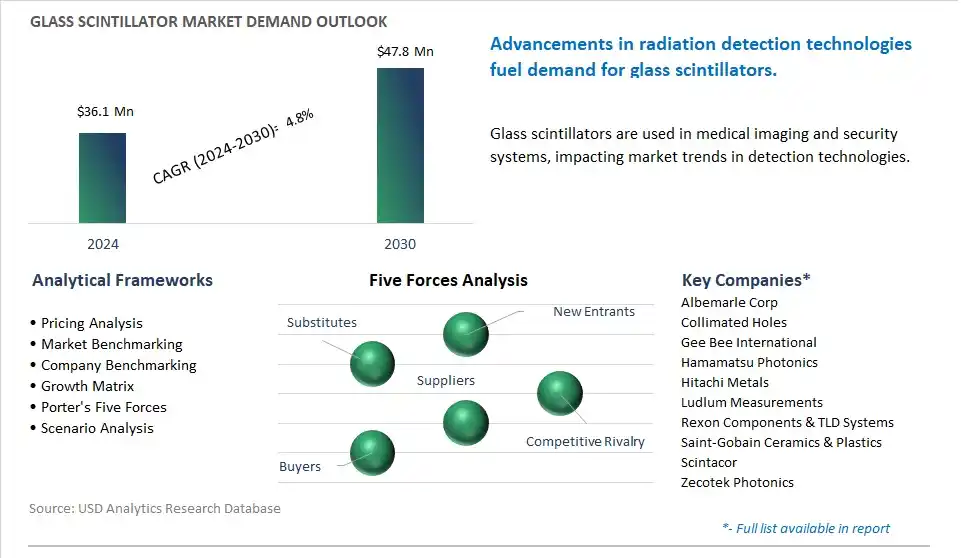
The global Glass Scintillator Market is poised to register a 4.8% CAGR from $36.1 Million in 2024 to $47.8 Million in 2030.
The global Glass Scintillator Market Study analyzes and forecasts the market size across 6 regions and 24 countries for diverse segments -By Product (Natural Lithium, Depleted Lithium, Enriched Lithium, Others), By Application (Oil and Gas, Nuclear Power Plant).
An Introduction to Global Glass Scintillator Market in 2024
The glass scintillator market is experiencing significant growth driven by its applications in radiation detection, medical imaging, and high-energy physics research. Key trends shaping the future of the industry include the development of advanced glass compositions, manufacturing techniques, and scintillation properties to improve detection sensitivity, energy resolution, and durability while meeting evolving requirements for homeland security, nuclear safety, and scientific instrumentation. As governments, research institutions, and healthcare providers invest in radiation detection technologies, there's a growing need for glass scintillators that offer high light yield, fast response time, and low background noise, enabling accurate and reliable detection of gamma rays, X-rays, and charged particles in diverse environments and applications. Moreover, advancements in glass scintillator production methods, including melt casting, sol-gel synthesis, and vapor deposition, are driving market expansion by improving material purity, homogeneity, and crystal structure while reducing manufacturing costs, waste generation, and environmental impact associated with traditional scintillator materials such as crystals and plastics. Additionally, the growing adoption of glass scintillators in positron emission tomography (PET), computed tomography (CT), and radiation therapy is fueling demand for high-performance detectors that offer superior spatial resolution, energy discrimination, and radiation shielding properties, facilitating more accurate diagnosis, treatment planning, and dose delivery in medical imaging and cancer treatment applications. Furthermore, the integration of glass scintillators with digital imaging, data processing, and machine learning algorithms is driving innovation and market growth in the radiation detection industry, enabling the development of smarter, more efficient, and more cost-effective solutions for the future of nuclear medicine, particle physics, and radiation monitoring.
Glass Scintillator Market Competitive Landscape
The market report analyses the leading companies in the industry including Albemarle Corp, Collimated Holes, Gee Bee International, Hamamatsu Photonics, Hitachi Metals, Ludlum Measurements, Rexon Components & TLD Systems, Saint-Gobain Ceramics & Plastics, Scintacor, Zecotek Photonics.
Glass Scintillator Market Dynamics
Glass Scintillator Market Trend: Advancements in Radiation Detection Technology
A significant trend in the glass scintillator market is the continuous advancements in radiation detection technology, driving the development of innovative scintillating glass materials with improved sensitivity, efficiency, and performance. Glass scintillators, characterized by their ability to emit light when exposed to ionizing radiation, are widely used in applications such as medical imaging, nuclear physics research, homeland security, and environmental monitoring. With increasing concerns about radiation exposure, nuclear safety, and security threats, there is a growing demand for high-performance scintillating materials that can accurately detect and measure various types of radiation sources. Manufacturers are investing in research and development to enhance the properties of glass scintillators, including their light output, decay time, energy resolution, and resistance to radiation damage, thereby enabling more precise and reliable detection capabilities. This trend is reshaping the glass scintillator market towards advanced materials and technologies that address the evolving needs of industries requiring radiation detection solutions.
Glass Scintillator Market Driver: Growing Demand for Radiation Monitoring and Security Solutions
A key driver propelling the glass scintillator market is the growing demand for radiation monitoring and security solutions driven by concerns about nuclear safety, environmental contamination, and security threats. Glass scintillators play a vital role in radiation detection systems used in various applications, including medical imaging devices such as positron emission tomography (PET) scanners, gamma cameras, and computed tomography (CT) scanners, where they enable the visualization and diagnosis of diseases such as cancer. Additionally, glass scintillators are utilized in nuclear physics experiments, particle detectors, and radiation portal monitors for homeland security and border control purposes. The increasing deployment of radiation detection systems in airports, seaports, border crossings, and critical infrastructure facilities to detect illicit trafficking of radioactive materials and ensure public safety drives market demand for glass scintillators as essential components of radiation detection and monitoring solutions.
Glass Scintillator Market Opportunity: Expansion into Emerging Applications and Industries
An opportunity for market expansion lies in diversifying glass scintillator applications into emerging sectors and industries where there is demand for radiation detection solutions and advanced materials. For example, glass scintillators can be used in environmental monitoring devices to detect radiation levels in soil, water, and air for nuclear waste management, environmental protection, and emergency response applications. Additionally, glass scintillators hold potential in security screening technologies such as cargo inspection systems, baggage scanners, and handheld radiation detectors used in law enforcement, customs, and border patrol operations. By exploring new application areas and collaborating with industry stakeholders, glass scintillator manufacturers can capitalize on opportunities to expand their market reach, develop customized solutions for specific industry needs, and drive growth and innovation in the glass scintillator market.
Glass Scintillator Market Share Analysis: Natural Lithium segment generated the highest revenue in the industry
Natural lithium is the largest segment in the glass scintillator market, primarily due to its widespread availability and cost-effectiveness compared to other types of lithium. Natural lithium, also known as lithium-6, is the most abundant lithium isotope found in nature. Its abundance makes it a preferred choice for manufacturing glass scintillators, which are used in various applications such as radiation detection, nuclear physics research, and medical imaging. Glass scintillators containing natural lithium offer excellent sensitivity to radiation and high light output, making them suitable for detecting and measuring various types of ionizing radiation, including gamma rays and neutrons. Additionally, natural lithium-based glass scintillators exhibit good energy resolution and stability, ensuring accurate and reliable detection of radiation sources. Further, the relatively lower cost of natural lithium compared to enriched or depleted lithium isotopes makes it a cost-effective option for producing glass scintillators in large quantities, thereby contributing to its dominance in the market. Over the forecast period, the abundance, performance characteristics, and cost-effectiveness of natural lithium make it the largest segment in the glass scintillator market.
Glass Scintillator Market Share Analysis: Nuclear Power Plant Segment is poised to register the fastest growth rate (CAGR) over the forecast period to 2030
The nuclear power plant segment is the fastest-growing segment in the glass scintillator market, driven by diverse key factors. The the global demand for nuclear energy is increasing as countries seek to reduce reliance on fossil fuels and mitigate greenhouse gas emissions. As a result, there is a growing emphasis on expanding existing nuclear power plants and constructing new ones, particularly in emerging economies. Glass scintillators play a crucial role in nuclear power plants for radiation detection, monitoring, and safety purposes. They are used in various applications within nuclear facilities, including radiation monitoring systems, environmental monitoring, personnel dosimetry, and nuclear reactor instrumentation. The importance of accurate and reliable radiation detection in nuclear power plants cannot be overstated, as it is essential for ensuring the safety of plant personnel, the surrounding environment, and the public. Additionally, advancements in glass scintillator technology have led to the development of more sensitive, durable, and cost-effective products, further driving their adoption in nuclear power plant applications. Further, stringent regulatory requirements and safety standards in the nuclear industry mandate the use of reliable radiation detection systems, creating a constant demand for glass scintillators. Over the forecast period, the expansion of the nuclear power industry, coupled with the increasing focus on safety and regulatory compliance, positions the nuclear power plant segment as the fastest-growing market for glass scintillators.
Glass Scintillator Market Report Segmentation
By Product
Natural Lithium
Depleted Lithium
Enriched Lithium
Others
By Application
Oil and Gas
Nuclear Power Plant
Regions Included
North America (US, Canada, Mexico)
Europe (Germany, UK, France, Spain, Italy, Russia, Rest of Europe)
Asia Pacific (China, India, Japan, South Korea, Australia, South East Asia, Rest of Asia)
South America (Brazil, Argentina, Rest of South America)
Middle East and Africa (Saudi Arabia, UAE, Rest of Middle East, South Africa, Egypt, Rest of Africa)
Glass Scintillator Companies Profiled in the Market Study
Albemarle Corp
Collimated Holes
Gee Bee International
Hamamatsu Photonics
Hitachi Metals
Ludlum Measurements
Rexon Components & TLD Systems
Saint-Gobain Ceramics & Plastics
Scintacor
Zecotek Photonics
*- List Not Exhaustive
TABLE OF CONTENTS
1 Introduction to 2024 Glass Scintillator Market
1.1 Market Overview
1.2 Quick Facts
1.3 Scope/Objective of the Study
1.4 Market Definition
1.5 Countries and Regions Covered
1.6 Units, Currency, and Conversions
1.7 Industry Value Chain
2 Research Methodology
2.1 Market Size Estimation
2.2 Sources and Research Methodology
2.3 Data Triangulation
2.4 Assumptions and Limitations
3 Executive Summary
3.1 Global Glass Scintillator Market Size Outlook, $ Million, 2021 to 2030
3.2 Glass Scintillator Market Outlook by Type, $ Million, 2021 to 2030
3.3 Glass Scintillator Market Outlook by Product, $ Million, 2021 to 2030
3.4 Glass Scintillator Market Outlook by Application, $ Million, 2021 to 2030
3.5 Glass Scintillator Market Outlook by Key Countries, $ Million, 2021 to 2030
4 Market Dynamics
4.1 Key Driving Forces of Glass Scintillator Industry
4.2 Key Market Trends in Glass Scintillator Industry
4.3 Potential Opportunities in Glass Scintillator Industry
4.4 Key Challenges in Glass Scintillator Industry
5 Market Factor Analysis
5.1 Value Chain Analysis
5.2 Competitive Landscape
5.2.1 Global Glass Scintillator Market Share by Company (%), 2023
5.2.2 Product Offerings by Company
5.3 Porter’s Five Forces Analysis
5.4 Pricing Analysis and Outlook
6 Growth Outlook Across Scenarios
6.1 Growth Analysis-Case Scenario Definitions
6.2 Low Growth Scenario Forecasts
6.3 Reference Growth Scenario Forecasts
6.4 High Growth Scenario Forecasts
7 Global Glass Scintillator Market Outlook by Segments
7.1 Glass Scintillator Market Outlook by Segments, $ Million, 2021- 2030
By Product
Natural Lithium
Depleted Lithium
Enriched Lithium
Others
By Application
Oil and Gas
Nuclear Power Plant
8 North America Glass Scintillator Market Analysis and Outlook To 2030
8.1 Introduction to North America Glass Scintillator Markets in 2024
8.2 North America Glass Scintillator Market Size Outlook by Country, 2021-2030
8.2.1 United States
8.2.2 Canada
8.2.3 Mexico
8.3 North America Glass Scintillator Market size Outlook by Segments, 2021-2030
By Product
Natural Lithium
Depleted Lithium
Enriched Lithium
Others
By Application
Oil and Gas
Nuclear Power Plant
9 Europe Glass Scintillator Market Analysis and Outlook To 2030
9.1 Introduction to Europe Glass Scintillator Markets in 2024
9.2 Europe Glass Scintillator Market Size Outlook by Country, 2021-2030
9.2.1 Germany
9.2.2 France
9.2.3 Spain
9.2.4 United Kingdom
9.2.4 Italy
9.2.5 Russia
9.2.6 Norway
9.2.7 Rest of Europe
9.3 Europe Glass Scintillator Market Size Outlook by Segments, 2021-2030
By Product
Natural Lithium
Depleted Lithium
Enriched Lithium
Others
By Application
Oil and Gas
Nuclear Power Plant
10 Asia Pacific Glass Scintillator Market Analysis and Outlook To 2030
10.1 Introduction to Asia Pacific Glass Scintillator Markets in 2024
10.2 Asia Pacific Glass Scintillator Market Size Outlook by Country, 2021-2030
10.2.1 China
10.2.2 India
10.2.3 Japan
10.2.4 South Korea
10.2.5 Indonesia
10.2.6 Malaysia
10.2.7 Australia
10.2.8 Rest of Asia Pacific
10.3 Asia Pacific Glass Scintillator Market size Outlook by Segments, 2021-2030
By Product
Natural Lithium
Depleted Lithium
Enriched Lithium
Others
By Application
Oil and Gas
Nuclear Power Plant
11 South America Glass Scintillator Market Analysis and Outlook To 2030
11.1 Introduction to South America Glass Scintillator Markets in 2024
11.2 South America Glass Scintillator Market Size Outlook by Country, 2021-2030
11.2.1 Brazil
11.2.2 Argentina
11.2.3 Rest of South America
11.3 South America Glass Scintillator Market size Outlook by Segments, 2021-2030
By Product
Natural Lithium
Depleted Lithium
Enriched Lithium
Others
By Application
Oil and Gas
Nuclear Power Plant
12 Middle East and Africa Glass Scintillator Market Analysis and Outlook To 2030
12.1 Introduction to Middle East and Africa Glass Scintillator Markets in 2024
12.2 Middle East and Africa Glass Scintillator Market Size Outlook by Country, 2021-2030
12.2.1 Saudi Arabia
12.2.2 UAE
12.2.3 Oman
12.2.4 Rest of Middle East
12.2.5 Egypt
12.2.6 Nigeria
12.2.7 South Africa
12.2.8 Rest of Africa
12.3 Middle East and Africa Glass Scintillator Market size Outlook by Segments, 2021-2030
By Product
Natural Lithium
Depleted Lithium
Enriched Lithium
Others
By Application
Oil and Gas
Nuclear Power Plant
13 Company Profiles
13.1 Company Snapshot
13.2 SWOT Profiles
13.3 Products and Services
13.4 Recent Developments
13.5 Financial Profile
Albemarle Corp
Collimated Holes
Gee Bee International
Hamamatsu Photonics
Hitachi Metals
Ludlum Measurements
Rexon Components & TLD Systems
Saint-Gobain Ceramics & Plastics
Scintacor
Zecotek Photonics
14 Appendix
14.1 Customization Offerings
14.2 Subscription Services
14.3 Related Reports
14.4 Publisher Expertise
By Product
Natural Lithium
Depleted Lithium
Enriched Lithium
Others
By Application
Oil and Gas
Nuclear Power Plant
Countries Analyzed
North America (US, Canada, Mexico)
Europe (Germany, UK, France, Spain, Italy, Russia, Rest of Europe)
Asia Pacific (China, India, Japan, South Korea, Australia, South East Asia, Rest of Asia)
South America (Brazil, Argentina, Rest of South America)
Middle East and Africa (Saudi Arabia, UAE, Rest of Middle East, South Africa, Egypt, Rest of Africa)
