The global Glue Laminated Timber Market is poised to register a 3.8% CAGR from $4.6 Billion in 2024 to $5.8 Billion in 2030.
The global Glue Laminated Timber Market Study analyzes and forecasts the market size across 6 regions and 24 countries for diverse segments -By Application (Residential, Commercial, Industrial, Other), By End-User (Roof Truss, Support & Columns, Furniture, Stairs, Ceiling Structures, Others).
An Introduction to Global Glue Laminated Timber Market in 2024
The glue laminated timber (glulam) market is experiencing rapid growth driven by the increasing demand for sustainable, high-performance building materials in construction projects worldwide. Key trends shaping the future of the industry include the adoption of advanced timber engineering techniques, digital design tools, and sustainable forestry practices to optimize structural performance, design flexibility, and environmental sustainability while meeting regulatory requirements and market demands for green building materials. As architects, engineers, and developers seek innovative solutions to address challenges related to urbanization, climate change, and resource depletion, there's a growing need for glulam products that offer superior strength, stability, and aesthetic appeal while minimizing environmental impact, carbon footprint, and lifecycle costs associated with traditional construction materials such as steel and concrete. Moreover, advancements in glulam manufacturing processes, including timber grading, adhesive technology, and laminating methods, are driving market expansion by improving product quality, consistency, and dimensional stability while enabling the production of large-scale, complex structures such as bridges, stadiums, and tall buildings that showcase the versatility and sustainability of engineered wood products. Additionally, the growing adoption of glulam in green building projects, eco-friendly developments, and mass timber construction is fueling demand for innovative designs and construction techniques that maximize energy efficiency, indoor comfort, and occupant well-being while minimizing environmental footprint and embodied carbon emissions throughout the building lifecycle. Furthermore, the integration of glulam with digital fabrication, robotic assembly, and prefabrication technologies is driving innovation and market growth in the timber industry, enabling the development of smarter, more resilient, and more sustainable solutions for the future of urban infrastructure, architectural design, and construction practices.
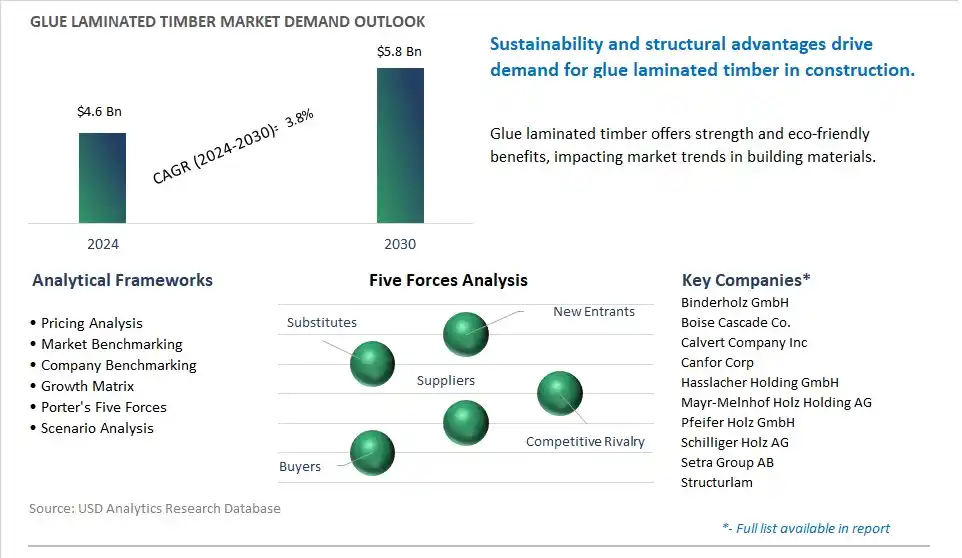
Glue Laminated Timber Market Competitive Landscape
The market report analyses the leading companies in the industry including Binderholz GmbH, Boise Cascade Co., Calvert Company Inc, Canfor Corp, Hasslacher Holding GmbH, Mayr-Melnhof Holz Holding AG, Pfeifer Holz GmbH, Schilliger Holz AG, Setra Group AB, Structurlam.
Glue Laminated Timber Market Dynamics
Glue Laminated Timber Market Trend: Growing Preference for Sustainable Construction Materials
A significant trend in the glue laminated timber market is the increasing preference for sustainable construction materials driven by environmental awareness, green building certifications, and regulatory mandates. Glue laminated timber, also known as glulam, is gaining popularity as a sustainable alternative to traditional building materials such as steel and concrete due to its renewable nature, low carbon footprint, and aesthetic appeal. With concerns about climate change and resource depletion shaping construction practices, there is a rising demand for timber-based solutions that offer environmental benefits and contribute to energy efficiency in buildings. Glulam, characterized by its strength, versatility, and architectural flexibility, is positioned to capitalize on this trend as a key component in sustainable building designs and green construction projects.
Glue Laminated Timber Market Driver: Advantages in Construction Efficiency, Cost-effectiveness, and Design Flexibility
A key driver propelling the glue laminated timber market is the advantages it offers in construction efficiency, cost-effectiveness, and design flexibility compared to traditional building materials. Glulam combines the structural strength of timber with the bonding capabilities of adhesives, resulting in beams and columns that are stronger, lighter, and more durable than solid wood or conventional lumber. This allows for faster construction times, reduced labor costs, and simplified on-site assembly, leading to overall project savings and increased efficiency. Additionally, glulam's versatility in design enables architects and engineers to create unique and innovative building structures such as arches, curves, and long spans, providing aesthetic appeal and architectural distinction to construction projects. The inherent advantages of glue laminated timber drive market demand across residential, commercial, and industrial sectors where there is a need for efficient, cost-effective, and sustainable building solutions.
Glue Laminated Timber Market Opportunity: Expansion into Tall Timber Buildings and Prefabricated Construction
An opportunity for market expansion lies in diversifying glue laminated timber applications into tall timber buildings and prefabricated construction systems, offering solutions for urban densification, sustainable urban development, and modular building projects. With advancements in timber engineering and construction technology, there is growing interest in using glue laminated timber for high-rise buildings, multi-story structures, and mixed-use developments as a viable alternative to traditional materials. Additionally, the adoption of prefabricated construction methods and off-site manufacturing processes presents opportunities for glulam manufacturers to supply pre-engineered timber components such as panels, beams, and trusses for rapid assembly and installation on construction sites. By capitalizing on the trend towards taller timber buildings and off-site construction practices, glue laminated timber producers can expand their market reach, enter new application areas, and position themselves as key players in the sustainable construction industry.
Glue Laminated Timber Market Share Analysis: Commercial segment generated the highest revenue in the industry
The commercial segment is the largest segment in the glue laminated timber market, primarily due to the widespread use of glue laminated timber (glulam) in commercial construction projects. Glulam is a versatile engineered wood product that offers diverse advantages, making it a preferred choice for various commercial applications. In commercial construction, glulam is commonly used for beams, columns, and other structural elements due to its superior strength, stability, and aesthetic appeal. Glulam beams can span long distances without the need for intermediate supports, allowing for flexible and open interior spaces in commercial buildings such as offices, retail centers, and educational facilities. Additionally, glulam's natural aesthetic qualities and ability to be shaped into curved or custom profiles make it a popular choice for architectural features such as exposed beams, trusses, and decorative elements in commercial structures. Further, glulam is prized for its sustainability and environmental benefits, as it is manufactured from sustainably sourced timber and contributes to carbon sequestration. The commercial sector's emphasis on sustainable building practices and the growing preference for timber construction materials further drive the demand for glulam in commercial projects. Over the forecast period, the versatility, strength, aesthetics, and sustainability of glulam position the commercial segment as the largest market for glue laminated timber.
Glue Laminated Timber Market Share Analysis: Roof Truss Segment is poised to register the fastest growth rate (CAGR) over the forecast period to 2030
The roof truss segment is the fastest-growing segment in the glue laminated timber market, driven by diverse key factors. The there is a growing trend towards timber construction in both residential and commercial buildings due to its sustainability, aesthetic appeal, and structural performance. Glue laminated timber (glulam) offers distinct advantages for roof construction, particularly in the design and fabrication of large and complex roof structures such as trusses. Glulam roof trusses are known for their strength-to-weight ratio, which allows for long spans without the need for intermediate supports, creating open and spacious interior environments. Additionally, glulam trusses can be prefabricated off-site, leading to faster construction times and cost savings. In addition, the architectural versatility of glulam enables the creation of unique and visually striking roof designs, enhancing the Over the forecast period aesthetic appeal of buildings. Further, the inherent fire resistance and durability of glulam make it a reliable choice for roof structures, ensuring long-term performance and safety. As a result, the demand for glulam roof trusses is experiencing rapid growth as more architects, builders, and developers recognize the benefits of timber construction and seek innovative solutions for roof design and construction. Over the forecast period, the combination of structural performance, design flexibility, sustainability, and cost-effectiveness positions the roof truss segment as the fastest-growing market in the glue laminated timber industry.
Glue Laminated Timber Market Report Segmentation
By Application
Residential
Commercial
Industrial
Other
By End-User
Roof Truss
Support & Columns
Furniture
Stairs
Ceiling Structures
Others
Regions Included
North America (US, Canada, Mexico)
Europe (Germany, UK, France, Spain, Italy, Russia, Rest of Europe)
Asia Pacific (China, India, Japan, South Korea, Australia, South East Asia, Rest of Asia)
South America (Brazil, Argentina, Rest of South America)
Middle East and Africa (Saudi Arabia, UAE, Rest of Middle East, South Africa, Egypt, Rest of Africa)
Glue Laminated Timber Companies Profiled in the Market Study
Binderholz GmbH
Boise Cascade Co.
Calvert Company Inc
Canfor Corp
Hasslacher Holding GmbH
Mayr-Melnhof Holz Holding AG
Pfeifer Holz GmbH
Schilliger Holz AG
Setra Group AB
Structurlam
*- List Not Exhaustive
TABLE OF CONTENTS
1 Introduction to 2024 Glue Laminated Timber Market
1.1 Market Overview
1.2 Quick Facts
1.3 Scope/Objective of the Study
1.4 Market Definition
1.5 Countries and Regions Covered
1.6 Units, Currency, and Conversions
1.7 Industry Value Chain
2 Research Methodology
2.1 Market Size Estimation
2.2 Sources and Research Methodology
2.3 Data Triangulation
2.4 Assumptions and Limitations
3 Executive Summary
3.1 Global Glue Laminated Timber Market Size Outlook, $ Million, 2021 to 2030
3.2 Glue Laminated Timber Market Outlook by Type, $ Million, 2021 to 2030
3.3 Glue Laminated Timber Market Outlook by Product, $ Million, 2021 to 2030
3.4 Glue Laminated Timber Market Outlook by Application, $ Million, 2021 to 2030
3.5 Glue Laminated Timber Market Outlook by Key Countries, $ Million, 2021 to 2030
4 Market Dynamics
4.1 Key Driving Forces of Glue Laminated Timber Industry
4.2 Key Market Trends in Glue Laminated Timber Industry
4.3 Potential Opportunities in Glue Laminated Timber Industry
4.4 Key Challenges in Glue Laminated Timber Industry
5 Market Factor Analysis
5.1 Value Chain Analysis
5.2 Competitive Landscape
5.2.1 Global Glue Laminated Timber Market Share by Company (%), 2023
5.2.2 Product Offerings by Company
5.3 Porter’s Five Forces Analysis
5.4 Pricing Analysis and Outlook
6 Growth Outlook Across Scenarios
6.1 Growth Analysis-Case Scenario Definitions
6.2 Low Growth Scenario Forecasts
6.3 Reference Growth Scenario Forecasts
6.4 High Growth Scenario Forecasts
7 Global Glue Laminated Timber Market Outlook by Segments
7.1 Glue Laminated Timber Market Outlook by Segments, $ Million, 2021- 2030
By Application
Residential
Commercial
Industrial
Other
By End-User
Roof Truss
Support & Columns
Furniture
Stairs
Ceiling Structures
Others
8 North America Glue Laminated Timber Market Analysis and Outlook To 2030
8.1 Introduction to North America Glue Laminated Timber Markets in 2024
8.2 North America Glue Laminated Timber Market Size Outlook by Country, 2021-2030
8.2.1 United States
8.2.2 Canada
8.2.3 Mexico
8.3 North America Glue Laminated Timber Market size Outlook by Segments, 2021-2030
By Application
Residential
Commercial
Industrial
Other
By End-User
Roof Truss
Support & Columns
Furniture
Stairs
Ceiling Structures
Others
9 Europe Glue Laminated Timber Market Analysis and Outlook To 2030
9.1 Introduction to Europe Glue Laminated Timber Markets in 2024
9.2 Europe Glue Laminated Timber Market Size Outlook by Country, 2021-2030
9.2.1 Germany
9.2.2 France
9.2.3 Spain
9.2.4 United Kingdom
9.2.4 Italy
9.2.5 Russia
9.2.6 Norway
9.2.7 Rest of Europe
9.3 Europe Glue Laminated Timber Market Size Outlook by Segments, 2021-2030
By Application
Residential
Commercial
Industrial
Other
By End-User
Roof Truss
Support & Columns
Furniture
Stairs
Ceiling Structures
Others
10 Asia Pacific Glue Laminated Timber Market Analysis and Outlook To 2030
10.1 Introduction to Asia Pacific Glue Laminated Timber Markets in 2024
10.2 Asia Pacific Glue Laminated Timber Market Size Outlook by Country, 2021-2030
10.2.1 China
10.2.2 India
10.2.3 Japan
10.2.4 South Korea
10.2.5 Indonesia
10.2.6 Malaysia
10.2.7 Australia
10.2.8 Rest of Asia Pacific
10.3 Asia Pacific Glue Laminated Timber Market size Outlook by Segments, 2021-2030
By Application
Residential
Commercial
Industrial
Other
By End-User
Roof Truss
Support & Columns
Furniture
Stairs
Ceiling Structures
Others
11 South America Glue Laminated Timber Market Analysis and Outlook To 2030
11.1 Introduction to South America Glue Laminated Timber Markets in 2024
11.2 South America Glue Laminated Timber Market Size Outlook by Country, 2021-2030
11.2.1 Brazil
11.2.2 Argentina
11.2.3 Rest of South America
11.3 South America Glue Laminated Timber Market size Outlook by Segments, 2021-2030
By Application
Residential
Commercial
Industrial
Other
By End-User
Roof Truss
Support & Columns
Furniture
Stairs
Ceiling Structures
Others
12 Middle East and Africa Glue Laminated Timber Market Analysis and Outlook To 2030
12.1 Introduction to Middle East and Africa Glue Laminated Timber Markets in 2024
12.2 Middle East and Africa Glue Laminated Timber Market Size Outlook by Country, 2021-2030
12.2.1 Saudi Arabia
12.2.2 UAE
12.2.3 Oman
12.2.4 Rest of Middle East
12.2.5 Egypt
12.2.6 Nigeria
12.2.7 South Africa
12.2.8 Rest of Africa
12.3 Middle East and Africa Glue Laminated Timber Market size Outlook by Segments, 2021-2030
By Application
Residential
Commercial
Industrial
Other
By End-User
Roof Truss
Support & Columns
Furniture
Stairs
Ceiling Structures
Others
13 Company Profiles
13.1 Company Snapshot
13.2 SWOT Profiles
13.3 Products and Services
13.4 Recent Developments
13.5 Financial Profile
Binderholz GmbH
Boise Cascade Co.
Calvert Company Inc
Canfor Corp
Hasslacher Holding GmbH
Mayr-Melnhof Holz Holding AG
Pfeifer Holz GmbH
Schilliger Holz AG
Setra Group AB
Structurlam
14 Appendix
14.1 Customization Offerings
14.2 Subscription Services
14.3 Related Reports
14.4 Publisher Expertise
By Application
Residential
Commercial
Industrial
Other
By End-User
Roof Truss
Support & Columns
Furniture
Stairs
Ceiling Structures
Others
Countries Analyzed
North America (US, Canada, Mexico)
Europe (Germany, UK, France, Spain, Italy, Russia, Rest of Europe)
Asia Pacific (China, India, Japan, South Korea, Australia, South East Asia, Rest of Asia)
South America (Brazil, Argentina, Rest of South America)
Middle East and Africa (Saudi Arabia, UAE, Rest of Middle East, South Africa, Egypt, Rest of Africa)
