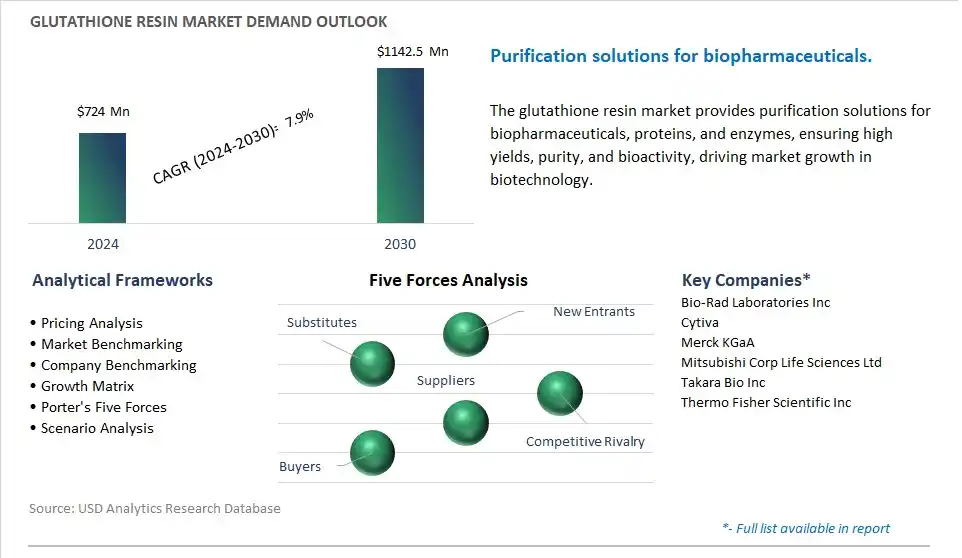
The global Glutathione Resin Market is poised to register a 7.9% CAGR from $724 Million in 2024 to $1142.5 Million in 2030.
The global Glutathione Resin Market Study analyzes and forecasts the market size across 6 regions and 24 countries for diverse segments -By Application (Protein Purification, Immunoprecipitation (IP), Research, Others).
An Introduction to Global Glutathione Resin Market in 2024
The future of the glutathione resin market is shaped by trends such as biomedical research, pharmaceutical manufacturing, and therapeutic applications driving innovation in resin design, purification processes, and medical therapies. Glutathione resin, a chromatography resin designed to capture and purify glutathione-tagged proteins, is a critical tool in biotechnology and pharmaceutical industries for protein purification and drug discovery. Key trends shaping this market include advancements in resin technology such as improved binding capacity, selectivity, and chemical stability to facilitate high-yield protein purification and downstream processing in biomanufacturing workflows, the development of innovative purification methods such as high-throughput screening, multi-modal chromatography, and continuous processing to streamline protein purification processes, reduce production costs, and accelerate therapeutic development timelines, and the adoption of glutathione resin in research laboratories, contract manufacturing organizations (CMOs), and biopharmaceutical companies for applications such as monoclonal antibody production, vaccine development, and gene therapy manufacturing. As the demand for biopharmaceuticals, personalized medicine, and novel therapies continues to grow, the need for glutathione resin products that offer high performance, scalability, and regulatory compliance is expected to drive market growth and stimulate further innovation in resin technology and applications.
Glutathione Resin Market Competitive Landscape
The market report analyses the leading companies in the industry including Bio-Rad Laboratories Inc, Cytiva, Merck KGaA, Mitsubishi Corp Life Sciences Ltd, Takara Bio Inc, Thermo Fisher Scientific Inc.
Glutathione Resin Market Dynamics
Glutathione Resin Market Trend: Growing Demand for Purification and Chromatography Technologies
A significant trend in the glutathione resin market is the growing demand for purification and chromatography technologies across various industries, including pharmaceuticals, biotechnology, and healthcare. Glutathione resin, a specialized chromatography resin designed for the purification and isolation of glutathione-related proteins and biomolecules, plays a crucial role in downstream processing applications, such as protein purification, drug discovery, and biopharmaceutical production. With increasing research activities, drug development pipelines, and biomanufacturing processes, there is a rising need for efficient and reliable purification methods to isolate target molecules with high purity and yield. Glutathione resin offers advantages such as high binding capacity, selectivity, and scalability, making it a preferred choice for purifying glutathione S-transferase (GST)-tagged proteins and other glutathione-binding proteins. The trend towards advanced purification and chromatography technologies drives market growth for glutathione resin, as industries seek innovative solutions to streamline bioprocesses, enhance product quality, and accelerate research and development efforts, fostering opportunities for market expansion and technological advancement in the biopharmaceutical and life sciences sectors.
Glutathione Resin Market Driver: Expansion of Biopharmaceutical and Biotechnology Industries
The primary driver for the glutathione resin market is the expansion of the biopharmaceutical and biotechnology industries worldwide. As the demand for biologics, recombinant proteins, and monoclonal antibodies continues to grow, driven by the increasing prevalence of chronic diseases, personalized medicine, and advancements in biotechnology, there is a corresponding need for efficient and cost-effective purification technologies to support bioprocess development and manufacturing. Glutathione resin plays a vital role in protein purification workflows, enabling the isolation and purification of target proteins and biomolecules from complex mixtures, including cell lysates and fermentation broths. Biopharmaceutical companies, contract manufacturing organizations (CMOs), and academic research institutions rely on glutathione resin for applications such as protein expression, protein-protein interaction studies, and antibody purification, driving market demand for chromatography resins and consumables. The expansion of the biopharmaceutical and biotechnology industries drives market growth for glutathione resin, as companies invest in bioprocessing infrastructure, purification technologies, and research capabilities to meet the growing demand for biologics and specialty therapeutics, creating opportunities for market expansion and revenue growth in the biopharmaceutical sector.
Glutathione Resin Market Opportunity: Development of Customized and Specialty Resin Products
An opportunity exists for companies operating in the glutathione resin market to develop customized and specialty resin products tailored to specific purification and chromatography applications. While glutathione resin is commonly used for capturing GST-tagged proteins and glutathione-binding proteins, there is potential to innovate and expand the product portfolio to address emerging market needs and niche applications. Companies can explore opportunities to develop specialty resin formulations with enhanced binding capacities, improved selectivity, and compatibility with diverse biomolecules and sample matrices. Additionally, there is potential to offer customized resin formats, such as pre-packed columns, bulk resin beads, and magnetic bead-based formats, to meet the varying needs of end-users and bioprocessing facilities. By focusing on product customization and specialty resin development, companies can differentiate their offerings, cater to specific market segments, and capture opportunities in niche applications such as cell therapy manufacturing, gene therapy, and regenerative medicine, driving growth and market penetration in the chromatography and bioprocessing sectors.
Glutathione Resin Market Ecosystem
The glutathione resin Market Ecosystem begins with the production of essential chemicals including reduced glutathione and oxidized glutathione, which serve as the building blocks for the resin. Major players in this stage include Ajinomoto Co., Inc., Merck KGaA, and Mylan N.V., specializing in amino acid production or biochemicals. Manufacturers also utilize pre-made agarose beads from suppliers including Nippon Agar Group Co., Ltd. or Lonza Group Ltd as the base matrix for the resin. Glutathione resin manufacturers including Bio-Rad Laboratories, Inc., Merck KGaA, and GE Healthcare specialize in coupling the reduced glutathione to the agarose matrix, ensuring high-quality affinity chromatography resin.
In distribution and sales, large glutathione resin manufacturers engage in direct sales, employing dedicated teams for customer interaction and project support. Additionally, specialized life science distributors including VWR International, LLC, Sigma-Aldrich (Merck KGaA), and Thermo Fisher Scientific Inc. facilitate reaching a broader customer base. The end users of glutathione resin primarily include biopharmaceutical companies, utilizing it in the research, development, and manufacturing of biopharmaceutical products including monoclonal antibodies and therapeutic proteins. Academic and research institutions also heavily rely on glutathione resin for protein purification in various research applications, while contract research organizations (CROs) involved in protein characterization or drug discovery utilize it for their projects.
Glutathione Resin Market Share Analysis: Protein Purification held the dominant revenue share in 2024
The largest segment in the Glutathione Resin Market is the Protein Purification segment. This dominance can be attributed to diverse factors. Glutathione resin is widely used in protein purification processes due to its high affinity and specificity for glutathione-tagged proteins. Glutathione S-transferase (GST) fusion proteins are commonly employed in recombinant protein expression systems for affinity purification, and glutathione resin serves as an effective matrix for capturing and isolating these fusion proteins from cell lysates or culture supernatants. Additionally, glutathione resin offers advantages such as high binding capacity, low non-specific binding, and compatibility with various sample matrices and buffer conditions, making it a versatile tool for protein purification applications. In addition, the increasing demand for purified proteins in academic research, pharmaceutical development, biotechnology, and diagnostics drives the demand for glutathione resin as a key component in protein purification workflows. Further, the growing adoption of recombinant protein technologies and the expansion of the biopharmaceutical industry further contribute to the prominence of the Protein Purification segment in the Glutathione Resin Market.
Glutathione Resin Market Report Scope-
By Application
Protein Purification
Immunoprecipitation (IP)
Research
Others
Glutathione Resin Market Companies Profiled
Bio-Rad Laboratories Inc
Cytiva
Merck KGaA
Mitsubishi Corp Life Sciences Ltd
Takara Bio Inc
Thermo Fisher Scientific Inc
*- List Not Exhaustive
TABLE OF CONTENTS
1 Introduction to 2024 Glutathione Resin Market
1.1 Market Overview
1.2 Quick Facts
1.3 Scope/Objective of the Study
1.4 Market Definition
1.5 Countries and Regions Covered
1.6 Units, Currency, and Conversions
1.7 Industry Value Chain
2 Research Methodology
2.1 Market Size Estimation
2.2 Sources and Research Methodology
2.3 Data Triangulation
2.4 Assumptions and Limitations
3 Executive Summary
3.1 Global Glutathione Resin Market Size Outlook, $ Million, 2021 to 2030
3.2 Glutathione Resin Market Outlook by Type, $ Million, 2021 to 2030
3.3 Glutathione Resin Market Outlook by Product, $ Million, 2021 to 2030
3.4 Glutathione Resin Market Outlook by Application, $ Million, 2021 to 2030
3.5 Glutathione Resin Market Outlook by Key Countries, $ Million, 2021 to 2030
4 Market Dynamics
4.1 Key Driving Forces of Glutathione Resin Industry
4.2 Key Market Trends in Glutathione Resin Industry
4.3 Potential Opportunities in Glutathione Resin Industry
4.4 Key Challenges in Glutathione Resin Industry
5 Market Factor Analysis
5.1 Value Chain Analysis
5.2 Competitive Landscape
5.2.1 Global Glutathione Resin Market Share by Company (%), 2023
5.2.2 Product Offerings by Company
5.3 Porter’s Five Forces Analysis
5.4 Pricing Analysis and Outlook
6 Growth Outlook Across Scenarios
6.1 Growth Analysis-Case Scenario Definitions
6.2 Low Growth Scenario Forecasts
6.3 Reference Growth Scenario Forecasts
6.4 High Growth Scenario Forecasts
7 Global Glutathione Resin Market Outlook by Segments
7.1 Glutathione Resin Market Outlook by Segments, $ Million, 2021- 2030
By Application
Protein Purification
Immunoprecipitation (IP)
Research
Others
8 North America Glutathione Resin Market Analysis and Outlook To 2030
8.1 Introduction to North America Glutathione Resin Markets in 2024
8.2 North America Glutathione Resin Market Size Outlook by Country, 2021-2030
8.2.1 United States
8.2.2 Canada
8.2.3 Mexico
8.3 North America Glutathione Resin Market size Outlook by Segments, 2021-2030
By Application
Protein Purification
Immunoprecipitation (IP)
Research
Others
9 Europe Glutathione Resin Market Analysis and Outlook To 2030
9.1 Introduction to Europe Glutathione Resin Markets in 2024
9.2 Europe Glutathione Resin Market Size Outlook by Country, 2021-2030
9.2.1 Germany
9.2.2 France
9.2.3 Spain
9.2.4 United Kingdom
9.2.4 Italy
9.2.5 Russia
9.2.6 Norway
9.2.7 Rest of Europe
9.3 Europe Glutathione Resin Market Size Outlook by Segments, 2021-2030
By Application
Protein Purification
Immunoprecipitation (IP)
Research
Others
10 Asia Pacific Glutathione Resin Market Analysis and Outlook To 2030
10.1 Introduction to Asia Pacific Glutathione Resin Markets in 2024
10.2 Asia Pacific Glutathione Resin Market Size Outlook by Country, 2021-2030
10.2.1 China
10.2.2 India
10.2.3 Japan
10.2.4 South Korea
10.2.5 Indonesia
10.2.6 Malaysia
10.2.7 Australia
10.2.8 Rest of Asia Pacific
10.3 Asia Pacific Glutathione Resin Market size Outlook by Segments, 2021-2030
By Application
Protein Purification
Immunoprecipitation (IP)
Research
Others
11 South America Glutathione Resin Market Analysis and Outlook To 2030
11.1 Introduction to South America Glutathione Resin Markets in 2024
11.2 South America Glutathione Resin Market Size Outlook by Country, 2021-2030
11.2.1 Brazil
11.2.2 Argentina
11.2.3 Rest of South America
11.3 South America Glutathione Resin Market size Outlook by Segments, 2021-2030
By Application
Protein Purification
Immunoprecipitation (IP)
Research
Others
12 Middle East and Africa Glutathione Resin Market Analysis and Outlook To 2030
12.1 Introduction to Middle East and Africa Glutathione Resin Markets in 2024
12.2 Middle East and Africa Glutathione Resin Market Size Outlook by Country, 2021-2030
12.2.1 Saudi Arabia
12.2.2 UAE
12.2.3 Oman
12.2.4 Rest of Middle East
12.2.5 Egypt
12.2.6 Nigeria
12.2.7 South Africa
12.2.8 Rest of Africa
12.3 Middle East and Africa Glutathione Resin Market size Outlook by Segments, 2021-2030
By Application
Protein Purification
Immunoprecipitation (IP)
Research
Others
13 Company Profiles
13.1 Company Snapshot
13.2 SWOT Profiles
13.3 Products and Services
13.4 Recent Developments
13.5 Financial Profile
Bio-Rad Laboratories Inc
Cytiva
Merck KGaA
Mitsubishi Corp Life Sciences Ltd
Takara Bio Inc
Thermo Fisher Scientific Inc
14 Appendix
14.1 Customization Offerings
14.2 Subscription Services
14.3 Related Reports
14.4 Publisher Expertise
By Application
Protein Purification
Immunoprecipitation (IP)
Research
Others
Countries Analyzed
North America (US, Canada, Mexico)
Europe (Germany, UK, France, Spain, Italy, Russia, Rest of Europe)
Asia Pacific (China, India, Japan, South Korea, Australia, South East Asia, Rest of Asia)
South America (Brazil, Argentina, Rest of South America)
Middle East and Africa (Saudi Arabia, UAE, Rest of Middle East, South Africa, Egypt, Rest of Africa)
