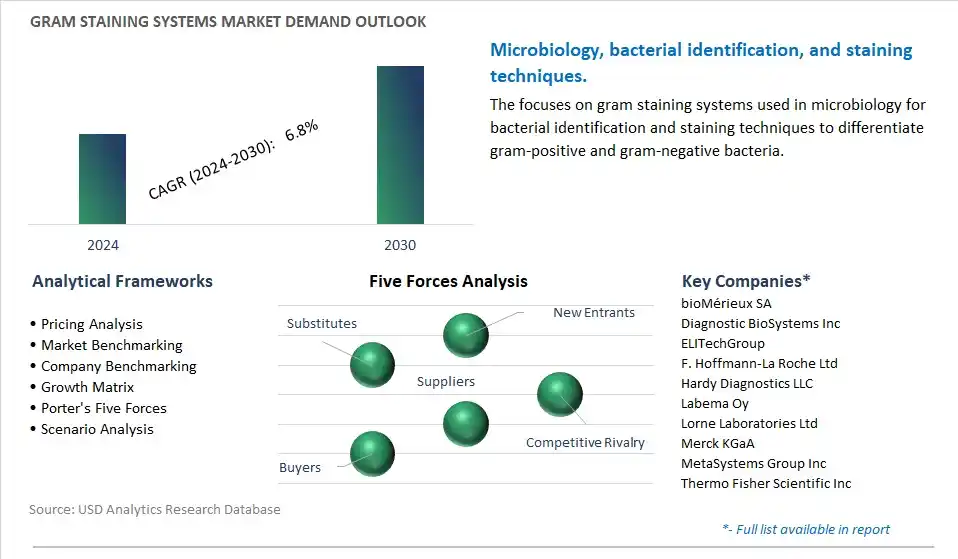
Gram Staining Systems Market is estimated to increase at a Compounded Annual Growth Rate of 6.8% CAGR over the forecast period from 2024 to 2030
The Gram Staining Systems Market study analyzes and forecasts the market size across 6 regions and 24 countries for diverse segments- By Product (Staining Systems, Staining Reagents, Accessories), By End-User (Diagnostic Laboratories, Hospitals, Others).
An Introduction to Gram Staining Systems Market in 2024
Gram staining is a fundamental technique used in microbiology laboratories for the differential identification of bacteria based on their cell wall characteristics. In 2024, the market for gram staining systems is characterized by advancements in automation, digitization, and point-of-care testing, offering enhanced speed, accuracy, and convenience for microbiological diagnosis. Automated gram staining platforms equipped with robotic sample handling, image analysis algorithms, and connectivity to laboratory information systems streamline the staining process and reduce manual errors. Furthermore, portable gram-staining devices enable rapid on-site testing in emergency departments, clinics, and remote healthcare settings, facilitating timely diagnosis and treatment of bacterial infections. With the increasing demand for rapid diagnostic solutions and the global threat of antimicrobial resistance, gram-staining systems remain indispensable tools in clinical microbiology, enabling clinicians to make informed treatment decisions and improve patient outcomes.
Market Trend: Integration of Automation and Digitalization
A significant trend in the market for Gram staining systems is the integration of automation and digitalization. With advancements in laboratory technology and the increasing demand for efficiency and accuracy in microbiological testing, there's a notable shift towards automated Gram-staining systems equipped with digital imaging and analysis capabilities. These systems streamline the staining process, reduce manual labor, and provide consistent and reproducible results, improving workflow efficiency and reducing turnaround times in clinical laboratories and microbiology research facilities. Additionally, the integration of digital imaging allows for enhanced visualization, documentation, and interpretation of Gram-stained slides, facilitating faster diagnosis and treatment decisions for infectious diseases.
Market Driver: Growing Need for Rapid and Accurate Microbial Identification
The primary driver propelling the market for Gram staining systems is the growing need for rapid and accurate microbial identification in clinical and research settings. Gram staining remains a fundamental technique in microbiology for the preliminary identification and classification of bacteria based on their cell wall characteristics. As the incidence of infectious diseases, antibiotic resistance, and healthcare-associated infections continues to rise, there's an increasing demand for microbiological testing methods that can provide timely and reliable results to guide patient management and infection control measures. Gram staining systems play a critical role in the rapid detection and classification of bacteria, aiding in the diagnosis of bacterial infections and guiding appropriate antibiotic therapy, thus driving market demand for these essential laboratory tools.
Market Opportunity: Development of Point-of-Care Gram Staining Systems
An untapped opportunity within the market for Gram staining systems lies in the development of point-of-care (POC) solutions for rapid microbial identification. While traditional Gram staining methods are typically performed in centralized laboratories, there's potential to innovate and miniaturize staining technologies to enable on-site and near-patient testing in clinical settings such as emergency departments, ambulatory care facilities, and outpatient clinics. By developing compact and user-friendly POC Gram staining systems, manufacturers can empower healthcare providers to perform rapid microbial identification at the bedside or point of care, facilitating prompt diagnosis and treatment decisions for infectious diseases. Additionally, POC Gram staining systems can enhance infection control practices by enabling timely screening and surveillance of pathogens in high-risk patient populations, thus improving patient outcomes and reducing healthcare-associated infections. Embracing the opportunity to develop POC Gram staining systems aligns with the growing demand for decentralized testing solutions and the goal of advancing point-of-care diagnostics in infectious disease management.
Gram Staining Systems Market Share Analysis: Staining Reagents
The Staining Reagents segment within the Gram Staining Systems Market is experiencing rapid growth due to its essential role in the Gram staining process, a fundamental technique used in microbiology laboratories for the differentiation and classification of bacteria based on their cell wall characteristics. Gram staining reagents, including crystal violet, iodine, ethanol or acetone, and safranin, are critical components of the Gram staining procedure, enabling the visualization and identification of Gram-positive and Gram-negative bacteria. These reagents work by selectively staining bacterial cells and differentiating them based on their ability to retain or decolorize the primary stain. With the increasing demand for accurate and rapid microbial identification in diagnostic laboratories and hospitals, there is a growing need for high-quality staining reagents that provide consistent and reliable results. Manufacturers are focusing on developing innovative formulations and ready-to-use staining reagents that enhance the efficiency and reproducibility of the Gram staining process, thereby reducing turnaround time and improving diagnostic accuracy. Additionally, the expansion of microbiology testing facilities, rising prevalence of infectious diseases, and growing emphasis on infection control measures are driving the adoption of Gram staining systems and reagents across healthcare settings worldwide. Diagnostic laboratories and hospitals are the primary end-users of Gram staining systems and reagents, where these products play a crucial role in clinical microbiology testing for the diagnosis and management of bacterial infections. As microbiology laboratories continue to modernize and automate their workflow, the demand for advanced Gram staining systems and high-quality staining reagents is expected to escalate, contributing to the rapid growth of the Staining Reagents segment in the Gram Staining Systems Market.
Gram Staining Systems Competitive Analysis
The market research study provides in-depth insights into leading companies including the SWOT analyses, product profile, financial details, and recent developments acrossbioMérieux SA, Diagnostic BioSystems Inc, ELITechGroup, F. Hoffmann-La Roche Ltd, Hardy Diagnostics LLC, Labema Oy, Lorne Laboratories Ltd, Merck KGaA, MetaSystems Group Inc, Thermo Fisher Scientific Inc
Gram Staining Systems Market Segmentation
By Product
Staining Systems
Staining Reagents
Accessories
By End-User
Diagnostic Laboratories
Hospitals
Others
Geographical Analysis
North America (United States, Canada, Mexico)
Europe (Germany, France, United Kingdom, Spain, Italy, Rest of Europe)
Asia Pacific (China, India, Japan, South Korea, Rest of Asia Pacific)
South America (Brazil, Argentina, Rest of South America)
Middle East and Africa (Saudi Arabia, UAE, Rest of Middle East, South Africa, Egypt, Rest of Africa)
Gram Staining Systems Market Companies
bioMérieux SA
Diagnostic BioSystems Inc
ELITechGroup
F. Hoffmann-La Roche Ltd
Hardy Diagnostics LLC
Labema Oy
Lorne Laboratories Ltd
Merck KGaA
MetaSystems Group Inc
Thermo Fisher Scientific Inc
Reasons to Buy the Gram Staining Systems Market Study
• Deepen your industry insights and navigate uncertainties for strategy formulation, CAPEX, and Operational decisions
• Gain access to detailed insights on the Gram Staining Systems Market, encompassing current market size, growth trends, and forecasts till 2030.
• Access detailed competitor analysis, enabling competitive advantage through a thorough understanding of market players, strategies, and potential differentiation opportunities
• Stay ahead of the curve with insights on technological advancements, innovations, and upcoming trends
• Identify lucrative investment avenues and expansion opportunities within the Gram Staining Systems Market industry, guided by robust, data-backed analysis.
• Understand regional and global markets through country-wise analysis, regional market potential, regulatory nuances, and dynamics
• Execute strategies with confidence and speed through information, analytics, and insights on the industry value chain
• Corporate leaders, strategists, financial experts, shareholders, asset managers, and governmental representatives can make long-term planning scenarios and build an integrated and timely understanding of market dynamics
• Benefit from tailored solutions and expert consultation based on report insights, providing personalized strategies aligned with specific business needs.
TABLE OF CONTENTS
1 Introduction to 2024 Gram Staining Systems Market
1.1 Market Overview
1.2 Quick Facts
1.3 Scope/Objective of the Study
1.4 Market Definition
1.5 Countries and Regions Covered
1.6 Units, Currency, and Conversions
1.7 Industry Value Chain
2 Research Methodology
2.1 Market Size Estimation
2.2 Sources and Research Methodology
2.3 Data Triangulation
2.4 Assumptions and Limitations
3 Executive Summary
3.1 Global Gram Staining Systems Market Size Outlook, $ Million, 2021 to 2030
3.2 Gram Staining Systems Market Outlook by Type, $ Million, 2021 to 2030
3.3 Gram Staining Systems Market Outlook by Product, $ Million, 2021 to 2030
3.4 Gram Staining Systems Market Outlook by Application, $ Million, 2021 to 2030
3.5 Gram Staining Systems Market Outlook by Key Countries, $ Million, 2021 to 2030
4 Market Dynamics
4.1 Key Driving Forces of Gram Staining Systems Industry
4.2 Key Market Trends in Gram Staining Systems Industry
4.3 Potential Opportunities in Gram Staining Systems Industry
4.4 Key Challenges in Gram Staining Systems Industry
5 Market Factor Analysis
5.1 Value Chain Analysis
5.2 Competitive Landscape
5.2.1 Global Gram Staining Systems Market Share by Company (%), 2023
5.2.2 Product Offerings by Company
5.3 Porter’s Five Forces Analysis
5.4 Pricing Analysis and Outlook
6 Growth Outlook Across Scenarios
6.1 Growth Analysis-Case Scenario Definitions
6.2 Low Growth Scenario Forecasts
6.3 Reference Growth Scenario Forecasts
6.4 High Growth Scenario Forecasts
7 Global Gram Staining Systems Market Outlook by Segments
7.1 Gram Staining Systems Market Outlook by Segments, $ Million, 2021- 2030
By Product
Staining Systems
Staining Reagents
Accessories
By End-User
Diagnostic Laboratories
Hospitals
Others
8 North America Gram Staining Systems Market Analysis and Outlook To 2030
8.1 Introduction to North America Gram Staining Systems Markets in 2024
8.2 North America Gram Staining Systems Market Size Outlook by Country, 2021-2030
8.2.1 United States
8.2.2 Canada
8.2.3 Mexico
8.3 North America Gram Staining Systems Market size Outlook by Segments, 2021-2030
By Product
Staining Systems
Staining Reagents
Accessories
By End-User
Diagnostic Laboratories
Hospitals
Others
9 Europe Gram Staining Systems Market Analysis and Outlook To 2030
9.1 Introduction to Europe Gram Staining Systems Markets in 2024
9.2 Europe Gram Staining Systems Market Size Outlook by Country, 2021-2030
9.2.1 Germany
9.2.2 France
9.2.3 Spain
9.2.4 United Kingdom
9.2.4 Italy
9.2.5 Russia
9.2.6 Norway
9.2.7 Rest of Europe
9.3 Europe Gram Staining Systems Market Size Outlook by Segments, 2021-2030
By Product
Staining Systems
Staining Reagents
Accessories
By End-User
Diagnostic Laboratories
Hospitals
Others
10 Asia Pacific Gram Staining Systems Market Analysis and Outlook To 2030
10.1 Introduction to Asia Pacific Gram Staining Systems Markets in 2024
10.2 Asia Pacific Gram Staining Systems Market Size Outlook by Country, 2021-2030
10.2.1 China
10.2.2 India
10.2.3 Japan
10.2.4 South Korea
10.2.5 Indonesia
10.2.6 Malaysia
10.2.7 Australia
10.2.8 Rest of Asia Pacific
10.3 Asia Pacific Gram Staining Systems Market size Outlook by Segments, 2021-2030
By Product
Staining Systems
Staining Reagents
Accessories
By End-User
Diagnostic Laboratories
Hospitals
Others
11 South America Gram Staining Systems Market Analysis and Outlook To 2030
11.1 Introduction to South America Gram Staining Systems Markets in 2024
11.2 South America Gram Staining Systems Market Size Outlook by Country, 2021-2030
11.2.1 Brazil
11.2.2 Argentina
11.2.3 Rest of South America
11.3 South America Gram Staining Systems Market size Outlook by Segments, 2021-2030
By Product
Staining Systems
Staining Reagents
Accessories
By End-User
Diagnostic Laboratories
Hospitals
Others
12 Middle East and Africa Gram Staining Systems Market Analysis and Outlook To 2030
12.1 Introduction to Middle East and Africa Gram Staining Systems Markets in 2024
12.2 Middle East and Africa Gram Staining Systems Market Size Outlook by Country, 2021-2030
12.2.1 Saudi Arabia
12.2.2 UAE
12.2.3 Oman
12.2.4 Rest of Middle East
12.2.5 Egypt
12.2.6 Nigeria
12.2.7 South Africa
12.2.8 Rest of Africa
12.3 Middle East and Africa Gram Staining Systems Market size Outlook by Segments, 2021-2030
By Product
Staining Systems
Staining Reagents
Accessories
By End-User
Diagnostic Laboratories
Hospitals
Others
13 Company Profiles
13.1 Company Snapshot
13.2 SWOT Profiles
13.3 Products and Services
13.4 Recent Developments
13.5 Financial Profile
List of Companies
bioMérieux SA
Diagnostic BioSystems Inc
ELITechGroup
F. Hoffmann-La Roche Ltd
Hardy Diagnostics LLC
Labema Oy
Lorne Laboratories Ltd
Merck KGaA
MetaSystems Group Inc
Thermo Fisher Scientific Inc
14 Appendix
14.1 Customization Offerings
14.2 Subscription Services
14.3 Related Reports
14.4 Publisher Expertise
By Product
Staining Systems
Staining Reagents
Accessories
By End-User
Diagnostic Laboratories
Hospitals
Others
Countries Analyzed
North America (United States, Canada, Mexico)
Europe (Germany, France, United Kingdom, Spain, Italy, Rest of Europe)
Asia Pacific (China, India, Japan, South Korea, Rest of Asia Pacific)
South America (Brazil, Argentina, Rest of South America)
Middle East and Africa (Saudi Arabia, UAE, Rest of Middle East, South Africa, Egypt, Rest of Africa)
