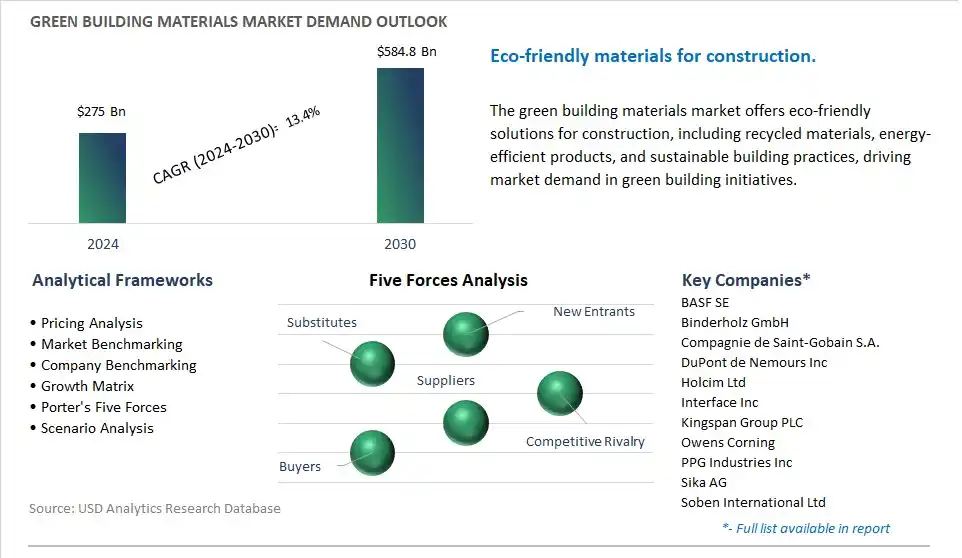
The global Green Building Materials Market is poised to register a 13.4% CAGR from $275 Billion in 2024 to $584.8 Billion in 2030.
The global Green Building Materials Market Study analyzes and forecasts the market size across 6 regions and 24 countries for diverse segments -By Application (Framing, Insulation, Roofing, Exterior Siding, Interior Finishing, Others), By End-User (Residential, Commercial, Industrial, Infrastructure, Others).
An Introduction to Global Green Building Materials Market in 2024
In the green building materials market, the future is driven by trends such as sustainability mandates, circular economy principles, and technological innovation driving advancements in material sourcing, manufacturing processes, and performance standards. Green building materials are characterized by their low environmental impact, renewable sourcing, and energy efficiency properties, making them ideal for sustainable construction projects. Key trends shaping this market include advancements in material science such as bio-based composites, recycled aggregates, and low-carbon concrete formulations to reduce embodied carbon, minimize resource depletion, and promote circularity in building material supply chains, the development of innovative manufacturing techniques such as 3D printing, digital fabrication, and modular construction to optimize material use, reduce waste, and accelerate project timelines in green building projects, and the adoption of green building material certifications such as Cradle to Cradle, Declare, and GreenGuard by architects, designers, and developers seeking to specify environmentally responsible products, meet regulatory requirements, and achieve sustainability goals. As the construction industry shifts towards greener, more resilient building practices, the demand for green building materials that offer durability, performance, and environmental benefits is expected to drive market growth and stimulate further innovation in material design, production methods, and building technologies.
Green Building Materials Market Competitive Landscape
The market report analyses the leading companies in the industry including BASF SE, Binderholz GmbH, Compagnie de Saint-Gobain S.A., DuPont de Nemours Inc, Holcim Ltd, Interface Inc, Kingspan Group PLC, Owens Corning, PPG Industries Inc, Sika AG, Soben International Ltd.
Green Building Materials Market Dynamics
Green Building Materials Market Trend: Growing Demand for Sustainable Construction Materials
A prominent trend in the market for Green Building Materials is the growing demand for sustainable construction materials. With increasing awareness of environmental issues and the need to reduce carbon emissions, there is a rising preference for building materials that have minimal environmental impact throughout their lifecycle, from extraction to disposal. Green building materials, such as recycled, reclaimed, and renewable materials, are gaining popularity due to their lower carbon footprint, improved energy efficiency, and potential for recycling or repurposing. This is driven by factors such as stringent building regulations, green building certification programs, and the growing adoption of sustainable construction practices by developers, architects, and contractors aiming to create healthier and more environmentally friendly buildings.
Green Building Materials Market Driver: Government Policies and Regulations Promoting Sustainability
The market for Green Building Materials is being driven by government policies and regulations promoting sustainability in the construction industry. Governments worldwide are implementing measures to reduce the environmental impact of buildings through building codes, standards, and incentives that encourage the use of green building materials. These policies include requirements for energy efficiency, water conservation, waste reduction, and the use of eco-friendly materials in public and private construction projects. Additionally, green building certification programs, such as LEED (Leadership in Energy and Environmental Design) and BREEAM (Building Research Establishment Environmental Assessment Method), incentivize the use of green building materials by awarding points for their incorporation into projects. The alignment of government policies with sustainability goals creates a conducive environment for the growth of the green building materials market by driving demand and investment in eco-friendly construction solutions.
Green Building Materials Market Opportunity: Innovation in Sustainable Material Technologies
An exciting opportunity within the market for Green Building Materials lies in innovation in sustainable material technologies. As the demand for eco-friendly construction materials continues to increase, there is a growing opportunity for companies to develop and commercialize innovative products that offer improved performance, durability, and environmental benefits. This includes the development of new materials made from renewable resources, such as bamboo, cork, and hemp, as well as advancements in recycling and repurposing technologies to transform waste materials into high-quality building products. Additionally, there is potential for innovation in energy-efficient insulation, low-emission paints and coatings, and sustainable concrete alternatives that reduce carbon emissions and resource consumption in the construction industry. By investing in research and development and collaborating with stakeholders across the construction value chain, companies can capitalize on the opportunity to meet the growing demand for green building materials and contribute to the development of a more sustainable built environment.
Green Building Materials Market Ecosystem
The green building materials market follows a Market Ecosystem that begins with sustainable resource management, involving companies including Sims Metal Management and Scandinavian Forest Industries sourcing recycled content and responsibly harvested wood. Material processing is handled by green material manufacturers, including Saint-Gobain and LafargeHolcim, which convert raw materials into eco-friendly building products including energy-efficient glass and low-carbon concrete.
These products undergo rigorous quality control testing in the manufacturer's labs to ensure they meet performance specifications and regulatory standards. Distribution and sales are facilitated by building material suppliers including Builders FirstSource and HD Supply Holdings, which supply green products to construction companies and contractors. Additionally, manufacturers engage in direct sales with major construction firms or architects for large-scale projects.
Construction companies including Skanska and Turner Construction integrate green building materials into their projects, emphasizing sustainability as a key differentiator and contributing to the growth of the green building materials Industry.
Green Building Materials Market Share Analysis: Commercial is the fastest growing market segment over the forecast period to 2030
The commercial sector is the fastest-growing segment in the Green Building Materials Market, driven by diverse key factors. Commercial buildings, including offices, retail spaces, and hospitality establishments, are increasingly prioritizing sustainability to reduce operational costs, enhance occupant comfort, and meet stringent environmental regulations. With businesses recognizing the long-term benefits of green buildings, there has been a surge in demand for eco-friendly construction materials that offer energy efficiency, durability, and aesthetic appeal. In addition, corporate sustainability initiatives and green building certifications, such as LEED (Leadership in Energy and Environmental Design) and BREEAM (Building Research Establishment Environmental Assessment Method), are incentivizing commercial developers to integrate sustainable practices and materials into their projects. Additionally, the growing awareness among consumers and tenants about the environmental impact of buildings has further accelerated the adoption of green construction materials in the commercial sector. As a result, the commercial segment is witnessing rapid growth within the Green Building Materials Market, driven by the increasing demand for sustainable and high-performance building solutions in the corporate landscape.
Green Building Materials Market Report Scope-
By Application
Framing
Insulation
Roofing
Exterior Siding
Interior Finishing
Others
By End-User
Residential
Commercial
Industrial
Infrastructure
Others
Green Building Materials Market Companies Profiled
BASF SE
Binderholz GmbH
Compagnie de Saint-Gobain S.A.
DuPont de Nemours Inc
Holcim Ltd
Interface Inc
Kingspan Group PLC
Owens Corning
PPG Industries Inc
Sika AG
Soben International Ltd
*- List Not Exhaustive
TABLE OF CONTENTS
1 Introduction to 2024 Green Building Materials Market
1.1 Market Overview
1.2 Quick Facts
1.3 Scope/Objective of the Study
1.4 Market Definition
1.5 Countries and Regions Covered
1.6 Units, Currency, and Conversions
1.7 Industry Value Chain
2 Research Methodology
2.1 Market Size Estimation
2.2 Sources and Research Methodology
2.3 Data Triangulation
2.4 Assumptions and Limitations
3 Executive Summary
3.1 Global Green Building Materials Market Size Outlook, $ Million, 2021 to 2030
3.2 Green Building Materials Market Outlook by Type, $ Million, 2021 to 2030
3.3 Green Building Materials Market Outlook by Product, $ Million, 2021 to 2030
3.4 Green Building Materials Market Outlook by Application, $ Million, 2021 to 2030
3.5 Green Building Materials Market Outlook by Key Countries, $ Million, 2021 to 2030
4 Market Dynamics
4.1 Key Driving Forces of Green Building Materials Industry
4.2 Key Market Trends in Green Building Materials Industry
4.3 Potential Opportunities in Green Building Materials Industry
4.4 Key Challenges in Green Building Materials Industry
5 Market Factor Analysis
5.1 Value Chain Analysis
5.2 Competitive Landscape
5.2.1 Global Green Building Materials Market Share by Company (%), 2023
5.2.2 Product Offerings by Company
5.3 Porter’s Five Forces Analysis
5.4 Pricing Analysis and Outlook
6 Growth Outlook Across Scenarios
6.1 Growth Analysis-Case Scenario Definitions
6.2 Low Growth Scenario Forecasts
6.3 Reference Growth Scenario Forecasts
6.4 High Growth Scenario Forecasts
7 Global Green Building Materials Market Outlook by Segments
7.1 Green Building Materials Market Outlook by Segments, $ Million, 2021- 2030
By Application
Framing
Insulation
Roofing
Exterior Siding
Interior Finishing
Others
By End-User
Residential
Commercial
Industrial
Infrastructure
Others
8 North America Green Building Materials Market Analysis and Outlook To 2030
8.1 Introduction to North America Green Building Materials Markets in 2024
8.2 North America Green Building Materials Market Size Outlook by Country, 2021-2030
8.2.1 United States
8.2.2 Canada
8.2.3 Mexico
8.3 North America Green Building Materials Market size Outlook by Segments, 2021-2030
By Application
Framing
Insulation
Roofing
Exterior Siding
Interior Finishing
Others
By End-User
Residential
Commercial
Industrial
Infrastructure
Others
9 Europe Green Building Materials Market Analysis and Outlook To 2030
9.1 Introduction to Europe Green Building Materials Markets in 2024
9.2 Europe Green Building Materials Market Size Outlook by Country, 2021-2030
9.2.1 Germany
9.2.2 France
9.2.3 Spain
9.2.4 United Kingdom
9.2.4 Italy
9.2.5 Russia
9.2.6 Norway
9.2.7 Rest of Europe
9.3 Europe Green Building Materials Market Size Outlook by Segments, 2021-2030
By Application
Framing
Insulation
Roofing
Exterior Siding
Interior Finishing
Others
By End-User
Residential
Commercial
Industrial
Infrastructure
Others
10 Asia Pacific Green Building Materials Market Analysis and Outlook To 2030
10.1 Introduction to Asia Pacific Green Building Materials Markets in 2024
10.2 Asia Pacific Green Building Materials Market Size Outlook by Country, 2021-2030
10.2.1 China
10.2.2 India
10.2.3 Japan
10.2.4 South Korea
10.2.5 Indonesia
10.2.6 Malaysia
10.2.7 Australia
10.2.8 Rest of Asia Pacific
10.3 Asia Pacific Green Building Materials Market size Outlook by Segments, 2021-2030
By Application
Framing
Insulation
Roofing
Exterior Siding
Interior Finishing
Others
By End-User
Residential
Commercial
Industrial
Infrastructure
Others
11 South America Green Building Materials Market Analysis and Outlook To 2030
11.1 Introduction to South America Green Building Materials Markets in 2024
11.2 South America Green Building Materials Market Size Outlook by Country, 2021-2030
11.2.1 Brazil
11.2.2 Argentina
11.2.3 Rest of South America
11.3 South America Green Building Materials Market size Outlook by Segments, 2021-2030
By Application
Framing
Insulation
Roofing
Exterior Siding
Interior Finishing
Others
By End-User
Residential
Commercial
Industrial
Infrastructure
Others
12 Middle East and Africa Green Building Materials Market Analysis and Outlook To 2030
12.1 Introduction to Middle East and Africa Green Building Materials Markets in 2024
12.2 Middle East and Africa Green Building Materials Market Size Outlook by Country, 2021-2030
12.2.1 Saudi Arabia
12.2.2 UAE
12.2.3 Oman
12.2.4 Rest of Middle East
12.2.5 Egypt
12.2.6 Nigeria
12.2.7 South Africa
12.2.8 Rest of Africa
12.3 Middle East and Africa Green Building Materials Market size Outlook by Segments, 2021-2030
By Application
Framing
Insulation
Roofing
Exterior Siding
Interior Finishing
Others
By End-User
Residential
Commercial
Industrial
Infrastructure
Others
13 Company Profiles
13.1 Company Snapshot
13.2 SWOT Profiles
13.3 Products and Services
13.4 Recent Developments
13.5 Financial Profile
BASF SE
Binderholz GmbH
Compagnie de Saint-Gobain S.A.
DuPont de Nemours Inc
Holcim Ltd
Interface Inc
Kingspan Group PLC
Owens Corning
PPG Industries Inc
Sika AG
Soben International Ltd
14 Appendix
14.1 Customization Offerings
14.2 Subscription Services
14.3 Related Reports
14.4 Publisher Expertise
By Application
Framing
Insulation
Roofing
Exterior Siding
Interior Finishing
Others
By End-User
Residential
Commercial
Industrial
Infrastructure
Others
Countries Analyzed
North America (US, Canada, Mexico)
Europe (Germany, UK, France, Spain, Italy, Russia, Rest of Europe)
Asia Pacific (China, India, Japan, South Korea, Australia, South East Asia, Rest of Asia)
South America (Brazil, Argentina, Rest of South America)
Middle East and Africa (Saudi Arabia, UAE, Rest of Middle East, South Africa, Egypt, Rest of Africa)
